Reading Time: 7 minutes
If you are looking for a practical AI decisioning definition that goes beyond enterprise buzzwords, you aren’t alone. As marketing tech evolves, understanding what AI decisioning is and exactly how automated decision-making works has become a massive competitive advantage. At its core, this marks a permanent shift away from static, rule-based systems. Instead of forcing consumers into rigid, pre-built segment buckets, modern brands are using live behavioral data to capture hidden data signals as they emerge.
This shift is powered by real-time stream processing, which intercepts hidden data signals the moment they occur. When brands replace slow, manual approvals with autonomous Next-Best-Action (NBA) marketing, they unlock genuine AI-Powered hyper-personalization and continuous, data-driven marketing optimization.
In the time it took you to read the introduction, a single consumer generated dozens of digital signals: a click, a hover, a geo-location ping, and a cart addition.
Think about it, when customers visit your platform, they are dropping hints long before they ever click “Add to Cart.” In fact, the entire interface acts like a high-fidelity sensor, capturing subtle behaviors in real time. Here are a few ways the technology intercepts and capitalizes on this data while the user is still on the page:
- The Click & Hover: JavaScript “event listeners” track every pixel a mouse touches, signaling hesitation, interest, or confusion before a user ever makes a choice.
- The Geo-location: Immediate IP address or GPS data is captured to instantly align the experience with their local weather, nearest physical store, and local currency.
- The Technical Meta-data: The system instantly reads their device type (e.g., iPhone 15), connection speed, and referral source (like an Instagram ad vs. a Google search) to gauge their current browsing mindset.
This is where the traditional marketing playbook completely falls apart. It is humanly impossible for a marketing team to analyze this level of micro-nuance in real-time, let alone write enough manual rules to respond to it effectively before the user clicks away.
To survive this shift, brands are forcing their marketing technology stacks to evolve. We are moving away from passive systems that simply record what a customer did yesterday, and moving toward a framework that can actively interpret what a customer wants right now.
The technology filling this gap, acting as the connective tissue between your raw data and your delivery channels, is AI Decisioning.
According to data from leading firms like BCG, brands that deploy AI in complex, distributed channel models are driving potential sales increases of 15% to 20% |
What is AI Decisioning?
At its core, AI Decisioning is the automated process of using artificial intelligence to make discrete, real-time choices. This marks a critical evolution in enterprise technology: unlike standard AI that might just “predict” a trend, decisioning acts on it.
Think of it as the “Brain” of your tech stack. It sits in the middle of your data and your execution tools, constantly asking: “Given everything we know about this person right now, what is the single best thing to do next?”
- Captures Micro-signal: It tracks “micro-moments” a human would miss, such as a brief hover over a button, the most active time, and device metadata.
- Goes Beyond Brittle Logic: It replaces rigid “If-Then” rules with Real-Time Stream Processing, handling millions of data combinations that would be impossible to code manually.
- The Millisecond Inferences: By converting signals into mathematical vectors, the AI calculates Propensity Scores to determine the exact likelihood of a purchase while the page is still loading.
- The Segment of One: It moves away from broad buckets to create a hyper-individualized journey, adjusting the experience for a single user based on their specific, immediate intent.
- Self-optimizing loops: Through reinforcement learning, the system observes every click (or non-click) to instantly optimize the next five seconds of the customer’s journey.
What is AI Decisioning in Marketing?
In marketing, this is often referred to as Next-Best-Action (NBA) marketing. It moves away from “campaign-centric” thinking, where you blast a segment, to “customer-centric” thinking, where the customer triggers the response.
The Scenario: Imagine a customer, Sarah, browsing a travel app.
- Without AI Decisioning: Sarah gets a generic push notification about “Summer Deals.”
- With AI Decisioning: The system sees that Sarah just looked at flights to Greece three times. It checks her loyalty status (Gold), her preferred budget (Luxury), and her local weather (Raining). It instantly decides to offer her a “Rainy Day Escape” discount on a boutique villa in Athens – sent via her preferred channel, WhatsApp.
AI Decisioning vs. Traditional Personalization
Many marketers confuse the two, but the difference is the level of “logic” involved.
| Feature | Traditional Personalization | AI Decisioning |
| Logic | Static, rule-based (If X, then Y) | Dynamic, machine-learning-based |
| Scale | Limited to a few segments | Hyper-individualized for millions |
| Speed | Often “after the fact” (Retargeting) | Instantaneous (During the session) |
| Goal | Inserting a name or past purchase | Predicting and fulfilling future intent |
To give a more visual perspective, let’s look at how this changes your usual “Monday Morning” experience.
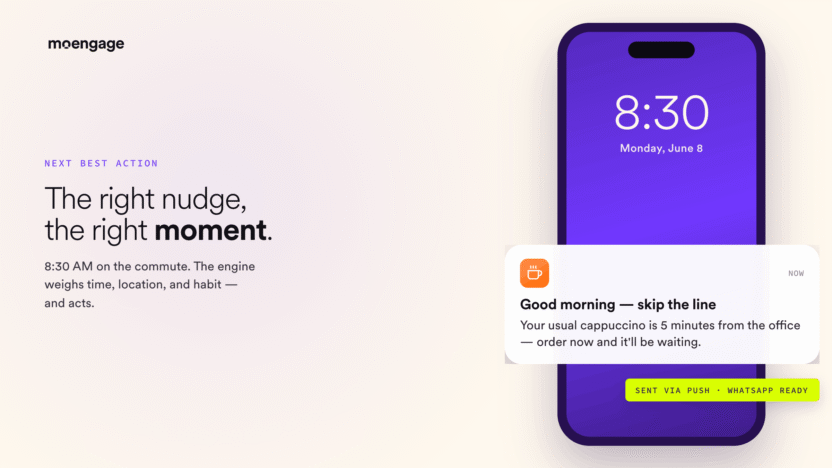
Picture this: It’s Sunday night, and you’re browsing indulgent, sugary cold foams on the Starbucks app, only to close it without ordering.
- Traditional Personalization is a blunt instrument. It sees that Sunday signal and pings you at 8:30 a.m. on Monday with: “Still craving that Caramel Frappuccino?” It’s technically accurate, but contextually deaf. You’re half-awake on a commute; a dessert-level drink is the last thing you want.
- AI Decisioning acts with cognizance. It recognizes impulsiveness and bifurcates the pattern: Sunday nights are mostly for window shopping treats and, at times, indulging, but weekday mornings are for the regular office-run order.
Instead of an irrelevant nudge, the engine calculates your location and the time to deliver the Next-Best-Action:
Why AI Decisioning Works
AI decisioning fundamentally changes how a marketing stack interprets human behavior, contrary to traditional systems that treat data as static records to be grouped into buckets.
- Multidimensional Pattern Recognition: Human intent is rarely linear. AI decisioning runs unsupervised machine learning models to untangle these distinct behaviors. Instead of treating a single high-value click as an immediate mandate to flood a customer with premium offers, the engine recognizes the broader behavioral pattern and matches its messaging to the user’s current mindset.
- Geospatial and Environmental Awareness: Relevance depends heavily on physical context. By processing real-time location data and streaming context (like local weather patterns or regional currency shifts), the engine ensures that digital nudges are only triggered when the customer is in a position to physically or logistically act on them.
- Temporal Contextualization: The value of a marketing message decays rapidly depending on the time of day and the user’s immediate environment. AI decisioning dynamically weighs temporal factors to understand that at 8:30 AM, factors like transaction speed and convenience drastically outweigh novelty and exploration. The engine adapts the actual value proposition of the interaction based on the clock, maximizing the probability of engagement.
How AI Decisioning Works in Customer Engagement
Modern customer engagement fails when there is a lag between a customer’s signal and a brand’s response. AI decisioning eliminates this latency by acting as a high-velocity processing layer that sits between your data stack and your delivery channels. It replaces static, scheduled campaigns with a persistent, four-step loop that interprets and acts on intent in under 100 milliseconds.
Collecting and Unifying Customer Data
The engine functions on a Unified Customer Profile, aggregating disparate data points into a single, real-time record.
- Historical Baseline: It integrates first-party data from CRM and purchase history to establish a customer’s long-term preferences and loyalty tier.
- Real-Time Context: The system layers in “live” signals, such as current device type, session behavior, and even local weather, to determine immediate relevance.
- Operational Sync: By integrating support tickets and social sentiment, the engine ensures promotional efforts are automatically suppressed for customers experiencing service issues.
Predicting Intent and Next-Best Actions
With a unified view, the engine applies predictive models to determine the optimal Next-Best-Action (NBA) for the individual’s current state.
- Propensity Modeling: The AI calculates the statistical probability of specific outcomes, such as churn risk or upsell potential, allowing you to prioritize the most business-critical or contextually relevant goal.
- Scoring and Filtering: The system filters product catalogs for relevance while scoring customer value to decide whether to trigger a high-touch VIP experience or an automated nudge.
Reinforcement Learning and Continuous Optimization
AI decisioning utilizes a closed feedback loop to “self-correct,” eliminating the need for manual rule updates.
- Adaptive Logic: If a user ignores a discount but engages with a “New Arrivals” banner, the AI instantly re-weights its strategy for that specific session.
- Automated ROI: This replaces slow A/B testing cycles. The engine identifies top-performing variants in hours and automatically reallocates traffic to the assets driving the highest conversion.
AI Agents and Journey Orchestration
The final stage translates mathematical probability into a tangible experience across every touchpoint.
- AI Agents: These functional “doers” execute decisions in real-time, dynamically modifying website layouts, hero images, or chatbot scripts as the user browses.
- Dynamic Orchestration: Rather than following a linear email drip, the engine manages a web of interactions. It ensures that whether the customer is in-app or in-store, the brand’s response is consistent and aware of their very last move.
The Hard Truth? Your Customers Are Moving Faster Than Your Approvals
Let’s be honest. Most brands today do not have a data-collection problem; ironically, it’s the opposite. You can buy every data scraper and analytics tool on the market, but if your strategy relies on spending a chunk of your time analyzing a report, creating a segment, getting a creative sign-off, and launching an email blast – chances are, you’ve already lost the customer.
AI decisioning works because it treats human hesitation as a highly perishable commodity. It accepts that the shelf-life of digital intent is measured in milliseconds. Every second a customer spends on your platform without receiving a contextually accurate message is a leaky bucket in your conversion funnel.
Traditional personalization leaves massive revenue on the table because it operates in retro-retargeting mode, chasing users with ads for products they looked at yesterday but have no interest in today. AI decisioning stops the bleeding by closing the revenue-latency gap. When you can optimize the experience during the session based on immediate propensity scores, bounce rates drop, and average order values climb. In a market where customer acquisition costs are soaring, maximizing the value of the live traffic you already have is your most critical growth lever.
Bridge The Latency Gap With MoEngage
If you’re ready to stop watching revenue leak from your conversion funnels due to slow manual approvals and rigid rules, you don’t need to engineer an AI decisioning framework from scratch.
At MoEngage, we’ve built this high-velocity logic right into our insights-led customer engagement platform. Merlin AI features advanced AI Decisioning that acts as your marketing stack’s persistent, “always-on” orchestration brain. Instead of relying on rigid, manual segments that quickly go stale, MoEngage’s Merlin AI utilizes continuous learning loops to analyze real-time behavioral propensities, instantly matching individual users with the optimal offer, creative, channel, and timing.
By scaling 1:1 personalization across millions of users simultaneously, MoEngage bridges the gap between raw data and instant revenue, helping your brand move just as fast as your customers.
The post What is AI Decisioning? Definition, Examples, and How It Works appeared first on MoEngage.