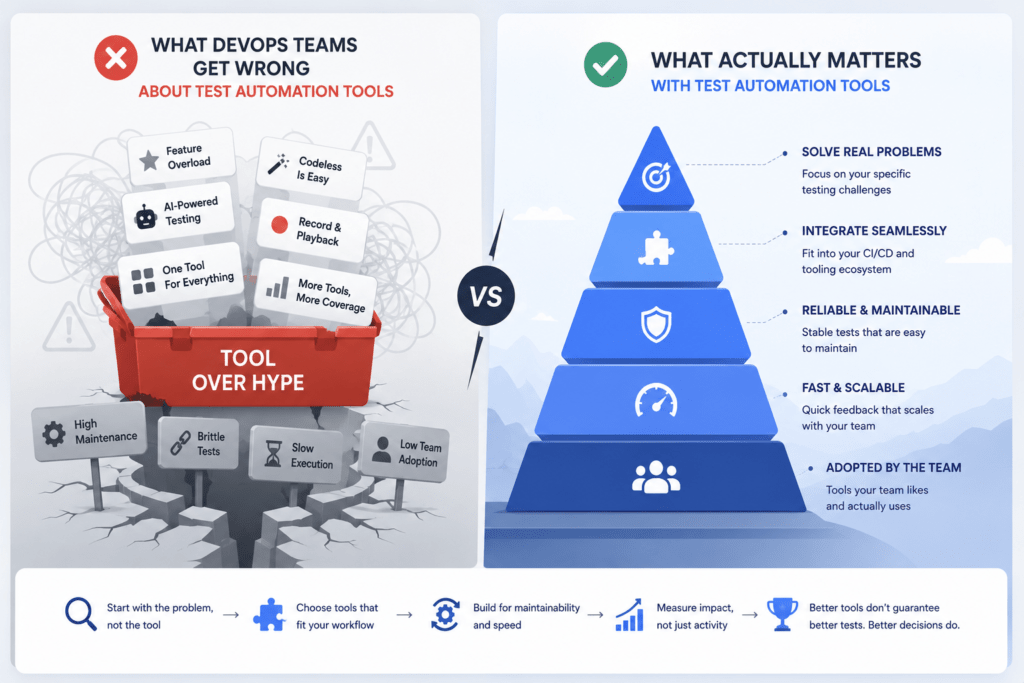
Test automation tools have become a standard part of DevOps workflows. Most engineering teams have them. Most engineering teams also have a complicated relationship with them – suites that take too long to run, tests that fail for no obvious reason, and a quiet suspicion that the green pipeline does not actually mean everything is fine.
The problems are rarely caused by bad tools. They are caused by the way tools get adopted, configured, and maintained. The same mistakes appear across teams of different sizes, different stacks, and different levels of DevOps maturity. Understanding them is the fastest way to get more value from the tooling you already have.
Also Read: Smarter DevOps with Kite: AI Meets Kubernetes
The most common mistake happens before a single line of test code is written. A team decides they need better test automation, they research available options, they pick something popular, and then they try to make it fit their actual situation.
This sequence produces tools that solve theoretical problems rather than real ones. A team with a change failure rate problem needs testing coverage that catches behavioral regressions before deployment. A team with a slow pipeline problem needs faster test execution and smarter test selection. A team with flaky tests needs better environment isolation. These are different problems and they point toward different tool decisions.
Before evaluating any test automation tool, the more useful question is: what specific failure mode is this tool meant to address? Which production incidents happened in the last six months that better test automation would have caught? Starting from that question produces clearer tool requirements and better tool choices.
Before evaluating specific tools, understanding what the current scope of test automation tools looks like across different testing layers is a useful starting point.
Treating the Integration Layer as an Afterthought
Most DevOps teams have reasonable unit test coverage and some form of end-to-end testing. The integration layer – where services interact with each other through APIs and shared dependencies – is where test automation investment consistently falls short.
This is where most production failures actually originate. Not in the isolated function logic that unit tests cover. Not in full user journeys that end-to-end tests validate. In the boundaries between services, where one component’s output becomes another component’s input, both sides need to agree on what that exchange looks like.
Test automation tools that focus exclusively on one layer leave this gap unaddressed. A comprehensive unit test suite and a set of end-to-end scenarios can both pass while a service boundary quietly breaks under conditions that neither layer was designed to test.
Addressing the integration layer specifically requires tools that can validate API behavior across service boundaries, handle dependency behavior systematically, and run fast enough to fit into a pull request review cycle. Teams that skip this layer are testing the parts of the system that rarely fail and leaving the parts that fail most often uncovered.
Also Read: Why API-First Architecture is the Backbone of Modern Digital Platforms
Underestimating the Maintenance Burden
Test automation tools create ongoing maintenance obligations that are easy to underestimate during the initial evaluation. The setup looks straightforward. The first suite runs cleanly. Six months later, the suite has grown, the codebase has evolved, and someone is spending two days per sprint keeping the tests working rather than writing new ones.
The maintenance burden concentrates in two areas. First, mocks and stubs that represent external dependencies need to stay current as those dependencies change. A mock written against a service that has since been updated three times is no longer testing real behavior – it is testing an artifact of how the service behaved when the mock was written. Second, test environments that share state between runs produce non-deterministic failures that are time-consuming to diagnose and fix.
Tools that have a systematic approach to keeping dependency representations current reduce the first problem. Tools that enforce test isolation and support reproducible environments reduce the second. These are not exciting features to evaluate in a demo, but they determine whether the test suite is still trusted and maintained a year after adoption.
Optimising for Coverage Percentage Instead of Signal Quality
Coverage percentage is the metric most teams track for test automation. It is also one of the least useful signals for whether the automation is actually working.
A suite can execute 90 percent of code lines while missing the integration failures, edge cases, and real-world usage patterns that cause most production incidents. High coverage built on tests that validate what developers assumed the system would do, rather than what it actually does, provides confidence that has not been earned.
The metric worth tracking instead is how often the test suite catches real regressions before they reach production. That number is harder to measure, but it reflects what test automation is actually supposed to do. Teams that shift their focus from coverage percentage to regression catch rate make different tool decisions, write different tests, and build suites that stay meaningful as the system evolves.
Making Tool Decisions in Isolation
Test automation tools do not operate in isolation. They connect to CI/CD pipelines, deployment systems, observability platforms, and the version control workflows that developers use every day. A tool that works well on its own but creates friction in the pipeline will eventually be worked around.
The integration surface of a test automation tool is one of the most important evaluation criteria and one of the most consistently underweighted. A tool with native support for the CI/CD platform the team uses, clear failure output that surfaces in the same dashboards developers already monitor, and a configuration model that fits the existing infrastructure will be used properly. A tool that requires custom scripting to connect to the pipeline, produces failure output in a format that nothing else reads, or needs a separate environment to run will create the kind of overhead that eventually causes teams to bypass it under deadline pressure.
Tool adoption decisions made with integration surface as a primary criterion produce automation setups that outlast the initial enthusiasm and stay part of the workflow rather than becoming technical debt.
Also Read: Top DevOps Tools for Seamless Salesforce CI/CD Integration
Building the Suite Once and Leaving It
Test automation suites that are built once and not actively maintained degrade predictably. New features get added without corresponding test coverage. Changed interfaces break existing tests that nobody updates promptly. Flaky tests accumulate until developers start re-running failures rather than investigating them.
The teams that get sustained value from test automation treat the suite as a living part of the codebase rather than a project with a completion date. Test coverage for new features is part of the definition of done. Interface changes come with test updates in the same pull request. Flaky tests get quarantined and fixed with the same priority as production bugs.
To Sum Up
This is not a tool problem – it is a practice problem. But the right tools make these practices easier to sustain. Tools with clear failure output make flaky test investigation faster. Tools that generate tests from real system behavior rather than manual authoring reduce the overhead of keeping coverage current. The tool choice shapes whether good testing practices are easy or difficult to maintain over time.














![Clicks Don’t Pay the Bills: Use This Audit Framework To Prove Content Revenue [Mozcon 2025 Speaker Series]](https://mgrowtech.com/wp-content/uploads/2025/05/MozCon-25-Speaker-Profile-Cards-2-120x86.png)