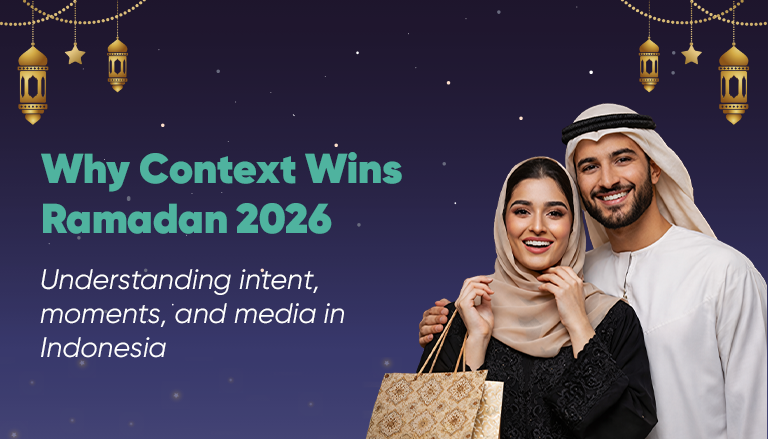
Every year, Ramadan quietly resets how Indonesia consumes content. Days start earlier. Nights stretch longer. Families gather more often around shared screens. What people watch changes, but more importantly, why they watch changes too.
For brands, this is where Ramadan becomes deceptive. The numbers look incredible. According to the Silverpush Ramadan Playbook 2026, YouTube reaches nearly 75% of Indonesian adults during Ramadan, driving over 153 billion views. Attention is everywhere. Yet performance often feels harder to sustain, not easier. Skips rise. Competition intensifies. Campaigns that looked solid on paper struggle to cut through.
The problem is not scale. It is alignment. Ramadan attention is not evenly distributed, and it is never neutral. It clusters around moments, emotions, and intent. Understanding that shift is where winning Ramadan actually begins.
Ramadan Viewing Is Not Passive. It Is Purpose-Driven.
What makes Ramadan different is not just when people watch, but how they watch.
During Ramadan, viewing becomes intentional. People are not idly scrolling. They are preparing sahur, planning iftar, researching gifts, comparing prices, validating choices, and coordinating family needs. This is reflected in behaviour. Research shows that 7 in 10 Ramadan research touchpoints in Indonesia are digital, led by YouTube, search, and social platforms working together.
This intent does not stay fixed throughout the day. It evolves. Early mornings are practical and time-bound. Midday brings quieter planning and research. Evenings pull families together, turning screens into shared decision spaces. Late nights slow things down again, opening room for reflection, spirituality, and longer-form engagement.
Once you see Ramadan viewing through this lens, one thing becomes clear. Attention is not random. It follows the need. And wherever need concentrates, certain content naturally rises to the surface.
Why Certain Content Wins Attention Again and Again
Because Ramadan viewing is intent-led, the same content categories resurface every year, not as fleeting trends, but as responses to real daily tensions.
- Food and cooking content dominate because meals anchor the entire day. Sahur hacks, quick iftar ideas, and family recipes are not entertainment. They function as daily planning tools that help households stay on schedule and within budget.
- Beauty and self-care content follows closely, especially creator-led routines that balance modesty, celebration, and practicality. Viewers look for guidance that feels realistic for long fasting days and evening gatherings.
- Shopping and gifting content gains momentum early, as audiences try to avoid last-minute chaos around Eid. Research, comparisons, and deal validation happen well before peak purchase days.
Across all these categories, creator voices carry disproportionate weight. During Ramadan, trust accelerates decision-making. In fact, 89% of viewers credit YouTube ads for brand discovery during Ramadan, and 80% say it helps them decide what to buy, reinforcing why context and creator alignment matter more than repetition.
Moments Do More Than Shift Schedules; They Change Mindsets
Ramadan is not one long peak period. It is a sequence of emotional and practical windows, each with its own mindset.
Sahur is about urgency and routine. Content needs to be fast, useful, and respectful of time. Midday viewing shifts into planning mode, researching meals, outfits, travel, and deals. Iftar is the emotional centre of the day. Families co-view, discuss, and decide together. Late nights after prayers create space for meaning, generosity, and calm engagement.
This is why timing during Ramadan is never just a media decision. It is a psychological one. A message that resonates during Iftar can feel intrusive in the morning. An offer that converts after prayers can feel out of place before them.
Once you acknowledge that mindset changes with the moment, another challenge becomes obvious. Most media plans are not built to adapt at this level of sensitivity.
Where Ramadan Campaigns Commonly Break Down
During Ramadan, ad volume increases sharply while tolerance drops just as fast. According to the playbook, ad volume increases by 2.8x during Ramadan, and viewers skip anything that feels mistimed or irrelevant.
The result is a familiar pattern. Impressions land, but intent does not. Creative fatigue quickly. Share of voice is hardest to defend exactly when competition peaks. And brands end up paying for reach that never had a chance to convert.
This is not because Ramadan audiences are unpredictable. It is because they are precise. They expect brands to understand the moment they are in, not just the audience they belong to.
How Platforms Actually Work Together During Ramadan
When you step back, the Ramadan discovery in Indonesia follows a clear flow.
YouTube becomes the decision engine. It is where people research deeply, learn from creators, and form preferences. TikTok accelerates trends, turning ideas into immediate desire. Meta reinforces trust through reviews, deals, and community validation. CTV comes into play at Iftar, when families co-view, and decisions become collective.
When these platforms are planned in isolation, they impact fragments. When they are connected through context, timing, and intent, they guide people naturally from attention to action.
This is where the conversation about Ramadan shifts. It stops being about buying more media and starts being about orchestrating moments.
What This Means for Brands Planning Ramadan 2026
The brands that win Ramadan 2026 do not try to dominate every hour. They identify the moments where intent peaks and earn relevance there. They adapt the creative to fit the emotional state of the viewer. They respect ritual while still driving measurable outcomes.
Context becomes the strategy. Media becomes the delivery. Performance follows alignment, not volume.
Turning Understanding into Action
Understanding Ramadan at this level requires more than intuition. It requires knowing which moments convert, how intent shifts by hour, how platforms reinforce each other, and how to activate without wasting budget during the noisiest season of the year.
That is exactly what the Silverpush Ramadan Playbook: Indonesia Edition is built to do. It maps real Ramadan viewing behaviour, identifies high-intent content environments, and shows how contextual and AI-led delivery turns attention into action when it matters most.
Ramadan is Indonesia’s biggest commercial moment and also the hardest to win. The brands that stand out will not be louder. They will be better aligned.