[ad_1]
I used to write Pin titles like I was playing darts: one bullseye keyword, throw, hope. That worked—until it didn’t. The accounts that kept growing weren’t just “right” on a single phrase. They taught Pinterest how their ideas connect.
That’s the shift: from keywords to context. Today we’ll build that context on purpose—and make it repeatable with Tailwind.
Pinterest’s hidden language: why context outranks keywords
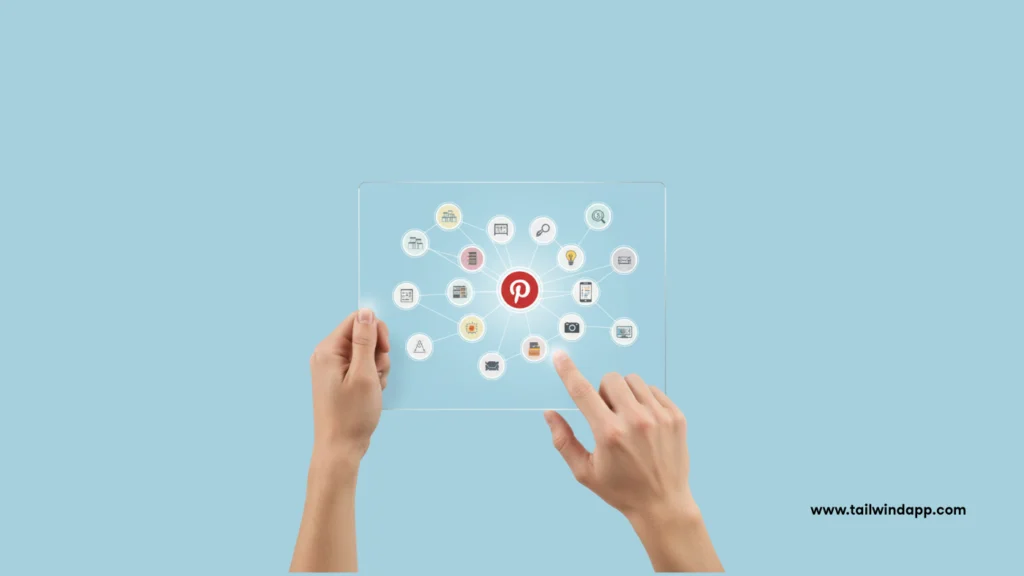
Pinterest doesn’t only match exact phrases anymore. It learns from the relationships between words, images, boards, and the ways people interact with them. When you design for that web of meaning, your Pins hold steady even when specific ranking dials move. The Pinterest SEO fundamentals provide the baseline.
Pinterest’s context engine in 2025
Pinterest groups content into topic clusters that align text and visuals, then reinforces those clusters with engagement signals—saves, clicks, and dwell time.
Contextual SEO vs. exact-match SEO
Exact matches are brittle. Semantically related phrasing (e.g., “pantry design,” “kitchen storage,” “small pantry layout”) keeps you visible as trends ebb and flow because Pinterest can still recognize “this is the same idea.”
Why semantic structure future-proofs your strategy
Consistent variation around a theme helps maintain relevance over time—a simple hedge against volatility.
How Pinterest learns meaning from language and imagery
Pinterest reads three layers at once—visuals, words, and behavior—and maps how they reinforce each other. What people do with your Pins teaches the machine what your ideas mean.
The multi-modal semantic model
Visual search (Lens) and topic graphs analyze images and text simultaneously—images carry meaning too. Pinterest has publicly emphasized where this is headed: according to Pinterest Business, the future of search is visual, and TechCrunch details AI-powered visual search updates accelerating that direction.
The behavioral layer: intent feedback
Each save and click teaches Pinterest which ideas belong together. When your image and text align, click-through rate rises—which tells the system your cluster is coherent.
Semantic drift
Meanings shift as audiences remix ideas (“cozy minimalism,” “elevated pantry,” “soft industrial”). Track evolving neighbors with Pinterest Trends and refresh clusters with insights from our Pinterest Predicts strategy walkthrough.
Discovering semantic clusters that power Pinterest visibility
A semantic cluster is a web of related phrases around one theme. You’re optimizing for a concept, not a single magic word.
Start with a core idea
Begin with the job-to-be-done: “small pantry storage.” Brainstorm labels (walk-in, pull-out), outcomes (declutter, visibility), and aesthetics (scandi, rustic, modern). The idea comes first; words follow.
Map “concept neighborhoods” with real Pinterest data
Use search bubbles, Pinterest Trends, and Tailwind’s Keyword Finder to confirm which terms frequently appear together. Favor terms that co-occur and earn engagement.
Build clusters by hand (fast)
Pick 5–7 related phrases per cluster. For each: note a visual anchor (“clear containers,” “labeled bins”) and one engagement cue to test (“before/after,” “small kitchen”). Keep it in a one-sheet.
Find gaps
Look for neighbors others ignore. If everyone aims at “farmhouse pantry,” try adjacent “country pantry” or “cottage pantry storage,” pairing with images that fit that lane.
Designing semantic layers into Pins, boards, and descriptions
Your goal is coherence. Make the image, title, description, and board title sing the same idea—no mixed messages.
Pin-level context
Use Ghostwriter to generate natural title/description variants that weave in secondary terms—no stuffing, just varied phrasing around the same idea. In Pin Scheduler, select Generate with Ghostwriter next to your title/description. Use patterns from the titles & descriptions guide.
Board-level taxonomy
Group boards under clear umbrellas (e.g., “DIY Home Decor,” “Budget Organizing,” “Small Spaces”). The board strategy guide covers naming and scope so your board grid looks like a tidy library, not a junk drawer.
Cross-Pin reinforcement
Turn on SmartPin for cornerstone URLs so fresh variants publish weekly with new copy and overlays, then schedule with Pin Spacing to avoid repetition. Each SmartPin uses three AI credits. The SmartPin launch explainer covers setup details.
Semantic integrity checklist
Quick gut-check before you schedule:
- Image: Depicts the idea precisely (e.g., don’t pair “minimalist pantry” with a maximalist photo).
- Text: Varies phrasing while keeping meaning (e.g., avoid repeating the same head term three times).
- Board: Belongs to the same theme (e.g., don’t pin a “small pantry” guide to a “Maximalist Kitchens” board).
- Engagement: Saves/CTR confirm relevance (e.g., if look-alikes underperform, change the image angle first).
Measuring semantic performance and evolution
Semantic SEO is living, not set-and-forget. Track clusters, not just single keywords, and watch which constellations gain momentum.
Make a semantic tracker
Create a sheet (or tag groups in analytics) where each row is a cluster with baseline impressions, saves, CTR. Compare clusters, not Pins in isolation.
Detect momentum
Mark clusters that rise even when you haven’t posted recently—those are “authority clusters.” Double down with fresh visuals and new phrasing.
Read decline signals
If impressions or CTR fall, consider “semantic fatigue” (repeating the same wording too often) or relevance decay (season passed). Adjust neighbors, test new imagery, and refresh overlays. The impressions drop explainer breaks down common patterns.
Run a quarterly review
Every 90 days, refresh clusters with adjacent terms from Keyword Finder and cross-check with Pinterest Trends seasonality.
Preventing semantic overlap and cannibalization
Sometimes the smartest move is not to add another synonym. Overlapping clusters can split authority and confuse ranking.
Spot redundant themes
Use tags or exports to identify boards or Pins competing on near-identical terms. Merge duplicates and focus engagement on the keeper.
Consolidate
Retitle boards under broader themes when they’re stepping on each other. Let one strong hub collect the signals.
When variants confuse the algo
“Farmhouse pantry” vs. “rustic pantry” may be too close if your imagery is identical. Differentiate visuals or pick one lane.
Safe automation
Automate creation without flooding the feed: run SmartPin, then enforce Pin Spacing. Pin Spacing enforces a minimum interval (default seven days) between Pins to the same URL; it’s a floor, not exact spacing. The scheduling guidance for local & niche businesses outlines timing guardrails.
Advanced semantic design: text × visuals × engagement
Think in triplets: the words, the picture, and the audience action should all point to the same idea.
The visual-linguistic loop
Consistent imagery reinforces what your text claims. Say “clear bins,” then show clear bins.
Engagement semantics
Tracking saves by cluster with manual tagging or exports shows which combinations are sticky. Those patterns are training data—follow them.
Ghostwriter + SmartPin synergy for semantic refresh
Rotate phrasing with Ghostwriter and ship weekly visuals with SmartPin to explore adjacent territory without copy-pasting yourself. The multi-URL Pin strategy shows a stack overview.
The 3-signal alignment test (60-second audit)
- Image: Precisely depicts the idea.
- Text: Varies phrasing while keeping meaning.
- Engagement: Saves/CTR confirm relevance. If not, change one variable and retest.
The semantic frontier: where Pinterest’s AI is heading
Pinterest keeps moving toward intent prediction—surfacing ideas before you type them. Brands that teach Pinterest a clear semantic model now will ride that wave next.
- Predictive discovery: recommendations built from semantic modeling of behavior.
- Concept clusters in Lens: image patterns like “Scandinavian kitchen” identified without explicit text.
- Get ready: diversify phrasing, refresh image language, and deepen themes now—work SmartPin + Ghostwriter into your weekly rhythm, with broader 2025 context in our Pinterest marketing guide.
Compliance snapshot
- Avoid keyword stuffing. Semantic variety should read naturally.
- Space repeats with Pin Spacing and publish at balanced times with SmartSchedule—and remember Pin Spacing’s minimum interval (default seven days) between Pins to the same URL.
- Use Ghostwriter for on-brand copy that varies phrasing without sounding robotic.
30-minute playbook (semantic edition)
- Pick one core idea to own for the next quarter (e.g., “small pantry storage”).
- Draft a 5–7 term cluster from Pinterest search bubbles + Pinterest Trends; keep each term’s image anchor beside it.
- Ship three visual angles that show the idea (e.g., clear bins, door racks, shelf risers).
- Write three title/description pairs with Ghostwriter that cover different neighbors in the cluster.
- Publish on rails: enable SmartPin for the cornerstone URL and Pin Spacing for safety.
- Score the cluster, not the Pin: impressions, saves, CTR weekly; prune any cannibalizing variants.
Where Tailwind fits (and why it saves hours)
- Ghostwriter: in-flow idea phrasing that reads like a human, not a thesaurus. It’s available inside Pin Scheduler and as a dedicated workspace.
- SmartPin: fresh Pins from a URL—new overlays and copy without the manual grind.
- Pin Scheduler + Pin Spacing + SmartSchedule: a safe cadence that avoids clusters while still hitting strong times.
Closing
The marketers who win on Pinterest don’t play whack-a-keyword. They build little ecosystems of meaning and let the platform learn. Start with one idea, show it clearly, say it three ways, and give it time to compound. Software can’t fake vision, but it can keep your best ideas in front of people—again and again—without burning you out. And yes, this is your nudge to flip on SmartPin. 
The post Using Latent Semantic Keywords on Pinterest appeared first on Tailwind Blog.
[ad_2]
Source_link