Key takeaways:
- The adoption of AI in Australian smart homes is primarily dictated by energy economics, insurance risk mitigation, and the evolving needs of an ageing population.
- AI development costs in smart homes range from AUD 70,000 to AUD 700,000+, depending on grid integrations, compliance engineering, and AI model complexity.
- Adherence to the Privacy Act 1988 and Australian data residency requirements is a structural necessity for the successful adoption of AI in smart home architecture from the outset
Residential technology in Australia is moving beyond connected switches and mobile dashboards. A clear shift is underway toward systems that learn from energy behaviour, environmental signals, and occupancy patterns. These adaptive platforms adjust heating, solar usage, lighting, and safety responses automatically. That shift is what increasingly defines the future of AI in smart homes in Australia.
Energy economics is one of the strongest drivers behind this transition. The Australian Energy Regulator confirmed in its 2024–25 Default Market Offer determination that residential electricity prices are increasing across eastern states, with NSW households facing rises of roughly 8–9% depending on network zones. As tariffs become more volatile, optimisation technologies that can automatically shift consumption or store solar generation are moving from convenience to necessity.
Demographic pressure is another structural factor. Australia’s National Disability Insurance Scheme continues to expand rapidly. The National Disability Insurance Agency reported more than 610,000 active participants in 2024, accelerating demand for assisted living technologies that support independence while maintaining safety monitoring. AI-enabled home automation systems are increasingly used to detect unusual activity, automate alerts, and reduce caregiver workload.
These forces change how residential technology is evaluated. The commercial question is no longer whether homes can be connected. It is whether AI for smart homes in Australia can meaningfully reduce operating costs, mitigate insurance risk, and improve operational efficiency across multi-property portfolios.
This blog analyses common AI smart home applications, development cost benchmarks (AUD 70,000 – 700,000+), compliance obligations, and measurable commercial impact. So, without further ado, let’s get started.
Ready to Deploy AI in Smart Homes in Australia?
Validate your use case, estimate total cost of ownership, and define a scalable roadmap before capital is committed.

Smart Home AI Use Cases in the Australian Market
In Australia, smart home AI adoption is shaped less by lifestyle trends and more by structural pressures such as energy pricing, climate exposure, insurance volatility, and assisted living demand. Businesses and property stakeholders are prioritising use cases that reduce operating costs, improve asset resilience, and support measurable compliance outcomes.
Below are the most remarkable AI applications in Australian homes, structured around prediction, decision-making, and measurable impact.
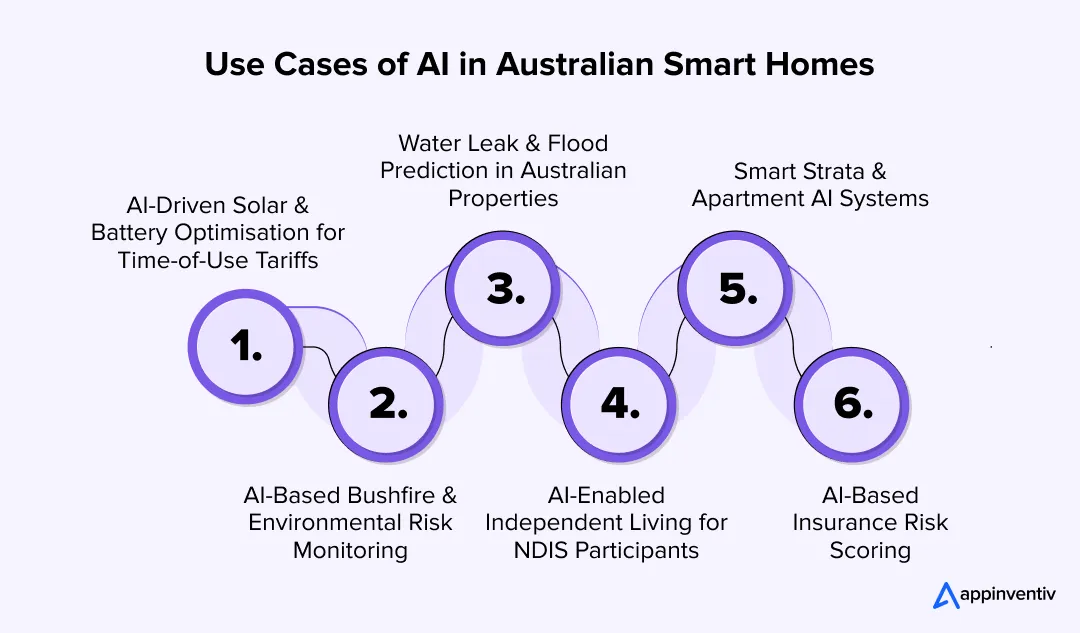
AI-Driven Solar & Battery Optimisation for Time-of-Use Tariffs
Australia’s rooftop solar penetration changes the logic of residential automation. In many Australia’s rooftop solar penetration has altered the economics of residential energy. Managing the “duck curve” is no longer a grid-only concern. It is a household asset management issue.
What AI Predicts: Rather than reacting to fixed schedules, the system builds forward-looking projections. It analyses historical consumption, occupancy rhythms, and real-time Bureau of Meteorology inputs. Over time, it refines load forecasts at the property level.
What It Decides: The intelligence layer determines when to store solar energy, when to export into the National Electricity Market during price peaks, and when to defer discretionary loads such as HVAC pre-cooling or pool systems.
This is where smart home energy management with AI moves beyond automation into economic optimisation.
Real-World Impact
RACE for 2030 has highlighted that broad AI integration into residential energy systems can significantly ease grid strain while reducing household costs.
The commercial implication is straightforward: energy becomes an actively managed asset, not a passive utility expense.
Primary Beneficiaries
- Energy retailers stabilising peak demand.
- Virtual Power Plant operators.
- Developers targeting stronger NatHERS performance outcomes.
AI-Based Bushfire & Environmental Risk Monitoring
Climate volatility across peri-urban NSW and Victoria introduces a different risk equation. Static smoke alarms are insufficient in high-risk corridors.
What AI Predicts: By correlating humidity shifts, wind velocity, smoke particulate density, and satellite data, the smart home automation using artificial intelligence estimates ignition risk at a micro-location level.
What It Decides: It can activate ember protection mechanisms, isolate ventilation pathways to reduce smoke ingress, and trigger high-priority evacuation alerts that override standard notification settings.
The logic is probabilistic rather than threshold-based.
Real-World Impact
CSIRO-backed initiatives such as FireSat demonstrate how AI-enabled fire detection can identify fires as small as 5 by 5 metres, improving response coordination.
For developers in bushfire-prone zones, this is a material resilience differentiator rather than a feature add-on.
Primary Beneficiaries
- Regional developers
- Property insurers
- Local government authorities responsible for emergency coordination.
Water Leak & Flood Prediction in Australian Properties
Water damage remains one of the most common non-weather insurance claims in high-density buildings. In Queensland, particularly, prevention is more cost-effective than remediation.
AI Predicts: Through ultrasonic acoustic sensing and anomaly detection in flow patterns, the system learns what “normal” looks like for each property. Deviations, even minor ones, are flagged early.
What It Decides: A staged water shut-off can be executed before structural damage spreads. Simultaneously, alerts are routed to owners and strata management.
This is not reactive plumbing control. It is continuous pattern assessment.
Real-World Impact
Resideo reports that smart leak detection solutions can reduce the frequency of water-related property damage by nearly 90%.
For asset owners, that translates directly into preserved capital and improved insurability.
Primary Beneficiaries
- Strata managers overseeing multi-dwelling assets.
- Institutional asset owners.
- Residential insurers seeking lower claim severity.
AI-Enabled Independent Living for NDIS Participants
The NDIS framework places emphasis on participant choice and control. AI-powered smart homes offer support without physical intrusion.
AI Predicts: Movement telemetry, vibration signatures, and appliance usage patterns are analysed to detect gait variation, fall probability, or emerging behavioural shifts. Importantly, this can be achieved without relying on invasive camera systems.
What It Decides: Lighting adjustments may activate automatically at night to reduce fall risk. If a participant’s activity of daily living profile shifts materially, caregivers are notified.
The system supports autonomy while preserving oversight.
Real-World Impact
Emerging implementations in assisted environments indicate that AI-driven personalisation enhances safe ageing-in-place for individuals with mobility or vision impairments.
For government-aligned housing and Specialist Disability Accommodation developers, the impact is both social and economic.
Primary Beneficiaries
- NDIS providers
- SDA developers
- Healthcare agencies managing long-term support costs
Smart Strata & Apartment AI Systems
Urban densification across Sydney, Melbourne, and Brisbane is pushing building systems toward higher complexity. Shared infrastructure requires predictive oversight.
AI Predicts: Using vibration and thermal telemetry, AI monitors lift motors, communal HVAC pumps, and other critical systems for fatigue signals. Peak demand trends across common areas are also modelled.
What It Decides: Maintenance can be scheduled during off-peak hours before breakdown occurs. Common-area energy loads can be modulated to avoid peak-demand surcharges.
In high-density settings, this shifts AI in Australian smart homes from consumer convenience to asset-level governance.
Real-World Impact
The 2025 Strata Market Report from CHU notes that proactive risk mitigation strategies contribute to greater insurance stability and improved building safety outcomes.
Operational predictability becomes an investment advantage.
Primary Beneficiaries
- Body corporates
- Strata managers
- Facility management firms overseeing large portfolios
AI-Based Insurance Risk Scoring
Insurers are progressively moving from postcode-based actuarial assumptions toward property-specific, data-informed underwriting.
AI Predicts
By evaluating maintenance history, environmental exposure, and active monitoring posture, the system estimates claim probability at an individual dwelling level.
What It Decides
Premium adjustments or safety credits may be applied to properties with verified, continuously monitored AI systems.
This represents a structural shift in how risk is priced.
Real-World Impact
Capgemini Australia reports that insurers are adopting advanced AI analytics and real-time data models to manage volatility and tailor pricing to desirable risks.
For well-maintained properties, AI becomes a lever for cost advantage.
Primary Beneficiaries
- Underwriters and brokers
- Insurers refining portfolio exposure
- Proactive property owners investing in resilience
Also Read: AI in Australian Retail Industry: Enterprise Use Cases & Examples
Compliance & Data Governance Requirements in Australia for AI Deployments in Australia
When deploying AI in Australian smart homes, the architectural roadmap is dictated by a stringent regulatory environment. Compliance is a functional requirement that directly influences the total cost of ownership. Let’s see how regulatory requirements shape the AI deployments in Australia:
- Privacy Act 1988 & Australian Privacy Principles (APP)
- Data Residency Requirements
- ASD Essential Eight & IoT Security
Privacy Act 1988 & Australian Privacy Principles (APP)
Systems that process behavioural patterns, energy usage, and biometric data fall under the Privacy Act 1988 and APPs. Smart home automation using artificial intelligence must ensure consent is an embedded part of the user experience.
- Data Minimisation: Systems should ingest only the specific telemetry required for the AI model to function.
- Anonymisation: Identifiable data must be stripped at the edge whenever possible before cloud transmission.
Data Residency Requirements
While not always legally mandated for all private residential data, there is a clear sovereign preference for Australian-hosted cloud environments (AWS Sydney/Melbourne or Azure Australia East). For projects involving government-funded sectors like the NDIS, keeping data on Australian soil is often a non-negotiable requirement to mitigate jurisdictional risk.
ASD Essential Eight & IoT Security
The Australian Signals Directorate (ASD) provides a framework that must guide the security posture of any AI smart home app development. Recommended practices include:
- Hardware-level encryption for all device-to-cloud communications.
- Automated firmware updates to patch vulnerabilities without user intervention.
- Multi-factor authentication (MFA) for all administrative and user-facing interfaces.
How Much Does AI Smart Home Development Cost in Australia?
The investment required for AI smart home platform development typically ranges between AUD 70,000 and AUD 700,000+, depending on scope and scale. Costs of developing apps for Australian homes are primarily driven by the depth of IoT hardware integration, the complexity of predictive models, cybersecurity hardening, and Australian data residency requirements.
Below is a structured cost and timeline breakdown table for different deployment levels.
| Complexity Level | Estimated Cost (AUD) | Estimated Timeline |
|---|---|---|
| Solar AI MVP | 70,000 – 150,000 | 3 – 6 Months |
| Integrated Residential Platform | 150,000 – 350,000 | 6 – 9 Months |
| Multi-Property / Strata AI Ecosystem | 350,000 – 700,000+ | 9 – 18+ Months |
Cost Breakdown by Development Stage
Allocating budget across the development lifecycle requires a focus on structural integrity and compliance. The following table outlines the distribution of investment for a typical deployment of AI in Australian smart homes.
| Development Stage | Percentage of Total Budget | Key Activities |
|---|---|---|
| Discovery & Architecture | 10% – 15% | Feasibility studies, tech stack selection, and cloud architecture design. |
| UX & Prototyping | 10% | User journey mapping for diverse Australian demographics and NDIS accessibility. |
| Data/IoT Integration | 20% | Connecting local sensors, smart meters, and legacy building systems. |
| Model Development / Integration | 15% – 20% | Training ML models for energy prediction or risk detection on local datasets. |
| App + Platform Build | 20% | Engineering the backend infrastructure and resident-facing mobile interfaces. |
| Security & Compliance Hardening | 10% | Implementing encryption, ASD Essential Eight protocols, and data residency. |
| QA & Reliability Testing | 10% | Hardware-in-the-loop testing and rigorous fail-safe verification. |
| Deployment & Monitoring | 5% | Staged rollout, environment setup, and initial performance baseline. |
Ongoing Operational Costs of AI Smart Home Systems
The initial build cost represents only part of total ownership. Sustaining AI smart home technology requires structured operational investment. Some common ongoing expenses required to keep pace with the key trends in Australian AI smart homes include:
- Cloud, Data Storage & Event Ingestion: As connected devices scale, ingesting continuous telemetry into Australian-hosted cloud environments becomes a recurring expense. Storage and compute requirements grow with portfolio size.
- Model Monitoring, Drift & Retraining: Energy tariffs change. Seasonal patterns shift. Household behaviour evolves. Without periodic retraining, models degrade. Monitoring and recalibration preserve reliability.
- Device Certification & Firmware Updates: IoT environments demand active firmware management. Security patches must be validated and deployed carefully to avoid disruption across properties.
- Support, Incident Response & SLA Operations: For strata or NDIS-critical deployments, uptime expectations are strict. This includes 24/7 monitoring, hardware incident coordination, and adherence to defined service levels.
For businesses assessing the cost of AI in Australian smart homes, the more relevant metric is total cost of ownership over five to seven years, not just the initial development outlay.
Core System Architecture for AI in Smart Homes in Australia
A robust AI home automation strategy in Australia relies on a modular architecture that separates the physical device layer from the intelligence layer. A resilient design must handle real-time data, intermittent connectivity in regional areas, Australian data residency expectations, and long-term maintainability.
Here are the core components which are typically used for AI deploymentsin Australian homes:
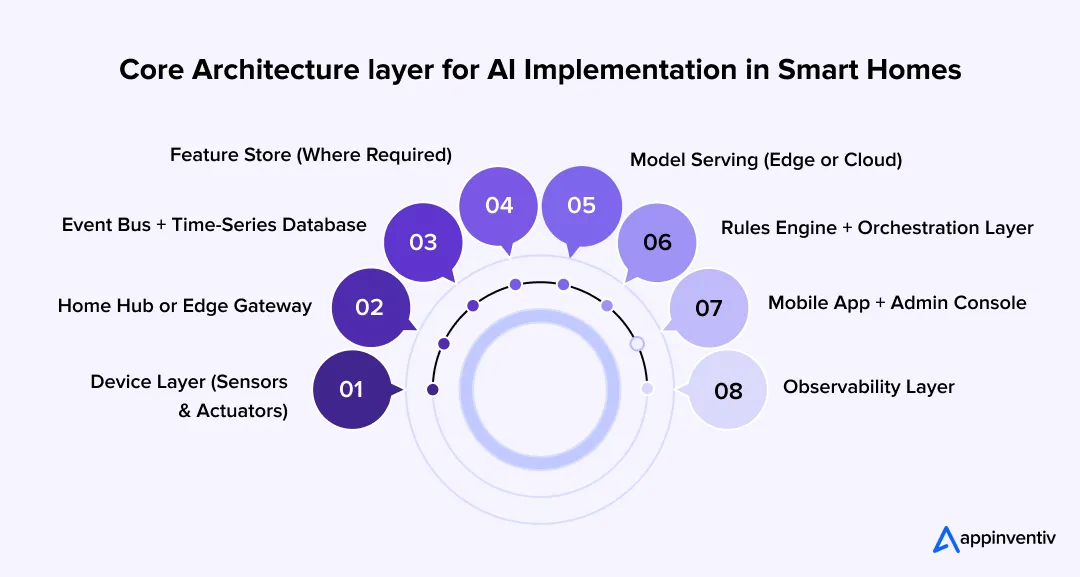
- Device Layer (Sensors & Actuators)
This includes smart meters, leak detectors, smoke sensors, HVAC controllers, vibration monitors, and environmental sensors. Device standardisation is critical. Mixed protocols without governance create integration debt. - Home Hub or Edge Gateway
The gateway aggregates local signals and performs preliminary filtering. In bushfire-prone or connectivity-limited regions, partial inference at the edge reduces latency and ensures continuity during outages. - Event Bus + Time-Series Database
Sensor data flows through an event streaming layer before landing in a time-series store. This enables historical pattern analysis for energy optimisation, anomaly detection, and predictive maintenance. - Feature Store (Where Required)
For advanced AI forecasting models, structured historical features must be stored consistently. This layer ensures reproducibility and supports retraining cycles. - Model Serving (Edge or Cloud)
Some decisions, such as leak shut-off, demand near-instant response and are better handled at the edge. Others, like tariff forecasting across portfolios, are suited to cloud-based inference. - Rules Engine + Orchestration Layer
AI predictions alone are insufficient. A rules engine translates predictions into actions while respecting governance policies, override logic, and compliance constraints. - Mobile App + Admin Console
Residents require visibility and control. Portfolio managers need dashboards, audit logs, and risk summaries. Role-based access control should be embedded from day one. - Observability Layer
Logs, metrics, traces, and model performance monitoring are non-negotiable. Without observability, drift, device failure, or integration issues remain invisible until a service disruption occurs.
This layered structure supports AI for smart homes in Australia at both single-property and multi-portfolio scale.
Edge vs Cloud: Architectural Decision Framework
Selecting where intelligence resides is not a purely technical choice. It is a risk decision that must be evaluated strategically.
Latency Sensitivity
Safety-critical actions such as water shut-off or fire alerts require near real-time execution. Edge inference reduces delay.
Offline Tolerance
Regional properties may experience network instability. Systems must maintain baseline functionality without constant cloud connectivity.
Privacy Requirements
If behavioural telemetry is sensitive, processing locally before transmitting anonymised signals can reduce exposure.
Cost & Maintainability
Cloud-centric systems simplify updates and centralised management. Edge-heavy systems require disciplined device fleet management.
In practice, most Australian deployments adopt a hybrid model. Immediate actions are processed locally, while portfolio analytics and training cycles operate in Australian-hosted cloud environments.
For boards assessing long-term viability, architecture clarity is often the difference between a scalable AI-Powered smart homes ecosystem and an expensive pilot that cannot expand beyond initial properties.
Real World Impact of AI Smart Home Deployments in Australia
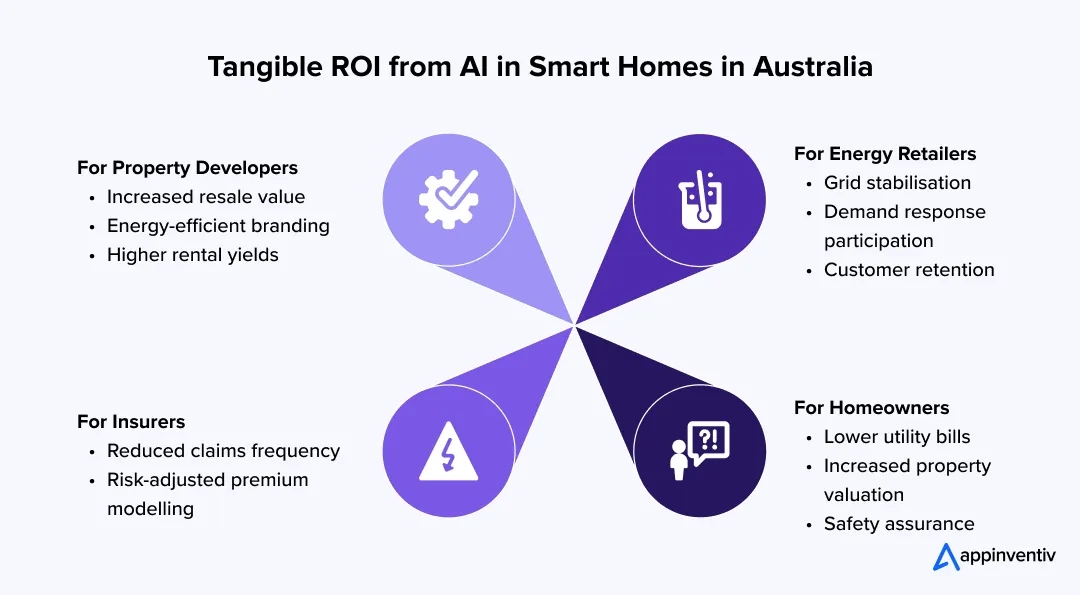
The integration of AI into residential assets provides measurable benefits that extend beyond simple convenience, directly impacting the balance sheets of developers, retailers, and insurers.
For Property Developers
Enterprise AI increases the “terminal value” of a development. By integrating smart home energy management with AI, developers can achieve higher NatHERS ratings more cost-effectively, meeting increasing buyer demand for 7-star energy-efficient homes. This branding often translates to faster sales velocity and a premium on resale values in competitive urban markets.
For Energy Retailers
AI-enabled homes serve as a distributed energy resource (DER). By orchestrating solar and battery storage across a portfolio of homes, retailers can participate in grid stabilisation and demand response programs. This reduces the need for expensive “peaker” plants and helps mitigate the financial risks associated with wholesale price volatility.
For Insurers
Real-time data moves insurance from reactive to preventive. AI-powered monitoring for water leaks, fire risks, and structural anomalies allows for risk-adjusted premium modelling. This proactive stance significantly reduces the frequency and severity of claims, particularly in high-density strata environments where a single leak can impact dozens of units.
For Homeowners
The primary impact is financial and psychological. Residents benefit from lower utility bills, often 20% to 30% lower than non-automated homes, while gaining the safety assurance of a home that actively monitors for environmental threats and personal health emergencies.
How to Implement AI in Smart Homes: A Step by Step Process
Rolling out AI in the app development process in Australia requires discipline. The sequencing of implementation steps matters as much as the technology stack. In most business environments, the difference between a scalable platform and a stalled pilot is clarity in execution phases.
Below is the structured approach to implement AI in smart homes:
Select a Use Case with Measurable ROI
Start with one outcome that can be tracked in financial terms. For some organisations, that is smart home energy management with AI tied to tariff reduction. For others, it is water leak prevention linked to insurance cost stability.
At this stage, you should define:
- Baseline cost or risk exposure
- Target improvement percentage
- Data required to validate improvement
Without this, AI becomes experimental rather than operational.
Establish Instrumentation and Integration Foundations
Before expanding automation, validate the integrity of your data layer. Poor telemetry quality undermines predictive performance and weakens executive confidence. This phase ensures that the system can ingest, standardise, and govern signals from multiple devices and external feeds across Australian environments.
At this stage, you should, focus on:
- Deploying and validating sensor accuracy
- Integrating with tariff feeds, weather inputs, or insurer systems
- Designing secure event ingestion pipelines
- Documenting data lineage and governance controls
If integration is rushed, remediation costs later will exceed initial savings.
Introduce Automation with Guardrails
Automation should not be deployed at full autonomy from day one. Especially in strata or NDIS-aligned contexts, transparency and override capability build trust. This stage introduces intelligence carefully, with escalation logic and human review pathways embedded into workflows.
At this stage, you should implement:
- Human override mechanisms
- Escalation thresholds for false positives
- Clear notification and consent flows
- Audit logging for automated decisions
The objective is controlled expansion, not aggressive automation.
Scale Across Properties or Portfolios
Once measurable value is proven at property level, scaling becomes an operational and governance exercise. Standardisation is critical at this stage. Expansion should prioritise consistency across buildings, regions, and asset classes to avoid fragmentation.
At this stage, you should concentrate on:
- Standardising hardware and integration protocols
- Centralising monitoring dashboards
- Formalising SLA and support frameworks
- Establishing portfolio-level reporting
At this point, AI in Australian smart homes evolves from a pilot initiative into infrastructure capability.
Ready to Move from Roadmap to Reality?
Implement AI in Smart Homes in Australia with governance, interoperability, and long-term cost clarity built in.

What Are the Deployment Risks and Mitigation Strategies for AI Smart Home Implementation?
Even well-funded initiatives encounter structural barriers. The following challenges frequently surface in Australian smart home deployments.
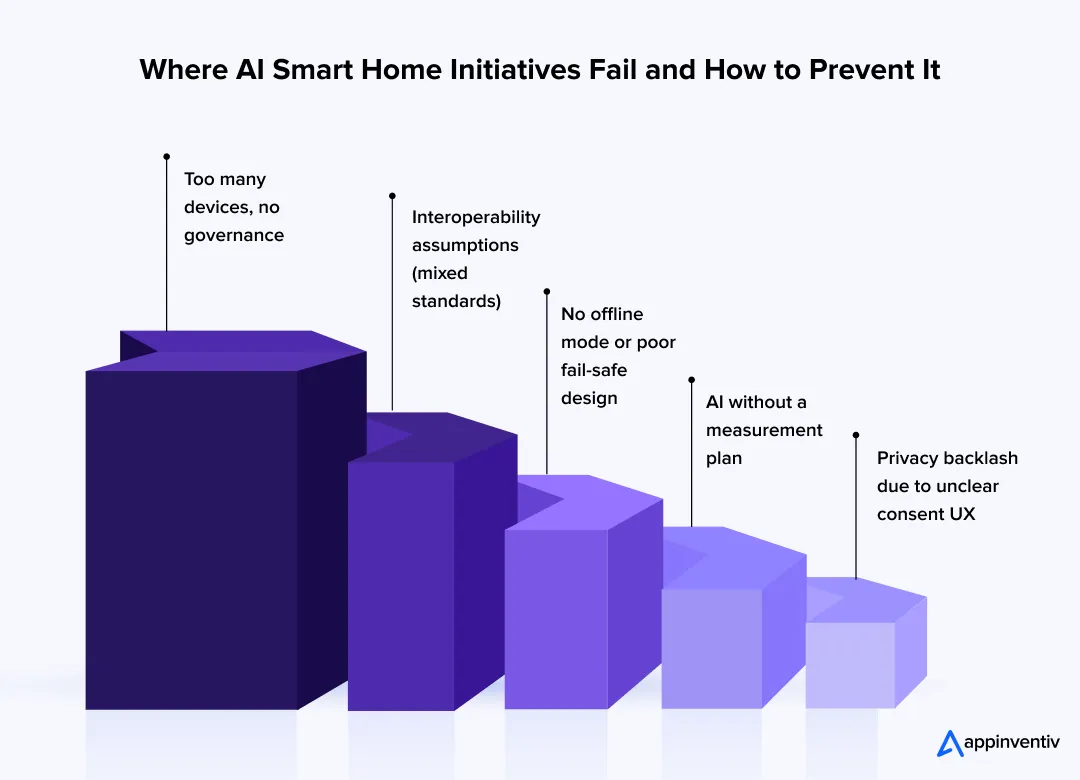
Too Many Devices, No Governance
Organisations often integrate multiple IoT vendors without a clear architectural policy. Over time, firmware incompatibility and fragmented dashboards create operational friction.
Mitigation requires:
- Standardisation of device protocols
- Centralised fleet management
- Structured firmware update processes
Interoperability Assumptions Across Mixed Infrastructure
Legacy building systems rarely align neatly with modern IoT frameworks. Assuming seamless compatibility can delay delivery and inflate integration costs.
Mitigation requires:
- Early-stage technical audits of existing infrastructure
- Controlled pilot testing before full deployment
- Defined integration standards across vendors
No Offline Mode or Weak Fail-Safe Design
In regional and peri-urban Australia, network reliability cannot be assumed. Systems that rely entirely on cloud inference may fail during outages.
Mitigation requires:
- Hybrid edge deployment for safety-critical actions
- Local fallback rules independent of cloud connectivity
- Periodic fail-safe testing under simulated outage conditions
AI Without a Measurement Framework
Deploying AI without predefined KPIs leads to ambiguous value and limited executive support. Without measurement, performance claims lack credibility.
Mitigation requires:
- Establishing baseline cost or risk metrics
- Quarterly performance reviews against targets
- Linking AI outcomes to financial reporting where possible
Privacy Backlash from Poor Consent Design
Residents may perceive surveillance rather than optimisation if communication is unclear. This risk is heightened in strata or assisted living environments.
Mitigation requires:
- Transparent consent architecture
- Clear data usage disclosures
- Role-based access controls
- Ongoing stakeholder communication
Successful AI in smart Homes in Australia initiatives are rarely defined by technology alone. They succeed because governance, measurement, and architectural discipline are treated as core design principles rather than afterthoughts.
Why Partner with Appinventiv for AI Smart Home Transformation
Appinventiv operates as a custom AI development company in Australia for businesses navigating the shift from legacy automation to intelligent, AI-led environments. With a decade of delivery experience in the APAC region, the focus is on architecting systems that are not only technologically advanced but also defensible under Australian regulatory and audit standards.
Our advisory and engineering teams assist leaders in moving beyond pilot projects by establishing a production-ready foundation. This includes discovery, reference architecture design, and the deployment of governed AI ecosystems that integrate seamlessly with existing building management and enterprise systems.
Global Expertise with an Australian Focus
We are recognised for our consistent growth and delivery excellence, recently named a Leader in AI-First Product Engineering. Our trajectory is validated by being ranked among APAC’s High-Growth Companies by Statista and the Financial Times for two consecutive years.
Strategic Delivery Metrics
| Performance Pillar | Achievement Baseline |
|---|---|
| Digital Assets Deployed in Australia | 3000+ |
| Tech Architects | 1600+ |
| Client Retention Rate | 78% |
| Agile Delivery Centers Across Australia | 5+ |
| Security Compliance SLA (ISO, SOC2) | 99.50% |
| Efficiency Gains in Australian Enterprises | 35% |
Services we deliver:
- Strategic Technology Consulting: Our digital strategy consulting services in Australia help businesses with architecture audits and AI roadmapping aligned with the Privacy Act 1988 and ASD Essential Eight.
- Custom AI Product Engineering: Development of predictive models for energy, risk monitoring, and NDIS-compliant assistive systems.
- Sovereign Cloud & AIOps: Deploying and maintaining AI workloads in Australian-hosted configurations to ensure data residency and long-term stability.
Appinventiv’s entry into the Australian Government’s Digital Marketplace further underscores our commitment to the highest standards of security and transparency required for public and private sector innovation.
If you are evaluating the adoption of AI in smart homes in Australia…..
Whether you are a property developer assessing solar optimisation, an insurer exploring telemetry-based underwriting, or an energy retailer designing demand-response automation, the decision should be structured.
We can conduct:
- A rapid architecture audit
- A compliance and data sovereignty review
- A cost and ROI benchmarking exercise
- A pilot feasibility assessment
AI in smart homes in Australia is no longer a novelty layer. It is becoming embedded residential infrastructure. The difference between a successful rollout and a stalled pilot often comes down to disciplined architecture, integration maturity, and operational governance.
If you are assessing next steps, we are available to scope the commercial and technical path forward.
Q. What is AI in smart homes?
A. AI in smart homes refers to the use of predictive models and data-driven automation within residential environments. Instead of relying on fixed rules, the system learns from usage patterns, environmental signals, and historical behaviour to make context-aware decisions.
In the context of AI in smart homes in Australia, this typically includes energy optimisation, leak detection, climate risk monitoring, and assisted living support, all governed by compliance and cybersecurity controls.
Q. What benefits do smart home energy management systems offer?
A. Smart home energy management with AI delivers measurable financial and operational outcomes rather than simple convenience.
Key benefits of AI powered home automation include:
- Reduced electricity bills through tariff-aware load shifting
- Improved return on rooftop solar and battery investments
- Participation in demand response or Virtual Power Plant programs
- Lower peak demand exposure in strata environments
For property developers and asset owners, these systems also enhance energy ratings and long-term asset value.
Q. How AI is transforming smart homes in Australia?
A. AI for smart homes in Australia is shifting residential systems from reactive automation to predictive infrastructure. Instead of responding to thresholds, systems forecast consumption, detect anomalies early, and recommend preventative action.
This transformation is particularly visible in:
- Solar and battery optimisation across high rooftop PV penetration areas
- Water leak detection in flood-prone regions
- Assisted independent living aligned with NDIS growth
- Portfolio-level risk scoring for insurers
The emphasis is on cost control, resilience, and governance rather than lifestyle enhancement.
Q. How AI improves smart home security?
A. AI smart home technology strengthens security by analysing patterns rather than relying solely on motion triggers.
It can:
- Detect unusual movement behaviour relative to established baselines
- Identify smoke or environmental anomalies before alarm thresholds are breached
- Correlate multiple sensor inputs to reduce false positives
By combining predictive logic with controlled escalation and audit logs, AI improves response quality while maintaining transparency.
Q. How much does a smart home system cost in Australia?
A. The cost of AI in Australian smart homes depends on scope, integration depth, and compliance requirements.
Typical investment ranges include:
- Solar AI MVP: AUD 70,000 – 150,000
- Integrated residential platform: AUD 150,000 – 350,000
- Multi-property or strata ecosystem: AUD 350,000 – 700,000+
Total cost of ownership should also account for cloud infrastructure, model retraining, firmware updates, and SLA-backed support operations.