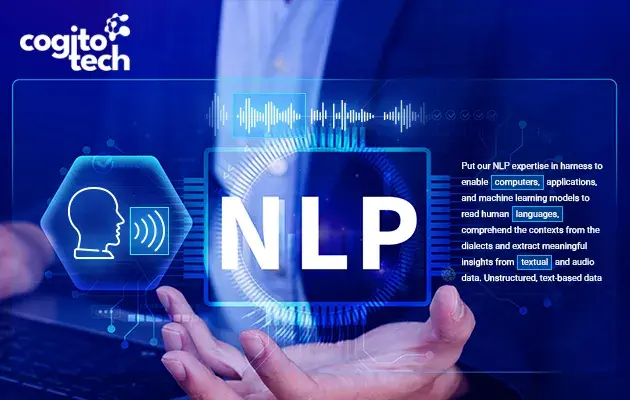
This guide will explore all aspects of NLP data annotation, covering text annotation, Named Entity Recognition (NER), sentiment analysis, relation extraction, speech transcription, audio annotation, intent labeling, and other essential techniques used to train modern language models. It will also discuss the annotation challenges and how these challenges are overcome, converting raw language data into consistent and accurate datasets for AI systems in 2026.
What is NLP Data Annotation?
NLP data annotation transforms unstructured audio & text content into meaningful conversations, documents, emails, customer support tickets, audio clips, or voice recordings. Depending on the specific application, annotators may classify text into predefined categories, transcribe speech, detect sentiment, recognize user intent, or tag relationships between different information pieces. These annotations serve as the ground truth for supervised learning and are used for fine-tuning large language models.
Types of NLP Data Annotation in 2026
Selecting appropriate annotation techniques depends on the business objective, the type of language data, and the AI model being developed.
1. Text Annotation
Text annotation is considered the lifeline of most NLP systems. It involves assigning labels to written content so AI models can understand context, recognize patterns, and extract meaningful information. Depending on the application, text annotation may operate at the sentence, phrase, document, or word level.
The types of text annotation include:-
– Text Classification
Text classification assigns predefined categories to documents, emails, messages, or reviews. It helps in automated ticket routing, document organization, spam detection, etc. For example, an email can be classified as:
- Billing
- Sales Inquiry
- Complaint
Common Applications
- Email routing
- Spam detection
- News categorization
- Customer support automation
- Document classification
– Named Entity Recognition (NER)
Named Entity Recognition identifies important entities within text, such as organizations, people, products, locations, currencies, dates, or medical conditions. For example, Apple will open a new office in the United States next year.
Annotated entities include:
- Organization → Apple
- Location → United States
- Time → Next Year
– Entity Linking
Entity linking is also known as named-entity disambiguation (NED). In NLP, it is a crucial task as it allows assigning a unique identity to entities mentioned in text. These entities can be popular locations, companies, individuals, and related items. The primary aim is to disambiguate and identify such entities to link them to a unique identifier.
Take one example
Apple announced its quarterly earnings.
Annotated Entity
- Apple → Apple Inc. (Technology Company)
instead of
– Sentiment Analysis
Sentiment annotation identifies the emotional tone expressed in text. The sentiment may be labeled as mixed or separated into negative or positive aspects for more granular analysis. Brands rely on sentiment analysis to monitor customer satisfaction, social media conversations, and product feedback.
For instance:-
The delivery was quick, but the product quality was disappointing.
- Delivery → Positive
- Product Quality → Negative
– Relation Extraction
Sometimes identifying entities isn’t enough. AI also needs to understand how those entities relate to one another.
For example:
John works at ABC Technologies.
Annotated Relationship
- John → Employee Of → ABC Technologies
– Coreference Resolution
Coreference resolution identifies when multiple words or phrases refer to the same entity within a sentence or across a conversation. It allows AI models to understand relationships and maintain context between pronouns and entities represented.
Let’s understand with an example
Sarah submitted the report. She approved it yesterday.
Annotated references:
- She → Sarah
- It → Report
– Intent Labeling
Intent labeling is one of the most critical annotation techniques for conversational AI. Rather than focusing solely on the words themselves, it recognizes the user’s underlying objective.
Check this inquiry:-
I need to reschedule my Friday’s appointment.
Annotated output might include
- Intent: Reschedule Appointment
Entities:
- Date: Friday
- Appointment Type: Existing appointment
– Conversation Annotation
Conversation annotation labels different elements within multi-turn dialogues to help AI understand conversational flow, speaker intent, and context across interactions.
Annotations include:
- Dialogue Acts (Question, Greeting, Request, Confirmation)
- Speaker Turns
- Intent Changes
- Conversation Context
- Escalation Points
- Response Quality
– Question-Answer Pair Annotation
Question-answer pair annotation involves labeling questions with their correct answers to train AI systems for information retrieval and conversational responses. These datasets teach models how to understand user queries and generate relevant, context-aware answers.
Example:
- Question: What is the capital of France?
- Answer: Paris
2. Speech Annotation
Speech annotation focuses on spoken language rather than written text. Instead of labeling documents, annotators work with audio recordings to build structured datasets for voice assistants, automatic speech recognition (ASR), and conversational AI.
Speech annotation includes:
- Speech transcription
- Pronunciation labeling
- Timestamp alignment
- Speaker diarization
- Accent and dialect identification
- Pause and disfluency annotation
3. Audio Annotation
Speech annotation focuses on spoken words, while audio annotation comprises all sounds present within an audio recording.
Depending on the use case, annotators identify:
- Music
- Animal sounds
- Background noise
- Traffic
- Human emotions
- Machinery
- Doorbells
- Alarms
- Environmental sounds
- Non-verbal vocalizations such as laughter or coughing
For example, healthcare AI may analyze coughing patterns or breathing sounds to assist clinicians, while automotive AI systems rely on audio annotation to detect emergency sirens and other road hazards. Audio annotation enables AI systems to understand not only what people say but also what is happening in the surrounding environment.
Challenges in NLP Data Annotation
Language introduces unique challenges that make NLP annotation harder than many other data modalities. One of the biggest challenges is ambiguity. The same word might have different meanings as per surrounding context. Rather than simple rule-based labeling, human judgment is often required for humor, sarcasm, abbreviations, abbreviations, idioms, and figurative language.
Context
It is rare that language exists in isolation. The meaning of a phrase, word, or sentence often depends on the surrounding conversation or text. To tackle this, annotators should consider broader context to assign accurate labels to ensure AI models can interpret references correctly.
Sarcasm
Sarcasm presents a challenge because the literal meaning of a statement often differs from the speaker’s actual intent. For example, “Great, another software crash!” expresses frustration rather than praise. Human annotators identify sarcastic expressions so models can better understand sentiment and intent.
Multilingual Data
Many AI applications operate across varied languages, each with its own syntax, grammar, and cultural nuances. Annotating multilingual datasets requires native language expertise to ensure consistent labeling and to preserve the meaning of the original text across different languages.
Domain-Specific Terminology
Industries such as healthcare, legal, finance, and insurance use specialized terminology that general annotators may not fully understand. Domain experts are required to label technical terms, abbreviations, and context-specific concepts, ensuring AI models learn industry-relevant knowledge.
Privacy and Sensitive Data
NLP datasets often contain personally identifiable information (PII), confidential business records, or sensitive customer data. Annotation workflows must incorporate data anonymization, secure handling practices, access controls, and regulatory compliance measures to protect data privacy while maintaining annotation quality.
Best Practices for High-Quality NLP Annotation
Develop Comprehensive Annotation Guidelines
Create clear labeling rules, examples, and edge-case definitions to ensure consistent annotations across teams.
Start with Pilot Annotation Batches
Run a small pilot to validate guidelines, identify ambiguities, and refine workflows before scaling.
Use Expert Annotators
Leverage native speakers, linguists, and domain experts to label language and industry-specific terminology.
Implement Double Review Workflows
Use independent reviews and adjudication to improve annotation accuracy and reduce labeling errors.
Create Gold Standard Datasets
Build verified benchmark datasets to train annotators and maintain consistent annotation quality.
Perform Regular QA Sampling
Audit random annotation samples to identify inconsistencies and ensure ongoing quality.
Measure Inter-Annotator Agreement (IAA)
Monitor agreement between annotators to evaluate consistency and improve annotation guidelines.
Establish Continuous Feedback Loops
Continuously refine guidelines and workflows based on reviewer feedback and model performance.
Integrate Human-in-the-Loop (HITL) Validation
Combine AI-assisted annotation with human review to validate outputs and improve dataset reliability.
Choosing the Right NLP Annotation Partner
Industry Experience
– Healthcare – Support for image annotation, speech & conversation annotation, EHR labeling, radiology and pathology reports, cardiovascular datasets, medical entity extraction, ophthalmology, etc.
– Finance – Label financial statements, SEC filings, annual reports, loan applications, customer communications, document classification, fraud detection, compliance monitoring, and regulatory documents for entity extraction.
– Retail: Label product descriptions, chat conversations, product catalogs, customer reviews, search queries, e-commerce content for product classification, named entity recognition (NER), sentiment analysis, intent detection, visual search, and personalized shopping experiences.
– Customer Service – Annotate call center transcripts, live chat interactions, chatbot conversations, support tickets, emails, conversation summarization, response generation, and escalation detection.
Scalability
The NLP data annotation providers must scale teams without compromising quality or turnaround time.
Data Security
The vendor must ensure secure infrastructure, controlled data access, and confidentiality. Annotation tasks must be performed as per industry standards and regulatory compliance requirements.
Linguistic Expertise
NLP data annotation service providers should handle multilingual datasets by employing native speakers and experienced linguists.
Domain Expertise
For specialized industries such as healthcare, finance, robotics, and logistics, the service provider must have a team of domain and subject matter experts. With a team of experts, you will stay assured of technical terminology and complex business workflows.
Quality Metrics
Track inter-annotator agreement (IAA), quality audit scores, and reviewer accuracy. Select the NLP data annotation company that maintains continuous quality monitoring and improvement processes.
Integrate Human-in-the-Loop Validation
An NLP data annotation company should review automated labels before incorporating them into training datasets. The vendor must use human feedback to continuously improve model performance and dataset quality.
Conclusion
Thus, it is more than labeling data to build production-ready NLP datasets. It demands linguistic expertise, quality assurance, domain knowledge, multilingual capabilities, and Human-in-the-Loop (HITL) supervision. By partnering with an experienced NLP data annotation provider like Cogito Tech, organizations can develop accurate, scalable, and high-quality datasets that power the next generation of intelligent AI applications.