Currently, businesses can tailor their GenAI technology with exclusive real estate data, allowing them to leverage domain knowledge in their AI systems. Integrating computer vision and NLP methods enables the interpretation of various forms of data, including images and text, facilitating the creation of new ways to showcase properties.
One example of how businesses are utilizing GenAI technology to integrate high-quality images and detailed descriptions is in virtual reality property viewing experiences, which enhance the overall experience for both sellers and buyers, who expect online property listings to be truly experiential.
The use of generative artificial intelligence could have a significant impact on the real estate industry, so in this blog, we will carefully evaluate its potential benefits.
How does GenAI help monetize real estate data?
Investors have access to extensive amounts of both proprietary and third-party data regarding properties, communities, tenants, and the market itself. By using this information to refine existing generative AI tools, businesses can identify investment opportunities, enhance building and interior design, create marketing materials, and improve customer experiences.
Fundamentally, generative AIs, such as large language models and chatbots, are off-the-shelf in nature, meaning they are pre-built AI products designed for multiple industries, rather than specifically for real estate. Despite their ability to comprehend general language patterns, they lack the specific knowledge necessary for property management.
Tailoring GenAI applications for real estate operations can benefit key areas, such as:
Design Innovation:
Creating architectural concepts and interior layouts for buildings and interior design via Gen AI is significantly simplified and accelerated by generating images of the interior space with a particular item or piece of furniture in place. This gives extra leverage for selling a property and influences the buyer’s decision. Such creativity, enabled by the use of generative AI tools, fuels innovation by transforming how spaces are envisioned and constructed.
Creating marketing collaterals:
Generating customized marketing campaigns, property listings, and messages for tenants is now easier with the help of Gen AI tools. It also helps to customize the content according to individual buyers in minutes, bringing your ideas to life and increasing engagement with buyers or renters through targeted content.
Answer domain-specific questions:
Using generative AI assistants or large language model (LLM) solutions can reduce the need for support staff and provide help in multiple languages for handling tenant questions, service requests, and complaints at any time.
Contract generation:
The real estate industry heavily relies on legal property documents, such as property valuations and lease agreements. It is essential to conform to accounting principles and standards, such as GASB 87, FASB ASC 842, and IASB IFRS 16, among others. It is here, Gen AI ensures documentation is up-to-date and creates legally compliant real estate contracts promptly.
Perform task workflows:
Custom LLM solutions or generative AI tools can utilize a property’s history, a renter’s particulars, and market forces to draft contracts on one’s behalf. The automation of the leasing process not only reduces errors but also saves time and keeps the organization compliant with legal requirements.
Automated property descriptions:
A gen AI–powered tool can summarize key themes across the leases, such as the monthly rent amount or the potential impact of market forces (including local environmental, social, and governance compliance laws) on leases. Additionally, the tool can scan across leases for a particular parameter (for example, all leases with a rent price per square foot below a certain level) and generate tables of information.
Virtual Staging:
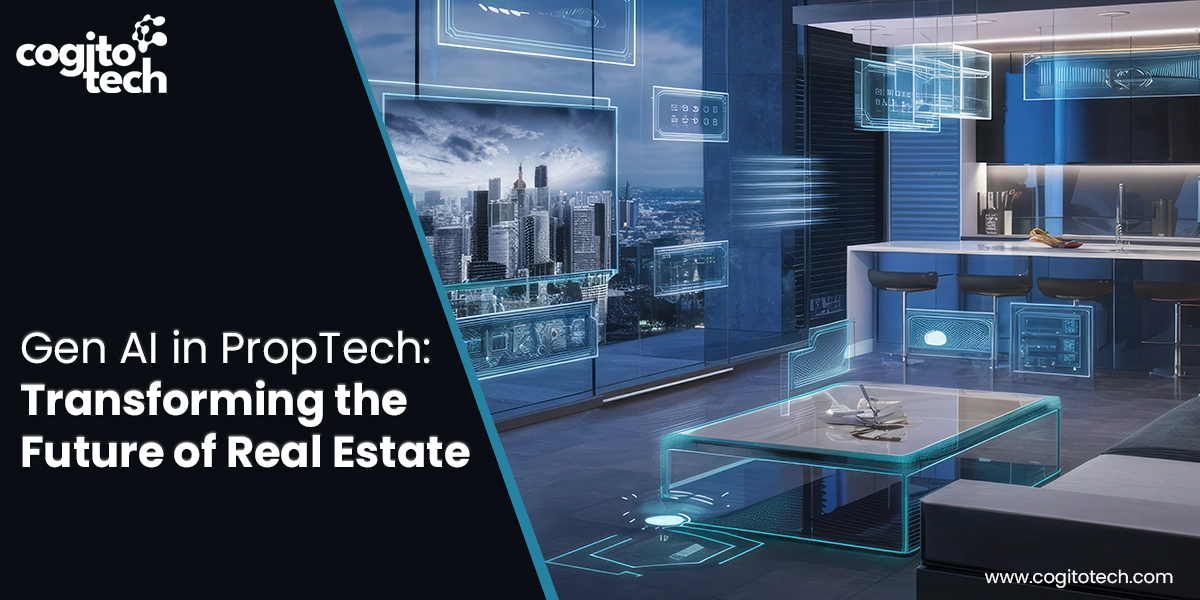
The use of Gen AI technology enables the creation of photo-realistic online tours of vacant properties by implementing hyper-personalized advice and immersive virtual tours. Customers can gain a greater insight into the properties they wish to purchase and reduce the time taken to secure a property. Realistic digital depictions of furniture and interior decor can also be included. By browsing for a home online, consumers are better able to visualize possible layouts of a house and, therefore, how a place could be adapted to their needs. Having this facility makes for a more enjoyable purchasing experience.
How can Cogito Tech help customize GenAI for the proptech industry?
There are three areas in which Cogito Tech offers to make your GenAI relevant for proptech tasks.
1. Data Collection & Preparation
Cogito Tech can assist with data collection for real estate development with customized GenAI for the proptech industry. They can access internal property information, including leases, maintenance records, CRM databases, historical tenant records, and financial data related to a property. Additionally, they can help with data from outside sources, including zoning maps, public property records, demographic data, tax assessments, market comps, MLS listings, and economic indicators. All this data will then be organized into structured formats and transformed into its most useful form for model training.
2. Model Fine-Tuning
Generative AI, when fine-tuned for PropTech, unleashes industry-specific intelligence that propels real estate innovation. This is because utilizing tailored AI model adaptations that incorporate market trends and tenant behavior enables PropTech firms to generate higher returns. This application fine-tunes the model for property listings for buying and selling, thereby determining its responses based on real estate usage.
General property-based AI models lack the context of the real estate industry. Fine-tuning the predictive model enables properties to best meet the needs of management, valuation, and tenant engagement. PropTech companies can gain a competitive edge by utilizing tailored AI solutions, either to enhance an enterprise-level company’s AI capabilities or to build their own generative AI tools.
3. Testing, Iteration & Guardrails
The process of testing and validation involves iterative testing by the team after the development of the AI system. The team tests the algorithms to eliminate or reduce inaccuracies in the provided answers while also removing misleading information. At Cogito Tech, we abide by compliance with local laws (e.g., fair housing laws) and implement safety checks and review procedures as necessary. Launching proptech innovations, which require adherence to several key principles and guardrails, forms the foundation of our custom solutions.
Conclusion
The application of generative AI is changing the face of property technology. This involves creating property management apps and digital tools that cater to all stakeholders, including buyers, sellers, tenants, landlords, and property managers, and provide more tailored services. The use of property management technology offers several benefits, including making the process more efficient and thus more appealing to tenants. The key advantage of the Gen AI model lies in its capacity to be tailored explicitly with real estate data, which assures the production of relevant and accurate property information and ideas.
Property technology companies can achieve more accurate valuation assessments and improve their customer relationship processes by integrating their internal data with an AI system. Additionally, this helps them with urban planning.
For the successful execution of this task, it is crucial to work with a company that is well-versed in personalizing AI. For a fine-tuning service, consider Cogito Tech. Our domain expertise, led by human architects and designers, state-of-the-art infrastructure, and tailored approach to training gen AI with spatial data about square footage, location, walls, furniture, and other architectural elements, help to create desired outcomes in PropTech applications.