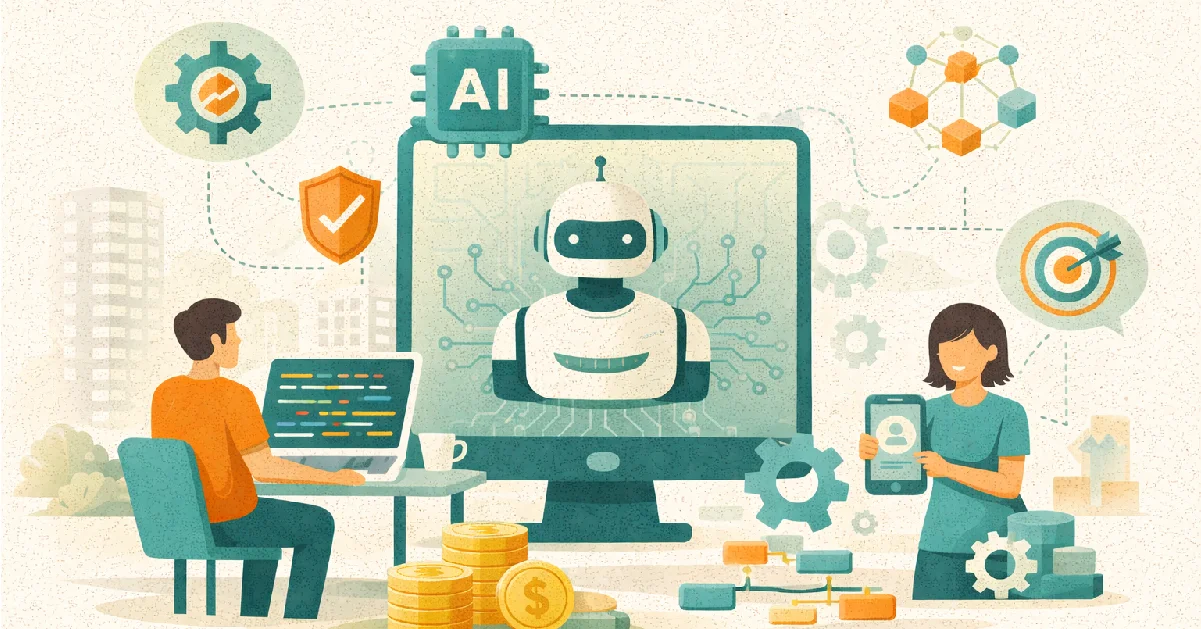
AI is changing pretty much everything, though, but let’s talk about the enterprise software development industry. The one thing AI has proved is how slow old methods were. AI can release cycles that once took months are now expected in weeks, sometimes days and it is exceptional. For the best development of your enterprise, you had to tie up with best software development company in india and it’s becoming a necessity rather than a choice because AI has already proven its worth. AI is not here for testing anymore; it has become the daily working partner. Somewhere, one enterprise team is still buried under legacy code and approvals, while another is shipping faster with the same headcount, with just smarter tools. And the gap is growing rapidly and it’s impacting the profits now.
Enterprise software was always complex, heavy, and slow by design, and for years that was accepted as normal. But now AI is quietly breaking that excuse. It’s writing code, reviewing it, catching bugs, and exposing inefficiencies teams learned to live with. This transformation isn’t dramatic or futuristic, but it’s practical and useful. In 2026, enterprise software development isn’t about doing more work; it’s about doing less wrong work, faster, and these five changes show exactly how AI is making that happen.
How AI Is Reshaping Enterprise Software Development in 2026

Manual Development
Traditional enterprises totally rely on human coding, even for repetitive work, but this kind of work AI does with better accuracy and results now. Developers spend hours on boilerplate, reviews, and fixes that add no real value, but AI can do this in minutes or sometimes in seconds with good guidance. In 2026, scaling software by hiring more people is expensive, slow, and inefficient, and AI exposes this mismatch very clearly.
Release Cycles Duration
In traditional enterprises release cycles are too slow for matching business reality. The approval layers, long QA phases, and rigid sprint structures, and all these processes delay the decisions, and by the time software ships, priorities have already changed. On the other hand, AI-driven teams adapt faster because feedback loops are shorter. They can see issues early, so they fix them early. And ultimately the release cycle took less time with AI.
Data Issue
Enterprises are filled and almost cluttered with massive amounts of data. Logs, metrics, user behavior, performance reports and much more data to lose in. And traditional models don’t connect this data in real time, and their decisions rely on past incidents and assumptions. But AI changes this completely, because with AI patterns are visible before failures happen.
Cost Inefficiency
In traditional enterprises, that inefficiency was hidden under “enterprise complexity,” but now with AI, it is measurable, and it is making a big impact. AI measures all the delays, bugs, reworks, and expenditures, so it clearly shows where time and money are slipping. Leaders can no longer justify slow delivery as normal, because all the comparisons are right there.
So, in 2026, traditional models aren’t breaking because they stopped working. But they’re breaking because something better is clearly working elsewhere.
5 Software Development Trends to Follow in 2026

AI Coding
AI can do the most time-consuming and complicated thing, which is coding. And AI is not trying to replace developers; this debate is already outdated. The real shift is how work gets distributed between humans and machines and how we balance both of them effortlessly.
Enterprises use AI to generate first drafts of code, but the value goes far beyond speed. AI takes care of consistency across massive codebases for the same structure, Same logic patterns. But humans can get fewer surprises during reviews so human touch and involvement will still be there. AI systems are trained on internal repositories, not just open-source examples. This means suggestions follow company-specific rules, architecture choices, and security constraints. So, developers aren’t against the system; they work with it effortlessly.
When AI does coding, and humans do coding, then the code reviews change in nature in both cases. AI flags syntax errors, performance issues, and risky patterns early. And human reviewers focus on intent, scalability, and long-term impact. With the help of AI, onboarding new developers becomes faster and less painful. Instead of reading endless documentation, developers learn by writing code with AI guidance. And mistakes are corrected in real time, not weeks later. Enterprises that avoid AI coding often call it “risk management.” In reality, they accept slower delivery, higher error rates, and rising maintenance costs. That trade-off is becoming harder to justify in 2026.
Secured Development with DevSecOps
By 2026, security will not be a phase at the end of development, because that model has already failed too many times. Enterprises used to treat security as a checkpoint. But now it’s baked into every commit, build, and deployment, not by policy, but by design. AI is becoming a bit extraordinary because it plays a quiet but critical role here. It scans code as it’s written, not after it’s merged. And vulnerabilities are flagged before they become habits. DevSecOps tools learn from past incidents. And they recognize risky patterns, misconfigurations, and access issues early. This shifts security from reaction to prevention.
Now developers don’t have to wait for security teams to raise tickets anymore.
Feedback arrives instantly, inside the development environment. And enterprises get fewer back-and-forths and less friction. Compliance also changes form. Instead of manual audits and late-stage reports, controls are enforced continuously. Every change leaves a trace and every decision is logged. This upgrade will reduce last-minute release blocks. Enterprises are adopting DevSecOps early to see fewer production breaches. Not because threats disappeared. But because systems are designed assuming threats exist. Teams are still pushing security to the end; call it flexibility. But they are inviting long-term loss and believing in luck blindly. In 2026, that’s not strategy, but that’s negligence.
Low-Code at Scale
Low-code finally stops being treated like a shortcut in 2026. It’s becoming a serious enterprise tool, but only when used with discipline. In early times, low-code used to fail because it created uncontrolled apps. Now AI is changing the equation of shadow systems, poor security and zero ownership. AI enforces architecture rules automatically. AI applies data access limits, security policies, and performance thresholds in a default way. Enterprises use low-code for internal platforms, workflows, dashboards, and operational tools. And these things are not experiments and they do support daily business decisions.
But even with a low-code strategy, developers don’t disappear from the process. They define standards and reusable components. Business teams assemble solutions within those boundaries. It just reduces dependency on core engineering teams for small but urgent needs. So engineers can focus on systems that actually carry risk and scale. Maintenance becomes manageable with it, because AI tracks usage, detects redundancy, and flags apps that should be retired or rewritten. And ultimately, low-code stops creating long-term mess. And the best benefit this trend offers is that it saves time, because ideas move to execution faster, without bypassing governance.
Cloud and Azure Development
In 2026, the advantage is not using Azure, it’s using it right. Most enterprises moved to the cloud years ago but carried old habits with them, running legacy architectures on modern platforms and calling it transformation. Cloud-native Azure development breaks that pattern. Applications are designed from the start to scale, fail safely, and recover automatically, instead of being patched later. AI-driven monitoring, automated scaling, and predictive cost insights become part of daily development, not emergency tools.
Security and identity are built into the system design, not added at the end, and access is controlled intentionally rather than assumed. Developers stop worrying about servers and start focusing on how systems behave under real load, while finance and engineering finally see the same cost picture. Enterprises still treating the cloud as just better hosting don’t fall behind loudly, they fall behind quietly, and in 2026 that gap grows fast.
.NET Core in Enterprise Systems
In 2026, .NET is not just superior for nostalgia but also for stability and scale. Enterprises are becoming practical; they care less about trends and more about systems that don’t break under load. The cross-platform support of .NET matters in real environments. With the help of its applications that run across containers, Linux servers, and hybrid setups without friction. Performance improvements make a visible difference at the enterprise scale. We can measure lower latency, better resource usage, and fewer surprises during peak traffic.
With .NET, security updates arrive faster and more consistently. These long-term support versions reduce forced upgrades and production risk. So in the upcoming time, developers will spend less time fighting the framework and more time designing systems that handle failure, scale, and growth.
Conclusion
In 2026, enterprise software development is no longer about tools alone. It’s about how quickly teams adapt when pressure shows up. AI, cloud-native platforms, DevSecOps, and modern frameworks have been making their place in the industry for years, but now they’re becoming an important part of every enterprise. Enterprises that evolve their development models early ship faster, break less, and recover quicker, because others will spend time explaining delays.
The gap between average teams and high-performing teams is widening quietly, and this is not because of talent but because of decisions. This is why enterprises increasingly look beyond generic vendors and towards focused partners offering software development services in Bangalore, where scale, cloud expertise, and AI-first thinking already coexist. Choosing the best software development company in India is about who understands modern enterprise pressure and builds systems that survive it, so don’t trust every company; choose the best for your business.