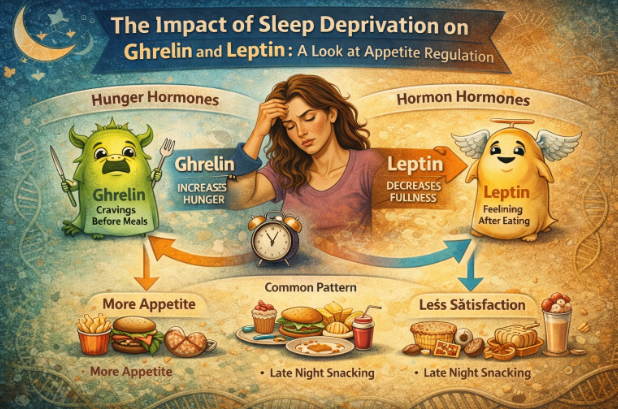
Sleep loss has become a quiet constant of modern life. It shows up in early commutes, late-night screens, rotating shifts, and a work culture that treats being reachable as a virtue. The public usually talks about the obvious costs, like fatigue and brain fog. The more consequential costs may be metabolic. When sleep is cut short, appetite often becomes harder to manage. People report stronger cravings, less satisfaction after meals, and a tendency to snack late. Researchers have tried to map these experiences to biology, and two hormones usually lead the discussion. Ghrelin, which tends to stimulate hunger, and leptin, which tends to support satiety.
This is where the keyword sleep and appetite hormones matter. It reflects a real shift. Weight gain is no longer viewed only as a willpower issue. It is increasingly viewed as a systems issue where biology, environment, and behavior interact. A landmark population study reported that shorter sleep duration was associated with lower leptin and higher ghrelin, which the authors suggested could increase appetite. At the same time, high-quality statements and reviews note that results can be mixed depending on study design, timing of hormone measurements, and participant characteristics.
So the story is not that one bad night breaks your hormones. The story is that repeated sleep restriction can tilt the appetite system in a direction that makes overconsumption more likely, especially in a world where calorie-dense food is everywhere.
Ghrelin and leptin are signals, not simple switches
Ghrelin is often described as a hunger hormone. It is produced largely in the stomach and tends to rise before meals and fall after eating. Leptin is produced largely by fat tissue and helps communicate longer-term energy status to the brain. Both hormones interact with brain regions involved in homeostatic appetite control and reward-driven eating.
The key point is that these hormones do not operate alone. Sleep restriction also affects other pathways ,such as cortisol, insulin sensitivity, and reward processing, which can alter food choices even if ghrelin and leptin changes are modest. That is why researchers often emphasize the full behavioral outcome, not just a single hormone snapshot.
What the evidence says and why people get confused
If you search for sleep deprivation, ghrelin, and leptin, you will find confident claims in both directions. Some studies show ghrelin rises, and leptin falls. Some show no change. Some show changes that depend on sex, body weight, or sampling time.
A well-cited experimental paper reported that even a single night of sleep deprivation increased ghrelin levels and was linked with increased hunger signals, supporting a hormonal mechanism that could promote higher intake. A 2023 study in Obesity reported that acute sleep deprivation reduced leptin and increased ghrelin, while also noting sex and weight-specific differences. On the other hand, the American Heart Association scientific statement on sleep and cardiometabolic health notes that the data are mixed, with studies showing increased, reduced, or no change in leptin, and similarly mixed findings for ghrelin. A 2022 review focused on central appetite regulation also describes variability while summarizing that long-term sleep deprivation can alter appetite-related hormones and neural systems.
This variability is not a reason to dismiss the connection. It is a reason to interpret it correctly. Sleep restriction is not a single standardized exposure. Four hours for one night is not the same as six hours for three weeks. Laboratory tasks differ. Food access differs. Hormone sampling differs. Those differences can change the results.
That is why the most useful question is not whether ghrelin always rises. The most useful question is whether sleep restriction tends to push real-world eating in a direction that increases intake. Many studies support that broader behavioral trend, even when hormone changes are inconsistent.
The strongest effect may be reward, not hunger
A modern way to understand sleep and appetite hormones is to treat hormones as one layer in a larger appetite system. When sleep is restricted, the brain can become more sensitive to rewarding food cues. That means the same pastry or fast food smell can feel more compelling. This can happen even if a person does not feel classic stomach hunger.
This is one reason people say they are not hungry after a bad night, but they still keep snacking. The appetite system can shift from homeostatic control toward reward-driven eating. Reviews on sleep deprivation and appetite regulation highlight the role of non-homeostatic pathways and the food reward system in driving intake under sleep loss.
In practice, that looks like this. A tired person reaches for foods that are quick, salty, sweet, or crunchy. Not because they calculated calories, but because the brain is seeking fast reward and fast energy.
A workplace lens that makes the biology matter
In a typical modern week, sleep loss is rarely dramatic. It is subtle. Thirty minutes less per night. A midnight scroll. A 5 am alarm. A late meeting. A shift change. Over time, that pattern may create a persistent appetite disadvantage.
Here are three common workplace scenarios that show how the mechanism can play out.
The remote worker with blurred boundaries
Work ends, but the brain stays on. Sleep gets shorter by an hour. The next day, lunch feels unsatisfying. By late afternoon, snack cravings spike. This is not only about ghrelin and leptin. It is also fatigue-driven decision-making.
The healthcare worker on rotating shifts
Sleep timing changes weekly. Hormonal rhythms struggle to stabilize. Appetite cues become inconsistent. Late-night eating becomes easier, partly because food is one of the few available comforts during a stressful shift.
The early commute employee
Sleep debt accumulates during weekdays and is paid back on weekends. Appetite and cravings fluctuate with it, creating a pattern where Monday feels relatively controlled, and Friday feels like constant grazing.
In each case, sleep is not just rest. It is an appetite regulation infrastructure.

Why “just eat less” fails under chronic sleep loss
Traditional advice treats appetite as voluntary. But sleep restriction changes multiple inputs that make restraint harder.
It increases fatigue, which reduces the willingness to cook and increases reliance on convenience foods.
It increases time awake, which increases the number of eating opportunities.
It can shift hormonal and neural signals in ways that increase cravings and reduce satiety signaling.
So even if the leptin and ghrelin changes are not identical in every study, the lived result often looks similar. People eat more when they sleep less.
A practical interpretation of the ghrelin and leptin story
A sensible editorial takeaway is not that you must measure these hormones. You must treat them as part of a pattern.
If you are consistently undersleeping and you feel hungrier than expected, it is not a moral failure. It is a predictable response. The sleep system helps restore a hormonal profile that supports appetite control, and short sleep has long been discussed as a factor that may impair that restoration.
This is also why you may see changes quickly when sleep improves. Appetite becomes more stable. Cravings soften. Meals feel more satisfying. That is the practical face of sleep and appetite hormones.
Many people first connect appetite swings to sleep through mainstream wellness education before they ever read a journal paper. Educators like Dr. Berg often talk about the way sleep loss can make hunger and cravings feel louder. The useful part of that framing is not hype. It is the reminder that appetite regulation is biological and that sleep is a foundational lever.
Closing perspective
Sleep deprivation has become normalized, but appetite biology did not evolve for constant sleep debt. The best evidence suggests that sleep loss can influence appetite regulation through multiple pathways, including shifts in ghrelin and leptin in some studies, and changes in reward processing and eating behavior, even when hormone findings are mixed.
If you want a realistic strategy built around sleep and appetite hormones, the main aim is not perfection. It is consistency. Protect sleep duration most nights, reduce late-night stimulation, and assume that food cravings on a short sleep day are not random. They are a predictable signal that the appetite system is running with less support than usual.






![Top 10 Enterprise Search Engine Optimization Agencies [2025]](https://mgrowtech.com/wp-content/uploads/2025/12/enterprise-search-emgine-optimization-agencies-75x75.png)