• About Us
  • Disclaimer
  • Contact Us
  • Privacy Policy
Sunday, May 24, 2026
mGrowTech
No Result
View All Result
  • Technology And Software
    • Account Based Marketing
    • Channel Marketing
    • Marketing Automation
      • Al, Analytics and Automation
      • Ad Management
  • Digital Marketing
    • Social Media Management
    • Google Marketing
  • Direct Marketing
    • Brand Management
    • Marketing Attribution and Consulting
  • Mobile Marketing
  • Event Management
  • PR Solutions
  • Technology And Software
    • Account Based Marketing
    • Channel Marketing
    • Marketing Automation
      • Al, Analytics and Automation
      • Ad Management
  • Digital Marketing
    • Social Media Management
    • Google Marketing
  • Direct Marketing
    • Brand Management
    • Marketing Attribution and Consulting
  • Mobile Marketing
  • Event Management
  • PR Solutions
No Result
View All Result
mGrowTech
No Result
View All Result
Home Al, Analytics and Automation

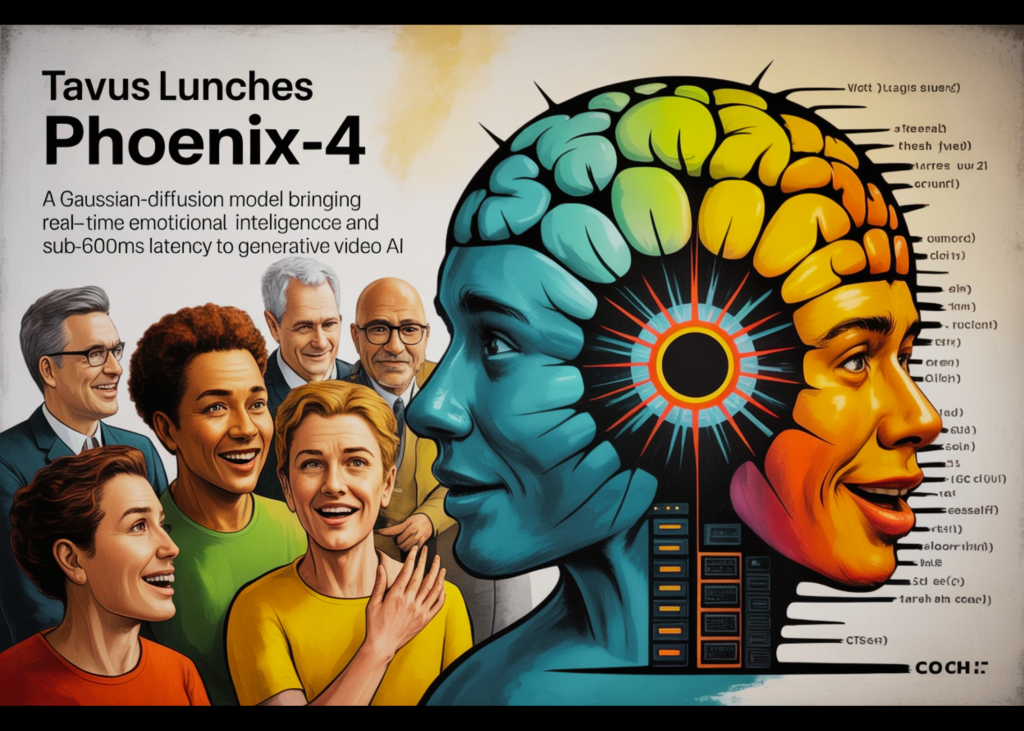
Tavus Launches Phoenix-4: A Gaussian-Diffusion Model Bringing Real-Time Emotional Intelligence And Sub-600ms Latency To Generative Video AI

Josh by Josh
February 19, 2026
in Al, Analytics and Automation
0
Tavus Launches Phoenix-4: A Gaussian-Diffusion Model Bringing Real-Time Emotional Intelligence And Sub-600ms Latency To Generative Video AI


The ‘uncanny valley’ is the final frontier for generative video. We have seen AI avatars that can talk, but they often lack the soul of human interaction. They suffer from stiff movements and a lack of emotional context. Tavus aims to fix this with the launch of Phoenix-4, a new generative AI model designed for the Conversational Video Interface (CVI).

Phoenix-4 represents a shift from static video generation to dynamic, real-time human rendering. It is not just about moving lips; it is about creating a digital human that perceives, times, and reacts with emotional intelligence.

The Power of Three: Raven, Sparrow, and Phoenix

To achieve true realism, Tavus utilizes a 3-part model architecture. Understanding how these models interact is key for developers looking to build interactive agents.

  1. Raven-1 (Perception): This model acts as the ‘eyes and ears.’ It analyzes the user’s facial expressions and tone of voice to understand the emotional context of the conversation.
  2. Sparrow-1 (Timing): This model manages the flow of conversation. It determines when the AI should interrupt, pause, or wait for the user to finish, ensuring the interaction feels natural.
  3. Phoenix-4 (Rendering): The core rendering engine. It uses Gaussian-diffusion to synthesize photorealistic video in real-time.
https://www.tavus.io/post/phoenix-4-real-time-human-rendering-with-emotional-intelligence

Technical Breakthrough: Gaussian-Diffusion Rendering

Phoenix-4 moves away from traditional GAN-based approaches. Instead, it uses a proprietary Gaussian-diffusion rendering model. This allows the AI to calculate complex facial movements, such as the way skin stretching affects light or how micro-expressions appear around the eyes.

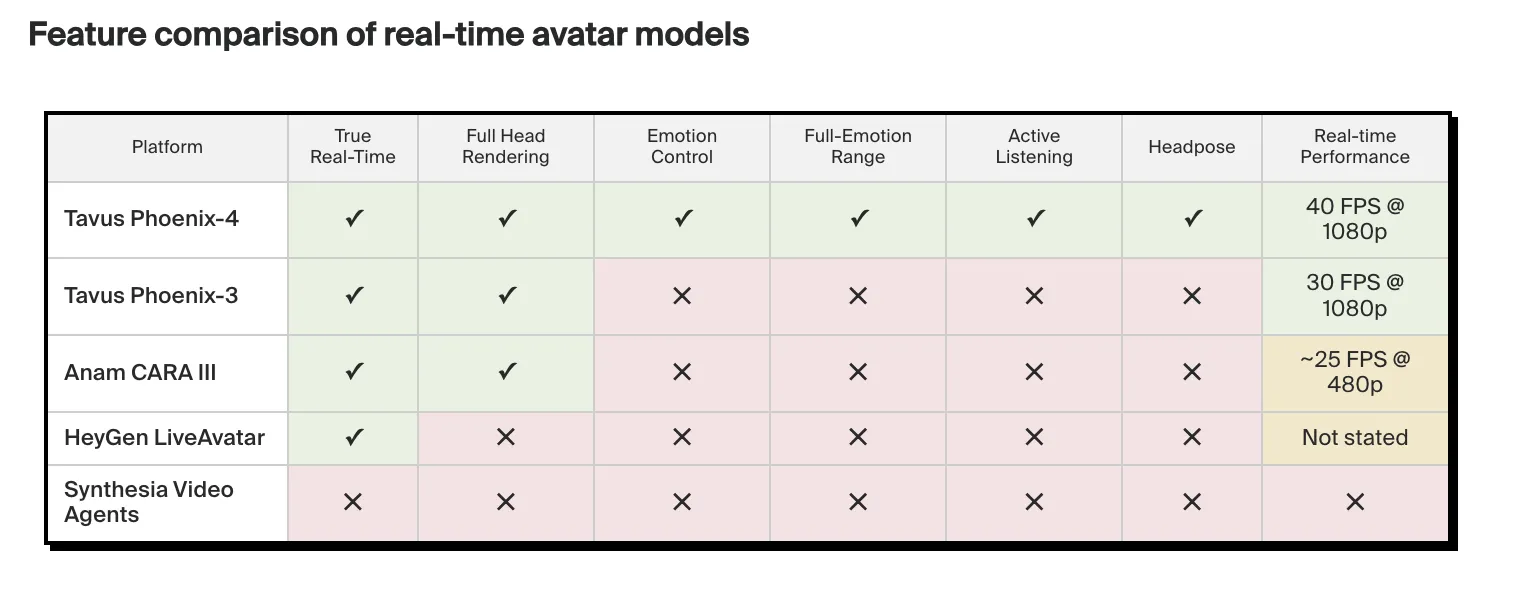
This means the model handles spatial consistency better than previous versions. If a digital human turns their head, the textures and lighting remain stable. The model generates these high-fidelity frames at a rate that supports 30 frames per second (fps) streaming, which is essential for maintaining the illusion of life.

Breaking the Latency Barrier: Sub-600ms

In a CVI, speed is everything. If the delay between a user speaking and the AI responding is too long, the ‘human’ feel is lost. Tavus has developed the Phoenix 4 pipeline to achieve an end-to-end conversational latency of sub-600ms.

This is achieved through a ‘stream-first’ architecture. The model uses WebRTC (Web Real-Time Communication) to stream video data directly to the client’s browser. Rather than generating a full video file and then playing it, Phoenix-4 renders and sends video packets incrementally. This ensures that the time to first frame is kept at an absolute minimum.

Programmatic Emotion Control

One of the most powerful features is the Emotion Control API. Developers can now explicitly define the emotional state of a Persona during a conversation.

By passing an emotion parameter in the API request, you can trigger specific behavioral outputs. The model currently supports primary emotional states including:

  • Joy
  • Sadness
  • Anger
  • Surprise

When the emotion is set to joy, the Phoenix-4 engine adjusts the facial geometry to create a genuine smile, affecting the cheeks and eyes, not just the mouth. This is a form of conditional video generation where the output is influenced by both the text-to-speech phonemes and an emotional vector.

Building with Replicas

Creating a custom ‘Replica’ (a digital twin) requires only 2 minutes of video footage for training. Once the training is complete, the Replica can be deployed via the Tavus CVI SDK.

The workflow is straightforward:

  1. Train: Upload 2 minutes of a person speaking to create a unique replica_id.
  2. Deploy: Use the POST /conversations endpoint to start a session.
  3. Configure: Set the persona_id and the conversation_name.
  4. Connect: Link the provided WebRTC URL to your front-end video component.
https://www.tavus.io/post/phoenix-4-real-time-human-rendering-with-emotional-intelligence

Key Takeaways

  • Gaussian-Diffusion Rendering: Phoenix-4 moves beyond traditional GANs to use Gaussian-diffusion, enabling high-fidelity, photorealistic facial movements and micro-expressions that solve the ‘uncanny valley’ problem.
  • The AI Trinity (Raven, Sparrow, Phoenix): The architecture relies on three distinct models: Raven-1 for emotional perception, Sparrow-1 for conversational timing/turn-taking, and Phoenix-4 for the final video synthesis.
  • Ultra-Low Latency: Optimized for the Conversational Video Interface (CVI), the model achieves sub-600ms end-to-end latency, utilizing WebRTC to stream video packets in real-time.
  • Programmatic Emotion Control: You can use an Emotion Control API to specify states like joy, sadness, anger, or surprise, which dynamically adjusts the character’s facial geometry and expressions.
  • Rapid Replica Training: Creating a custom digital twin (‘Replica’) is highly efficient, requiring only 2 minutes of video footage to train a unique identity for deployment via the Tavus SDK.

Check out the Technical details, Docs and Try it here. Also, feel free to follow us on Twitter and don’t forget to join our 100k+ ML SubReddit and Subscribe to our Newsletter. Wait! are you on telegram? now you can join us on telegram as well.


Source_link

READ ALSO

Tencent Open-Sources TencentDB Agent Memory: A 4-Tier Local Memory Pipeline for AI Agents

Nous Research Releases Contrastive Neuron Attribution (CNA): Sparse MLP Circuit Steering Without SAE Training or Weight Modification

Related Posts

Tencent Open-Sources TencentDB Agent Memory: A 4-Tier Local Memory Pipeline for AI Agents
Al, Analytics and Automation

Tencent Open-Sources TencentDB Agent Memory: A 4-Tier Local Memory Pipeline for AI Agents

May 24, 2026
Nous Research Releases Contrastive Neuron Attribution (CNA): Sparse MLP Circuit Steering Without SAE Training or Weight Modification
Al, Analytics and Automation

Nous Research Releases Contrastive Neuron Attribution (CNA): Sparse MLP Circuit Steering Without SAE Training or Weight Modification

May 23, 2026
A Step-by-Step Coding Tutorial to Implement GBrain: The Self-Wiring Memory Layer Built by Y Combinator’s Garry Tan for AI Agents
Al, Analytics and Automation

A Step-by-Step Coding Tutorial to Implement GBrain: The Self-Wiring Memory Layer Built by Y Combinator’s Garry Tan for AI Agents

May 23, 2026
Microsoft Releases Fara1.5: A Family of Browser Computer-Use Agents (4B/9B/27B) That Outperform OpenAI Operator and Gemini 2.5 Computer Use on Online-Mind2Web
Al, Analytics and Automation

Microsoft Releases Fara1.5: A Family of Browser Computer-Use Agents (4B/9B/27B) That Outperform OpenAI Operator and Gemini 2.5 Computer Use on Online-Mind2Web

May 22, 2026
Justin Solomon appointed associate dean of engineering education | MIT News
Al, Analytics and Automation

Justin Solomon appointed associate dean of engineering education | MIT News

May 22, 2026
Qwen Introduces Qwen3.7-Max: A Reasoning Agent Model With a 1M-Token Context Window
Al, Analytics and Automation

Qwen Introduces Qwen3.7-Max: A Reasoning Agent Model With a 1M-Token Context Window

May 21, 2026
Next Post
6 brand safety best practices to inform your 2026 marketing plan

6 brand safety best practices to inform your 2026 marketing plan

POPULAR NEWS

Trump ends trade talks with Canada over a digital services tax

Trump ends trade talks with Canada over a digital services tax

June 28, 2025
15 Trending Songs on TikTok in 2025 (+ How to Use Them)

15 Trending Songs on TikTok in 2025 (+ How to Use Them)

June 18, 2025
Communication Effectiveness Skills For Business Leaders

Communication Effectiveness Skills For Business Leaders

June 10, 2025
App Development Cost in Singapore: Pricing Breakdown & Insights

App Development Cost in Singapore: Pricing Breakdown & Insights

June 22, 2025
Comparing the Top 7 Large Language Models LLMs/Systems for Coding in 2025

Comparing the Top 7 Large Language Models LLMs/Systems for Coding in 2025

November 4, 2025

EDITOR'S PICK

New tactics and tools you should know

LinkedIn Marketing in 2026: The Complete Guide

December 17, 2025
How to Earn Citations & Mentions in AI Search

How to Earn Citations & Mentions in AI Search

November 14, 2025
Good SEO Plus Lazy Marketing Won’t Cut It Anymore

Good SEO Plus Lazy Marketing Won’t Cut It Anymore

June 3, 2025
2026 F1 Miami Grand Prix: 17 Full-Throttle Brand Experiences

2026 F1 Miami Grand Prix: 17 Full-Throttle Brand Experiences

May 17, 2026

About

We bring you the best Premium WordPress Themes that perfect for news, magazine, personal blog, etc. Check our landing page for details.

Follow us

Categories

  • Account Based Marketing
  • Ad Management
  • Al, Analytics and Automation
  • Brand Management
  • Channel Marketing
  • Digital Marketing
  • Direct Marketing
  • Event Management
  • Google Marketing
  • Marketing Attribution and Consulting
  • Marketing Automation
  • Mobile Marketing
  • PR Solutions
  • Social Media Management
  • Technology And Software
  • Uncategorized

Recent Posts

  • My New Book Is Here: The Persuasion Engine
  • We’re partnering with U.S. Soccer to bring fans closer to the action with Search.
  • Ansel Adams’ Trust Says AI-Colorized Version Of His Work Was Exhibited Without Permission
  • Tencent Open-Sources TencentDB Agent Memory: A 4-Tier Local Memory Pipeline for AI Agents
  • About Us
  • Disclaimer
  • Contact Us
  • Privacy Policy
No Result
View All Result
  • Technology And Software
    • Account Based Marketing
    • Channel Marketing
    • Marketing Automation
      • Al, Analytics and Automation
      • Ad Management
  • Digital Marketing
    • Social Media Management
    • Google Marketing
  • Direct Marketing
    • Brand Management
    • Marketing Attribution and Consulting
  • Mobile Marketing
  • Event Management
  • PR Solutions