This piece walks you through the essentials of robotics data annotation, sharing insights to meet them, and how Cogito Tech’s domain-specific, scalable data annotation workflows, backed by deep experience and proven expertise, support next-gen robotics.
What is robotics data annotation?
Data annotation for robotics is the process of adding metadata or tags to raw data, such as images, videos, and sensor inputs (LiDAR, IMU, radar), to enable robotic systems to navigate, perceive, and act intelligently across tasks ranging from simple to highly complex.
Robots understand the nuances of their surroundings and operational context from annotated data, helping them accurately interpret both their tasks and the environment in which they operate. High-quality annotation directly influences a robot’s ability to carry out tasks with high precision — whether that means recognizing and handling objects like packages, tools, components, or consumer products — or distinguishing among various sizes, weights, and destinations. Annotated data trains robots to understand what a package or a car part looks like under different conditions, enabling them to make correct decisions quickly and reliably.
Why is data annotation in robotics unique?
Since robots operate in fast-changing and often unpredictable environments – such as navigating a crowded warehouse or identifying crop maturity in orchards – data annotation for robotics is fundamentally different from annotation for virtual-only AI models. To operate autonomously, robots rely on multiple sensor inputs, including RGB imagery, LiDAR, IMU, radar, and more, for perception and decision-making. Only accurate annotation allows machine learning models to interpret this multimodal data correctly.
Here is why data annotation in robotics is different from normal annotation:
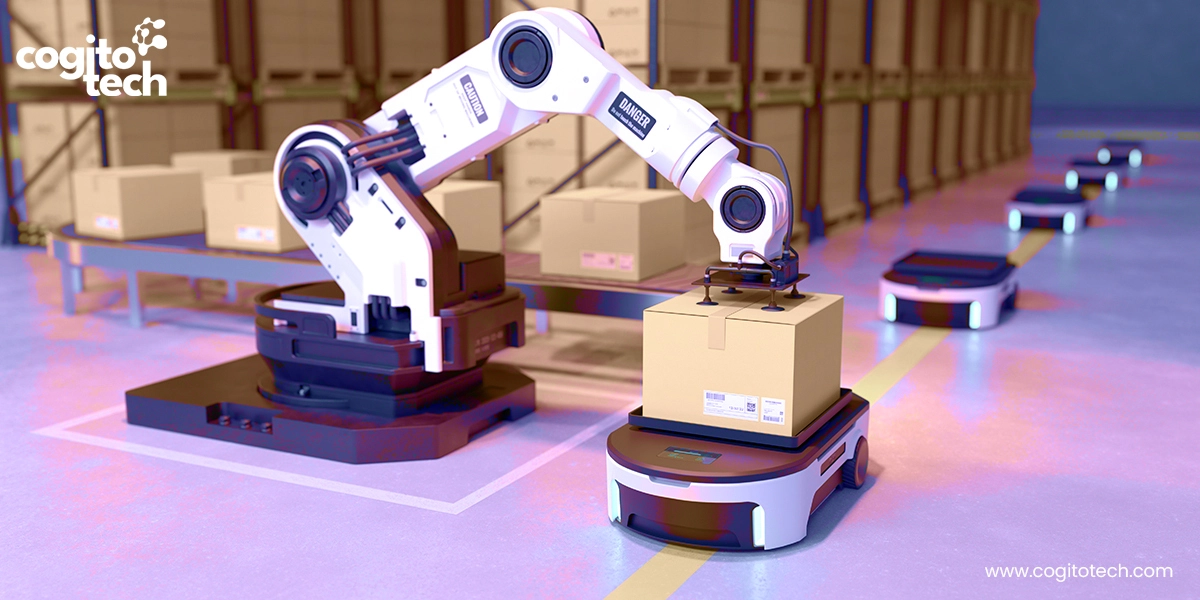
- Multimodal data: Robots rely on multimodal sensor streams. For example, a warehouse robot may capture RGB images, LiDAR, IMU, radar, and more simultaneously. Annotators must align these data streams, enabling the robot to understand objects, estimate distance, and detect movement.
- Environmental complexity: A robot operates in highly variable and unpredictable environments– for example, a factory floor with uneven lighting across welding zones, frequently shifting layouts, and cluttered pathways. Training data must capture this variability for reliable performance. Environments also contain constantly moving elements, such as forklifts, pallets, and workers. Robots must recognize these objects and predict their motion to navigate safely. Accordingly, annotated datasets need to include these images in different lighting conditions, pallets in every possible position and orientation, and workers walking at different speeds and angles.
- Safety sensitivity: Robotic systems rely on correctly labeled 3D data to understand their surroundings when navigating real spaces like warehouses. Incorrect labels can cause misjudged clearance and unsafe actions – collisions, abrupt stops, or unpredictable maneuvers. Even small labeling errors – for example, mislabeling a shiny or reflective surface – can cause a robot to stop suddenly or turn in a risky direction.
For instance, Amazon’s warehouse robots (AMRs) are trained on precisely labeled LiDAR data to ensure they do not collide with racks while moving between them.
Robotics data annotation: key use cases

Annotated data drives several core capabilities of the robotics system, such as:
- Autonomous navigation: Labeled data trains robots to navigate without crashing. Training data – such as labeled images, depth maps, and 3D point clouds – enable robotic systems to identify obstacles, pathways, walls, and other elements, and adjust to changing layouts.
- Object manipulation: Annotated data enables robotic arms to grab, sort, and assemble objects precisely by marking grasp points, object edges, textures, and contact surfaces.
- Human–robot interaction: Training data that contains labeled human poses, gestures, and proximity indicators helps robots understand human movements, allowing them to avoid collisions and unsafe behaviors.
- Semantic mapping and spatial understanding: Labels on floors, walls, doors, racks, and equipment help robots build structured maps of their environment.
- Quality inspection and defect detection: Robotic systems detect defects or errors by learning from labeled images and sensor readings that include normal appearances, defect patterns, and early signs of wear.
A common example of robotics training data is labeled LiDAR point clouds and camera images featuring vehicles, cyclists, pedestrians, road signs, and surroundings, used for training autonomous vehicles.
Types of data annotation techniques in robotics
- Object detection: Labeling objects in images or videos and tracking their movement so robots can recognize objects and follow them as they move.
- Semantic segmentation: Labeling every pixel in an image to help robots understand their environment at a granular level, differentiating safe areas across danger zones, such as walkways, machinery, or vegetation.
- Pose estimation: Labeling joints, orientations, and positions of humans or objects to support precise robotic arm movement, safe human–robot interaction, and accurate interpretation of how objects or people are oriented.
- SLAM (Simultaneous Localization and Mapping): Creating a map while simultaneously locating the robot within that map for real-time autonomous navigation and dynamic adjustment as surroundings change.
- Medical robotics annotation: Robotic surgery relies on annotated 3D point clouds, surgical tools, gestures, tissues, organs, and video frames to safely track instruments, navigate anatomical structures, and assist surgeons during procedures.
Cogito Tech’s domain-specific and scalable data annotation for robotics AI
Building robotics AI that adapts to real-world complexity requires more than generic datasets. Robots deal with sensor noise, unpredictable environments, and simulation-to-real gaps – challenges that demand precise, context-aware annotation. With over eight years of experience in AI training data and human-in-the-loop services, Cogito Tech provides custom, scalable annotation workflows designed for robotics AI.
- High-quality multimodal annotation
Our team collects, curates, and annotates multimodal robotic data (RGB images, LiDAR, radar, IMU, control signals, and tactile inputs). Our pipelines support:– 3D point cloud labeling and segmentation
– Sensor fusion (LiDAR ↔ camera alignment)
– Action labeling based on human demonstrations
– Temporal and interaction trackingThis ensures robots understand objects, depth, motion, and human behavior across highly variable environments.
- Human-in-the-loop precision
Accuracy is critical in robotics. Cogito Tech combines automation with expert validation to refine complex 3D, motion, and sensor data. Our human-in-the-loop teams ensure safe, reliable datasets that improve navigation, manipulation, and prediction in dynamic real-world settings. - Domain-specific expertise
Different robotics domains require different annotation skills. Cogito Tech’s team, led by domain experts, brings contextual knowledge – segmenting crops in orchards, labeling tools in factories, or identifying gestures for human-robot interaction – delivering consistent, high-fidelity datasets tailored to each application. - Advanced annotation tools
Our purpose-built tools support 3D boxes, semantic segmentation, instance tracking, interpolation, and precise spatial-temporal labeling. This enables accurate perception and decision-making for AMRs, drones, industrial robots, and more. - Simulation, Real-Time Feedback & Model Refinement
To reduce the sim-to-real gap, Cogito monitors model performance in simulated and digital twin environments, offering real-time corrections and continuous dataset improvements to accelerate deployment readiness. - Teleoperation for next-gen robotics
For high-stakes or unstructured environments, Cogito Tech provides teleoperation training through VR interfaces, haptic devices, low-latency systems, and ROS-based simulators. Our Innovation Hubs enable expert operators to remotely guide robots, generating rich behavioral data that enhances autonomy and shared control. - Built for real-world robotics
From warehouse AMRs and agricultural drones to surgical systems and industrial manipulators, Cogito Tech delivers the precise annotated data needed for safe, high-performance robotic intelligence – securely, at scale, and with domain depth.
Conclusions
As robots take on more autonomy in warehouses, farms, factories, hospitals, and beyond, the need for precise and context-aware data annotation becomes mission-critical. It is annotated data that grounds robotic intelligence in the realities of dynamic environments. Backed by years of hands-on experience and domain-led workflows, Cogito Tech delivers the high-fidelity, multimodal training data that ensures robotics systems operate safely, efficiently, and with real-world reliability.