[ad_1]
TL;DR: Best AI Tools for Education in 2026
According to G2 reviews, SchoolStatus is the highest-rated AI tool for education, earning a 4.8/5 rating for its predictive attendance analytics, automated family outreach, and multilingual communication. Other AI tools for education include:
- Illumine (4.5/5): Helps childcare centers manage parent updates, lesson plans, assessments, and daily reports.
- ClassDojo (4.5/5): Connects teachers, students, and families through classroom updates, behavior tracking, and AI-assisted communication.
- Socrative (4.5/5): Speeds up assessment creation and grading while helping teachers identify learning gaps.
- Mentimeter (4.7/5): Makes lessons more interactive with live polls, quizzes, word clouds, and AI-assisted presentations.
- Blackboard (4.0/5): Supports instructors with AI-assisted assessments, rubrics, course management, and grading workflows.
- iSpring Suite (4.6/5): Turns PowerPoint content into interactive courses, quizzes, translations, and narrated eLearning experiences.
- ParentSquare (4.6/5): Simplifies family communication with AI writing support, engagement insights, and multilingual translation.
- PowerSchool Schoology Learning (4.4/5): Combines LMS workflows, student insights, tutoring support, grading, and course management in one platform.
If you’ve spent any time in a classroom recently, you already know the feeling. Teachers are planning lessons late into the night, adapting content for different learning needs, grading piles of assignments, tracking student progress, and still trying to show up fully present the next morning. The job hasn’t just gotten harder; it has become more complex in ways traditional teaching tools were never designed to handle.
That’s where AI tools for education are starting to make a meaningful difference. These platforms use artificial intelligence to support teachers, schools, and students with tasks like lesson planning, assessment, grading, tutoring, parent communication, translation, analytics, and classroom engagement.
This is the reality most educators are navigating, and it’s why I started paying closer attention to education software and how it is reshaping the classroom experience. What once felt like an experimental add-on is becoming a meaningful shift in how teachers plan lessons, assess learning, and connect with students. The numbers reflect that momentum. According to a 2025 report on how AI and human teachers can collaborate in education, AI in education is projected to grow from $5.18 billion in 2024 to $112.3 billion by 2034.
9 best AI tools for education: My shortlist
These tools show AI moving beyond content generation into everyday education workflows from lesson planning and assessments to communication, translation, analytics, and student support. Most offer free access or free versions, making AI adoption easier for educators across childcare, K-12, and higher ed.
| AI tool for education | G2 rating | Best for | AI features | Free trial |
| 1. Illumine | 4.5/5 | Child care centers | AI-assisted parent communication, translations, lesson plans, forms, and analytics | Yes |
| 2. ClassDojo | 4.5/5 | Classroom communication | AI assistant for lesson planning, family communication, and teacher workflows | Yes |
| 3. Socrative | 4.5/5 | End-to-end assessment workflow | AI assistant for assessment creation, automated grading, and learning app insights | Free trial for paid plans |
| 4. Mentimeter | 4.7/5 | Real-time audience interaction | AI presentation builder with response grouping and content moderation | No |
| 5. Blackboard | 4.5/5 | Higher ed course management | AI course creation with translation, image generation, narration, in app AI assistant | No |
| 6. iSpring Suite | 4.6/5 | PowerPoint-based eLearning | AI course and quiz generation, voiceover creation, and image generation | Yes |
| 7. ParentSquare | 4.6/5 | K-12 parent communication | AI messaging, engagement insights, and auto translation | No |
| 8. SchoolStatus | 4.8/5 | Attendance-driven communication | Predictive attendance, personalized messaging, auto translation, literary updates | No |
| 9. PowerSchool Schoology Learning | 4.4/5 | Unified student information system | AI tutoring, content creation, data analysis, and career guidance | No |
Note: The details here reflect the most current capabilities as of June 2026, but may change over time.
How I determined the best AI tools for education in 2026
To keep the evaluation fair, I shortlisted AI-enabled tools from the G2 Summer Grid® Report 2026 across classroom management, classroom messaging, and assessment. I evaluated them using G2 Score, customer satisfaction, market presence, verified user sentiment, and cross-checked vendor documentation for AI capabilities, integrations, classroom use cases, and student-facing functionality.
Product images were sourced from the respective vendors to reflect the 2026 education software landscape.
After evaluating AI tools across these education categories, I narrowed the list using the following criteria:
- Ease of setup: How quickly teachers, schools, or districts can start using the tool without heavy technical support.
- Teacher experience: How intuitive the platform feels for daily classroom tasks such as planning, communication, assessment, and student support.
- Student engagement: Whether the tool improves participation, collaboration, personalized learning, or learner motivation.
- AI functionality: Whether the AI features support lesson creation, feedback, differentiation, tutoring, automation, or classroom insights beyond basic content generation.
- Integration depth: How well the tool connects with learning management systems, Google Workspace, Microsoft tools, communication platforms, and classroom applications.
- Data privacy and security: Whether the platform supports responsible handling of student data and provides transparency around privacy, compliance, and AI usage.
AI tools are transforming education by automating time-consuming tasks, personalizing learning, and enhancing student engagement. From intelligent tutoring and assessment generation to lesson planning and real-time analytics, these tools empower teachers to focus on what matters most — teaching.
Here are 9 of the best AI tools making an impact in education today.
1. Illumine: Best for childcare centers
In my analysis of G2 review data, Illumine stood out as a strong fit for early learning teams that want to reduce the writing effort behind pupil observations, baseline assessments, end-of-term reports, and parent-facing updates. When I looked at G2 reviews, the clearest AI value was helping educators turn rough teacher-written notes into clearer, more professional communication for families.
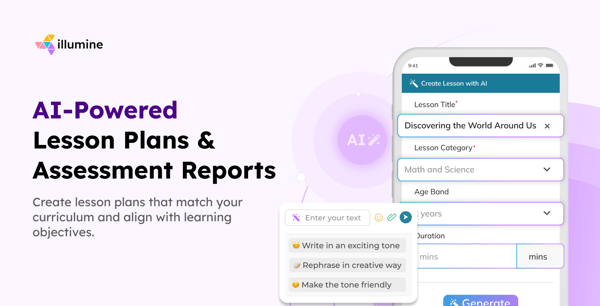
G2 reviewers highlighted that Illumine’s AI can improve the clarity, grammar, spelling, tone, and structure of teacher-written notes. One reviewer specifically mentioned that the AI can expand teacher-written notes and rewrite them in a more professional way, making reports clearer and easier to share with parents. For schools and educators, this points to a practical benefit: Illumine helps reduce the manual effort involved in writing assessment-related documentation while still supporting high-quality parent communication.
Its AI-supported reporting sits alongside strong family communication and classroom sharing features. In my analysis of review data, I found instant messaging was rated 95%, reinforcing Illumine’s strength in helping teachers stay connected with families. Users also mentioned being able to share 100+ pictures, videos, observations, and reports with parents, making it easier for families to follow a child’s progress.
One area schools may want to manage is notification volume, since reviewers mentioned receiving too many alerts when parents like, comment, or interact in the class. However, that feedback also suggests strong parent engagement within the platform. With instant messaging rated 95%, Illumine still comes across as a strong tool for keeping families connected to day-to-day classroom activity.
2. ClassDojo: Best for classroom communication
ClassDojo earned its place in my analysis because it is especially strong for teachers who need a simple way to manage classroom behavior while keeping families involved in everyday student progress. When I looked at G2 review data, the clearest value came from how the platform combines behavior tracking, parent communication, progress sharing, and multilingual messaging into one daily classroom workflow.

ClassDojo’s biggest strength is classroom behavior management. In my analysis of G2 reviews, teachers described using it to track attendance, behavior, rewards, self-regulation, and participation, with students responding well to points, progress visibility, and positive recognition. This aligns with strong feature scores for progress reporting at 92% and remote computer monitoring at 88%, showing ClassDojo’s value in helping teachers document behavior, motivate students, and reinforce classroom expectations.
I also saw strong evidence that ClassDojo helps teachers communicate with families more consistently, especially when language differences could otherwise create barriers. Reviewers mentioned translated messages, Google Translate integration, and support for non-English-speaking families. That makes the platform valuable for sharing updates about learning, behavior, and student work without forcing teachers to rely on separate translation or messaging tools. Instant messaging was rated 92%, which reinforces communication as one of ClassDojo’s strongest user-rated areas.
ClassDojo is less about advanced lesson creation and more about keeping the classroom organized, motivated, and connected. Some classroom content-building capabilities appear less central to the user experience, but reviewers still describe the platform as useful for day-to-day classroom management, parent updates, behavior tracking, and student progress sharing. In that sense, ClassDojo stands out most for teachers who want a practical, easy-to-use system for encouraging positive behavior and keeping families connected to what is happening in class.
71%
of users who used AI for assessments, questions, rubrics, feedback, or reports found that it improved assessment workflows.
Source: G2 Summer Grid Report 2026 for classroom management
3. Socrative: Best for end-to-end assessment workflow
Socrative stood out in my analysis of G2 review data for helping teachers turn quick classroom assessments into immediate instructional insight. While reviewers do not describe broad generative AI features, they repeatedly point to AI-adjacent value through automated grading, instant feedback, real-time quiz data, progress reporting, and response insights that help teachers adjust instruction quickly.
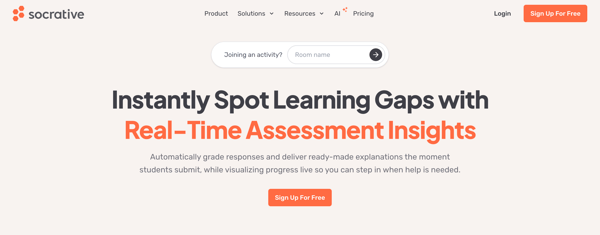
Teachers value Socrative most for live visibility into student understanding. G2 reviewers mentioned seeing quiz results in real time, identifying the most-missed questions, spotting misconceptions, and supporting students while an assessment is still happening. This aligns with strong scores for interactive quizzes at 93% and progress reporting at 92%.
Socrative also helps reduce manual grading across formative and summative assessments. Reviewers said scores are generated automatically, student work is saved, reports help track progress, and feedback helps students correct their thinking faster than paper-based tests. Its 91% score for student assignment collection further supports its strength in collecting and acting on classroom assessment data.
The main area users want improved is quiz flexibility, including time limits, richer question options, and automatic question generation. Even so, reviewers describe Socrative as a dependable assessment tool that saves time through instant feedback, automated scoring, live results, and progress reports.
54%
of users who used AI for reports, insights, analytics, or progress visibility found that it supported assessment and feedback decisions.
Source: G2 Summer Grid Report 2026 for classroom management
4. Mentimeter: Best for real-time audience interaction
Mentimeter made the shortlist because it helps educators make live lessons more interactive while checking student understanding in real time. Its strongest value is not broad AI automation, but the way it supports quick quizzes, polls, word clouds, Q&A, and classroom feedback loops that teachers can act on during instruction.
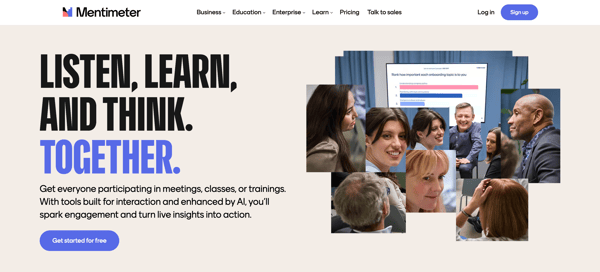
The clearest AI-related benefit is quiz creation. One G2 reviewer specifically mentioned Mentimeter’s “artificial intelligence prompting box,” which can automatically create a Menti quiz. For teachers, this is useful when building quick classroom checks, training activities, or engagement exercises without starting from scratch. This connects well with strong feature scores for real-time assessment at 95% and question variety at 90%.
I also found that Mentimeter is especially strong once those activities are live. Reviewers described using it to assess understanding, gather feedback from large cohorts, encourage anonymous participation, and adjust teaching based on responses. Its quizzes, word clouds, and live polls help make lessons more participatory, supported by a 92% mobile compatibility rating.
AI use still appears to be developing. One educator suggested AI could further help by analyzing quiz results and summarizing key insights. Even so, G2 reviewers already frame Mentimeter as a strong classroom engagement and assessment tool, with AI having room to build on its real-time feedback strengths.
5. Blackboard: Best for higher ed course management
Blackboard stood out in my analysis of G2 review data because it combines large-scale LMS management with emerging AI support for course design, assessment planning, and instructor efficiency. Its value is strongest for schools and higher education teams that need to manage courses, assignments, assessments, grading, student access, and online learning workflows in one system.
The clearest AI-related strength appears in Blackboard Ultra. G2 reviewers mentioned new AI tools, AI-driven efficiencies, course-building support, idea generation, formative assessment, and continued AI development. One reviewer said the new AI tools are “underpinned by strong pedagogical principles” and help tutors generate ideas while reducing effort around formative assessments and feedback tools.
That AI direction fits well with Blackboard’s broader assessment strengths. In my review of the data, Blackboard had strong feature scores for automated grading at 91%, question variety at 90%, and real-time assessment at 88%. Reviewers also described Blackboard Ultra as becoming easier to use for building courses with assignments, tests, grading, and learning materials.
The main gap is that users still want AI to go further with course content creation. Still, reviewers frame this as a future opportunity rather than a current blocker, since Blackboard is already valued for assessments, grading, course materials, and large-scale academic workflows. As its AI capabilities continue to develop, Blackboard has room to become even more useful for instructors looking to save time across both course setup and ongoing teaching tasks.
25%
of users who used AI for personalized or adaptive learner support found that it helped improve student learning outcomes and support.
Source: G2 Summer Grid Report 2026 for assessment management
6. iSpring Suite: Best for PowerPoint-based eLearning
For educators and training teams building eLearning content from existing PowerPoint materials, iSpring Suite stood out in my analysis of G2 review data as a strong shortlist choice. Its AI value is strongest in speeding up course creation, visual asset development, translation, and LMS-ready training production. That makes it especially useful for teams that need to turn static lessons into interactive learning experiences without rebuilding content from scratch.
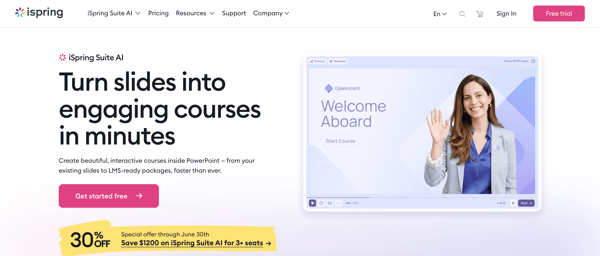
What stood out most in the reviews was how iSpring helps reduce the time and effort behind course development. G2 reviewers specifically mentioned AI text-to-speech, AI character videos, voiceover options, AI-generated images, and AI prompts as helpful for streamlining narration, creating videos, building visuals, and boosting creativity during course design. This aligns with strong feature scores for question variety at 92%, automated grading at 90%, and white-labeling at 88%. Together, those capabilities show why iSpring is useful for both instructional design and scalable training delivery.
Another reason iSpring stood out is its support for accessible and multilingual learning content. Reviewers called AI Translation a “game changer,” saying it helps translate training content in just a few clicks and saves hours for teams with multiple language needs. Users also highlighted TTS, closed captions, narration editing, role-play simulations, quizzes, and PowerPoint integration as useful for creating interactive, LMS-ready courses for remote learners and different learner groups.
A challenge users pointed out is that AI-generated content still needs educator review to ensure it fits the right tone, learning objective, and instructional context. Rather than treating this as a major drawback, reviewers seem to see human review as a necessary step in using AI well. iSpring’s value is that it helps speed up course creation while still giving educators control over design choices, assessments, narration, and the final learning experience.
24%
of users who used AI for grading, scoring, rubric creation, or evaluation automation found that it improved assessment workflows.
Source: G2 Summer Grid Report 2026 for assessment management
7. ParentSquare: Best for K-12 parent communication
In my analysis of G2 review data, ParentSquare made the shortlist because it helps districts centralize school-home communication while making outreach more accessible for every family. It is especially useful for schools that need to manage posts, alerts, direct messages, forms, newsletters, secure documents, and family updates from one platform instead of relying on disconnected communication tools.
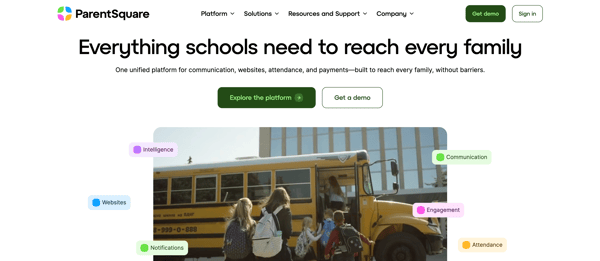
The clearest AI benefit is automatic translation for multilingual family outreach. G2 reviewers mentioned messages being translated into families’ preferred languages, support for over 100 languages, and the ability to communicate through text, app, and email. This makes ParentSquare especially useful for districts trying to keep families informed in the language and channel that works best for them. That strength is backed by high feature scores for mass messaging at 97% and push notifications at 96%.
ParentSquare also stood out for taking repetitive communication tasks off school staff’s plates. G2 reviewers pointed to auto notices for lunch balances and state test scores, Smart Notices for weather closures, overnight SIS syncing for contact updates, and automatic guardian attachment when students are added to groups. They also valued delivery tracking, message receipt confirmation, and detailed reporting, which connect well with ParentSquare’s 94% analytics rating.
One area to watch is translation flexibility for bilingual or multilingual users. The reviewer wanted more control over receiving messages in the original language instead of being locked into one preferred language. Even so, that feedback reinforces how central translation is to ParentSquare’s value. Reviewers still describe the platform as a strong way to save time, reach more families, and keep school communication accessible.
8. SchoolStatus: Best for attendance-driven communication
In my analysis of SchoolStatus‘s G2 review data, I found that the platform helps schools connect family communication with student data in one place. It is especially useful for educators who need to reach families, conduct document outreach, and understand student performance, attendance, and engagement patterns without jumping between disconnected systems.
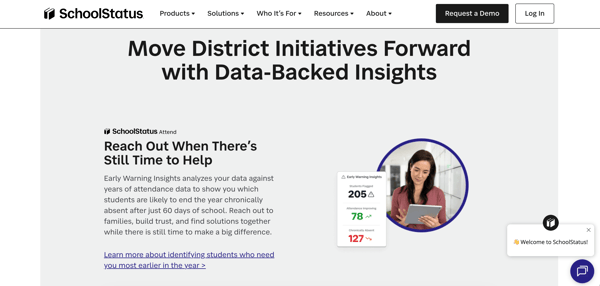
The strongest AI-related value I saw was in translation-supported communication. G2 reviewers mentioned AI translation, auto-translate, and messages being sent in a family’s home or preferred language. This helps teachers communicate with non-English-speaking parents through texts, emails, and broadcasts, which aligns with strong feature scores for mass messaging at 96% and message sync at 94%.
SchoolStatus also stood to me for creating a more complete communication record around each student. G2 reviewers said calls, texts, emails, and parent interactions are automatically recorded or documented, with transcription helping staff refer back to meetings and resolve questions. Users also highlighted student snapshots, attendance, grades, and behavior referrals, which connect well with analytics, being rated 95%.
There is also room for AI to make parent communication even easier. One reviewer suggested adding tools that could help teachers rephrase messages or start outreach with less effort. That feedback builds on an already strong communication workflow, since the same reviewer valued fast parent messaging, group messages, attachments, archived communication, and easy outreach through text, email, and calls.
45%
of users reported that AI reduced staff workload, email volume, phone calls, and other repetitive support tasks.
Source: G2 Summer Grid Report 2026 for classroom messaging
9. PowerSchool: Best for a unified student information system
In my analysis of G2 review data, PowerSchool Schoology Learning stood out for schools that need a central LMS to manage digital classrooms, assessments, grades, resources, and SIS-connected workflows. It is especially useful for educators who want to organize learning across courses while keeping assignments, communication, student progress, and grading activity in one place.
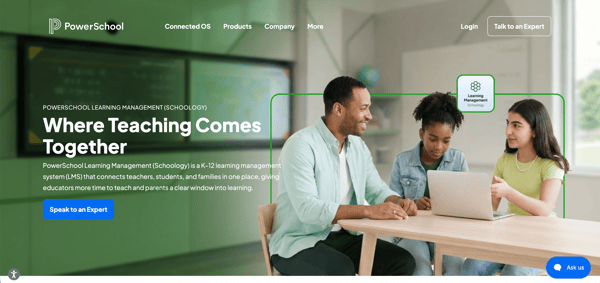
The strongest AI value I saw was around grading and assessment efficiency. G2 reviewers mentioned using digital rubrics, quizzes, student self-assessments, assignment data, and automated grade syncing to reduce manual assessment work. This connects well with Schoology’s classroom management score of 88% and LMS integration score of 87%, showing its value in helping teachers manage grading and learning workflows more efficiently.
Schoology also stood out for helping teachers personalize and organize learning at scale. Reviewers pointed to adaptive release, differentiated access to curriculum materials, portfolios, course folders, quizzes, and integrations with tools like Google, Microsoft, Nearpod, and PowerSchool SIS. These features make it easier for teachers to keep students on track while managing resources, updates, and classroom activity from one platform.
There is room for Schoology to add more intelligence to quiz and assessment creation. One reviewer said they would like rules that could randomly generate advanced math questions for each student. Even so, that feedback builds on an already strong assessment foundation, since reviewers value Schoology for quizzes, rubrics, grade syncing, classroom organization, and student progress tracking.
65%
of users who used AI chatbots or FAQ automation found that it helped answer routine questions without requiring staff intervention.
Source: G2 Summer Grid Report 2026 for classroom messaging
How much do AI education tools cost?
Pricing for AI education tools varies based on class size, number of users, AI features, integrations, admin controls, and institution-level support. Most tools use a mix of free plans, monthly subscriptions, per-user pricing, and custom enterprise quotes.
- Individual educator / light classroom use: Free to ~$39/month
- Small team/department use: ~$39-$99/month or low per-user pricing
- Institution-wide / enterprise learning: Usually a custom quote
- AI-enhanced education platforms: Often custom quote unless bundled into a standard plan
Common pricing models: Free plans, monthly subscriptions, annual contracts, per-user pricing, classroom or school licenses, and custom district or enterprise quotes.
How to pick the right AI tools for education
In my view, a good AI tool should make a teacher more effective, not invisible. When I evaluate education AI tools, I look for clear answers on privacy, accuracy, training support, curriculum fit, and integrity design. If a tool cannot explain those areas clearly, that is usually the answer.
1. Data privacy & student safety
I treat every AI tool in a classroom as a data decision, not just a software decision. It may involve students’ information, behaviors, learning histories, and communication patterns, so I would want to know exactly what the tool collects, where that data goes, and who controls it. If the vendor cannot answer those questions clearly, I would see that as a major red flag.
- Does it comply with FERPA, COPPA, or your regional equivalent?
- Is student data used to train external models?
- Can you request data deletion? Is there a clear privacy policy?
2. Accuracy, bias & academic quality
I would not rely on an AI tool just because it sounds confident. If it gives wrong answers or produces content with cultural blind spots, it can weaken student trust and put extra pressure on the teacher to catch every issue. A strong education AI tool should support teacher review without making quality control entirely the teacher’s burden.
- Test it yourself across subjects, grade levels, and student demographics.
- Does it flag uncertainty or allow human review before sharing with students?
- Was it built with educators, not just engineers?
3. Curriculum alignment & actual classroom fit
When I look at AI tools for education, I ask whether they truly save teachers time. If a tool creates content that teachers have to rewrite for their standards, grade level, or classroom needs, it is not really reducing the workload. The right tool should fit naturally into the way teachers already plan, teach, and support students.
- Can it map to your curriculum standards (e.g., Common Core, IB)?
- Does it differentiate for different learning levels and needs?
- Does it integrate with tools you already use (Google Classroom, Canvas)?
4. Teacher training & onboarding support
I don’t think resistance to AI in schools is always about unwillingness. Often, teachers are given complex tools without enough time, training, or support to use them well. A tool is only useful if teachers can build confidence with it through structured onboarding, practical examples, and ongoing help.
- Is there structured onboarding apart from documentation a form of resource?
- Is ongoing support and professional development included?
- Can teachers pilot it with a small group before full rollout?
5. Academic integrity & human-centred design
I would be cautious of any AI tool that tries to replace teacher judgment instead of strengthening it. The best classroom AI tools should help teachers guide learning, not weaken the student-teacher relationship or make it easier for students to bypass thinking. If a tool removes the teacher from the decision-making process, I would question whether it is truly designed for education.
- Does the tool encourage independent thinking or just supply answers?
- Does it have guardrails against academic dishonesty?
- Does it keep the teacher in the loop as the final decision-maker?
How to integrate AI tools for education into classroom workflows
I don’t think bringing AI into the classroom means teachers need to rebuild everything from scratch. The better approach is to layer AI onto the parts of the workflow that already work, especially where it can save time without weakening teacher judgment. Here’s the five-step process I’d follow.
Step 1: Audit your current workflow before adding anything new
Before choosing an AI tool, I would first look at how teaching, planning, assessment, and communication already happen. The goal is to find the tasks that take a lot of time but add less direct instructional value, such as grading routine assignments, writing repetitive feedback, or drafting parent communications. These are usually the best places to start with AI support. Without this step, it is easy to end up with a tool that looks useful but does not solve a real classroom problem.
Step 2: Start with one tool and one use case
Avoid trying to change the entire workflow at once. A better starting point is one AI tool for one clear task, such as generating quiz questions, summarizing student feedback, or adapting a lesson plan for different learning levels. This gives teachers space to learn how the tool works and decide whether it is actually helping. Once that first use case works well, it becomes much easier to expand with confidence.
Step 3: Verify and adapt every AI output
I see AI tools as assistants, not final decision-makers. Anything AI creates, whether it is a rubric, reading passage, lesson outline, or feedback draft, should still go through the teacher’s professional judgment before students see it. I would check for accuracy, age appropriateness, cultural sensitivity, and alignment with curriculum standards. In practice, you should treat AI output as a useful first draft, not a finished classroom resource.
Step 4: Be transparent with students and parents
Transparency matters when AI becomes part of classroom practice. Teachers do not need to explain every small AI-assisted task, but students and parents should understand how AI is being used and why. A short note in a syllabus, a classroom discussion, or a parent newsletter can help build trust. It also gives teachers a chance to model responsible AI use and introduce students to AI literacy.
Step 5: Reflect and refine regularly
Treat AI integration as something to review, not something to set once and forget. Every few weeks, it helps to ask whether the tool is saving meaningful time, improving student support, or creating new problems. If the answer changes, the workflow should change too. The educators who benefit most from AI are usually the ones who keep adjusting their approach based on what they see in the classroom.
Is AI going to replace teachers?
No, I don’t believe AI is going to replace teachers, and UNESCO backs this up. The UNESCO Teacher Task Force position paper argues that while AI can support teaching through automation and data-driven insights, it cannot replicate the relational, ethical, and human dimensions that make great teaching what it is.
AI tools for education are best suited to handle repetitive tasks such as grading, lesson planning, and adaptive content delivery, freeing educators to focus on what matters most: empathy, mentorship, and the development of critical thinking. The future of the classroom is not human versus AI; it is human and AI, working together.
What are the best practices for managing data privacy and student safety issues?
As more educators explore AI tools for teachers and education, I believe data privacy and student safety need to be part of the decision from the very beginning. A tool may look helpful in the classroom, but if it cannot protect student information clearly and responsibly, it is not worth the risk. Here are five essential points I would keep in mind.
1. Know what data the AI tool collects
Before introducing any teacher AI tool or student AI platform into your classroom, read the privacy policy carefully. Understand what student data is being collected, stored, and whether it is shared with third parties.
Potential risk: student data could be sold to advertisers or used to train third-party AI models without consent, exposing your school to serious legal liability.
2. Stick to school-approved AI tools for school
Not every free AI tool for teachers meets district or institutional data protection standards. Always check whether a tool has been vetted by your school’s IT or administration before using it with students.
Potential risk: Unapproved tools may potentially lack basic encryption or security protocols, leaving student records vulnerable to data breaches.
3. Never input identifiable student information
When using AI tools for education, avoid entering names, grades, or personal details on any platform that hasn’t been cleared for student data handling, especially for special education teachers, where sensitivity is even higher.
Potential risk: Identifiable student data entered into unsecured platforms could be exposed or accessed by unauthorized parties, putting your school at risk of violating FERPA and COPPA regulations.
4. Teach students about AI and data awareness
If students are using AI tools directly, make digital literacy part of the lesson. Help them understand what they share, with whom, and why it matters.
Potential risk: Without this guidance, students may potentially and unknowingly share sensitive personal information on AI platforms, creating safety risks that extend well beyond the classroom.
5. Stay current on evolving regulations
AI in education is moving fast, and so are the rules around it. Educators using AI tools should stay informed about FERPA, COPPA, and any local data protection laws governing how student information can be used.
Potential risk: Falling behind on compliance carries the potential risk of significant financial penalties for schools and lasting reputational damage that erodes community trust.
Frequently asked questions about AI tools for education
Got questions? G2 has the answers.
Q1. What are some free AI tools for teachers?
Some free AI tools for teachers include Illumine, ClassDojo, and iSpring Suite, which offer free plans or free versions. These tools help with lesson planning, classroom communication, interactive activities, assessments, and parent updates.
Q2. How is AI used in education?
AI is used in education to automate lesson planning, generate quizzes, personalize learning, support student engagement, translate parent messages, and analyze student performance.
Q3. What are the best online assessment tools for teachers?
The best online assessment tools for teachers help create quizzes, rubrics, polls, and real-time checks for understanding. Blackboard supports AI-generated rubrics and assessments for higher education, while Mentimeter helps with live audience response and formative assessment.
Q4. What are the best AI tools for teachers’ lesson plans?
For AI lesson planning, ClassDojo, Illumine, and iSpring Suite are strong options. They help teachers generate lesson ideas, classroom activities, quizzes, course outlines, and personalized learning materials faster.
Q5. Which AI tools help teachers save time?
AI tools that help teachers save time include ClassDojo for everyday classroom workflows, Illumine for daily reports and parent communication, and iSpring Suite for course creation, interactive lessons, and assessments. These tools reduce manual work around planning, messaging, reporting, and content creation.
Q6. How can AI personalize learning?
AI can personalize learning by analyzing student progress, identifying learning gaps, and recommending targeted content, activities, or interventions. PowerSchool supports personalized insights and student learning assistance, while Illumine and ClassDojo help educators tailor learning support to individual student needs.
Q7. What are some AI tools that help teachers support struggling students?
PowerSchool, SchoolStatus, and Blackboard are useful AI tools for supporting struggling students because they surface student insights, attendance risks, learning gaps, and engagement patterns. Teachers can use these insights to create timely interventions and provide more personalized student support.
Q8. Which AI tools help teachers communicate with parents?
ParentSquare, ClassDojo, Illumine, and SchoolStatus are strong AI tools for parent communication. They support AI-assisted messages, personalized family updates, auto-translation, engagement insights, and two-way communication between schools and families.
Q9. How can schools use AI responsibly?
Schools can use AI responsibly by protecting student data, reviewing AI-generated content, keeping teachers in control, and setting clear policies for privacy, bias, accuracy, and transparency. Education AI tools should support teachers rather than replace professional judgment.
Q10. What are the best AI tools for creating worksheets?
For AI worksheet creation and classroom materials, teachers can use ClassDojo and iSpring Suite. These tools help generate activities, quizzes, lesson content, interactive exercises, and PowerPoint-based eLearning materials that can be adapted into worksheets.
Start small with AI without losing the human touch
The best way to approach AI tools for education is to start with the part of teaching that feels most repetitive or time-consuming, not the flashiest feature. Pick one clear use case, such as drafting parent updates, creating a quiz, adapting a lesson, or spotting students who may need extra support, and test one tool against that need.
From there, treat AI as a classroom assistant, not a replacement for professional judgment. Review every output, protect student data, and expand only when the tool clearly saves time, improves learning, or helps you be more present with students.
Ultimately, the right AI tool is the one that gives teachers back time without taking away the human judgment, creativity, and care that make learning meaningful. Start small, measure what improves, and let AI support the work that helps you teach with more clarity, confidence, and connection.
Want to see where digital learning is headed next? Explore online learning platform statistics that reveal the future to learn more about education technology.
[ad_2]
Source_link