
Jessica Abbadia
19 August 2026
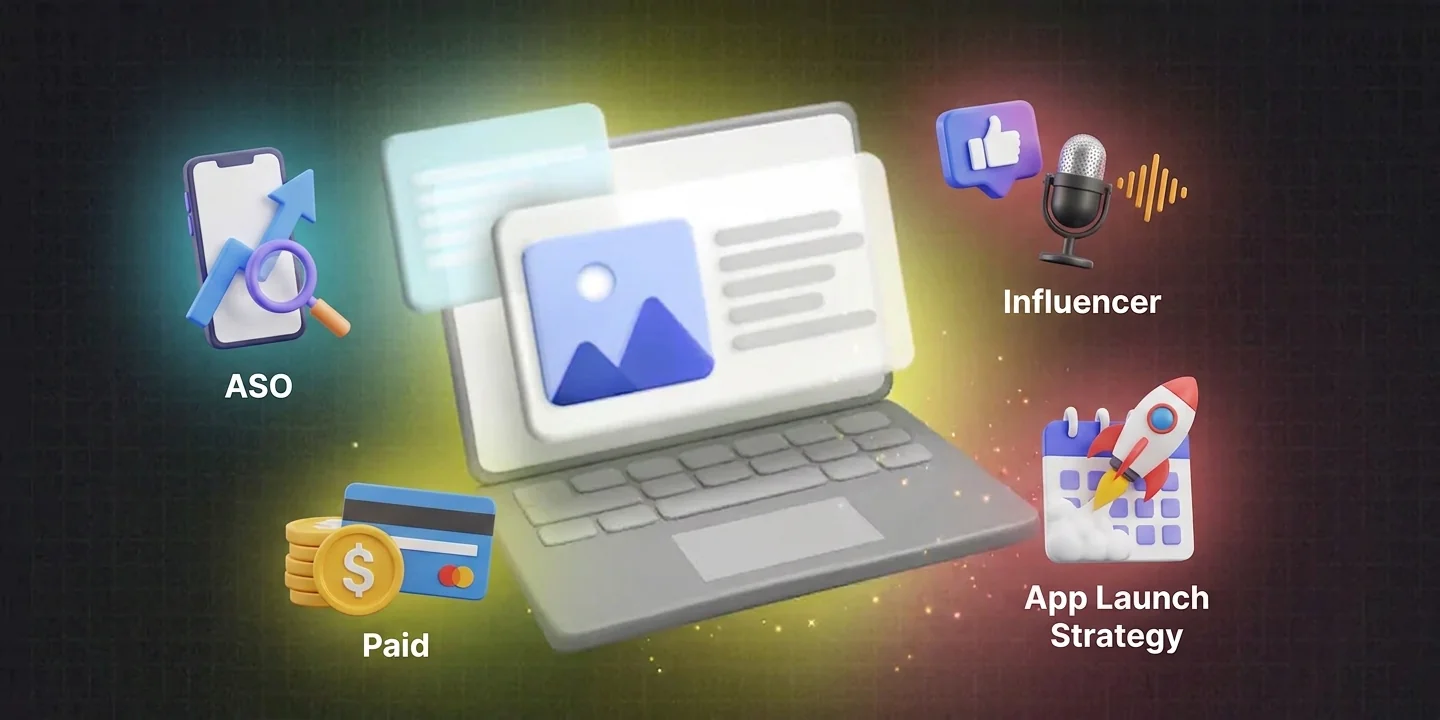
Launching an app without a clear plan is like firing a rocket with no destination loaded. Those first 90 days will either build real, compounding momentum or bleed your budget on installs that ghost you before week two. A properly sequenced app launch strategy lines up paid acquisition, ASO, and influencer seeding so each channel is actively feeding the others, not competing with them. Here is exactly how to pull that off.
Why Sequencing Beats Simultaneous Spend in Your App Launch Strategy
Here is the thing: most teams flip every switch on launch day, then spend the following month scratching their heads over rising cost per install and organic rankings that refuse to budge. The problem is almost never the channels themselves. It is the order and the timing. Paid ads, ASO, and creator content each send different signals to the algorithm, and app stores reward apps that show compounding engagement over time, not a single dramatic spike that flatlines by Thursday.
What sequencing actually does is create a feedback loop. Early paid traffic generates conversion data that sharpens your store listing. A sharper listing lifts organic conversion for every visitor who shows up later through influencers or search. Get the order right and you have a flywheel. Get it wrong and you have three expensive spend lines pulling in completely different directions, none of them helping the others.
According to mobile market intelligence, apps that concentrate quality installs early in their lifecycle tend to hold category rankings considerably longer. That ranking stability is the real payoff of a deliberate sequence, not the launch-day numbers everyone obsesses over. If you want the strategic thinking behind this approach, our take on long-term growth architecture explains how launch velocity connects to durable retention over time.
Days 1 to 30: Priming ASO Updates and App Store Foundations
Your first 30 days are about building a foundation that actually converts before you scale any spend. Pushing paid budget toward a weak store listing is one of the most common and expensive mistakes we see teams make. Every visitor you bring in converts below their real potential. Fix the fundamentals first and the rest of the sequence gets measurably cheaper.
Start with keyword research, metadata, and creative assets. Optimize your title, subtitle, and keyword field around terms with real search volume and achievable difficulty scores. Then test screenshots and preview videos, because in our experience, these two elements drive the majority of store conversion decisions and get the least attention during pre-launch. Apple’s own product page optimization tools let you A/B test icons and screenshots directly inside App Store Connect, so start running experiments from day one rather than waiting until you have convinced yourself you have “enough” data.
Several issues quietly kill conversion before you even notice them. Our breakdown of common ASO mistakes covers the usual suspects: vague descriptions, untested visuals, and keyword stuffing that confuses the algorithm rather than converts the visitor. Pair that with our guide on how to write an app description that ranks and converts.
Concrete priorities for this window:
- Finalize localized metadata for your top three markets.
- Launch two screenshot variants and let the data pick a winner.
- Instrument every event you need with a strong analytics setup.
- Seed a small volume of authentic reviews from beta users.
Solid measurement underpins everything that follows. If your tracking is shaky from the start, review how to get the most out of app analytics before spending a dollar on paid acquisition. This is not optional groundwork. It is the thing that makes the rest of the sequence readable.
Days 15 to 45: Launching Apple Search Ads to Capture Intent
Once your listing converts reliably, layer in Apple Search Ads. This channel earns priority because it puts your app in front of users at the exact moment they are actively searching for something like it, and that intent produces the highest-quality traffic available anywhere in the iOS ecosystem. Overlapping it with your late ASO phase means paid conversion data flows back into your keyword decisions in near real time, which is genuinely useful.
Start with a Discovery campaign to surface search terms you would never have considered on your own. Move the winning terms into Exact Match campaigns with controlled bids. Apple’s Search Ads best practices recommend separating brand, category, and competitor keyword groups so you can read performance cleanly and allocate budget by intent tier rather than guessing which segment is actually working.
Three tactics accelerate results during this phase:
- Protect your brand terms first. Competitors bid on your name regularly, and defending it is usually your cheapest, highest-converting spend across the entire campaign.
- Feed creative variants. Custom Product Pages let you match ad copy to specific keyword themes, which lifts both tap-through rate and post-install conversion in ways that a single generic page simply cannot.
- Watch the true north metric. Optimize toward retained users and post-install events, not raw install volume. Raw installs are a vanity number at this stage.
Because iOS and Android reward different signals, your paid mix should reflect platform nuance from the beginning. Our comparison of iOS versus Android acquisition helps you decide where to weight early budget. For a broader view of paid and organic coordination, the app user acquisition strategy guide is a useful companion throughout this phase.
Days 30 to 60: Influencer Seeding to Widen the Top of Funnel
By day 30, your listing converts well and your paid data is starting to mature. This is when you introduce influencer seeding to expand reach beyond high-intent search and into discovery-driven demand. Creators generate awareness that paid search simply cannot reach, and they produce social proof that lifts conversion across every other channel running at the same time.
The sequencing here matters more than most teams realize. Launching creators after your store listing is polished means their audiences land on a page that was actually built to convert. Launching them alongside active Apple Search Ads means branded search volume rises as curious viewers look you up, which improves your defensive paid efficiency at the same time. Both things happen simultaneously when the timing is right.
Start with micro and mid-tier creators whose audiences genuinely match your core use case. What we have seen consistently is that they deliver stronger engagement rates and lower cost than mega-influencers, and their content feels native to the platform rather than obviously sponsored. Our playbook on app promotion with influencers details how to brief creators for actual downloads rather than vanity views, and our creator network shows how vetted talent shortens sourcing time considerably.
Structure the seeding wave for compounding effect:
- Group creators into two or three release clusters rather than one large blast, so momentum sustains across multiple weeks instead of peaking on day one and vanishing.
- Give each creator a unique tracking link or promo code to attribute installs accurately.
- Repurpose top-performing creator clips as paid social and Custom Product Page assets.
That repurposing step is where seeding earns extra value most teams completely leave on the table. Winning organic clips become your best-performing ads with a regularity that still surprises people. It is exactly the kind of iteration our creative testing guide is built around.
Days 60 to 90: Sustaining Organic Rankings and Compounding Velocity
The final 30 days are about converting launch spikes into durable organic strength. This is where many teams lose the plot, cutting budget the moment paid metrics show any softness. Instead, shift from acquisition-heavy spend toward retention, reputation, and ranking maintenance. These three things compound quietly and pay dividends for months after the launch window closes.
Refresh your metadata using the real search terms your Apple Search Ads Discovery campaign surfaced over the previous weeks. Those terms represent proven demand, and folding them into your ASO keyword strategy improves organic visibility without adding media cost. Then double down on ratings velocity, because a steady flow of positive reviews correlates directly with higher store conversion and long-term ranking stability. This is not a nice-to-have at this stage. It is a ranking input.
Retention becomes your ranking engine here. Both the App Store and Google Play weight engagement and return usage heavily, so onboarding improvements often move rankings more than additional spend does. eMarketer’s app marketing research consistently identifies retention as the strongest predictor of long-term revenue per user, and the store algorithms reflect exactly that priority.
Maintain the flywheel with these moves:
- Rotate seasonal or refreshed screenshots to keep conversion climbing.
- Keep a lean, always-on Apple Search Ads brand campaign running throughout.
- Activate a second creator wave targeting your most engaged user segment.
- Report on blended CAC and retained ROAS, not channel silos.
Measuring blended performance keeps you honest about what the sequence actually produced. Our guide on how to measure mobile ROI shows how to attribute value across paid and organic without double counting. For teams scaling this into a repeatable system, the enterprise growth playbook outlines what mature app organizations do once the first 90-day cycle closes.
Building the Playbook Into a Repeatable Growth System
The 90-day sequence is not a one-time launch tactic. Think of it as a template you run for every major feature release, market expansion, or seasonal push. Each cycle produces cleaner data, sharper creative, and stronger baseline rankings, which means every subsequent launch starts from higher ground than the one before it. That compounding effect is the whole point.
Bottom line: the discipline that separates winning teams is documentation. Record which keywords converted, which creators drove retained users, and which screenshot variants won in testing. That institutional knowledge compounds faster than any single campaign budget can. When you formalize this process, you stop reacting to spend and start executing a genuine go-to-market strategy that scales predictably across quarters.
If your team lacks the bandwidth to orchestrate paid, ASO, and creator work in parallel, that is a clear signal worth taking seriously. Understanding what a growth agency does can help clarify whether to build capability internally or partner externally to maintain launch velocity without burning out the people running your core product.
Conclusion
Launch velocity comes from sequence, not from turning everything on at once. Build a conversion-ready listing first, layer Apple Search Ads to capture intent, release influencer seeding to widen reach, then reinvest in retention and ranking maintenance to lock in what you built. Run these 90 days as a repeatable system and each new release compounds on the last. Sequence deliberately, measure blended results, and momentum starts to sustain itself without heroic effort every cycle.
FAQs
Should I run Apple Search Ads before finishing ASO?
Optimize your store listing first so every paid visitor converts at full potential. Running ads against a weak listing inflates cost per install and burns budget that a polished, well-tested page would have captured on its own.
How much budget should I allocate across the 90 days?
Weight early spend toward Apple Search Ads intent capture, then shift budget toward influencer seeding and retention as organic signals build. Keep an always-on brand campaign running throughout to protect branded search and defend against competitors bidding on your name.
What metric proves the sequence is working?
Track retained users and blended CAC rather than raw installs. Rising organic rankings alongside stable or falling blended acquisition cost is the clearest sign your paid and organic channels are genuinely reinforcing each other rather than just coexisting.
How many influencers do I need for a launch?
Quality beats quantity every time. In our experience, a cluster of well-matched micro and mid-tier creators released in two or three waves usually outperforms a single large campaign because it sustains momentum longer and produces reusable creative assets for paid channels.
Can this playbook work for both iOS and Android?
Yes, though the paid mix differs by platform. Apple Search Ads anchors iOS intent capture, while Android leans on Google UAC campaigns and Play Store optimization. Adjust the weighting by platform, but keep the same core sequence: listing first, then paid, then seeding, then retention.
Jessica Abbadia
Jessica is Moburst’s VP of Organic. She specializes in enhancing organic performance for apps and games all over the world, while actively developing innovative methods for increasing app visibility and conversion, as well as offering her vast knowledge for the benefit of the mobile community.
She graduated from law school and now serves as an animal rights activist who also loves reading books while sipping a strong coffee and holding one – or more – of her three cats.