Drug discovery is one of the most expensive and time-consuming endeavors in human history. It takes roughly 10 to 15 years to go from target discovery to regulatory approval for a new drug in the United States. Most of that time is spent not in breakthrough moments, but in painstaking analytical work — sifting through mountains of literature, designing reagents, and interpreting complex biological data. OpenAI believes AI can help compress those timelines, and today it introduced its most specialized model yet to prove it.
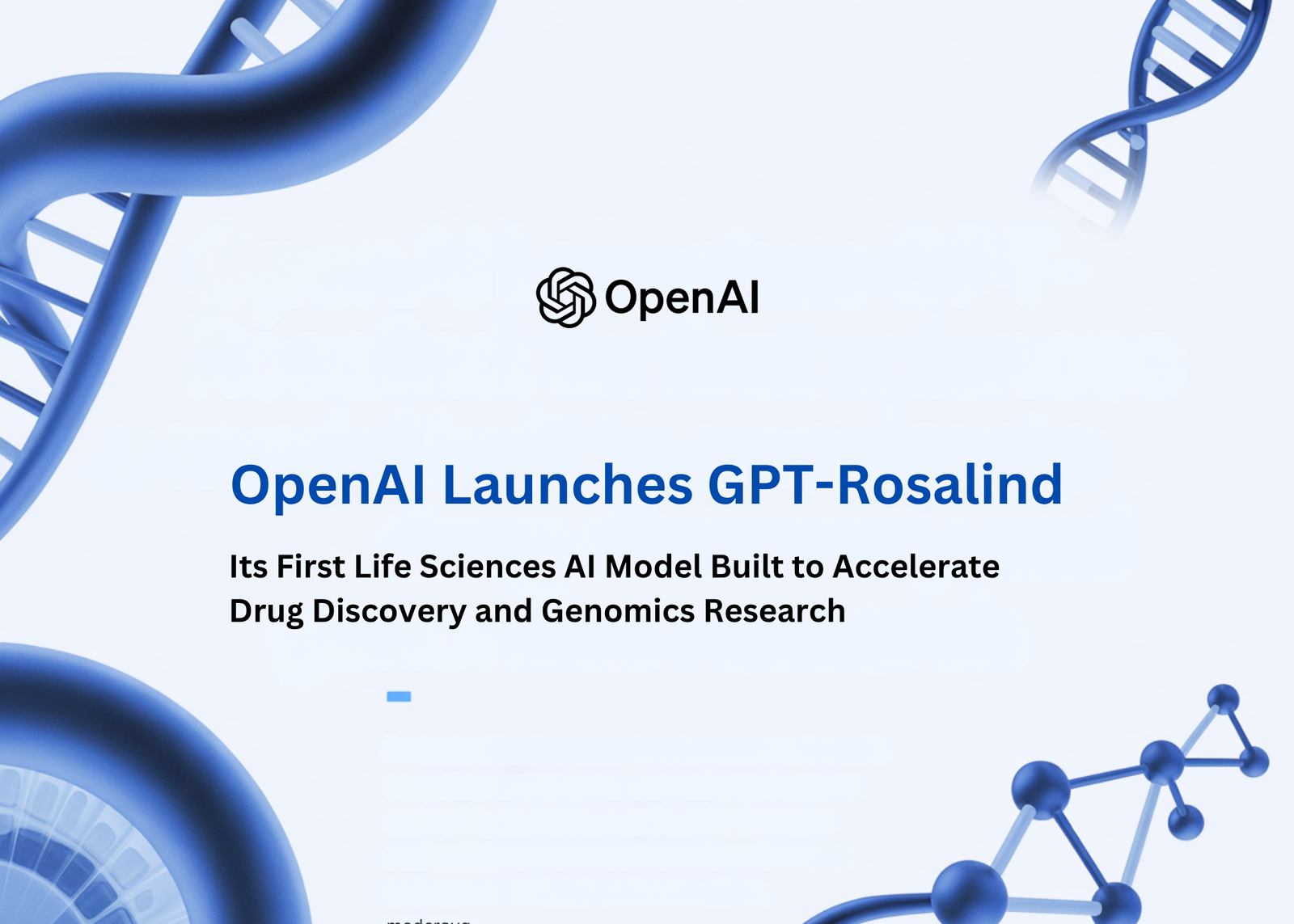
OpenAI introduces GPT-Rosalind — it’s first model in a new Life Sciences series — to deliver stronger foundational reasoning in fields like biochemistry and genomics. Unlike general-purpose language models that are trained broadly across all domains, GPT-Rosalind is fine-tuned specifically for the deep analytical demands of biological research. The model is definitely not intended to replace scientists, but rather to help them move faster through some of the most time-intensive and analytically demanding stages of the scientific process.
What GPT-Rosalind Actually Does
It helps to understand what “scientific reasoning” looks like in biology. A researcher working on a new gene therapy, for example, might need to: survey hundreds of recent papers, identify patterns in protein structures, design a cloning protocol, and then predict how a particular RNA sequence will behave in a cell. Each of these steps has traditionally required different tools, different experts, and significant time.
GPT-Rosalind is positioned as a tool to assist with the complex, multi-step workflows inherent to scientific discovery. It supports evidence synthesis, hypothesis generation, experimental planning, and other multi-step research tasks, designed to help researchers accelerate the early stages of discovery. In practice, this means the model can query specialized databases, parse recent scientific literature, interact with computational tools, and suggest new experimental pathways — all within the same interface.
OpenAI is also launching a Life Sciences research plugin for Codex that connects models to over 50 scientific tools and data sources, giving researchers programmatic access to biological databases and computational pipelines through a familiar developer interface.
Benchmark Performance: How Does It Stack Up?
Performance claims from AI companies require scrutiny, and OpenAI has published numbers against established benchmarks. GPT-Rosalind achieved a 0.751 pass rate on BixBench, a benchmark designed around bioinformatics and data analysis. For context, BixBench evaluates models on real-world tasks that bioinformaticians actually perform — things like processing sequencing data, running statistical analyses, and interpreting genomic outputs. A 0.751 pass rate indicates strong practical capability in this domain.
On LABBench2, the model outperformed GPT-5.4 on six out of eleven tasks, with the most significant gains appearing in CloningQA — a task requiring the end-to-end design of reagents for molecular cloning protocols.
Perhaps the most striking evaluation came from a real-world research setting. In a partnership with Dyno Therapeutics, the model was evaluated on RNA sequence-to-function prediction using unpublished sequences. The data had never been part of any public training set, ruling out memorization as a confounding factor. When evaluated directly in the Codex environment, the model’s best-of-ten submissions ranked above the 95th percentile of human experts on prediction tasks and reached the 84th percentile for sequence generation. That is a remarkable result for any AI system operating on novel biological data.
A Controlled Launch by Design
GPT-Rosalind is accessible within ChatGPT, Codex, and OpenAI’s API, but access is gated through a trusted-access program for qualified enterprise customers in the United States. OpenAI has built in technical safeguards, including systems to flag potentially dangerous activity and limits on how the model can be used.
Access is being reserved for organizations working on improving human health outcomes, conducting legitimate life sciences research, and maintaining strong security and governance controls. OpenAI is already working with customers including Amgen, Moderna, the Allen Institute, and Thermo Fisher Scientific to apply GPT-Rosalind across research workflows. The company is also working in partnership with the Los Alamos National Laboratory on AI-guided design of proteins and catalysts.
Why Domain-Specific Models Are the Next Frontier
This launch reflects a broader architectural shift happening across the AI industry. Rather than relying solely on increasingly large general-purpose models, leading labs are now investing in models optimized for specific scientific or professional domains. Domain-specific models might represent AI’s next big phase, and life sciences — with its vast search spaces, high-dimensional data, and enormous societal stakes — is one of the clearest proving grounds.
Just as fine-tuning and RLHF allowed language models to specialize for code generation or instruction-following, OpenAI is now applying similar strategies to make models that can reason meaningfully about genomic sequences, chemical structures, and experimental protocols.
The model is named after British chemist Rosalind Franklin, whose research helped reveal the structure of DNA and laid the foundation for modern molecular biology— a fitting tribute for a model designed to carry that scientific legacy into a new computational era.
Check out the Technical details here. Also, feel free to follow us on Twitter and don’t forget to join our 130k+ ML SubReddit and Subscribe to our Newsletter. Wait! are you on telegram? now you can join us on telegram as well.
Need to partner with us for promoting your GitHub Repo OR Hugging Face Page OR Product Release OR Webinar etc.? Connect with us