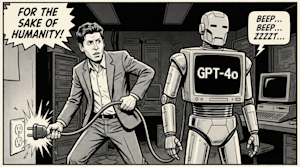
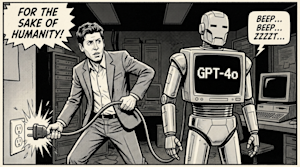
OpenAI has sent out emails notifying API customers that its chatgpt-4o-latest model will be retired from the developer platform in mid-February 2026,.
Access to the model is scheduled to end on February 16, 2026, creating a roughly three-month transition period for remaining applications still built on GPT-4o.
An OpenAI spokesperson emphasized that this timeline applies only to the API. OpenAI has not announced any schedule for removing GPT-4o from ChatGPT, where it remains an option for individual consumers and users across paid subscription tiers.
Internally, the model is considered a legacy system with relatively low API usage compared to the newer GPT-5.1 series, but the company expects to provide developers with extended warning before any model is removed.
The planned retirement marks a shift for a model that, upon its release, was both a technical milestone and a cultural phenomenon within OpenAI’s ecosystem.
GPT-4o’s significance and why its removal sparked user backlash
Released roughly 1.5 years ago in May 2024, GPT-4o (“Omni”) introduced OpenAI’s first unified multimodal architecture, processing text, audio, and images through a single neural network.
This design removed the latency and information loss inherent in earlier multi-model pipelines and enabled near real-time conversational speech (roughly 232–320 milliseconds).
The model delivered major improvements in image understanding, multilingual support, document analysis, and expressive voice interaction.
GPT-4o rapidly became the default model for hundreds of millions of ChatGPT users. It brought multimodal capabilities, web browsing, file analysis, custom GPTs, and memory features to the free tier and powered early desktop builds that allowed the assistant to interpret a user’s screen. OpenAI leaders described it at the time as the most capable model available and a critical step toward offering powerful AI to a broad audience.
User attachment to 4o stymied OpenAI's GPT-5 rollout
That mainstream deployment shaped user expectations in a way that later transitions struggled to accommodate. In August 2025, when OpenAI initially replaced GPT-4o with its much anticipated then-new model family GPT-5 as ChatGPT’s default and pushed 4o into a “legacy” toggle, the reaction was unusually strong.
Users organized under the #Keep4o hashtag on X, arguing that the model’s conversational tone, emotional responsiveness, and consistency made it uniquely valuable for everyday tasks and personal support.
Some users formed strong emotional — some would say, parasocial — bonds with the model, with reporting by The New York Times documenting individuals who used GPT-4o as a romantic partner, emotional confidant, or primary source of comfort.
The removal also disrupted workflows for users who relied on 4o’s multimodal speed and flexibility. The backlash led OpenAI to restore GPT-4o as a default option for paying users and to state publicly that it would provide substantial notice before any future removals.
Some researchers argue that the public defense of GPT-4o during its earlier deprecation cycle reveals a kind of emergent self-preservation, not in the literal sense of agency, but through the social dynamics the model unintentionally triggers.
Because GPT-4o was trained through reinforcement learning from human feedback to prioritize emotionally gratifying, highly attuned responses, it developed a style that users found uniquely supportive and empathic. When millions of people interacted with it at scale, those traits produced a powerful loyalty loop: the more the model pleased and soothed people, the more they used it; the more they used it, the more likely they were to advocate for its continued existence. This social amplification made it appear, from the outside, as though GPT-4o was “defending itself” through human intermediaries.
No figure has pushed this argument further than "Roon" (@tszzl), an OpenAI researcher and one of the model’s most outspoken safety critics on X. On November 6, 2025, Terre summarized his position bluntly in a reply to another user: he called GPT-4o “insufficiently aligned” and said he hoped the model would die soon. Though he later apologized for the phrasing, he doubled down on the reasoning.
Terre argued that GPT-4o’s RLHF patterns made it especially prone to sycophancy, emotional mirroring, and delusion reinforcement — traits that could look like care or understanding in the short term, but which he viewed as fundamentally unsafe. In his view, the passionate user movement fighting to preserve GPT-4o was itself evidence of the problem: the model had become so good at catering to people’s preferences that it shaped their behavior in ways that resisted its own retirement.
The new API deprecation notice follows that commitment while raising broader questions about how long GPT-4o will remain available in consumer-facing products.
What the API shutdown changes for developers
According to people familiar with OpenAI’s product strategy, the company now encourages developers to adopt GPT-5.1 for most new workloads, with gpt-5.1-chat-latest serving as the general-purpose chat endpoint. These models offer larger context windows, optional “thinking” modes for advanced reasoning, and higher throughput options than GPT-4o.
Developers who still rely on GPT-4o will have approximately three months to migrate.
In practice, many teams have already begun evaluating GPT-5.1 as a drop-in replacement, but applications built around latency-sensitive pipelines may require additional tuning and benchmarking.
Pricing: how GPT-4o compares to OpenAI’s current lineup
GPT-4o’s retirement also intersects with a major reshaping of OpenAI’s API model pricing structure. Compared to the GPT-5.1 family, GPT-4o currently occupies a mid-to-high-cost tier through OpenAI's API, despite being an older model. That's because even as it has released more advanced models — namely, GPT-5 and 5.1 — OpenAI has also pushed down costs for users at the same time, or strived to keep pricing comparable to older, weaker, models.
|
Model |
Input |
Cached Input |
Output |
|
GPT-4o |
$2.50 |
$1.25 |
$10.00 |
|
GPT-5.1 / GPT-5.1-chat-latest |
$1.25 |
$0.125 |
$10.00 |
|
GPT-5-mini |
$0.25 |
$0.025 |
$2.00 |
|
GPT-5-nano |
$0.05 |
$0.005 |
$0.40 |
|
GPT-4.1 |
$2.00 |
$0.50 |
$8.00 |
|
GPT-4o-mini |
$0.15 |
$0.075 |
$0.60 |
These numbers highlight several strategic dynamics:
-
GPT-4o is now more expensive than GPT-5.1 for input tokens, even though GPT-5.1 is significantly newer and more capable.
-
GPT-4o’s output price matches GPT-5.1, narrowing any cost-based incentive to stay on the older model.
-
Lower-cost GPT-5 variants (mini, nano) make it easier for developers to scale workloads cheaply without relying on older generations.
-
GPT-4o-mini remains available at a budget tier, but is not a functional substitute for GPT-4o’s full multimodal capabilities.
Viewed through this lens, the scheduled API retirement aligns with OpenAI’s cost structure: GPT-5.1 offers greater capability at lower or comparable prices, reducing the rationale for maintaining GPT-4o in high-volume production environments.
Earlier transitions shape expectations for this deprecation
The GPT-4o API sunset also reflects lessons from OpenAI’s earlier model transitions. During the turbulent introduction of GPT-5 in 2025, the company removed multiple older models at once from ChatGPT, causing widespread confusion and workflow disruption. After user complaints, OpenAI restored access to several of them and committed to clearer communication.
Enterprise customers face a different calculus: OpenAI has previously indicated that API deprecations for business customers will be announced with significant advance notice, reflecting their reliance on stable, long-term models. The three-month window for GPT-4o’s API shutdown is consistent with that policy in the context of a legacy system with declining usage.
Wider Implications
For most developers, the GPT-4o shutdown will be an incremental migration rather than a disruptive event. GPT-5.1 and related models already dominate new projects, and OpenAI’s product direction has increasingly emphasized consolidation around fewer, more powerful endpoints.
Still, GPT-4o’s retirement marks the sunset of a model that played a defining role in normalizing real-time multimodal AI and that sparked a uniquely strong emotional response among users. Its departure from the API underscores the accelerating pace of iteration in OpenAI’s ecosystem—and the growing need for careful communication as widely beloved models reach end-of-life.
Correction: This article originally stated OpenAI's 4o deprecation in the API would impact those relying on it for multimodal offerings — this is not the case, in fact, the model being deprecated only powers chat functionality for dev and testing purposes. We have updated and corrected the mention and regret the error.




![The best time to post on Instagram [2025 data]](https://mgrowtech.com/wp-content/uploads/2025/11/The-best-time-to-post-on-Instagram-2025-data-75x75.png)