The MIT-led Institute for Artificial Intelligence and Fundamental Interactions (IAIFI) has received renewed support from the National Science Foundation (NSF) for an additional five years, increasing annual funding from $4 million to $4.98 million. The renewal marks a new phase for IAIFI, which has spent its first five years building a research model and an interdisciplinary community around a central premise: that AI can open new ways of doing physics, while physics can help mold better AI systems.
Launched in 2020 as part of the National Artificial Intelligence Research Institutes program, IAIFI brings together researchers from MIT, along with Harvard, Northeastern, Tufts, and Boston universities. Its work has shown that machine learning can accelerate discovery in physics, while insights from physics can make AI systems more principled and interpretable.
“From the beginning, IAIFI has been built around a two-way street: AI enabling better physics, and physics enabling better AI,” says Jesse Thaler, IAIFI’s director and a professor of physics at MIT. “We have seen this virtuous cycle play out across multiple areas of physics and AI over the past five years. The exchange is producing not just new results, but genuinely new ways of doing science.”
Research across physics and AI
IAIFI’s research spans particle physics, nuclear physics, astrophysics, and foundational AI, with many advances emerging from collaborations across those areas.
In particle physics, IAIFI researchers have developed AI techniques to handle the immense data rates from the Large Hadron Collider in real-time, helping turn a firehose of collision data into actionable physics. In nuclear physics, IAIFI researchers are using AI-based generative methods to model the interactions of quarks and gluons in lattice quantum chromodynamics, creating new ways to study the structure of matter from first principles. In astrophysics, machine learning is being used to uncover new cosmic phenomena and improve the sensitivity of the MIT-led LIGO gravitational-wave experiment.
At the same time, ideas from physics are informing the development of new AI methods. IAIFI researchers are developing learning algorithms and new model architectures that embed physics knowledge and best practices — including symmetries, geometric structures, exactness guarantees, and statistical methodologies — directly into neural networks, producing systems that are more reliable, interpretable, and data-efficient.
“AI has begun to transform how physicists tackle some of the field’s most challenging problems,” says Mike Williams, interim director of IAIFI and a professor of physics at MIT. “More importantly, it is starting to expand the frontier of what problems we can realistically address, making it possible to pursue questions that were once completely beyond our reach.”
Training the next generation
A defining feature of IAIFI is its investment in people. The IAIFI Postdoctoral Fellows program supports early-career scientists pursuing research at the intersection of physics and AI, pairing each fellow with mentors in both domains and fostering collaboration across institutions.
Eight fellows have completed the program to date. Three have secured faculty positions; others have taken research roles at leading AI companies or joined startups, reflecting how broadly the skills cultivated at IAIFI translate.
“The IAIFI Fellowship shows what can happen when early-career scientists are given the freedom and support to work across traditional boundaries,” says Phiala Shanahan, IAIFI’s interim deputy director and a professor of physics at MIT. “Our fellows aren’t just contributing to physics or to AI separately — they are helping shape a growing field at the intersection.”
IAIFI’s annual PhD Summer School has become a focal point for the growing community of “centaur scientists” with expertise in both physics and AI. For the 2026 edition, the program received nearly 600 applications for roughly 100 in-person spots, with about 300 additional participants expected to join virtually. Previous participants have strongly recommended the school to their peers for its combination of lectures, hands-on tutorials, coding sprints, and networking events.
At MIT, IAIFI has helped shape new educational pathways, including an interdisciplinary PhD program in physics, statistics, and data science — a collaboration between the Department of Physics and the Statistics and Data Science Center — which has awarded 20 doctoral degrees since 2021. IAIFI members Phil Harris and Isaac Chuang have also developed a course on computational data science in physics, offered both on campus (Course 8.16) and as a free online course through MITx.
A growing community
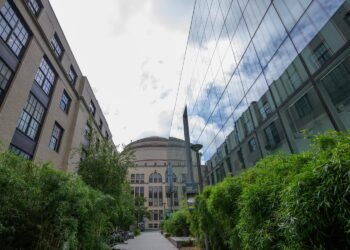
Beyond its core research and training programs, IAIFI convenes researchers through its annual summer workshop, which will be held this year at the MIT Schwarzman College of Computing building. The institute also engages the broader public through collaborations with the MIT Museum, the Museum of Science in Boston, hackathons, and widely viewed online content exploring AI and physics.
“IAIFI shows what becomes possible when researchers in physics, computation, statistics, and data science organize around shared scientific questions,” says Nergis Mavalvala, dean of the MIT School of Science and the Curtis and Kathleen Marble Professor of Astrophysics. “That kind of sustained, cross-disciplinary collaboration is essential to the future of scientific discovery.”
IAIFI is hosted in the Laboratory of Nuclear Science at MIT, led by Director Jesse Thaler (currently on sabbatical), Interim Director Mike Williams, Interim Deputy Director Phiala Shanahan, and Managing Director Marisa LaFleur, along with steering committee members Lisa Barsotti, Isaac Chuang, Will Detmold, Bill Freeman, Phil Harris, Lina Necib, Tess Smidt, and Marin Soljacic (and steering committee members from other IAIFI universities).
Looking ahead
As a member of the National Artificial Intelligence Research Institutes program, IAIFI is part of a nationwide effort to advance AI-driven discovery and innovation.
“The connections among the NSF AI Institutes have been as valuable as the work within them and continue to grow,” says Marisa LaFleur, IAIFI’s managing director. “We’re sharing management strategies and resources for training, community building, and collaboration that make the whole network stronger.”
For IAIFI, the renewed funding is an opportunity to push deeper into what the institute calls the “physics of AI” — using physical reasoning, physical challenges, and physical tools not just to apply AI, but to understand and improve it. That agenda, along with a growing community of researchers trained to work across disciplines, is what drives the institute’s next phase.
“The first phase of IAIFI established the model: interdisciplinary research, early-career talent, and a dynamic community, organized around the idea that AI and physics make each other stronger,” Thaler says. “Now we have the foundation — and the entrepreneurial spirit of our centaur scientists — to push that model into new territory and raise our ambitions.”