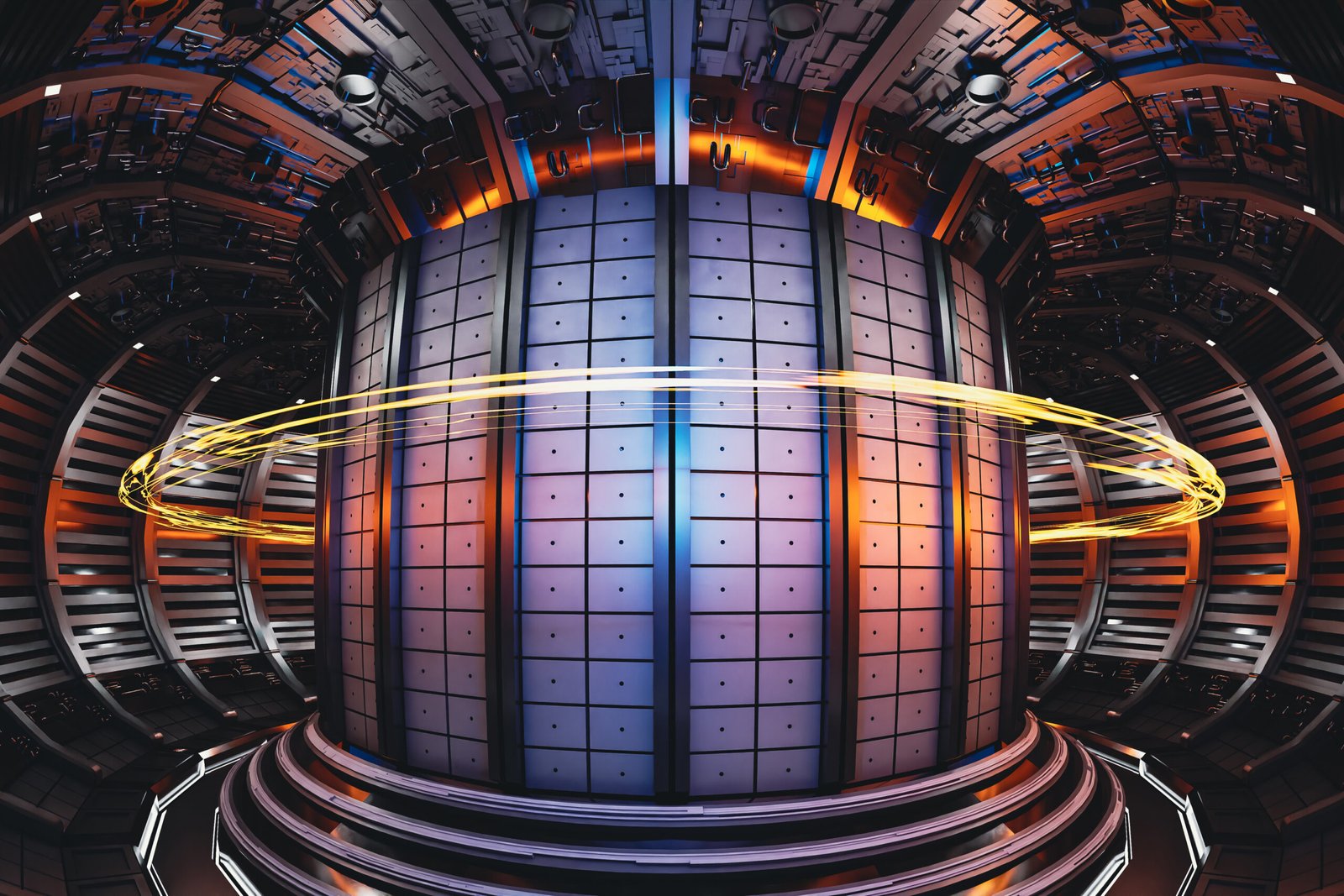
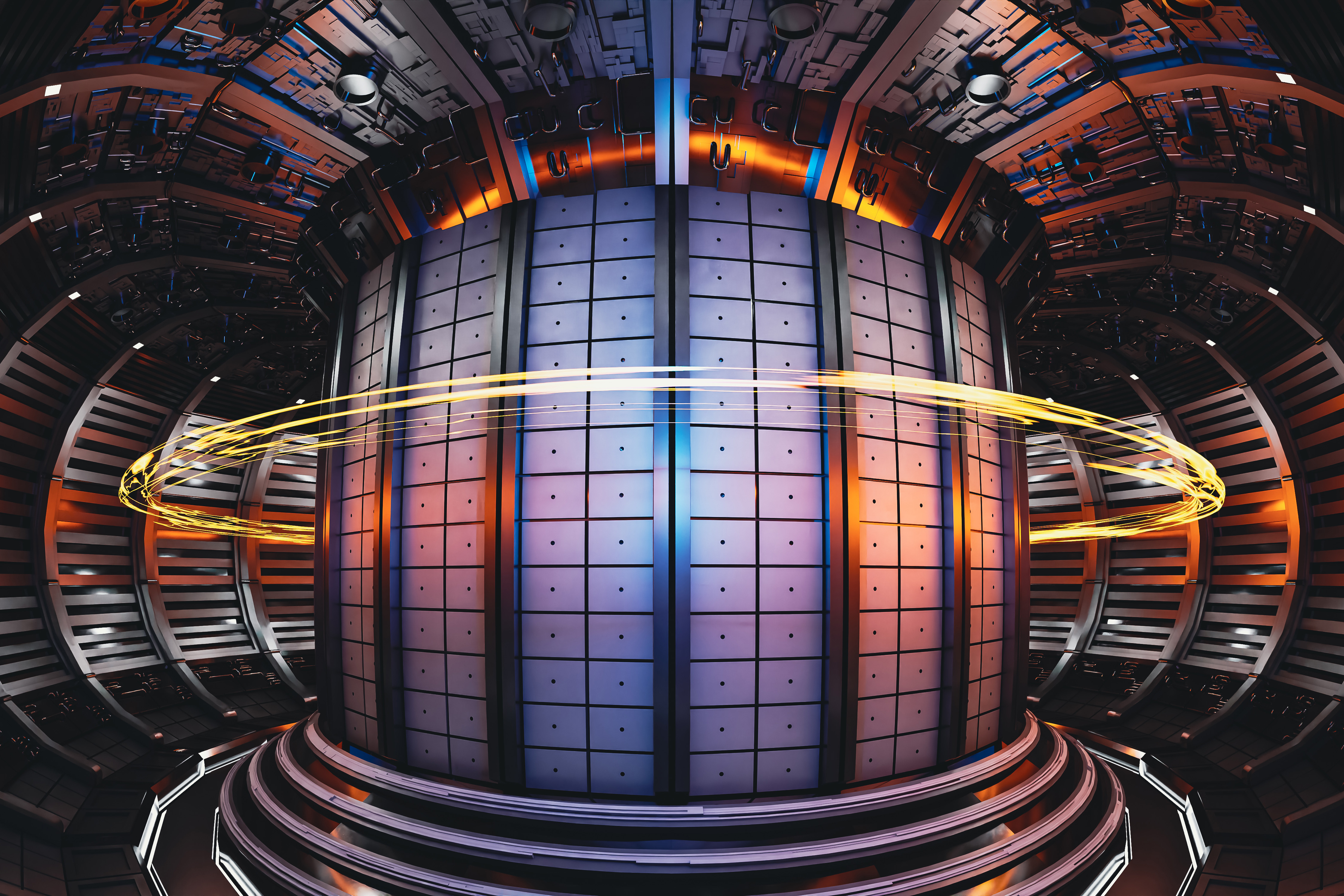
Tokamaks are machines that are meant to hold and harness the power of the sun. These fusion machines use powerful magnets to contain a plasma hotter than the sun’s core and push the plasma’s atoms to fuse and release energy. If tokamaks can operate safely and efficiently, the machines could one day provide clean and limitless fusion energy.
Today, there are a number of experimental tokamaks in operation around the world, with more underway. Most are small-scale research machines built to investigate how the devices can spin up plasma and harness its energy. One of the challenges that tokamaks face is how to safely and reliably turn off a plasma current that is circulating at speeds of up to 100 kilometers per second, at temperatures of over 100 million degrees Celsius.
Such “rampdowns” are necessary when a plasma becomes unstable. To prevent the plasma from further disrupting and potentially damaging the device’s interior, operators ramp down the plasma current. But occasionally the rampdown itself can destabilize the plasma. In some machines, rampdowns have caused scrapes and scarring to the tokamak’s interior — minor damage that still requires considerable time and resources to repair.
Now, scientists at MIT have developed a method to predict how plasma in a tokamak will behave during a rampdown. The team combined machine-learning tools with a physics-based model of plasma dynamics to simulate a plasma’s behavior and any instabilities that may arise as the plasma is ramped down and turned off. The researchers trained and tested the new model on plasma data from an experimental tokamak in Switzerland. They found the method quickly learned how plasma would evolve as it was tuned down in different ways. What’s more, the method achieved a high level of accuracy using a relatively small amount of data. This training efficiency is promising, given that each experimental run of a tokamak is expensive and quality data is limited as a result.
The new model, which the team highlights this week in an open-access Nature Communications paper, could improve the safety and reliability of future fusion power plants.
“For fusion to be a useful energy source it’s going to have to be reliable,” says lead author Allen Wang, a graduate student in aeronautics and astronautics and a member of the Disruption Group at MIT’s Plasma Science and Fusion Center (PSFC). “To be reliable, we need to get good at managing our plasmas.”
The study’s MIT co-authors include PSFC Principal Research Scientist and Disruptions Group leader Cristina Rea, and members of the Laboratory for Information and Decision Systems (LIDS) Oswin So, Charles Dawson, and Professor Chuchu Fan, along with Mark (Dan) Boyer of Commonwealth Fusion Systems and collaborators from the Swiss Plasma Center in Switzerland.
“A delicate balance”
Tokamaks are experimental fusion devices that were first built in the Soviet Union in the 1950s. The device gets its name from a Russian acronym that translates to a “toroidal chamber with magnetic coils.” Just as its name describes, a tokamak is toroidal, or donut-shaped, and uses powerful magnets to contain and spin up a gas to temperatures and energies high enough that atoms in the resulting plasma can fuse and release energy.
Today, tokamak experiments are relatively low-energy in scale, with few approaching the size and output needed to generate safe, reliable, usable energy. Disruptions in experimental, low-energy tokamaks are generally not an issue. But as fusion machines scale up to grid-scale dimensions, controlling much higher-energy plasmas at all phases will be paramount to maintaining a machine’s safe and efficient operation.
“Uncontrolled plasma terminations, even during rampdown, can generate intense heat fluxes damaging the internal walls,” Wang notes. “Quite often, especially with the high-performance plasmas, rampdowns actually can push the plasma closer to some instability limits. So, it’s a delicate balance. And there’s a lot of focus now on how to manage instabilities so that we can routinely and reliably take these plasmas and safely power them down. And there are relatively few studies done on how to do that well.”
Bringing down the pulse
Wang and his colleagues developed a model to predict how a plasma will behave during tokamak rampdown. While they could have simply applied machine-learning tools such as a neural network to learn signs of instabilities in plasma data, “you would need an ungodly amount of data” for such tools to discern the very subtle and ephemeral changes in extremely high-temperature, high-energy plasmas, Wang says.
Instead, the researchers paired a neural network with an existing model that simulates plasma dynamics according to the fundamental rules of physics. With this combination of machine learning and a physics-based plasma simulation, the team found that only a couple hundred pulses at low performance, and a small handful of pulses at high performance, were sufficient to train and validate the new model.
The data they used for the new study came from the TCV, the Swiss “variable configuration tokamak” operated by the Swiss Plasma Center at EPFL (the Swiss Federal Institute of Technology Lausanne). The TCV is a small experimental fusion experimental device that is used for research purposes, often as test bed for next-generation device solutions. Wang used the data from several hundred TCV plasma pulses that included properties of the plasma such as its temperature and energies during each pulse’s ramp-up, run, and ramp-down. He trained the new model on this data, then tested it and found it was able to accurately predict the plasma’s evolution given the initial conditions of a particular tokamak run.
The researchers also developed an algorithm to translate the model’s predictions into practical “trajectories,” or plasma-managing instructions that a tokamak controller can automatically carry out to for instance adjust the magnets or temperature maintain the plasma’s stability. They implemented the algorithm on several TCV runs and found that it produced trajectories that safely ramped down a plasma pulse, in some cases faster and without disruptions compared to runs without the new method.
“At some point the plasma will always go away, but we call it a disruption when the plasma goes away at high energy. Here, we ramped the energy down to nothing,” Wang notes. “We did it a number of times. And we did things much better across the board. So, we had statistical confidence that we made things better.”
The work was supported in part by Commonwealth Fusion Systems (CFS), an MIT spinout that intends to build the world’s first compact, grid-scale fusion power plant. The company is developing a demo tokamak, SPARC, designed to produce net-energy plasma, meaning that it should generate more energy than it takes to heat up the plasma. Wang and his colleagues are working with CFS on ways that the new prediction model and tools like it can better predict plasma behavior and prevent costly disruptions to enable safe and reliable fusion power.
“We’re trying to tackle the science questions to make fusion routinely useful,” Wang says. “What we’ve done here is the start of what is still a long journey. But I think we’ve made some nice progress.”
Additional support for the research came from the framework of the EUROfusion Consortium, via the Euratom Research and Training Program and funded by the Swiss State Secretariat for Education, Research, and Innovation.