
• About Us
  • Disclaimer
  • Contact Us
  • Privacy Policy
Friday, January 23, 2026
mGrowTech
No Result
View All Result
  • Technology And Software
    • Account Based Marketing
    • Channel Marketing
    • Marketing Automation
      • Al, Analytics and Automation
      • Ad Management
  • Digital Marketing
    • Social Media Management
    • Google Marketing
  • Direct Marketing
    • Brand Management
    • Marketing Attribution and Consulting
  • Mobile Marketing
  • Event Management
  • PR Solutions
  • Technology And Software
    • Account Based Marketing
    • Channel Marketing
    • Marketing Automation
      • Al, Analytics and Automation
      • Ad Management
  • Digital Marketing
    • Social Media Management
    • Google Marketing
  • Direct Marketing
    • Brand Management
    • Marketing Attribution and Consulting
  • Mobile Marketing
  • Event Management
  • PR Solutions
No Result
View All Result
mGrowTech
No Result
View All Result
Home Brand Management

New Branding for Muse Group by Collins — BP&O

Josh by Josh
August 5, 2025
in Brand Management
0
New Branding for Muse Group by Collins — BP&O
0
SHARES
0
VIEWS
Share on FacebookShare on Twitter


Symbols, logo, custom typeface and motion graphics for Muse Group designed by Collins

Muse Group exists as a collection of digital products covering all aspects of the creative process in music. This reviewer is familiar with Audacity and has used it in the past, but other platforms include Ultimate Guitar, MuseClass, MuseScore, and MuseHub. These tools are used by a range of professional musicians, budding amateurs, and everyone in between, working across all genres to learn, play, and create.

Despite the integral nature of these products to musical creation, the Muse brand itself was largely invisible, lacking a clear identity, a shared voice, or a central purpose to unify its digital suite.

Collins (San Francisco Symphony, Crane & Sustana) was tasked with consolidating these individual products under a single brand (which makes sense) – described by the studio as a ‘Creative Fluency Company’ (decidedly less so). Specifically, the ambition was to help ‘anyone reach a state where musical expression becomes second nature, where creation flows freely and musicians are able to express themselves with as little friction as possible’. Better.

Symbols, logo, custom typeface and motion graphics for Muse Group designed by Collins

With this new positioning in mind, creative musical expression and liberation become central to the new Muse Group visual identity, establishing a consistent visual language across the products through new symbols and a resolved, formalised system to promote these assets.

From the foundational principles of music – musical motifs, the real nuts and bolts of musical communication – Collins has built a sense of boisterous improvisation and spontaneous musical expansion. That’s not to say the result is undisciplined. Yes, it’s full of life, expression, passion, and agency, but it’s also supported by a functional underlying system that builds recognition through repeating patterns and motifs – just like a jazz session or jam.

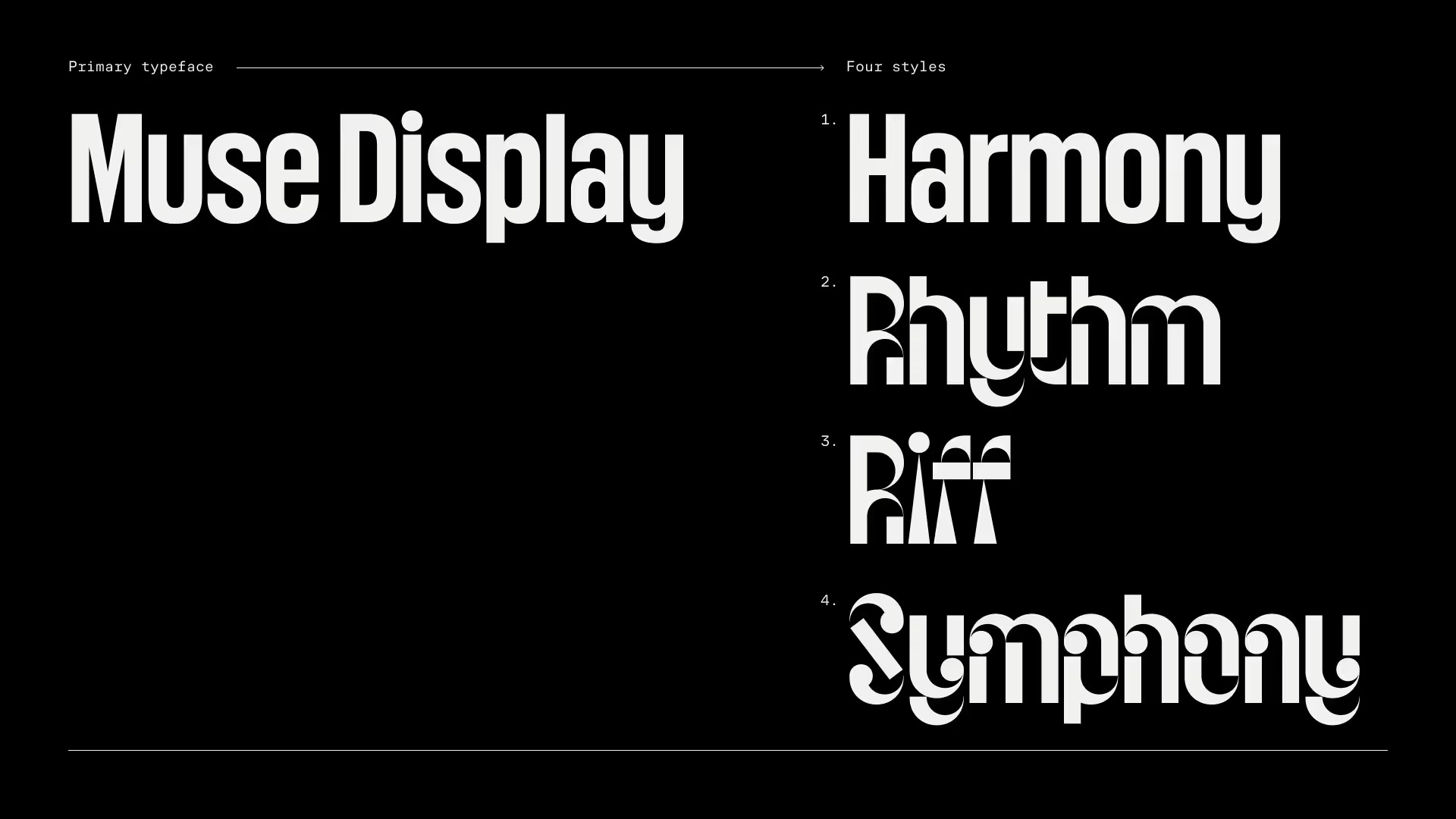
There are two clearly delineated parts to this work. First, the foundational elements that operate at the smallest level, representing the brand in restricted spaces (Instagram, for example). These include the new product symbols, a black background, and the top and bottom lines of the five-lined staff (or stave), which anchor type and bring structure to space – along with four styles of Muse Display, a new corporate typeface.

The logos offer a clearer stylistic continuity. By limiting them to Muse Display’s most expressive shapes, some are more successful than others. However, collectively they play with tension, harmony, balance, and energy – elements of graphic design that neatly align with musical principles.
Symbols, logo, custom typeface and motion graphics for Muse Group designed by Collins

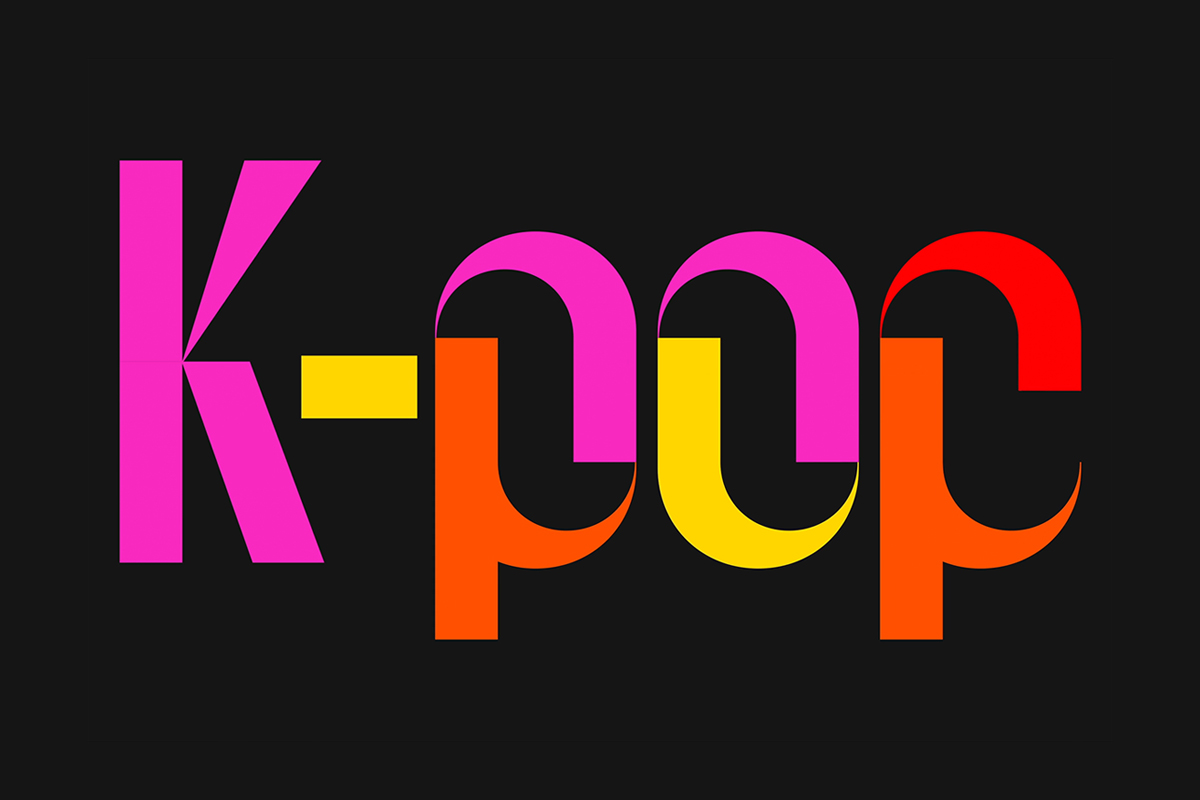
The custom typeface delivers much of Muse’s character. Harmony, Rhythm, Riff, and Symphony share similar proportions, but through abstraction and the use of elemental modular geometric forms, they become more about feeling than literal meaning. This is amplified in motion, expanding outwards like sound waves and responding to audio cues. Here, Collins’s collaboration with SFS shines – functioning in much the same way to convey the energy of a musical performance, even when static.

Where words are too much, a waveform device has been added (also animated), used to give brand character to assets like Muse’s Linkedin banner. This adds scope but feels somewhat disconnected from the typography.

These kinds of intersections – musicality and motion, combined with the technology to skilfully realise their graphic potential – are what separate studios today, much like dynamic and programmatic identities did in the early 2010s. AI may reduce that gap, but it still takes significant experience to make living assets work cohesively across platforms.

What remains a challenge is the rollout. While the team at Collins clearly has expertise and craft, the abilities and/or proclivities of the in-house team remain to be seen. I’ve seen this skills divide play out recently, where in-house teams question why the work doesn’t look as good – often due to not following guidelines, the guidelines not being robust enough, or simply lacking experience crafting different types of work in a studio context. Sometimes, the disparity between concept, technology, and platform is simply too great.
Symbols, logo, custom typeface and motion graphics for Muse Group designed by Collins

This issue becomes especially acute during everyday communication, when big, genre-specific typography isn’t appropriate (you use ‘Jazz’ and it doesn’t speak to the RnB producer). What’s left is a black background, two lines, and the least expressive version of a corporate typeface. The websites are largely fine (but no expressive type or motion), except for Audacity, which has yet to make the change. Muse’s social presence is still a mess, though there’s still time to resolve this.



Source_link

READ ALSO

Why You Shouldn’t Use AI for Logo Design (And How to Use It the Right Way Instead)

Atlético Dallas by Moniker — BP&O

Related Posts

Brand Management

Why You Shouldn’t Use AI for Logo Design (And How to Use It the Right Way Instead)

January 22, 2026
Atlético Dallas by Moniker — BP&O
Brand Management

Atlético Dallas by Moniker — BP&O

January 22, 2026
Bangkok Bank maintains Strong Growth with Baht 46,007 Million Profit in 2025
Brand Management

Bangkok Bank maintains Strong Growth with Baht 46,007 Million Profit in 2025

January 21, 2026
Evil Ray by Seachange — BP&O
Brand Management

Evil Ray by Seachange — BP&O

January 20, 2026
Brand Management

The New Dacia Jogger: A Campaign for Friendship

January 20, 2026
Brand Management

Top Branding & Design Trends For 2026

January 19, 2026
Next Post
11 Best Chromebooks of 2025, Tested and Reviewed

11 Best Chromebooks of 2025, Tested and Reviewed

POPULAR NEWS

Trump ends trade talks with Canada over a digital services tax

Trump ends trade talks with Canada over a digital services tax

June 28, 2025
Communication Effectiveness Skills For Business Leaders

Communication Effectiveness Skills For Business Leaders

June 10, 2025
15 Trending Songs on TikTok in 2025 (+ How to Use Them)

15 Trending Songs on TikTok in 2025 (+ How to Use Them)

June 18, 2025
App Development Cost in Singapore: Pricing Breakdown & Insights

App Development Cost in Singapore: Pricing Breakdown & Insights

June 22, 2025
Google announced the next step in its nuclear energy plans 

Google announced the next step in its nuclear energy plans 

August 20, 2025

EDITOR'S PICK

Fish It Script (No Key, Pastebin, Auto Farm)

Fish It Script (No Key, Pastebin, Auto Farm)

October 25, 2025

Create Magical Customer Experiences with MoEngage’s Merlin AI

October 19, 2025
OpenAI Releases ChatGPT ‘Pulse’: Proactive, Personalized Daily Briefings for Pro Users

OpenAI Releases ChatGPT ‘Pulse’: Proactive, Personalized Daily Briefings for Pro Users

September 26, 2025
Google antitrust ruling clears the way for Apple’s Gemini push

Google antitrust ruling clears the way for Apple’s Gemini push

September 6, 2025

About

We bring you the best Premium WordPress Themes that perfect for news, magazine, personal blog, etc. Check our landing page for details.

Follow us

Categories

  • Account Based Marketing
  • Ad Management
  • Al, Analytics and Automation
  • Brand Management
  • Channel Marketing
  • Digital Marketing
  • Direct Marketing
  • Event Management
  • Google Marketing
  • Marketing Attribution and Consulting
  • Marketing Automation
  • Mobile Marketing
  • PR Solutions
  • Social Media Management
  • Technology And Software
  • Uncategorized

Recent Posts

  • How I Got AI to Quote Us with 4 Simple Strategies
  • List of Spin a Baddie Codes
  • Sennheiser introduces new TV headphones bundle with Auracast
  • Microsoft Releases VibeVoice-ASR: A Unified Speech-to-Text Model Designed to Handle 60-Minute Long-Form Audio in a Single Pass
  • About Us
  • Disclaimer
  • Contact Us
  • Privacy Policy
No Result
View All Result
  • Technology And Software
    • Account Based Marketing
    • Channel Marketing
    • Marketing Automation
      • Al, Analytics and Automation
      • Ad Management
  • Digital Marketing
    • Social Media Management
    • Google Marketing
  • Direct Marketing
    • Brand Management
    • Marketing Attribution and Consulting
  • Mobile Marketing
  • Event Management
  • PR Solutions

Are you sure want to unlock this post?
Unlock left : 0
Are you sure want to cancel subscription?