[ad_1]
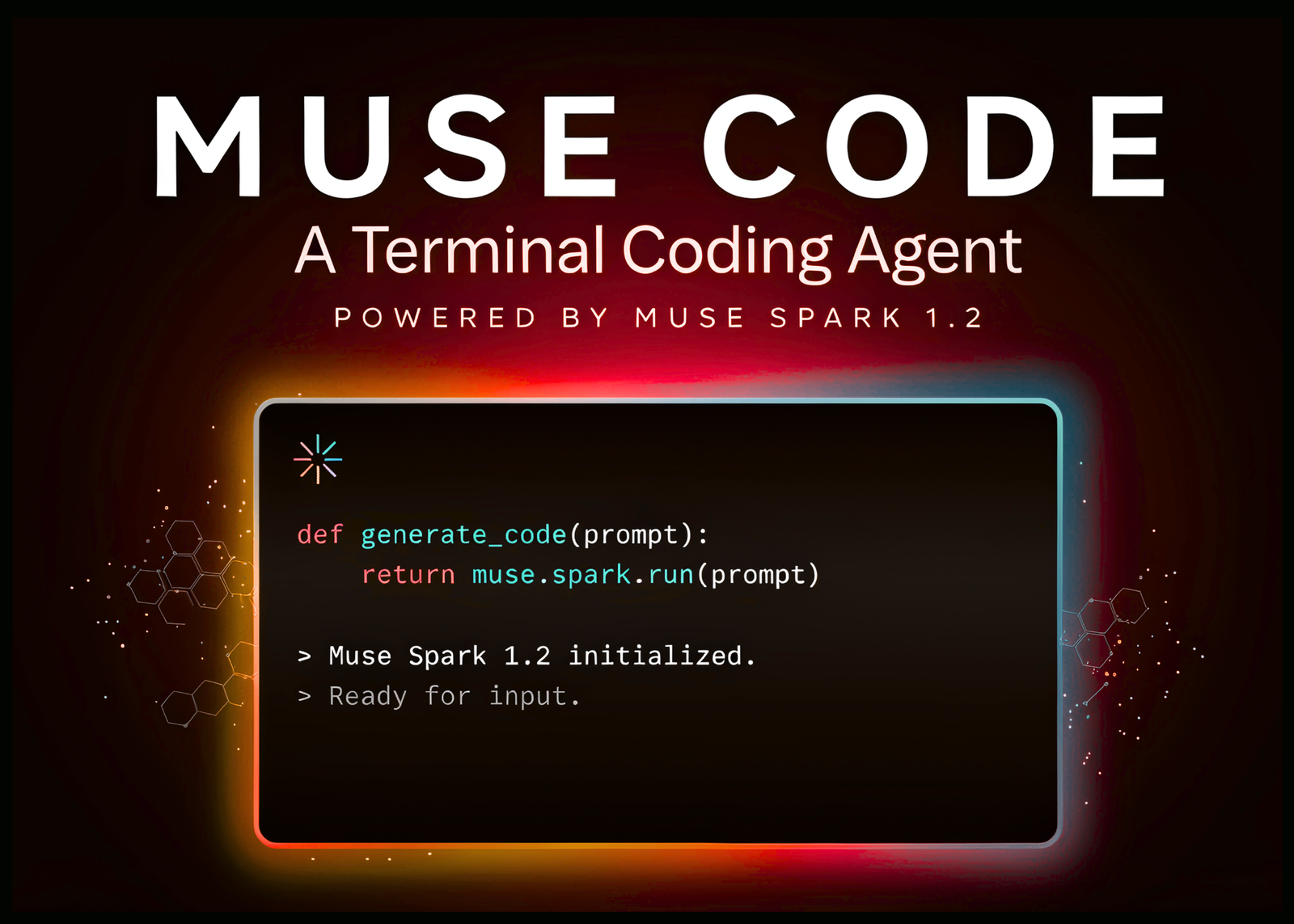
Meta AI has released Muse Code (in beta), a terminal coding agent in beta, powered by its new Muse Spark 1.2 model. Meta positions the pair as its next step toward the frontier, with larger models on the way. Muse Code targets complex software engineering across large repositories: it plans changes, writes code, and validates the results. A set of async background agents stays alive for the whole session instead of spawning per task. A local append-only event log records every model call, tool run, approval, and edit, which Meta calls replay-exact and restart-safe. Muse Spark 1.2 was co-trained with the harness itself. Meta also published a kernel-optimization case study running 1,000+ tool calls over as long as 24 hours.
Is it deployable
Yes. Muse Code ships in beta for macOS and Linux via curl -fsSL https://dev.meta.ai/install.sh | bash. Muse Spark 1.2 is available in Muse Code and the Meta Model API, with expanded global access. The launch post does not mention downloadable weights, so treat this as a hosted dependency.
- Company level: The API path fits any size. The Muse Code path fits teams already running agents in sandboxes with review gates.
- Industries: Software and SaaS, developer tooling, fintech engineering, GPU and inference infrastructure, semiconductors and HPC.
- Applications: Repository-scale refactors and migrations, long-running bug triage, test generation, and GPU kernel optimization.
Async background agents
Muse Code runs a simple agent loop plus a set of async background agents. These specialized agents remain active throughout each session. They are not spawned for individual tasks, which Meta says avoids redundant information gathering. They carry out next steps and choose when to report back to the main agent. Meta states this persistence reduces latency and steering on difficult, multi-step tasks.
Runtime design
Muse Code uses a local event log. Every model call, tool run, approval, and edit is appended to it. Meta calls this single source of truth replay-exact and restart-safe. After a crash, the agent resumes precisely where it stopped, letting long-running tasks survive failures.
Bundled skills
Three default skills ship with the agent. /plan turns a task into an approval-gated plan. /grill stress-tests that plan until it holds up. /goal works toward successful completion of the specified objective.
What changed in Muse Spark 1.2
Muse Spark 1.2 is a coding-focused update to Muse Spark 1.1. Meta reports gains in code generation, complex debugging, codebase understanding, and end-to-end developer workflows. The research team significantly scaled up training compute on coding tasks and expanded environment diversity. The model keeps its strength in other areas, including general agents.
Three important training details:
- Co-training with the harness: Muse Spark 1.2 was co-trained with Muse Code. Training included rejection-sampled harness trajectories and recipe optimizations for goals, compaction, and subagents. The Muse Code toolset was integrated to maximize harness compatibility.
- Long-horizon training: Training covered whole-repository generation, large end-to-end projects, and auto-research. The model uses planning, goal conditioning, and context compaction to sustain progress.
- Self-improvement: Muse Spark 1.1 generated challenging coding environments and instruction-following templates, then graded candidate solutions against those requirements. That produced a scalable training dataset for 1.2.
Evaluation
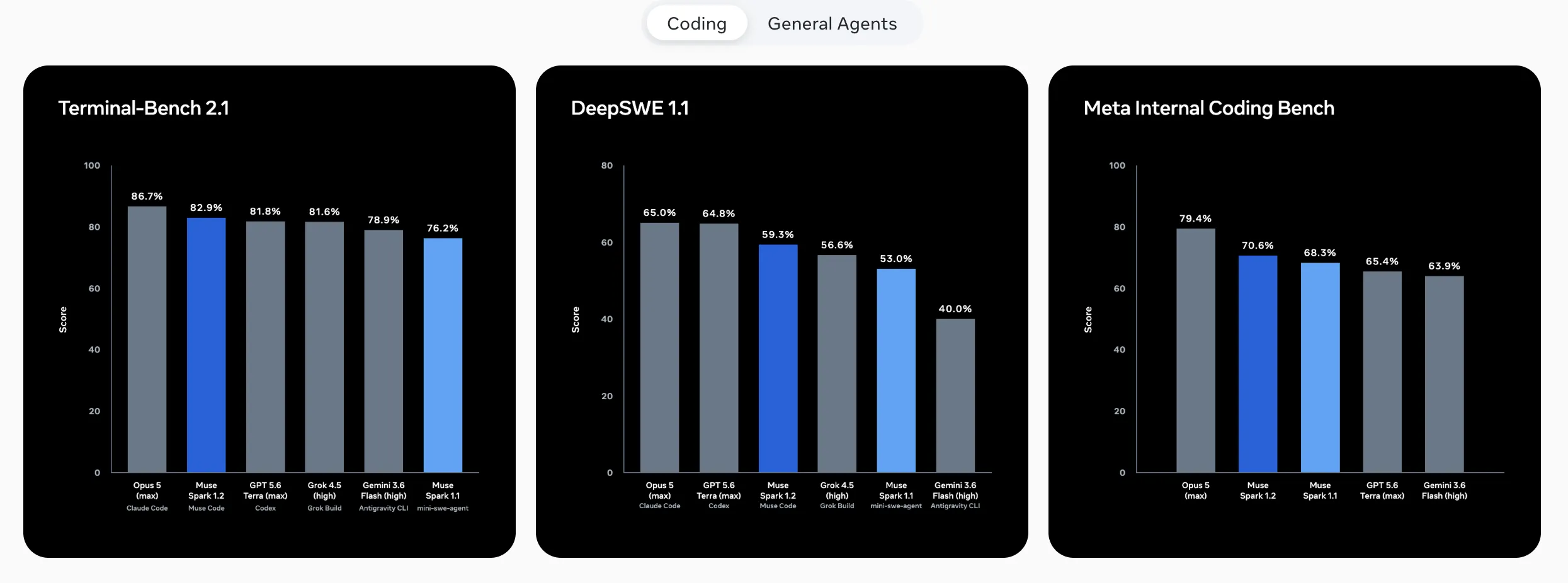
Meta’s methodology report is unusually specific. Terminal-Bench 2.1 uses all 89 tasks, pass@1 over five attempts. DeepSWE v1.1 covers 113 tasks across 91 repositories and five languages. Meta Internal Coding Bench holds 440 tasks derived from real internal pull requests. Runs execute in isolated Daytona cloud sandboxes. Comparisons include Grok 4.5, Claude Opus 5, GPT-5.6 Terra, Gemini 3.6 Flash, and Kimi K3, each with its own agent product. Meta notes its harness may not be tuned for third-party models. For reference, Meta’s model page lists Muse Spark 1.1 at 80.0 on Terminal-Bench 2.1.
Case study: kernel optimization
Meta tested iterative GPU kernel optimization over 1,000+ tool calls, running up to 24 hours. The model writes, compiles, profiles, and progressively improves kernels against a provided baseline. Benchmarks covered KDA and MLA kernels on NVIDIA Hopper GPUs. For KDA, the baseline is the FLA Triton implementation, with third-party kernel libraries prohibited. Muse Spark 1.2 paired a chunk-parallel preparation kernel with a sequential inter-chunk scan. For MLA, the reference is PyTorch at batch size 1, 64 heads, sequence length 8192, and latent dimension 512. The model built a two-kernel Triton pipeline that reuses the shared KV latent as both K and V.
Key Takeaways
- Muse Code is a beta terminal coding agent for macOS and Linux, powered by Muse Spark 1.2.
- Persistent async background agents replace per-task spawning to cut redundant information gathering.
- An append-only local event log makes the runtime replay-exact and restart-safe after crashes.
- Muse Spark 1.2 was co-trained with the harness and trained on long-horizon, repository-scale work.
- Kernel case study ran 1,000+ tool calls over 24 hours on NVIDIA Hopper KDA and MLA kernels.
Check out the Technical details, Model (Muse Spark 1.2) and Evaluation Methodology. Also, feel free to follow us on Twitter and don’t forget to join our 150k+ML SubReddit and Subscribe to our Newsletter. Wait! are you on telegram? now you can join us on telegram as well.
Need to partner with us for promoting your GitHub Repo OR Hugging Face Page OR Product Release OR Webinar etc.? Connect with us

Asif Razzaq is the CEO of Marktechpost Media Inc.. As a visionary entrepreneur and engineer, Asif is committed to harnessing the potential of Artificial Intelligence for social good. His most recent endeavor is the launch of an Artificial Intelligence Media Platform, Marktechpost, which stands out for its in-depth coverage of machine learning and deep learning news that is both technically sound and easily understandable by a wide audience. The platform boasts of over 2 million monthly views, illustrating its popularity among audiences.
[ad_2]
Source_link