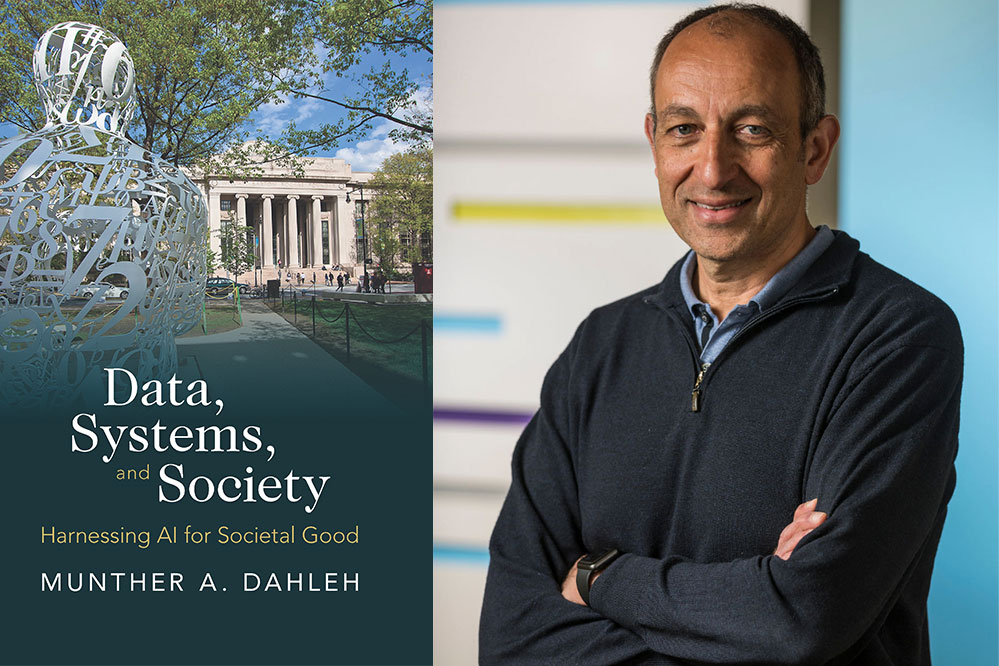
Research that crosses the traditional boundaries of academic disciplines, and boundaries between academia, industry, and government, is increasingly widespread, and has sometimes led to the spawning of significant new disciplines. But Munther Dahleh, a professor of electrical engineering and computer science at MIT, says that such multidisciplinary and interdisciplinary work often suffers from a number of shortcomings and handicaps compared to more traditionally focused disciplinary work.
But increasingly, he says, the profound challenges that face us in the modern world — including climate change, biodiversity loss, how to control and regulate artificial intelligence systems, and the identification and control of pandemics — require such meshing of expertise from very different areas, including engineering, policy, economics, and data analysis. That realization is what guided him, a decade ago, in the creation of MIT’s pioneering Institute for Data, Systems and Society (IDSS), aiming to foster a more deeply integrated and lasting set of collaborations than the usual temporary and ad hoc associations that occur for such work.
Dahleh has now written a book detailing the process of analyzing the landscape of existing disciplinary divisions at MIT and conceiving of a way to create a structure aimed at breaking down some of those barriers in a lasting and meaningful way, in order to bring about this new institute. The book, “Data, Systems, and Society: Harnessing AI for Societal Good,” was published this March by Cambridge University Press.
The book, Dahleh says, is his attempt “to describe our thinking that led us to the vision of the institute. What was the driving vision behind it?” It is aimed at a number of different audiences, he says, but in particular, “I’m targeting students who are coming to do research that they want to address societal challenges of different types, but utilizing AI and data science. How should they be thinking about these problems?”
A key concept that has guided the structure of the institute is something he refers to as “the triangle.” This refers to the interaction of three components: physical systems, people interacting with those physical systems, and then regulation and policy regarding those systems. Each of these affects, and is affected by, the others in various ways, he explains. “You get a complex interaction among these three components, and then there is data on all these pieces. Data is sort of like a circle that sits in the middle of this triangle and connects all these pieces,” he says.
When tackling any big, complex problem, he suggests, it is useful to think in terms of this triangle. “If you’re tackling a societal problem, it’s very important to understand the impact of your solution on society, on the people, and the role of people in the success of your system,” he says. Often, he says, “solutions and technology have actually marginalized certain groups of people and have ignored them. So the big message is always to think about the interaction between these components as you think about how to solve problems.”
As a specific example, he cites the Covid-19 pandemic. That was a perfect example of a big societal problem, he says, and illustrates the three sides of the triangle: there’s the biology, which was little understood at first and was subject to intensive research efforts; there was the contagion effect, having to do with social behavior and interactions among people; and there was the decision-making by political leaders and institutions, in terms of shutting down schools and companies or requiring masks, and so on. “The complex problem we faced was the interaction of all these components happening in real-time, when the data wasn’t all available,” he says.
Making a decision, for example shutting schools or businesses, based on controlling the spread of the disease, had immediate effects on economics and social well-being and health and education, “so we had to weigh all these things back into the formula,” he says. “The triangle came alive for us during the pandemic.” As a result, IDSS “became a convening place, partly because of all the different aspects of the problem that we were interested in.”
Examples of such interactions abound, he says. Social media and e-commerce platforms are another case of “systems built for people, and they have a regulation aspect, and they fit into the same story if you’re trying to understand misinformation or the monitoring of misinformation.”
The book presents many examples of ethical issues in AI, stressing that they must be handled with great care. He cites self-driving cars as an example, where programming decisions in dangerous situations can appear ethical but lead to negative economic and humanitarian outcomes. For instance, while most Americans support the idea that a car should sacrifice its driver rather than kill an innocent person, they wouldn’t buy such a car. This reluctance lowers adoption rates and ultimately increases casualties.
In the book, he explains the difference, as he sees it, between the concept of “transdisciplinary” versus typical cross-disciplinary or interdisciplinary research. “They all have different roles, and they have been successful in different ways,” he says. The key is that most such efforts tend to be transitory, and that can limit their societal impact. The fact is that even if people from different departments work together on projects, they lack a structure of shared journals, conferences, common spaces and infrastructure, and a sense of community. Creating an academic entity in the form of IDSS that explicitly crosses these boundaries in a fixed and lasting way was an attempt to address that lack. “It was primarily about creating a culture for people to think about all these components at the same time.”
He hastens to add that of course such interactions were already happening at MIT, “but we didn’t have one place where all the students are all interacting with all of these principles at the same time.” In the IDSS doctoral program, for instance, there are 12 required core courses — half of them from statistics and optimization theory and computation, and half from the social sciences and humanities.
Dahleh stepped down from the leadership of IDSS two years ago to return to teaching and to continue his research. But as he reflected on the work of that institute and his role in bringing it into being, he realized that unlike his own academic research, in which every step along the way is carefully documented in published papers, “I haven’t left a trail” to document the creation of the institute and the thinking behind it. “Nobody knows what we thought about, how we thought about it, how we built it.” Now, with this book, they do.
The book, he says, is “kind of leading people into how all of this came together, in hindsight. I want to have people read this and sort of understand it from a historical perspective, how something like this happened, and I did my best to make it as understandable and simple as I could.”












![Top 10 Enterprise Search Engine Optimization Agencies [2025]](https://mgrowtech.com/wp-content/uploads/2025/12/enterprise-search-emgine-optimization-agencies-120x86.png)