
• About Us
  • Disclaimer
  • Contact Us
  • Privacy Policy
Saturday, April 25, 2026
mGrowTech
No Result
View All Result
  • Technology And Software
    • Account Based Marketing
    • Channel Marketing
    • Marketing Automation
      • Al, Analytics and Automation
      • Ad Management
  • Digital Marketing
    • Social Media Management
    • Google Marketing
  • Direct Marketing
    • Brand Management
    • Marketing Attribution and Consulting
  • Mobile Marketing
  • Event Management
  • PR Solutions
  • Technology And Software
    • Account Based Marketing
    • Channel Marketing
    • Marketing Automation
      • Al, Analytics and Automation
      • Ad Management
  • Digital Marketing
    • Social Media Management
    • Google Marketing
  • Direct Marketing
    • Brand Management
    • Marketing Attribution and Consulting
  • Mobile Marketing
  • Event Management
  • PR Solutions
No Result
View All Result
mGrowTech
No Result
View All Result
Home Al, Analytics and Automation

Liquid AI’s LFM2-VL-3B Brings a 3B Parameter Vision Language Model (VLM) to Edge-Class Devices

Josh by Josh
October 25, 2025
in Al, Analytics and Automation
0
Liquid AI’s LFM2-VL-3B Brings a 3B Parameter Vision Language Model (VLM) to Edge-Class Devices


Liquid AI released LFM2-VL-3B, a 3B parameter vision language model for image text to text tasks. It extends the LFM2-VL family beyond the 450M and 1.6B variants. The model targets higher accuracy while preserving the speed profile of the LFM2 architecture. It is available on LEAP and Hugging Face under the LFM Open License v1.0.

Model overview and interface

LFM2-VL-3B accepts interleaved image and text inputs and produces text outputs. The model exposes a ChatML like template. The processor inserts an <image> sentinel that is replaced with encoded image tokens at run time. The default text context length is 32,768 tokens. These details help devs reproduce evaluations and integrate the model with existing multimodal pipelines.
https://www.liquid.ai/blog/lfm2-vl-3b-a-new-efficient-vision-language-for-the-edge

Architecture

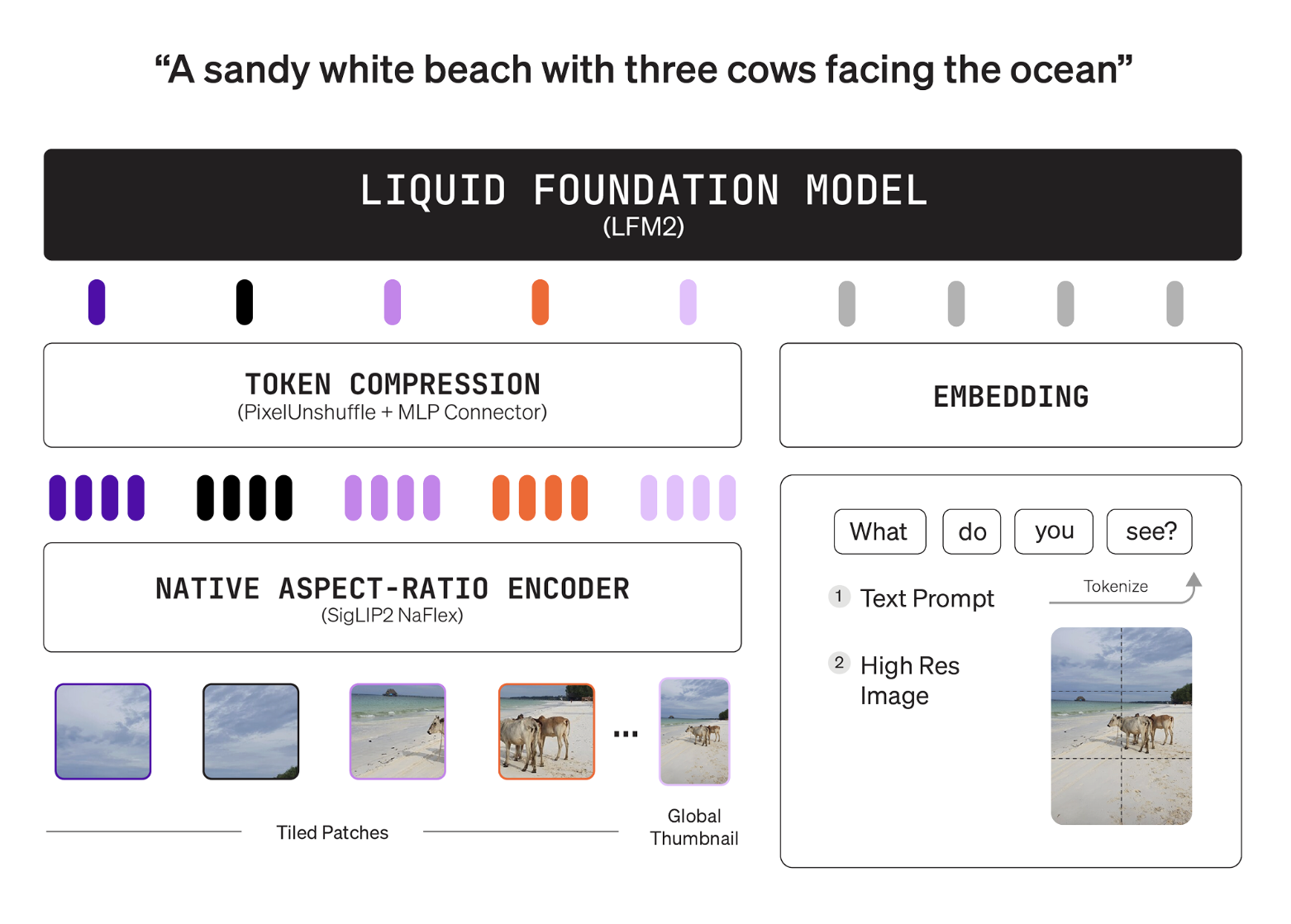
The stack pairs a language tower with a shape aware vision tower and a projector. The language tower is LFM2-2.6B, a hybrid convolution plus attention backbone. The vision tower is SigLIP2 NaFlex at 400M parameters, it preserves native aspect ratios and avoids distortion. The connector is a 2 layer MLP with pixel unshuffle, it compresses image tokens before fusion with the language space. This design lets users cap vision token budgets without retraining the model.

The encoder processes native resolutions up to 512×512. Larger inputs are split into non overlapping 512×512 patches. A thumbnail pathway provides global context during tiling. The efficient token mapping is documented with concrete examples, a 256×384 image maps to 96 tokens, a 1000×3000 image maps to 1,020 tokens. The model card exposes user controls for minimum and maximum image tokens and the tiling switch. These controls tune speed and quality at inference time.

Inference settings

The Hugging Face model card provides recommended parameters. Text generation uses temperature 0.1, min p 0.15, and a repetition penalty of 1.05. Vision settings use min image tokens 64, max image tokens 256, and image splitting enabled. The processor applies the chat template and the image sentinel automatically. The example uses AutoModelForImageTextToText and AutoProcessor with bfloat16 precision.

How is it trained?

Liquid AI describes a staged approach. The team performs joint mid training that adjusts the text to image ratio over time. The model then undergoes supervised fine tuning focused on image understanding. The data sources are large scale open datasets plus in house synthetic vision data for task coverage.

Benchmarks

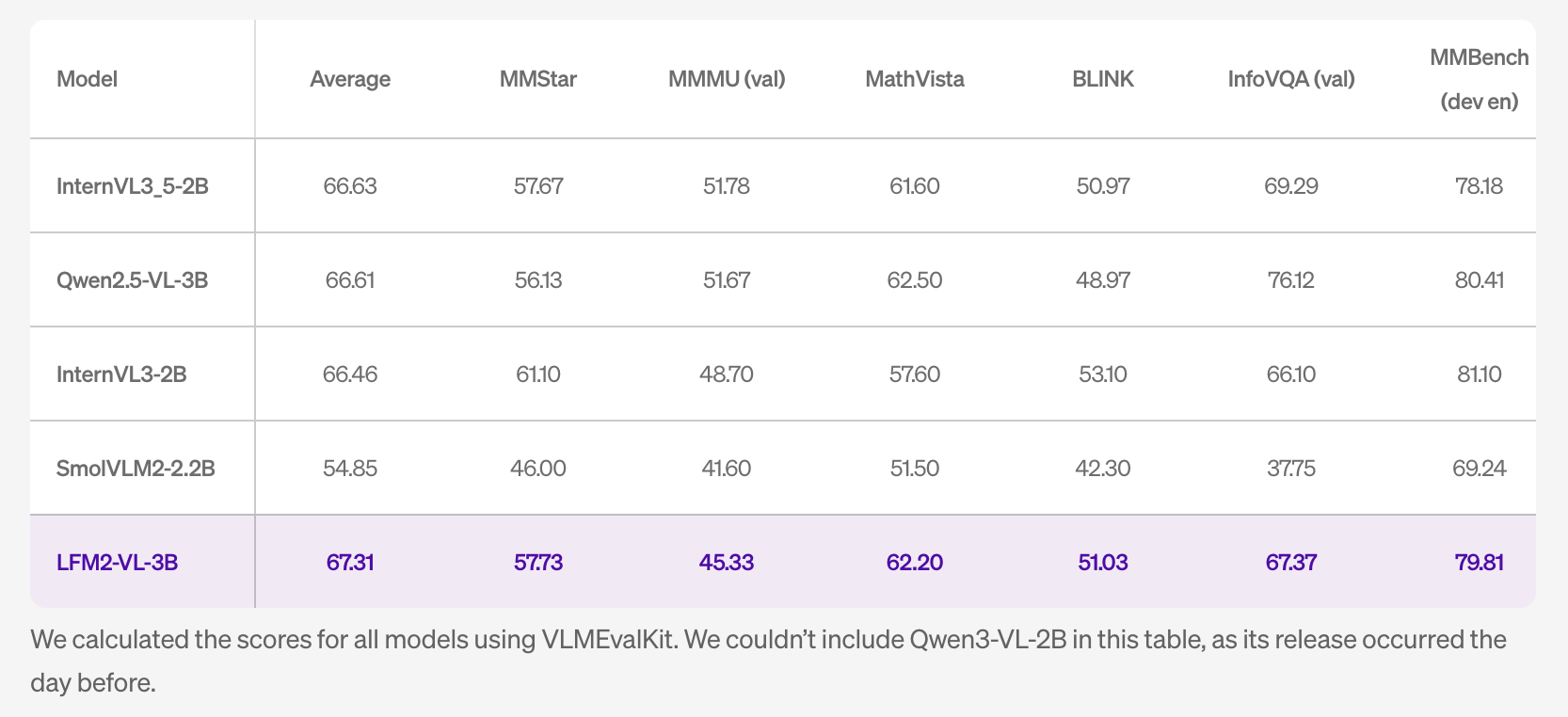
The research team reports competitive results among lightweight open VLMs. On MM-IFEval the model reaches 51.83. On RealWorldQA it reaches 71.37. On MMBench dev en it reaches 79.81. The POPE score is 89.01. The table notes that scores for other systems were computed with VLMEvalKit. The table excludes Qwen3-VL-2B because that system was released one day earlier.
https://www.liquid.ai/blog/lfm2-vl-3b-a-new-efficient-vision-language-for-the-edge

The language capability remains close to the LFM2-2.6B backbone. The research team cites 30 percent on GPQA and 63 percent on MMLU. This matters when perception tasks include knowledge queries. The team also states expanded multilingual visual understanding across English, Japanese, French, Spanish, German, Italian, Portuguese, Arabic, Chinese, and Korean.

Why edge users should care?

The architecture keeps compute and memory within small device budgets. Image tokens are compressible and user constrained, so throughput is predictable. SigLIP2 400M NaFlex encoder preserves aspect ratios, which helps fine grained perception. The projector reduces tokens at the connector, which improves tokens per second. The research team also published a GGUF build for on device runtimes. These properties are useful for robotics, mobile, and industrial clients that need local processing and strict data boundaries.

Key Takeaways

  1. Compact multimodal stack: 3B parameter LFM2-VL-3B pairs an LFM2-2.6B language tower with a 400M SigLIP2 NaFlex vision encoder and a 2-layer MLP projector for image-token fusion. NaFlex preserves native aspect ratios.
  2. Resolution handling and token budgets: Images run natively up to 512×512, larger inputs tile into non overlapping 512×512 patches with a thumbnail pathway for global context. Documented token mappings include 256×384 → 96 tokens and 1000×3000 → 1,020 tokens.
  3. Inference interface: ChatML-like prompting with an <image> sentinel, default text context 32,768 tokens, recommended decoding settings, and processor-level controls for image splitting enable reproducible evaluation and easy integration in multimodal pipelines.
  4. Measured performance: Reported results include MM-IFEval 51.83, RealWorldQA 71.37, MMBench-dev-en 79.81, and POPE 89.01. Language-only signals from the backbone are about 30% GPQA and 63% MMLU, useful for mixed perception plus knowledge workloads.

LFM2-VL-3B is a practical step for edge multimodal workloads, the 3B stack pairs LFM2-2.6B with a 400M SigLIP2 NaFlex encoder and an efficient projector, which lowers image token counts for predictable latency. Native resolution processing with 512 by 512 tiling and token caps gives deterministic budgets. Reported scores on MM-IFEval, RealWorldQA, MMBench, and POPE are competitive for this size. Open weights, a GGUF build, and LEAP access reduce integration friction. Overall, this is an edge ready VLM release with clear controls and transparent benchmarks.


Check out the Model on HF and Technical details. Feel free to check out our GitHub Page for Tutorials, Codes and Notebooks. Also, feel free to follow us on Twitter and don’t forget to join our 100k+ ML SubReddit and Subscribe to our Newsletter. Wait! are you on telegram? now you can join us on telegram as well.


Michal Sutter is a data science professional with a Master of Science in Data Science from the University of Padova. With a solid foundation in statistical analysis, machine learning, and data engineering, Michal excels at transforming complex datasets into actionable insights.

🙌 Follow MARKTECHPOST: Add us as a preferred source on Google.


Source_link

READ ALSO

MIT scientists build the world’s largest collection of Olympiad-level math problems, and open it to everyone | MIT News

Google DeepMind Introduces Decoupled DiLoCo: An Asynchronous Training Architecture Achieving 88% Goodput Under High Hardware Failure Rates

Related Posts

MIT scientists build the world’s largest collection of Olympiad-level math problems, and open it to everyone | MIT News
Al, Analytics and Automation

MIT scientists build the world’s largest collection of Olympiad-level math problems, and open it to everyone | MIT News

April 24, 2026
Google DeepMind Introduces Decoupled DiLoCo: An Asynchronous Training Architecture Achieving 88% Goodput Under High Hardware Failure Rates
Al, Analytics and Automation

Google DeepMind Introduces Decoupled DiLoCo: An Asynchronous Training Architecture Achieving 88% Goodput Under High Hardware Failure Rates

April 24, 2026
Mend Releases AI Security Governance Framework: Covering Asset Inventory, Risk Tiering, AI Supply Chain Security, and Maturity Model
Al, Analytics and Automation

Mend Releases AI Security Governance Framework: Covering Asset Inventory, Risk Tiering, AI Supply Chain Security, and Maturity Model

April 24, 2026
“Your Next Coworker May Not Be Human” as Google Bets Everything on AI Agents to Power the Office
Al, Analytics and Automation

“Your Next Coworker May Not Be Human” as Google Bets Everything on AI Agents to Power the Office

April 23, 2026
Google Cloud AI Research Introduces ReasoningBank: A Memory Framework that Distills Reasoning Strategies from Agent Successes and Failures
Al, Analytics and Automation

Google Cloud AI Research Introduces ReasoningBank: A Memory Framework that Distills Reasoning Strategies from Agent Successes and Failures

April 23, 2026
The Most Efficient Approach to Crafting Your Personal AI Productivity System
Al, Analytics and Automation

The Most Efficient Approach to Crafting Your Personal AI Productivity System

April 23, 2026
Next Post
CSaaS: Your 24/7 Digital Security Team Explained

CSaaS: Your 24/7 Digital Security Team Explained

POPULAR NEWS

Trump ends trade talks with Canada over a digital services tax

Trump ends trade talks with Canada over a digital services tax

June 28, 2025
Communication Effectiveness Skills For Business Leaders

Communication Effectiveness Skills For Business Leaders

June 10, 2025
15 Trending Songs on TikTok in 2025 (+ How to Use Them)

15 Trending Songs on TikTok in 2025 (+ How to Use Them)

June 18, 2025
App Development Cost in Singapore: Pricing Breakdown & Insights

App Development Cost in Singapore: Pricing Breakdown & Insights

June 22, 2025
Comparing the Top 7 Large Language Models LLMs/Systems for Coding in 2025

Comparing the Top 7 Large Language Models LLMs/Systems for Coding in 2025

November 4, 2025

EDITOR'S PICK

Data Labeling for LLMs: More Effective AI Models

Data Labeling for LLMs: More Effective AI Models

June 6, 2025
Modernising Core Banking Systems in Australia: 2026 Guide

Modernising Core Banking Systems in Australia: 2026 Guide

April 21, 2026

Anthropic’s New Research Shows Claude can Detect Injected Concepts, but only in Controlled Layers

November 1, 2025

Slam dunk: The logo that defined a league

April 17, 2026

About

We bring you the best Premium WordPress Themes that perfect for news, magazine, personal blog, etc. Check our landing page for details.

Follow us

Categories

  • Account Based Marketing
  • Ad Management
  • Al, Analytics and Automation
  • Brand Management
  • Channel Marketing
  • Digital Marketing
  • Direct Marketing
  • Event Management
  • Google Marketing
  • Marketing Attribution and Consulting
  • Marketing Automation
  • Mobile Marketing
  • PR Solutions
  • Social Media Management
  • Technology And Software
  • Uncategorized

Recent Posts

  • The Scoop: Nike, Meta and Microsoft detail top priorities as they slash jobs, offer early retirement
  • Give Mom Warm Coffee All Year Long With This Ember Smart Mug Deal
  • AI Decision Making for Personalization & Revenue
  • How to use Gemini to tackle your spring cleaning list
  • About Us
  • Disclaimer
  • Contact Us
  • Privacy Policy
No Result
View All Result
  • Technology And Software
    • Account Based Marketing
    • Channel Marketing
    • Marketing Automation
      • Al, Analytics and Automation
      • Ad Management
  • Digital Marketing
    • Social Media Management
    • Google Marketing
  • Direct Marketing
    • Brand Management
    • Marketing Attribution and Consulting
  • Mobile Marketing
  • Event Management
  • PR Solutions