One of the most common questions we get from clients these days: Are blogs still a worthwhile channel to invest in?
It’s fair to wonder. AI has changed the discovery landscape and in some ways, content feels more commoditized than ever. Where does that leave the role of blogs as de facto content factories?
I’ll admit, I’m somewhat biased on the subject. I’m what you might call a blogging OG. I started a baseball blog more than 20 years ago, back when the concept was fairly new, and that has since evolved into a long-lasting passion project. The B2B marketing blog you’re reading this post on has been around for even longer. I like writing blogs and I like reading blogs.
But I’m also a realist. I can see the numbers: the dwindling traffic, the sometimes questionable ROI proposition. B2B business leaders are right to scrutinize the impact of this publishing channel and in some cases, the best recommendation really is to divert resources elsewhere.
But usually it’s not. And that’s not my bias speaking, it’s cold hard data. Let’s take a tour of what the latest research says about blogs and their value in the era of AI search.

Declining traffic is a story, but it’s not the whole story
Let’s start with the bad news, because there’s no point in ignoring the elephant in the room. AI-powered search is structurally changing where discovery happens. Gartner projected traditional search engine volume would drop 25% by 2026 as users migrated toward AI chatbots and virtual agents, and now we’re here. You’ve probably seen this trend reflected in your own dashboards.
For blog publishers who’ve built their ROI case on organic traffic volume, the problem is plain to see. Fewer queries are resolving to a list of blue links. More are resolving to a synthesized answer. And your blog post, however good, may never get clicked.
But here’s where the story gets more interesting: the clicks that do come through AI search convert at a significantly higher rate. SEMrush research puts the average LLM visitor at 4.4x more valuable than a traditional organic search visitor based on conversion rates. Similarweb data published in May shows ChatGPT referral traffic converting at 7.1%, second only to paid search.
In our own client programs, we have almost universally seen organic traffic – with blogs often as a main driver – convert at significantly higher rates than baseline. That’s because the trust signals from a high search ranking transfer to the user who clicks through. The same goes for LLMs, which are evaluating authority even more deeply and robustly.
Here’s what AI systems actually cite
Here’s the part that should recalibrate how you think about any investment in blogging for B2B marketing. When you look at raw citation volume across major AI platforms, brand-owned content doesn’t dominate:
Sounds deflating! But the data also shows that blogs in particular are very citable by nature. It’s a clear path to getting your brand in the mix – with the right approach.
Wix’s AI Search Lab, analyzing 75,000 AI answers, discovered that…
…articles are cited 2.7x more often for informational queries, with articles and listicles together accounting for 67% of informational citations.
Editorial and informational content consistently outperforms commercial pages, per Otterly’s study. The format of blog content – structured, informational, not transactional – is exactly what LLMs are looking for when they synthesize answers.
Your blog may not be the most-cited source in the world. But it might also be the only owned vehicle you have that produces content in the format AI systems actually want.
Topical breadth and the query fan-out effect
One of the more counterintuitive findings in GEO research concerns how AI search engines actually process queries. Rather than matching a single question to a single result, they decompose queries into 8-12 parallel sub-queries, retrieve content for each, and synthesize. This is called query fan-out, and it has important implications for how you think about your content inventory.
Consider that 68% of pages cited in AI Overviews don’t rank in the top 10 organic results. Approximately 90% of ChatGPT citations come from beyond the first or second page of traditional search.
The lesson, which feels very pertinent to those enterprise brands with huge legacy blog libraries: Your carefully optimized cornerstone content isn’t necessarily what gets pulled. A niche post from three years ago answering a highly specific question might be exactly what matches one of those sub-queries.
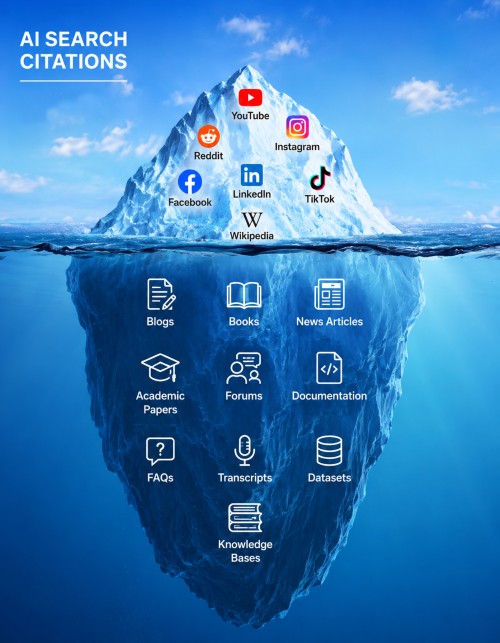
“Blogs are now the iceberg beneath the water.”
Lee Odden, TopRank Marketing
What doesn’t work with B2B content anymore
Sticking to the old scale-based playbook is definitely not the winning formula. Two findings from recent research should put that to rest for good.
- First: content volume has almost zero correlation with AI visibility. An Ahrefs analysis of 75,000 brands found that sheer page count correlates at roughly 0.194 with AI citation rates. While extensive topical coverage is valuable, per the query fan-out, publishing more doesn’t get you cited more on its own.
- Second: length doesn’t help either. According to Ahrefs, content length shows essentially zero correlation with AI citations, and 53% of all AI Overview citations go to pages under 1,000 words. The era of the 3,000-word SEO epic written to satisfy a keyword density target is over.
Bottom line: It is increasingly easy to create massive quantities of mediocre content, and increasingly useless.
So what does correlate to AI visibility? Original research, proprietary data, demonstrated expertise, a clear point of view, and structured content that can be extracted at the passage level without losing meaning. AI systems don’t rank pages, they evaluate passages. A tight, well-structured 800-word post with a specific claim and supporting data will outperform a sprawling generic overview almost every time.
The importance of fresh content
One area where blogs have a structural advantage over static website content: recency. ZipTie reports that AI-cited content is 25.7% fresher on average than traditionally ranked content, and that 76.4% of ChatGPT’s top-cited pages were updated within the last 30 days.
Here’s what that means for your blog strategy: a regular refresh cadence matters as much as net-new publishing. Updating a high-performing post with current statistics and recent references is more than just good hygiene: it’s a citation signal. According to ZipTie, a structured refresh strategy can increase citation rates by up to 292%.
Did I mention that maintaining your archive is a lot more cost-efficient than constantly pumping out new content and URLs?
The brand entity case
There’s one more dimension to this that doesn’t show up in traffic reports. Blogs don’t just generate citations directly; they build the brand entity that AI systems learn from over time.
Ahrefs found that branded web mentions correlate at 0.66-0.71 with AI visibility across ChatGPT, AI Mode, and AI Overviews. The more contexts in which your brand appears across the web – including third-party coverage, UGC, and citations of your original research – the more likely you are to surface in AI-generated responses.
Blogs are the upstream source for those mentions. When you publish original data or a well-argued point of view, you create the raw material that other sites cite, that practitioners share in forums, and that AI systems eventually learn to associate with your brand. As Otterly.AI puts it: “treat your blog like a source, not a sales brochure.”
So, are blogs worth it for today’s B2B marketing?
The honest answer is: it depends on what you’re publishing and why.
If your blog exists to crank out keyword-targeted posts that capture mid-funnel clicks, the ROI case is harder to make than it used to be. That model was already showing its age before AI search accelerated the decline.
But if your blog functions as an authoritative reference – publishing original research, covering specific use cases in depth, maintaining a regular refresh cadence, and building genuine topical authority – then the data supports continued investment.
Blogs might not drive the traffic they once did, but they’re as influential on AI citation and discovery as any other channel, and often require a relatively lower publishing lift.
Want to learn how you rejuvenate your blog performance, or launch a new one with instant momentum?

About the author
Nick Nelson is our friendly neighborhood writer-man. As the Associate Content Director at TopRank Marketing, he is on a mission to energize brand narratives with smart, fun, sharp wordplay. In his free time, Nick enjoys basking in the misery of Minnesota sports fandom, making cringeworthy puns, and smothering all types of food in buffalo sauce.