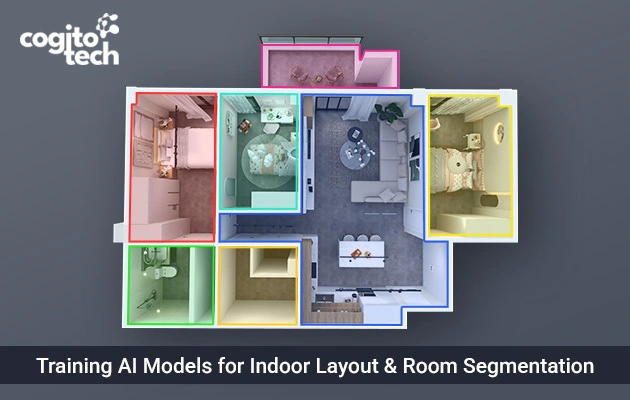
As organizations invest in indoor scene parsing and spatial AI, a common question emerges:
Who prepares these datasets, and what does the process involve?
Preparing datasets for indoor layout is more complex than simply collecting images. It requires a combination of semantic annotation, 3D scanning, geometric validation, metadata management, and human quality assurance. In this guide, we will explain who builds indoor layout datasets, how room segmentation data is created, what annotation techniques are used, and more.
Who prepares these datasets, and what does the process involve?
Preparing datasets for indoor layout is more complex than simply collecting images. It requires a combination of semantic annotation, 3D scanning, geometric validation, metadata management, and human quality assurance. In this guide, we will explain who builds indoor layout datasets, how room segmentation data is created, what annotation techniques are used, and more.
What is a Floor Plan in Indoor AI?
A floor plan is a two-dimensional (2D) scaled representation of a building level viewed from above. It represents the spatial arrangements of doors, rooms, windows, and other architectural features. Floor plans work as structured inputs for indoor navigation, digital twin creation, and BIM generation in indoor AI.
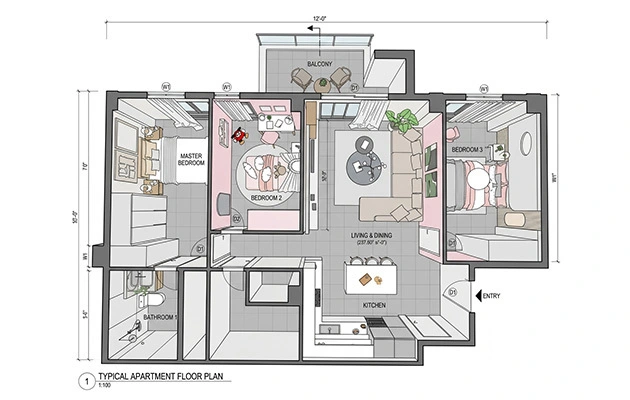
A floor plan contains four categories
- Room-boundary elements (RBEs) – doors, walls, partitions, and other structures that define room boundaries.
- Room-type elements (RTEs) – labels that indicate room functions, such as bedroom, kitchen, bathroom, or office.
- Floor-plan object elements (FOEs) – fixtures and furniture, including toilets, sinks, sofas, tables, and appliances.
- Floor-plan text elements (FTEs) – annotations, dimensions, symbols, and construction notes.
Simple vs. Complex Floor Plans
Floor plans fall into two categories
Simple Brochure-Type (SBT) Plans
These are simplified layouts designed for home buyers and renters. They contain clear room boundaries and labels but limited construction detail.
Complex Architectural-Type (CAT) Plans
These include dimensions, engineering symbols, structural annotations, and construction notes intended for architects, engineers, and BIM professionals.
What are Indoor Layout and Room Segmentation Datasets?
Although the terms are often used interchangeably, they represent different levels of spatial understanding.
| Dataset Type | Purpose |
| Indoor layout dataset | Detect walls, doors, windows, and structural boundaries |
| Room segmentation dataset | Assign labels such as kitchen, bedroom, or bathroom to each region |
| Indoor scene parsing dataset | Pixel-level labeling for objects and surfaces |
| RGB-D dataset | Combine RGB images with depth information for 3D comprehension |
Who Builds These Datasets?
Enterprises that need customer indoor layout and room segmentation datasets often work with expert annotation providers. Leading service providers support floor-plan vectorization, semantic segmentation, LiDAR labeling, and human-in-the-loop quality assurance workflows. These datasets are used to develop AI applications for indoor navigation, AR/VR visualization, space utilization assessment, etc.
What Should Enterprises Look for in an Indoor Layout and Room Segmentation AI Dataset Provider?
The right dataset service provider supports ensuring long-term AI success. Organizations should assess whether the provider offers:-
- Experience with RGB, RGB-D, and LiDAR data – the provider must have expertise in annotating multimodal datasets, as it allows AI models to understand both spatial depth and visual appearance.
- Support for custom room taxonomies – the chosen company must be able to create project-specific room categories and labeling guidelines to match your application requirements.
- 3D point-cloud annotation capabilities – for digital twins, indoor mapping, and scene understanding applications, it is essential to offer 3D spatial data.
- Human-in-the-loop quality assurance – there must be a team of expert reviewers who should validate annotations throughout the entire workflow to reduce labeling errors and improve accuracy.
- Inter-annotator agreement tracking – the service provider should measure annotation consistency with the use of quality metrics and deliver reliable datasets.
- Scalable annotation teams – the selected service partner should be capable of handling growing dataset volumes while maintaining quality and meeting deadlines.
- Secure data handling and compliance – the provider should follow strict security practices and comply with relevant data privacy and confidentiality standards.
- Export formats compatible with PyTorch, TensorFlow, ROS, and digital twin platforms – datasets must be delivered in formats that perfectly integrate with your AI training pipelines and deployment environments.
Specialized Data Annotation Companies
- Cogito Tech – Indoor layout annotation, room segmentation, floor-plan vectorization, LiDAR, and 3D point-cloud labeling.
- Anolytics – Custom AI dataset creation and annotation services for computer vision, spatial AI, and 3D data.
- Deepen AI – 3D and LiDAR annotation solutions for spatial understanding and mapping applications.
- SuperAnnotate – Collaborative annotation platform with segmentation, QA, and workflow management capabilities.
- Label Studio – Open-source annotation platform that supports custom indoor scene and floor-plan labeling workflows.
How Are Room Segmentation Datasets Created?

Building an indoor scene understanding dataset involves several coordinated stages.
1. Data Capture
Data is collected using:
- RGB cameras
- RGB-D sensors
- LiDAR scanners
- mobile mapping systems
- or 360° indoor imaging devices
While RGB images capture visual details such as colors and textures, depth sensors and LiDAR provide accurate geometric information, helping AI models to understand the three-dimensional structure of indoor spaces.
2. Scene Reconstruction
Once the data is captured, it is further reconstructed into a unified spatial representation. This step ensures that room boundaries and object locations remain geometrically consistent across modalities. The captured data is converted into:
- 3D point clouds
- Polygonal meshes
- or spatially aligned image sets
It creates a coherent digital representation of the indoor environment that serves as the foundation for annotation.
3. Room Boundary Annotation
After reconstruction, annotators identify the physical boundaries that define each room. In open-plan homes, boundaries may be defined using architectural cues such as flooring changes, ceiling variations, or furniture arrangements. Annotators identify:
- walls
- doors
- windows
- openings
- and transitions between rooms
In open-plan environments where physical walls may be absent, annotators rely on architectural cues such as flooring changes, ceiling variations, furniture placement, and functional layouts to establish accurate room boundaries.
4. Semantic Room Labeling
Once the spatial boundaries are established, each room is assigned a semantic label based on its function. Enterprises often require custom room taxonomies tailored to hospitality, healthcare, retail, or industrial facilities. Each region is assigned a room category such as:
- kitchen
- bedroom
- bathroom
- living room
- office
- corridor
- or utility area
5. Quality Validation
The final stage checks:
- geometric consistency
- label completeness
- cross-view alignment
- and annotation accuracy
For enterprise-scale projects, this process may involve validating thousands of rooms and millions of annotated pixels or 3D points before the dataset is delivered for model training.
Why Indoor Datasets Are Difficult to Build
Indoor scene understanding is significantly more challenging than outdoor object detection because of the complexity and variability of indoor environments.
Occlusions
Curtains, furniture, and appliances often block room corners and walls, making boundary annotation difficult.
Open-Plan Layouts
Modern homes combine kitchen, dining, and living areas into a single space that creates ambiguity in room segmentation.
Lighting Variation
Reflections, shadows, sunlight, and artificial lighting can change the appearance of the same room throughout the day.
Multi-Floor Buildings
It is really difficult to preserve vertical connectivity between staircases, floors, elevators, and corridors.
Annotation Ambiguity
Even experts may disagree on whether a space should be labeled as a dining area, living room extension, lobby, or corridor.
Different Applications Need Different Annotations
A key insight from floor-plan analysis research is that not all applications require the same annotations. This means that dataset creation does not work with a one-size-fits-all approach; rather, it needs to be driven by the target application.
| Application | Annotation Required | Why is it Required |
| Indoor Navigation | Doors, walls, stairways, corridors | It helps the AI system to understand navigable paths, obstacles, and connectivity between spaces. |
| Space Utilization Analytics | Furniture, room types, and occupancy zones | It helps assess how spaces are used to optimize layouts and resource allocation. |
| 3D BIM Generation | Doors, windows, and structural elements | It creates precise digital building models for construction, design, and facility management. |
| VR/AR Building Visualization | Room boundaries, fixtures, and textures | It produces an interactive and realistic virtual environment for visualization and training. |
| Digital Twin Applications | Structural elements, room semantics, and furniture utilities | It presents real-time virtual representations of buildings for monitoring and simulation. |
Conclusion
The success of indoor layout and room segmentation AI depends on the quality of the data behind it. Well-annotated datasets help AI models to understand indoor spaces accurately, making them essential for applications such as digital twins, smart buildings, BIM, indoor navigation, and space utilization analytics. Choosing the right dataset partner ensures scalable, high-quality data that supports reliable AI performance.
Frequently Asked Questions
Indoor layout datasets are created by research institutions for benchmarking and by leading data annotation companies.
Room segmentation labels entire room regions (kitchen, bedroom, etc.), while scene parsing performs pixel-level labeling of all objects and surfaces within the scene.
Annotators use architectural cues such as flooring changes, ceiling variations, wall openings, and furniture layout to define functional room boundaries.
Human reviewers resolve ambiguous layouts, verify geometric consistency, and ensure that AI-generated annotations meet the accuracy requirements of real-world deployment.