In this article, you will learn a clear, practical framework to diagnose why a language model underperforms and how to validate likely causes quickly.
Topics we will cover include:
- Five common failure modes and what they look like
- Concrete diagnostics you can run immediately
- Pragmatic mitigation tips for each failure
Let’s not waste any more time.
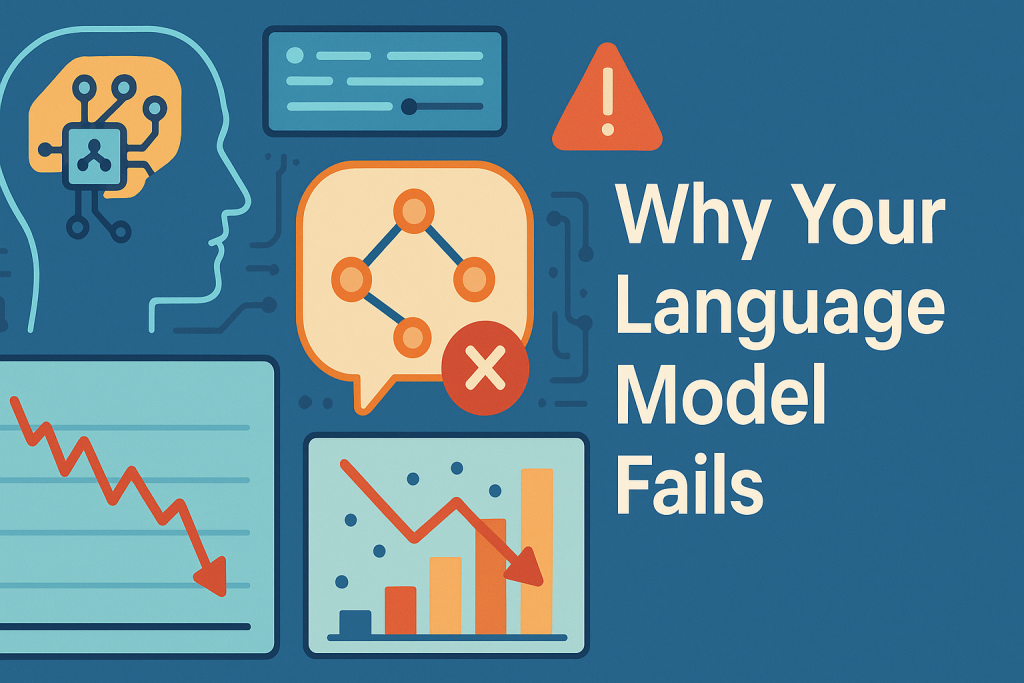
How to Diagnose Why Your Language Model Fails
Image by Editor
Introduction
Language models, as incredibly useful as they are, are not perfect, and they may fail or exhibit undesired performance due to a variety of factors, such as data quality, tokenization constraints, or difficulties in correctly interpreting user prompts.
This article adopts a diagnostic standpoint and explores a 5-point framework for understanding why a language model — be it a large, general-purpose large language model (LLM), or a small, domain-specific one — might fail to perform well.
Diagnostic Points for a Language Model
In the following sections, we will uncover common reasons for failure in language models, briefly describing each one and providing practical tips for diagnosis and how to overcome them.
1. Poor Quality or Insufficient Training Data
Just like other machine learning models such as classifiers and regressors, a language model’s performance greatly depends on the amount and quality of the data used to train it, with one not-so-subtle nuance: language models are trained on very large datasets or text corpora, often spanning from many thousands to millions or billions of documents.
When the language model generates outputs that are incoherent, factually incorrect, or nonsensical (hallucinations) even for simple prompts, chances are the quality or amount of training data used is not sufficient. Specific causes could include a training corpus that is too small, outdated, or full of noisy, biased, or irrelevant text. In smaller language models, the consequences of this data-related issue also include missing domain vocabulary in generated answers.
To diagnose data issues, inspect a sufficiently representative portion of the training data if possible, analyzing properties such as relevance, coverage, and topic balance. Running targeted prompts about known facts and using rare terms to identify knowledge gaps is also an effective diagnostic strategy. Finally, keep a trusted reference dataset handy to compare generated outputs with information contained there.
When the language model generates outputs that are incoherent, factually incorrect, or nonsensical (hallucinations) even for simple prompts, chances are the quality or amount of training data used is not sufficient.
2. Tokenization or Vocabulary Limitations
Suppose that by analyzing the inner behavior of a freshly trained language model, it appears to struggle with certain words or symbols in the vocabulary, breaking them into tokens in an unexpected manner, or failing to properly represent them. This may stem from the tokenizer used in conjunction with the model, which does not align appropriately with the target domain, yielding far-from-ideal treatment of uncommon words, technical jargon, and so on.
Diagnosing tokenization and vocabulary issues involves inspecting the tokenizer, namely by checking how it splits domain-specific terms. Utilizing metrics such as perplexity or log-likelihood on a held-out subset can quantify how well the model represents domain text, and testing edge cases — e.g., non-Latin scripts or words and symbols containing uncommon Unicode characters — helps pinpoint root causes related to token management.
3. Prompt Instability and Sensitivity
A small change in the wording of a prompt, its punctuation, or the order of multiple nonsequential instructions can lead to significant changes in the quality, accuracy, or relevance of the generated output. That is prompt instability and sensitivity: the language model becomes overly sensitive to how the prompt is articulated, often because it has not been properly fine-tuned for effective, fine-grained instruction following, or because there are inconsistencies in the training data.
The best way to diagnose prompt instability is experimentation: try a battery of paraphrased prompts whose overall meaning is equivalent, and compare how consistent the results are with each other. Likewise, try to identify patterns under which a prompt results in a stable versus an unstable response.
4. Context Windows and Memory Constraints
When a language model fails to use context introduced in earlier interactions as part of a conversation with the user, or misses earlier context in a long document, it can start exhibiting undesired behavior patterns such as repeating itself or contradicting content it “said” before. The amount of context a language model can retain, or context window, is largely determined by memory limitations. Accordingly, context windows that are too short may truncate relevant information and drop earlier cues, whereas overly lengthy contexts can hinder tracking of long-range dependencies.
Diagnosing issues related to context windows and memory limitations entails iteratively evaluating the language model with increasingly longer inputs, carefully measuring how much it can correctly recall from earlier parts. When available, attention visualizations are a powerful resource to check whether relevant tokens are attended across long ranges in the text.
5. Domain and Temporal Drifts
Once deployed, a language model is still not exempt from providing wrong answers — for example, answers that are outdated, that miss recently coined terms or concepts, or that fail to reflect evolving domain knowledge. This means the training data might have become anchored in the past, still relying on a snapshot of the world that has already changed; consequently, changes in facts inevitably lead to knowledge degradation and performance degradation. This is analogous to data and concept drifts in other types of machine learning systems.
To diagnose temporal or domain-related drifts, continuously compile benchmarks of new events, terms, articles, and other relevant materials in the target domain. Track the accuracy of responses using these new language items compared to responses related to stable or timeless knowledge, and see if there are significant differences. Additionally, schedule periodic performance-monitoring schemes based on “fresh queries.”
Final Thoughts
This article examined several common reasons why language models may fail to perform well, from data quality issues to poor management of context and drifts in production caused by changes in factual knowledge. Language models are inevitably complex; therefore, understanding possible reasons for failure and how to diagnose them is key to making them more robust and effective.