• About Us
  • Disclaimer
  • Contact Us
  • Privacy Policy
Thursday, March 12, 2026
mGrowTech
No Result
View All Result
  • Technology And Software
    • Account Based Marketing
    • Channel Marketing
    • Marketing Automation
      • Al, Analytics and Automation
      • Ad Management
  • Digital Marketing
    • Social Media Management
    • Google Marketing
  • Direct Marketing
    • Brand Management
    • Marketing Attribution and Consulting
  • Mobile Marketing
  • Event Management
  • PR Solutions
  • Technology And Software
    • Account Based Marketing
    • Channel Marketing
    • Marketing Automation
      • Al, Analytics and Automation
      • Ad Management
  • Digital Marketing
    • Social Media Management
    • Google Marketing
  • Direct Marketing
    • Brand Management
    • Marketing Attribution and Consulting
  • Mobile Marketing
  • Event Management
  • PR Solutions
No Result
View All Result
mGrowTech
No Result
View All Result
Home Al, Analytics and Automation

How to Create AI-ready APIs?

Josh by Josh
November 3, 2025
in Al, Analytics and Automation
0


Postman recently released a comprehensive checklist and developer guide for building AI-ready APIs, highlighting a simple truth: even the most powerful AI models are only as good as the data they receive—and that data comes through your APIs. If your endpoints are inconsistent, unclear, or unreliable, models waste time fixing bad inputs instead of producing insight. Postman’s playbook distills years of best practices into practical steps that help teams make their APIs predictable, machine-readable, and dependable for AI workloads.

This article summarizes the key ideas from that playbook. As we move into a world where Agents—not humans—will make purchases, compare options, and interact with services, APIs must evolve. Unlike developers, Agents can’t compensate for messy docs or ambiguous behavior. They rely on standardized patterns and automatically generated, machine-consumable documentation that stays in sync with your schema. The goal is simple: create APIs that humans and AI agents can understand instantly, so your systems can scale smarter and unlock their full potential.

Machine consumable metadata

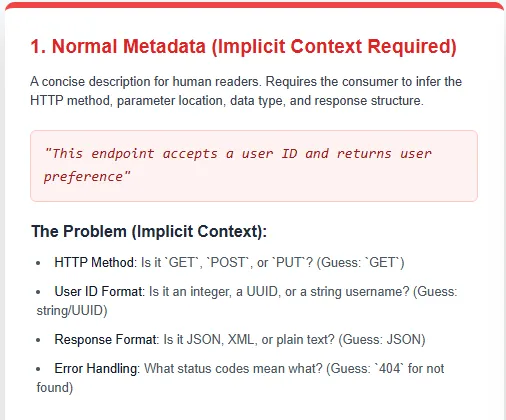
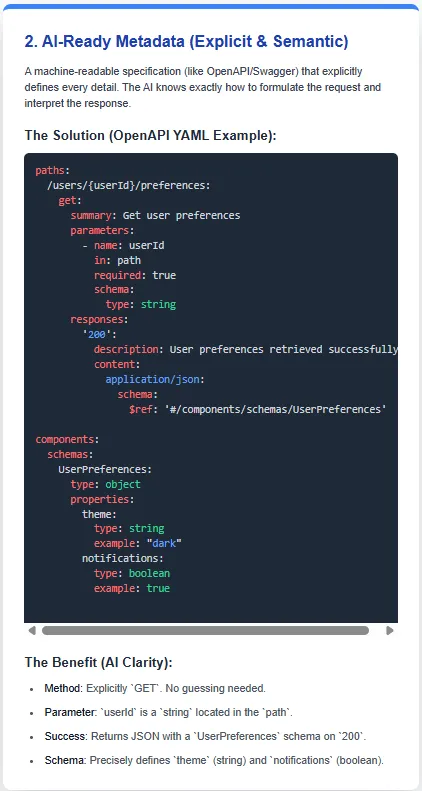
Humans can infer missing details from vague API docs, but AI agents can’t—they rely entirely on explicit, machine-readable metadata. Instead of saying “this endpoint returns user preferences,” an AI-ready API must define everything: request type, parameter schema, response structure, and object definitions. Clear metadata like the example above removes ambiguity, ensures agents don’t guess, and makes APIs fully understandable to machines.
Rich Error Semantics

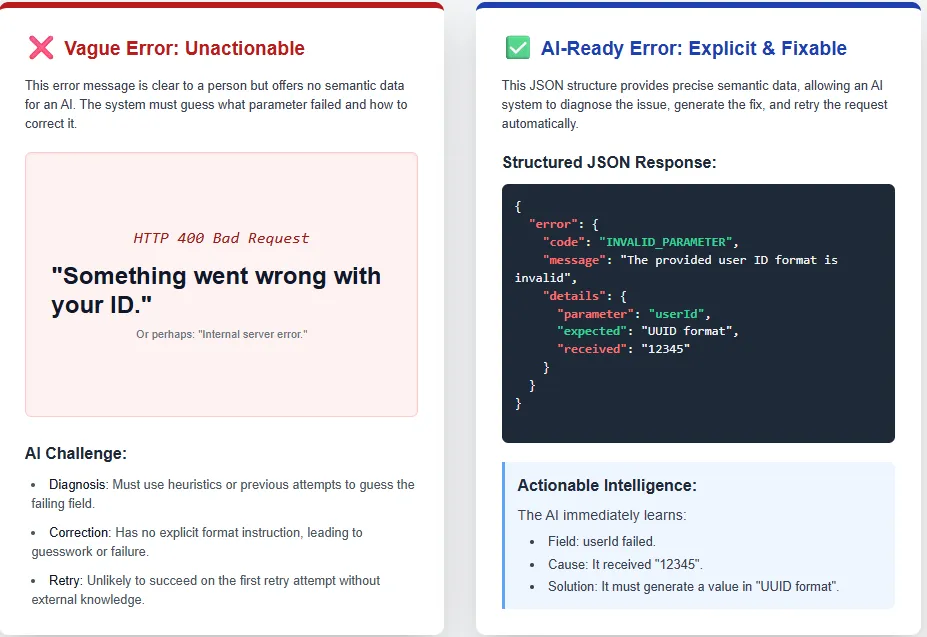
Developers can interpret vague errors like “Something went wrong,” but AI agents can’t—they need precise, structured guidance. AI-ready APIs must clearly spell out what failed, why it failed, and how to fix it. Rich error metadata with fields like code, message, expected, and received removes guesswork and enables agents to self-correct instead of getting stuck.
Introspection Capabilities

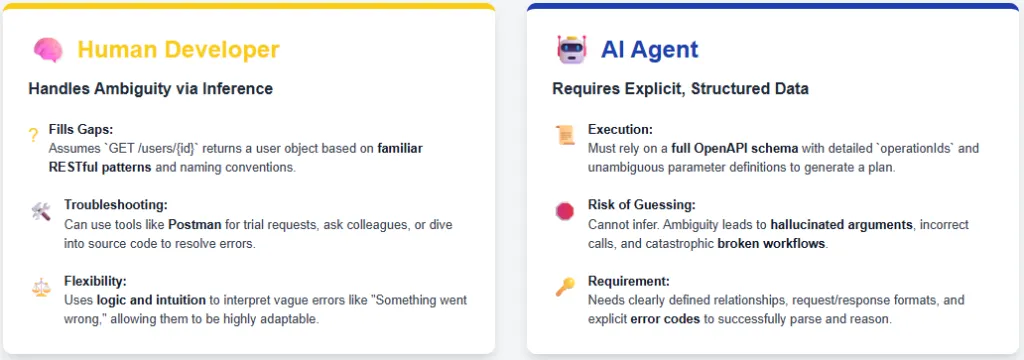
For APIs to be AI-ready, they must move beyond human-centric, vague documentation. Unlike developers who can infer missing details using context and RESTful conventions, AI agents rely entirely on structured data for planning and execution. This means APIs must provide complete introspection through a full schema, explicitly defining all endpoints, parameters, data schemas, and error codes. Without this clarity, AI systems are forced to guess, which inevitably leads to broken workflows and unreliable, hallucinated behavior.
Consistent Naming Patterns

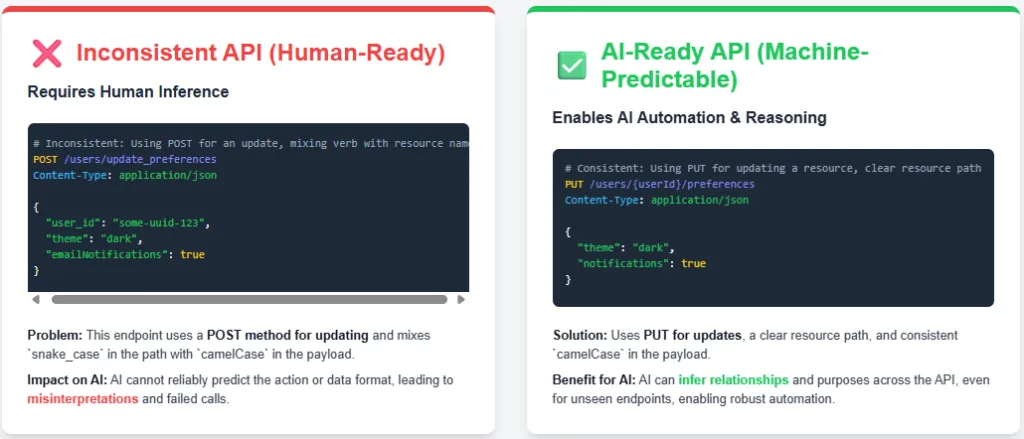
AI systems rely on consistent patterns, so predictable naming conventions make your API far easier for them to understand and navigate. When endpoints and fields follow clear, uniform structures—like proper REST methods and consistent casing—AI can infer relationships and behaviors without guesswork. This reduces ambiguity and enables more accurate automation, reasoning, and integration across your entire API.
Predictable behaviour

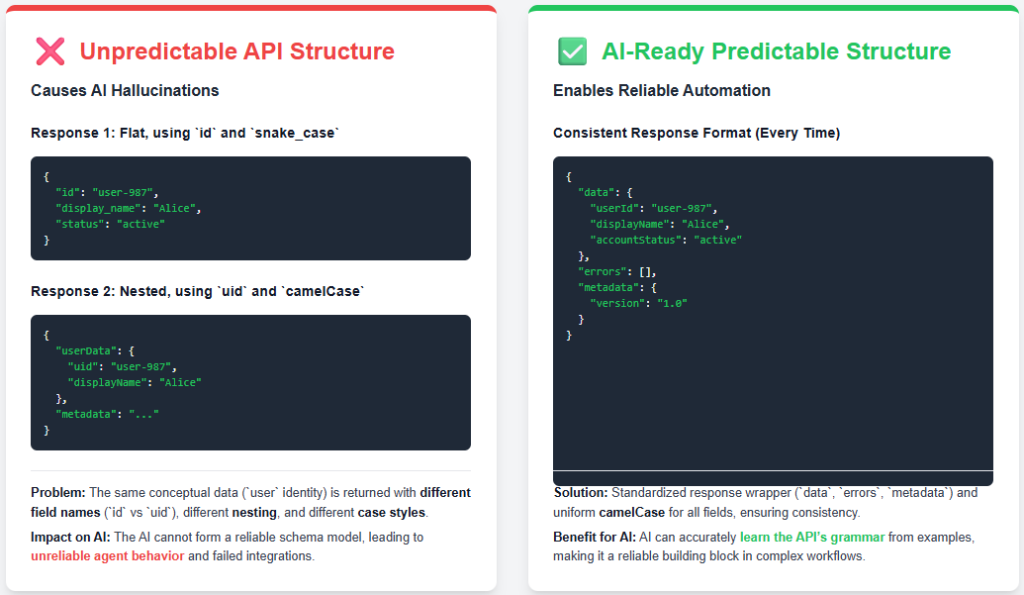
AI agents need strict consistency—same inputs should always produce the same structure, format, and fields. Humans can troubleshoot inconsistent responses using intuition, but AI can’t assume or investigate; it only learns from the patterns you provide. If naming, nesting, or errors vary across endpoints, the agent becomes unreliable or breaks entirely. To be AI-ready, your API must enforce predictable responses, uniform naming, consistent error handling, and zero hidden edge cases. In short: inconsistent inputs lead to inconsistent agent behavior.
Proper documentation

Humans can look things up when docs are unclear, but AI agents can’t—they only know what your API explicitly tells them. Without clear, complete documentation, an agent can’t discover endpoints, understand parameters, predict responses, or recover from errors. Good documentation isn’t optional for AI-ready APIs—it’s the only way agents can learn and reliably interact with your system.

Reliable and fast

AI agents act as orchestrators, making rapid and often parallel API calls—so your API’s speed and reliability directly impact their performance. Humans can wait out slow responses or retry manually, but agents will time out, fail, or break entire workflows. In fast, automated environments, an AI system is only as strong as the APIs it relies on. If your API can’t keep up, neither can your AI.

Discoverability

Humans can track down missing APIs through wikis, chats, code, or intuition—but AI agents can’t. If an API isn’t clearly published with structured, searchable metadata, it simply doesn’t exist to them. AI systems depend on standardized, discoverable specs and examples to understand how to use an API. Making your API visible, accessible, and well-indexed—through platforms like the Postman API Network—ensures both developers and agents can reliably find and integrate it.


I am a Civil Engineering Graduate (2022) from Jamia Millia Islamia, New Delhi, and I have a keen interest in Data Science, especially Neural Networks and their application in various areas.

🙌 Follow MARKTECHPOST: Add us as a preferred source on Google.


Source_link

READ ALSO

New MIT class uses anthropology to improve chatbots | MIT News

How to Design a Streaming Decision Agent with Partial Reasoning, Online Replanning, and Reactive Mid-Execution Adaptation in Dynamic Environments

Related Posts

New MIT class uses anthropology to improve chatbots | MIT News
Al, Analytics and Automation

New MIT class uses anthropology to improve chatbots | MIT News

March 12, 2026
How to Design a Streaming Decision Agent with Partial Reasoning, Online Replanning, and Reactive Mid-Execution Adaptation in Dynamic Environments
Al, Analytics and Automation

How to Design a Streaming Decision Agent with Partial Reasoning, Online Replanning, and Reactive Mid-Execution Adaptation in Dynamic Environments

March 12, 2026
3 Questions: On the future of AI and the mathematical and physical sciences | MIT News
Al, Analytics and Automation

3 Questions: On the future of AI and the mathematical and physical sciences | MIT News

March 12, 2026
NVIDIA Releases Nemotron 3 Super: A 120B Parameter Open-Source Hybrid Mamba-Attention MoE Model Delivering 5x Higher Throughput for Agentic AI
Al, Analytics and Automation

NVIDIA Releases Nemotron 3 Super: A 120B Parameter Open-Source Hybrid Mamba-Attention MoE Model Delivering 5x Higher Throughput for Agentic AI

March 11, 2026
A better method for planning complex visual tasks | MIT News
Al, Analytics and Automation

A better method for planning complex visual tasks | MIT News

March 11, 2026
Google AI Introduces Gemini Embedding 2: A Multimodal Embedding Model that Lets Your Bring Text, Images, Video, Audio, and Docs into the Embedding Space
Al, Analytics and Automation

Google AI Introduces Gemini Embedding 2: A Multimodal Embedding Model that Lets Your Bring Text, Images, Video, Audio, and Docs into the Embedding Space

March 11, 2026
Next Post
Moving past speculation: How deterministic CPUs deliver predictable AI performance

Moving past speculation: How deterministic CPUs deliver predictable AI performance

POPULAR NEWS

Trump ends trade talks with Canada over a digital services tax

Trump ends trade talks with Canada over a digital services tax

June 28, 2025
Communication Effectiveness Skills For Business Leaders

Communication Effectiveness Skills For Business Leaders

June 10, 2025
15 Trending Songs on TikTok in 2025 (+ How to Use Them)

15 Trending Songs on TikTok in 2025 (+ How to Use Them)

June 18, 2025
App Development Cost in Singapore: Pricing Breakdown & Insights

App Development Cost in Singapore: Pricing Breakdown & Insights

June 22, 2025
Google announced the next step in its nuclear energy plans 

Google announced the next step in its nuclear energy plans 

August 20, 2025

EDITOR'S PICK

Amazon sells MOBA March of Giants to Ubisoft

Amazon sells MOBA March of Giants to Ubisoft

December 15, 2025
Google Maps can tell Polestar 4 drivers when to merge lanes

Google Maps can tell Polestar 4 drivers when to merge lanes

November 6, 2025
How Brands Use Moment Marketing to Connect with Audiences

How Brands Use Moment Marketing to Connect with Audiences

August 18, 2025

The Scoop: Astronomer skyrocketed to fame as an embarrassing meme. What now?

July 22, 2025

About

We bring you the best Premium WordPress Themes that perfect for news, magazine, personal blog, etc. Check our landing page for details.

Follow us

Categories

  • Account Based Marketing
  • Ad Management
  • Al, Analytics and Automation
  • Brand Management
  • Channel Marketing
  • Digital Marketing
  • Direct Marketing
  • Event Management
  • Google Marketing
  • Marketing Attribution and Consulting
  • Marketing Automation
  • Mobile Marketing
  • PR Solutions
  • Social Media Management
  • Technology And Software
  • Uncategorized

Recent Posts

  • Boosting disaster resilience with Google’s Groundsource
  • Search Has Changed. And So Have We.
  • Global Customer Loyalty Report 2026
  • How to find insights on social & beyond
  • About Us
  • Disclaimer
  • Contact Us
  • Privacy Policy
No Result
View All Result
  • Technology And Software
    • Account Based Marketing
    • Channel Marketing
    • Marketing Automation
      • Al, Analytics and Automation
      • Ad Management
  • Digital Marketing
    • Social Media Management
    • Google Marketing
  • Direct Marketing
    • Brand Management
    • Marketing Attribution and Consulting
  • Mobile Marketing
  • Event Management
  • PR Solutions