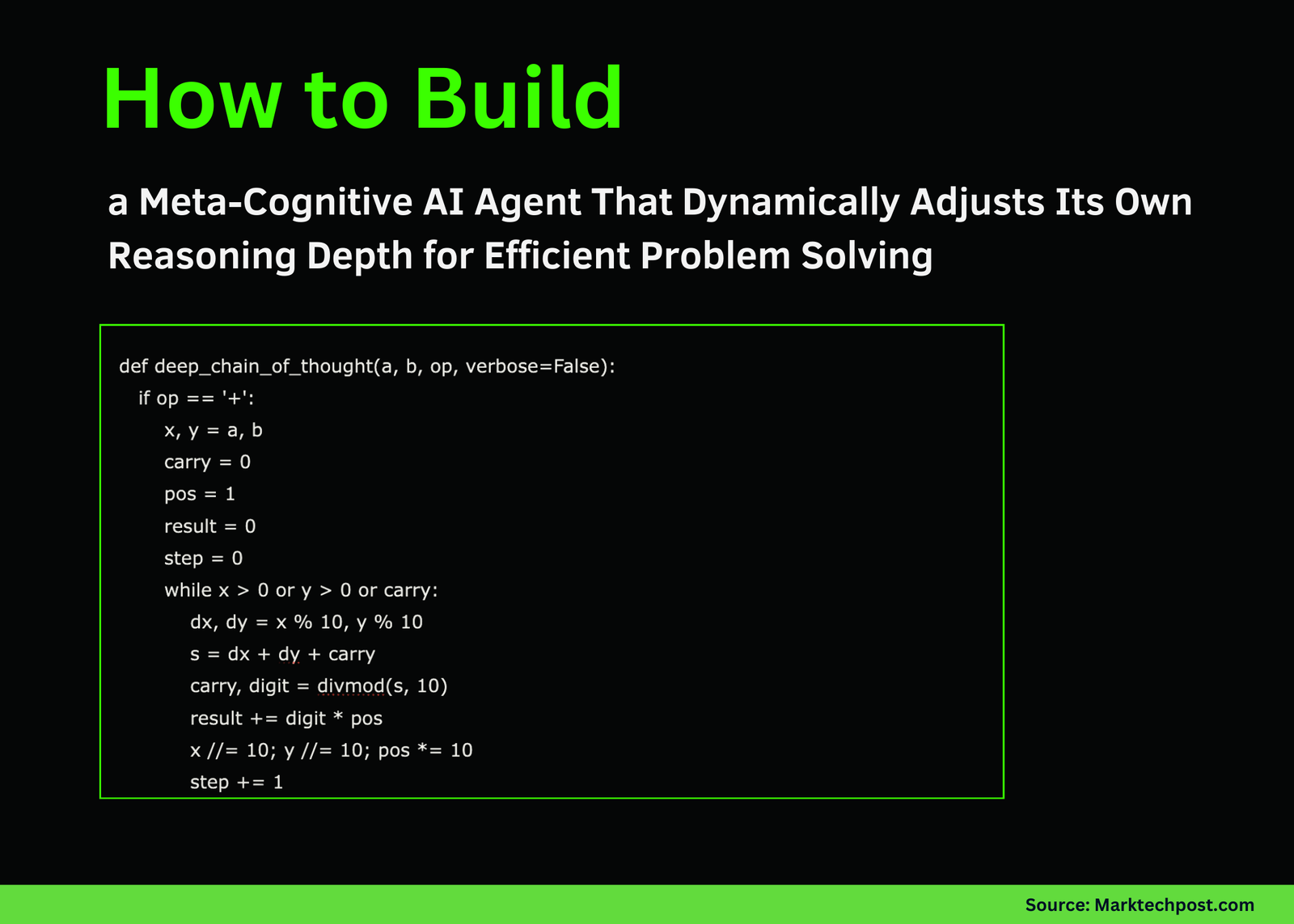
In this tutorial, we build an advanced meta-cognitive control agent that learns how to regulate its own depth of thinking. We treat reasoning as a spectrum, ranging from fast heuristics to deep chain-of-thought to precise tool-like solving, and we train a neural meta-controller to decide which mode to use for each task. By optimizing the trade-off between accuracy, computation cost, and a limited reasoning budget, we explore how an agent can monitor its internal state and adapt its reasoning strategy in real time. Through each snippet, we experiment, observe patterns, and understand how meta-cognition emerges when an agent learns to think about its own thinking. Check out the FULL CODE NOTEBOOK.
import random
import numpy as np
import torch
import torch.nn as nn
import torch.optim as optim


OPS = ['+', '*']


def make_task():
   op = random.choice(OPS)
   if op == '+':
       a, b = random.randint(1, 99), random.randint(1, 99)
   else:
       a, b = random.randint(2, 19), random.randint(2, 19)
   return a, b, op


def true_answer(a, b, op):
   return a + b if op == '+' else a * b


def true_difficulty(a, b, op):
   if op == '+' and a <= 30 and b <= 30:
       return 0
   if op == '*' and a <= 10 and b <= 10:
       return 1
   return 2


def heuristic_difficulty(a, b, op):
   score = 0
   if op == '*':
       score += 0.6
   score += max(a, b) / 100.0
   return min(score, 1.0)


def fast_heuristic(a, b, op):
   if op == '+':
       base = a + b
       noise = random.choice([-2, -1, 0, 0, 0, 1, 2, 3])
   else:
       base = int(0.8 * a * b)
       noise = random.choice([-5, -3, 0, 0, 2, 5, 8])
   return base + noise, 0.5


def deep_chain_of_thought(a, b, op, verbose=False):
   if op == '+':
       x, y = a, b
       carry = 0
       pos = 1
       result = 0
       step = 0
       while x > 0 or y > 0 or carry:
           dx, dy = x % 10, y % 10
           s = dx + dy + carry
           carry, digit = divmod(s, 10)
           result += digit * pos
           x //= 10; y //= 10; pos *= 10
           step += 1
   else:
       result = 0
       step = 0
       for i, d in enumerate(reversed(str(b))):
           row = a * int(d) * (10 ** i)
           result += row
           step += 1
   return result, max(2.0, 0.4 * step)


def tool_solver(a, b, op):
   return eval(f"{a}{op}{b}"), 1.2


ACTION_NAMES = ["fast", "deep", "tool"]
We set up the world our meta-agent operates in. We generate arithmetic tasks, define ground-truth answers, estimate difficulty, and implement three different reasoning modes. As we run it, we observe how each solver behaves differently in terms of accuracy and computational cost, which form the foundation of the agent’s decision space. Check out the FULL CODE NOTEBOOK.
def encode_state(a, b, op, rem_budget, error_ema, last_action):
   a_n = a / 100.0
   b_n = b / 100.0
   op_plus = 1.0 if op == '+' else 0.0
   op_mul = 1.0 - op_plus
   diff_hat = heuristic_difficulty(a, b, op)
   rem_n = rem_budget / MAX_BUDGET
   last_onehot = [0.0, 0.0, 0.0]
   if last_action is not None:
       last_onehot[last_action] = 1.0
   feats = [
       a_n, b_n, op_plus, op_mul,
       diff_hat, rem_n, error_ema
   ] + last_onehot
   return torch.tensor(feats, dtype=torch.float32, device=device)


STATE_DIM = 10
N_ACTIONS = 3


class PolicyNet(nn.Module):
   def __init__(self, state_dim, hidden=48, n_actions=3):
       super().__init__()
       self.net = nn.Sequential(
           nn.Linear(state_dim, hidden),
           nn.Tanh(),
           nn.Linear(hidden, hidden),
           nn.Tanh(),
           nn.Linear(hidden, n_actions)
       )
   def forward(self, x):
       return self.net(x)


policy = PolicyNet(STATE_DIM, hidden=48, n_actions=N_ACTIONS).to(device)
optimizer = optim.Adam(policy.parameters(), lr=3e-3)
We encode each task into a structured state that captures operands, operation type, predicted difficulty, remaining budget, and recent performance. We then define a neural policy network that maps this state to a probability distribution over actions. As we work through it, we see how the policy becomes the core mechanism through which the agent learns to regulate its thinking. Check out the FULL CODE NOTEBOOK.
GAMMA = 0.98
COST_PENALTY = 0.25
MAX_BUDGET = 25.0
EPISODES = 600
STEPS_PER_EP = 20
ERROR_EMA_DECAY = 0.9


def run_episode(train=True):
   log_probs = []
   rewards = []
   info = []
   rem_budget = MAX_BUDGET
   error_ema = 0.0
   last_action = None


   for _ in range(STEPS_PER_EP):
       a, b, op = make_task()
       state = encode_state(a, b, op, rem_budget, error_ema, last_action)
       logits = policy(state)
       dist = torch.distributions.Categorical(logits=logits)
       action = dist.sample() if train else torch.argmax(logits)
       act_idx = int(action.item())


       if act_idx == 0:
           pred, cost = fast_heuristic(a, b, op)
       elif act_idx == 1:
           pred, cost = deep_chain_of_thought(a, b, op, verbose=False)
       else:
           pred, cost = tool_solver(a, b, op)


       correct = (pred == true_answer(a, b, op))
       acc_reward = 1.0 if correct else 0.0
       budget_penalty = 0.0


       rem_budget -= cost
       if rem_budget < 0:
           budget_penalty = -1.5 * (abs(rem_budget) / MAX_BUDGET)


       step_reward = acc_reward - COST_PENALTY * cost + budget_penalty
       rewards.append(step_reward)


       if train:
           log_probs.append(dist.log_prob(action))


       err = 0.0 if correct else 1.0
       error_ema = ERROR_EMA_DECAY * error_ema + (1 - ERROR_EMA_DECAY) * err
       last_action = act_idx


       info.append({
           "correct": correct,
           "cost": cost,
           "difficulty": true_difficulty(a, b, op),
           "action": act_idx
       })


   if train:
       returns = []
       G = 0.0
       for r in reversed(rewards):
           G = r + GAMMA * G
           returns.append(G)
       returns = list(reversed(returns))
       returns_t = torch.tensor(returns, dtype=torch.float32, device=device)
       baseline = returns_t.mean()
       adv = returns_t - baseline
       loss = -(torch.stack(log_probs) * adv).mean()
       optimizer.zero_grad()
       loss.backward()
       optimizer.step()


   return rewards, info
We implement the heart of learning using the REINFORCE policy gradient algorithm. We run multi-step episodes, collect log-probabilities, accumulate rewards, and compute returns. As we execute this part, we watch the meta-controller adjust its strategy by reinforcing decisions that balance accuracy with cost. Check out the FULL CODE NOTEBOOK.
print("Training meta-cognitive controller...")
for ep in range(EPISODES):
   rewards, _ = run_episode(train=True)
   if (ep + 1) % 100 == 0:
       print(f" episode {ep+1:4d} | avg reward {np.mean(rewards):.3f}")


def evaluate(n_episodes=50):
   all_actions = {0: [0,0,0], 1: [0,0,0], 2: [0,0,0]}
   stats = {0: {"n":0,"acc":0,"cost":0},
            1: {"n":0,"acc":0,"cost":0},
            2: {"n":0,"acc":0,"cost":0}}


   for _ in range(n_episodes):
       _, info = run_episode(train=False)
       for step in info:
           d = step["difficulty"]
           a_idx = step["action"]
           all_actions[d][a_idx] += 1
           stats[d]["n"] += 1
           stats[d]["acc"] += 1 if step["correct"] else 0
           stats[d]["cost"] += step["cost"]


   for d in [0,1,2]:
       if stats[d]["n"] == 0:
           continue
       n = stats[d]["n"]
       print(f"Difficulty {d}:")
       print(" action counts [fast, deep, tool]:", all_actions[d])
       print(" accuracy:", stats[d]["acc"]/n)
       print(" avg cost:", stats[d]["cost"]/n)
       print()


print("Policy behavior by difficulty:")
evaluate()
We train the meta-cognitive agent over hundreds of episodes and evaluate its behavior across difficulty levels. We observe how the policy evolves, using fast heuristics for simple tasks while resorting to deeper reasoning for harder ones. As we analyze the outputs, we understand how training shapes the agent’s reasoning choices. Check out the FULL CODE NOTEBOOK.
print("\nExample hard task with meta-selected thinking mode:")
a, b, op = 47, 18, '*'
state = encode_state(a, b, op, MAX_BUDGET, 0.3, None)
with torch.no_grad():
   logits = policy(state)
   act = int(torch.argmax(logits).item())


print(f"Task: {a} {op} {b}")
print("Chosen mode:", ACTION_NAMES[act])


if act == 1:
   pred, cost = deep_chain_of_thought(a, b, op, verbose=True)
elif act == 0:
   pred, cost = fast_heuristic(a, b, op)
   print("Fast heuristic:", pred)
else:
   pred, cost = tool_solver(a, b, op)
   print("Tool solver:", pred)


print("True:", true_answer(a,b,op), "| cost:", cost)
We inspect a detailed reasoning trace for a hard example chosen by the trained policy. We see the agent confidently pick a mode and walk through the reasoning steps, allowing us to witness its meta-cognitive behavior in action. As we test different tasks, we appreciate how the model adapts its thinking based on context.
In conclusion, we have seen how a neural controller can learn to dynamically choose the most effective reasoning pathway based on the task’s difficulty and the constraints of the moment. We observe how the agent gradually discovers when quick heuristics are sufficient, when deeper reasoning is necessary, and when calling a precise solver is worth the cost. Through this process, we experience how metacognitive control transforms decision-making, leading to more efficient and adaptable reasoning systems.
Check out the FULL CODE NOTEBOOK. Feel free to check out our GitHub Page for Tutorials, Codes and Notebooks. Also, feel free to follow us on Twitter and don’t forget to join our 100k+ ML SubReddit and Subscribe to our Newsletter. Wait! are you on telegram? now you can join us on telegram as well.

Asif Razzaq is the CEO of Marktechpost Media Inc.. As a visionary entrepreneur and engineer, Asif is committed to harnessing the potential of Artificial Intelligence for social good. His most recent endeavor is the launch of an Artificial Intelligence Media Platform, Marktechpost, which stands out for its in-depth coverage of machine learning and deep learning news that is both technically sound and easily understandable by a wide audience. The platform boasts of over 2 million monthly views, illustrating its popularity among audiences.