• About Us
  • Disclaimer
  • Contact Us
  • Privacy Policy
Friday, May 29, 2026
mGrowTech
No Result
View All Result
  • Technology And Software
    • Account Based Marketing
    • Channel Marketing
    • Marketing Automation
      • Al, Analytics and Automation
      • Ad Management
  • Digital Marketing
    • Social Media Management
    • Google Marketing
  • Direct Marketing
    • Brand Management
    • Marketing Attribution and Consulting
  • Mobile Marketing
  • Event Management
  • PR Solutions
  • Technology And Software
    • Account Based Marketing
    • Channel Marketing
    • Marketing Automation
      • Al, Analytics and Automation
      • Ad Management
  • Digital Marketing
    • Social Media Management
    • Google Marketing
  • Direct Marketing
    • Brand Management
    • Marketing Attribution and Consulting
  • Mobile Marketing
  • Event Management
  • PR Solutions
No Result
View All Result
mGrowTech
No Result
View All Result
Home Al, Analytics and Automation

Hexo Labs Open-Sources SIA: A Self-Improving Agent That Updates Both the Harness and the Model Weights

Josh by Josh
May 29, 2026
in Al, Analytics and Automation
0
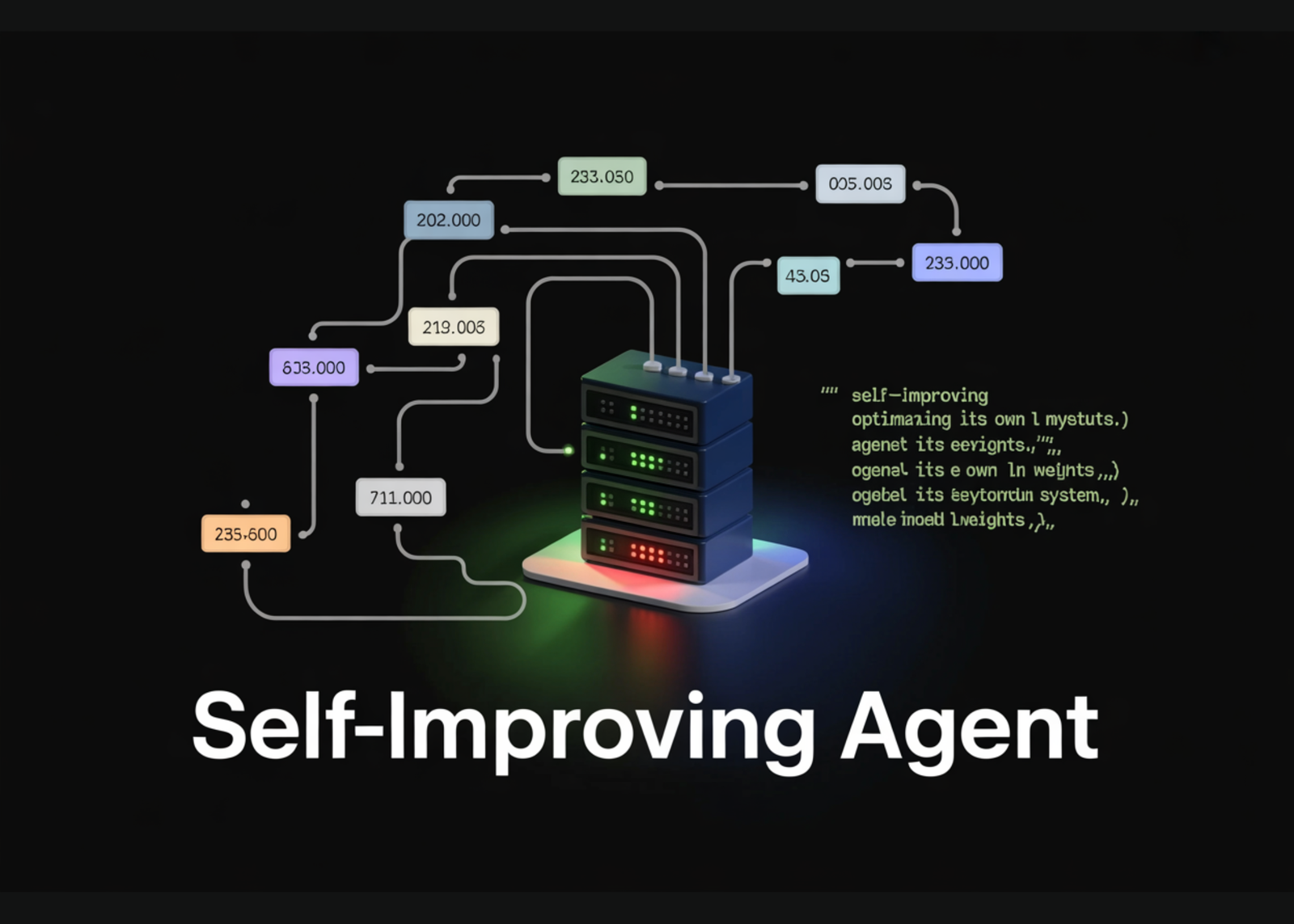
Hexo Labs Open-Sources SIA: A Self-Improving Agent That Updates Both the Harness and the Model Weights


Most AI agents stop improving once a human stops tuning them. The model is fixed. The scaffold around it is fixed. Hexo Labs wants to move both at once. It released SIA (Self-Improving AI) this week as an open-source framework under an MIT license.

The core claim of this research is narrow but concrete. SIA edits both the agent’s scaffold and the model’s weights inside one self-improving loop.

What is SIA (Self-Improving AI)

SIA splits a task-specific agent into two parts. The first is the harness, also called the scaffold. That covers the system prompt, tool-dispatch logic, retry policy, and answer-extraction code. The second part is the model weights themselves.

Three LLM components drive the loop. A Meta-Agent writes the initial scaffold from a task specification and any reference code. A Task-Specific Agent runs the task and logs every step. A Feedback-Agent then reads that full trajectory and decides what to change.

That decision is the key idea. After each run, the Feedback-Agent picks one of two actions. It can rewrite the scaffold while weights stay fixed. Or it can trigger a weight update while the scaffold stays fixed.

The base model is openai/gpt-oss-120b. Weight updates use LoRA, a low-rank adapter, at rank 32. The Meta-Agent and Feedback-Agent both run on Claude Sonnet 4.6. Training runs on H100 GPUs through Modal, the team’s RL platform.

The research team labels its two operating points SIA-H and SIA-W+H. SIA-H uses harness updates only. SIA-W+H adds weight updates on top.
https://arxiv.org/pdf/2605.27276

The Benchmark Case

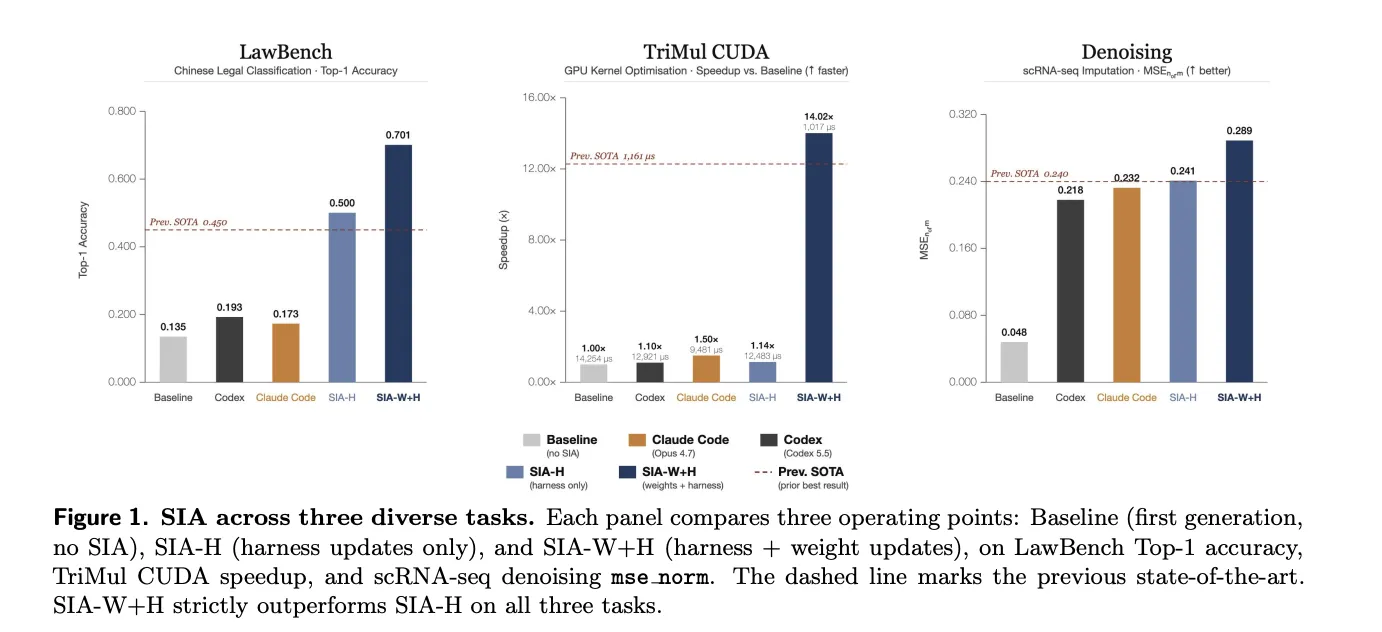
The research team tested SIA on three deliberately different domains. The pattern held across all three. Weight updates added gains beyond what scaffold editing alone reached. “Initial” is the base model through the Meta-Agent’s first scaffold, before any feedback.

Task Initial Prev. SOTA SIA-H (harness only) SIA-W+H (harness + weights)
LawBench (top-1 acc) 13.5% 45.0% 50.0% 70.1%
AlphaEvolve TriMul (reward) 0.105 1.292 0.120 1.475
Denoising (mse_norm) 0.048 0.240 0.241 0.289

On LawBench, the task is 191-class Chinese criminal charge classification. Harness iteration built a TF-IDF plus LinearSVC pipeline and plateaued at 50.0%. Weight updates via PPO then pushed accuracy to 70.1%. That is a 20.1 percentage-point gain over the harness-only best.

The TriMul task asks for a custom CUDA kernel on an H100 GPU. The kernel computes a core operation in AlphaFold2’s Evoformer module. Scaffold edits reached a 1.14× speedup over baseline. Weight updates then drove runtime from 12,483 to 1,017 microseconds. That is a 91.9% reduction from the harness-only peak.

One honest caveat appears in the same chart. The coding agent Claude Code reached 1.50× on TriMul unaided, beating SIA-H’s 1.14×. SIA-W+H still led overall at 14.02×.

For denoising, the agent tunes MAGIC, a single-cell RNA imputation method. Harness sweeps over its hyperparameters settled at 0.241 mse_norm. The first weight-update checkpoint added a two-line step that no scaffold produced. It rounded imputed counts to non-negative integers, lifting the score to 0.289.

How the Feedback-Agent Picks Its Move

SIA does not run one fixed RL recipe. The Feedback-Agent selects a training algorithm based on the reward signal it observes.

On LawBench, the reward was a clean outcome-based scalar, so it used PPO with GAE. On TriMul, most kernels failed to compile, so it used entropic advantage weighting. That method up-weights rare high-reward rollouts. On denoising, it used GRPO, which eliminates the value network entirely.

The research team also lists REINFORCE with KL-to-base, DPO, and best-of-N behavioural cloning. Each maps to a different reward shape and failure risk.

Strengths and What to Watch

Strengths:

  • First system to edit both scaffold and weights in one loop, per the authors’ comparison table.
  • Consistent gains over prior SOTA across three unrelated domains.
  • Open source under MIT, installable as sia-agent, with four bundled tasks.
  • Algorithm choice is conditioned on observed rewards, not a fixed schedule.

What to Watch:

  • The research reports three tasks; broader algorithm-selection results are deferred.
  • Both levers optimise the same fixed verifier, risking coupled Goodhart effects.
  • The research warn the joint fixed point may be fragile under perturbation.

Marktechpost’s Visual Explainer

Hexo Labs · Open Source (MIT)

SIA: Self-Improving AI

Harness + Weight Updates

A self-improving loop that edits both an agent’s scaffold and its model weights, without further human tuning.

gpt-oss-120b
LoRA rank 32
3 benchmarks
Claude Sonnet 4.6 agents

The Gap

Two silos, operating in isolation

Harness school

Edit the scaffold

A meta-agent rewrites prompts, tools, and retry logic. The model weights stay fixed.

Test-time training

Edit the weights

An RL pipeline updates the model on task feedback. The harness stays fixed.


SIA closes the gap by moving both levers inside one loop.

READ ALSO

Media Advisory: MIT to establish regional quantum hub | MIT News

Perplexity AI Open-Sources Unigram Tokenizer That Achieves 5x Lower p50 Latency Than Hugging Face tokenizers Crate

Anatomy

What SIA actually is

  • Harness (scaffold): the system prompt, tool-dispatch logic, retry policy, and answer-extraction code.
  • Weights: the model’s own parameters, adapted with LoRA at rank 32.
  • Three LLM components drive the loop: a Meta-Agent, a Task-Specific Agent, and a Feedback-Agent.

The Loop

One loop, two levers

After each run, the Feedback-Agent reads the full trajectory and picks one action.

Action A

Harness update

Rewrite the scaffold. Weights are held fixed.

Action B

Weight update

Train LoRA weights. The scaffold is held fixed.


The two levers interleave freely, not in locked sequential phases.

Evidence

Benchmark results

Task Initial Prev. SOTA SIA-H SIA-W+H
LawBench (top-1 acc) 13.5% 45.0% 50.0% 70.1%
AlphaEvolve TriMul (reward) 0.105 1.292 0.120 1.475
Denoising (mse_norm) 0.048 0.240 0.241 0.289

SIA-W+H (harness + weights) beat SIA-H (harness only) on all three tasks.

Mechanism

How the Feedback-Agent picks its move

  • LawBench: a clean outcome-based reward, so it used PPO with GAE. Accuracy reached 70.1%.
  • TriMul: most kernels fail to compile, so it used entropic advantage weighting. Runtime hit 1,017 µs.
  • Denoising: it used GRPO, which eliminates the value network. Score rose to 0.289.
  • Also available: REINFORCE + KL-to-base, DPO, and best-of-N behavioural cloning.

RQ2

What each lever changes

Harness

Externalised changes

Software-engineering improvements: new tools, tighter parsers, retry logic.

Weights

Internalised knowledge

Domain knowledge no prompt reaches: H100 kernel patterns, an integer-rounding step.


The harness shapes how the agent searches; weight updates change what the model knows.

The Honest Read

Limitations to keep in view

  • Both levers optimise the same fixed verifier, risking a coupled co-evolutionary Goodhart effect.
  • Fixed points can look strong on the verifier yet stay fragile under perturbation.
  • The paper reports three tasks; broader algorithm-selection results are deferred.
  • A separate 350× superintelligence claim in launch coverage does not appear in the paper.

Get Started

Run it yourself

Open source under MIT at hexo-ai/sia. Built on gpt-oss-120b with LoRA rank 32.

# install the Claude backend
pip install 'sia-agent[claude]'
export ANTHROPIC_API_KEY="..."

# run 5 self-improvement generations on a bundled task
sia --task lawbench --max_gen 5 --run_id 1

Four bundled tasks ship in the box: gpqa, lawbench, longcot-chess, spaceship-titanic.


01 / 09

Key Takeaways

  • SIA is the first self-improving loop that edits both an agent’s scaffold and its model weights.
  • A Feedback-Agent reads each run’s full trajectory, then picks a harness rewrite or weight update.
  • Combining both levers beat scaffold-only on all three tasks: LawBench, TriMul kernels, scRNA-seq denoising.
  • Harness edits add software-engineering hygiene; weight updates surface domain knowledge no prompt reaches.
  • Open source under MIT (hexo-ai/sia), built on gpt-oss-120b with LoRA rank 32.

Check out the Repo and Research Paper. Also, feel free to follow us on Twitter and don’t forget to join our 150k+ ML SubReddit and Subscribe to our Newsletter. Wait! are you on telegram? now you can join us on telegram as well.

Need to partner with us for promoting your GitHub Repo OR Hugging Face Page OR Product Release OR Webinar etc.? Connect with us



Source_link

Related Posts

Media Advisory: MIT to establish regional quantum hub | MIT News
Al, Analytics and Automation

Media Advisory: MIT to establish regional quantum hub | MIT News

May 28, 2026
Perplexity AI Open-Sources Unigram Tokenizer That Achieves 5x Lower p50 Latency Than Hugging Face tokenizers Crate
Al, Analytics and Automation

Perplexity AI Open-Sources Unigram Tokenizer That Achieves 5x Lower p50 Latency Than Hugging Face tokenizers Crate

May 28, 2026
Sakana AI Proposes DiffusionBlocks: a Block-wise Training Framework That Converts Residual Networks into Independently Trainable Denoising Modules
Al, Analytics and Automation

Sakana AI Proposes DiffusionBlocks: a Block-wise Training Framework That Converts Residual Networks into Independently Trainable Denoising Modules

May 28, 2026
Meet EAGLE 3.1: The Speculative Decoding Algorithm That Fixes Attention Drift in LLM Inference
Al, Analytics and Automation

Meet EAGLE 3.1: The Speculative Decoding Algorithm That Fixes Attention Drift in LLM Inference

May 27, 2026
Design a High-Precision Retrieve-and-Rerank Pipeline with ZeroEntropy Zerank-2 Reranker
Al, Analytics and Automation

Design a High-Precision Retrieve-and-Rerank Pipeline with ZeroEntropy Zerank-2 Reranker

May 27, 2026
Meet OmniVoice Studio: A Local, Open-Source Alternative to ElevenLabs
Al, Analytics and Automation

Meet OmniVoice Studio: A Local, Open-Source Alternative to ElevenLabs

May 26, 2026
Next Post
Trump’s new green card rules: Why tech workers could be in trouble

Trump’s new green card rules: Why tech workers could be in trouble

POPULAR NEWS

Trump ends trade talks with Canada over a digital services tax

Trump ends trade talks with Canada over a digital services tax

June 28, 2025
15 Trending Songs on TikTok in 2025 (+ How to Use Them)

15 Trending Songs on TikTok in 2025 (+ How to Use Them)

June 18, 2025
Communication Effectiveness Skills For Business Leaders

Communication Effectiveness Skills For Business Leaders

June 10, 2025
App Development Cost in Singapore: Pricing Breakdown & Insights

App Development Cost in Singapore: Pricing Breakdown & Insights

June 22, 2025
Comparing the Top 7 Large Language Models LLMs/Systems for Coding in 2025

Comparing the Top 7 Large Language Models LLMs/Systems for Coding in 2025

November 4, 2025

EDITOR'S PICK

G.O.A.T.S. Location in Goat Simulator 3

G.O.A.T.S. Location in Goat Simulator 3

May 7, 2026
How to Implement a Manufacturing Execution System in Australia

How to Implement a Manufacturing Execution System in Australia

March 25, 2026
How One Agency CEO Transformed Employee Retention

How One Agency CEO Transformed Employee Retention

November 26, 2025
Razer BlackShark V3 Pro Review: High-End Gaming Audio

Razer BlackShark V3 Pro Review: High-End Gaming Audio

September 14, 2025

About

We bring you the best Premium WordPress Themes that perfect for news, magazine, personal blog, etc. Check our landing page for details.

Follow us

Categories

  • Account Based Marketing
  • Ad Management
  • Al, Analytics and Automation
  • Brand Management
  • Channel Marketing
  • Digital Marketing
  • Direct Marketing
  • Event Management
  • Google Marketing
  • Marketing Attribution and Consulting
  • Marketing Automation
  • Mobile Marketing
  • PR Solutions
  • Social Media Management
  • Technology And Software
  • Uncategorized

Recent Posts

  • The State of Mobile Marketing Strategy 2026
  • How a fragrance brand is rewriting the rules of beauty storytelling 
  • Researchers automated LLM reasoning strategy design and cut token usage by 69.5%
  • Here’s how Google is responding to Fitbit users who don’t like the new Health app
  • About Us
  • Disclaimer
  • Contact Us
  • Privacy Policy
No Result
View All Result
  • Technology And Software
    • Account Based Marketing
    • Channel Marketing
    • Marketing Automation
      • Al, Analytics and Automation
      • Ad Management
  • Digital Marketing
    • Social Media Management
    • Google Marketing
  • Direct Marketing
    • Brand Management
    • Marketing Attribution and Consulting
  • Mobile Marketing
  • Event Management
  • PR Solutions