Key takeaways:
- Enterprises in Australia are adopting Gen AI to address real productivity gaps, particularly in reporting, analysis, and service delivery.
- From banking and pharmaceutical to mining and agriculture, Gen AI is applied across industries to modernise legacy systems and automate knowledge-intensive and documentation-heavy workflows.
- The strongest outcomes appear where Gen AI is embedded into modernised platforms and data estates, rather than deployed as standalone tools.
Australian enterprises are under sustained productivity pressure. According to the Australian Bureau of Statistics, labour productivity growth has remained weak across multiple sectors despite rising technology investment. At the same time, operating costs and compliance workloads continue to rise.
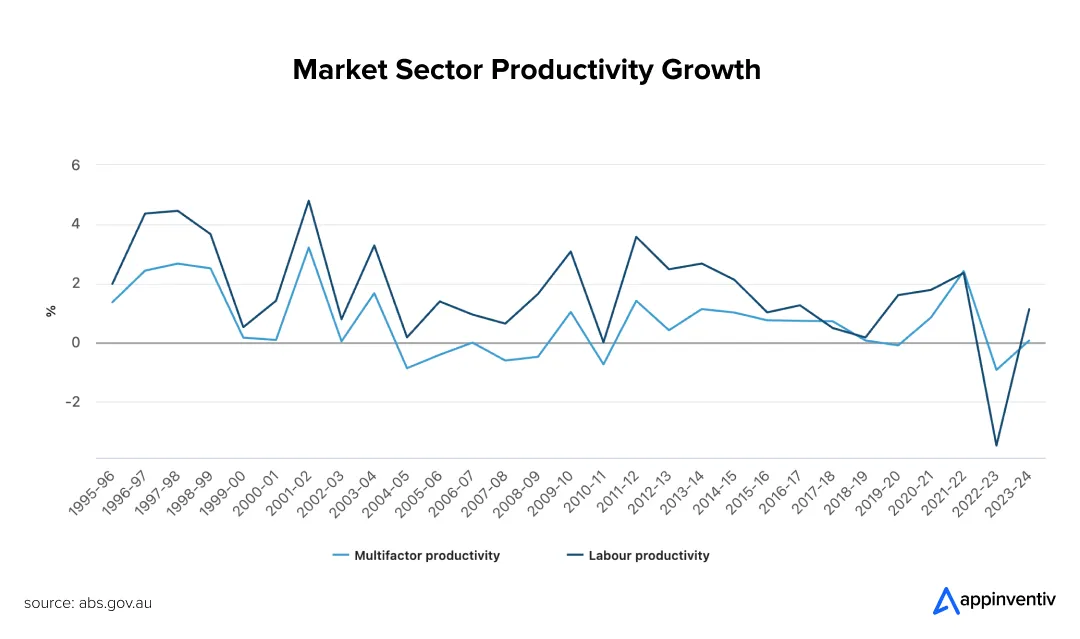
This gap between investment and outcomes is where generative AI has started to matter.
Over the past year, Australian enterprises apply generative AI to reduce reporting cycles, compress decision timelines, and stabilise service delivery where headcount growth is no longer viable. According to a research report conducted by SAS, nearly 63% of Australian enterprises were using Generative AI (Gen AI) in mid-2024, ranking Australia fourth globally. This number has grown rapidly in recent years.
As a result, generative AI use cases in Australia are now being assessed alongside core system upgrades and automation programs. The question is no longer whether the technology is capable. The question is whether it can operate safely, predictably, and at scale within Australian governance expectations.
Considering this, this blog focuses on practical generative AI use cases for Australian enterprises that address real operational friction.
By 2030, up to 98% of task hours could be technically automatable using advanced AI
The question is not whether work will change, but whether your systems are ready to support that shift responsibly.
How Australian Enterprises Are Approaching Generative AI Differently
Australian enterprises are taking a noticeably conservative path compared to peers in less-regulated markets. Adoption is shaped by a strong compliance culture and a clear understanding that technology decisions are increasingly board-level matters.
As a result, Generative AI initiatives in Australia are usually evaluated through three lenses before any model is selected.
- Can this be governed?
- Can it be audited?
- Can the organisation own the outcome over time?
These questions matter more than whether a model is open source, proprietary, or technically advanced.
This approach is reinforced by regulatory expectations from bodies such as APRA, ASIC, and OAIC, even where explicit AI rules are still evolving. Most organisations assume accountability for AI-assisted decisions will ultimately rest with leadership rather than vendors or models. In response, controls around data usage, output validation, access, and human oversight are being designed in from the outset.
Once these governance boundaries are clear, the conversation naturally shifts away from model selection and toward integration strategy. Australian enterprises typically evaluate this through three broad approaches: Build vs Buy vs Augment:
Build vs Buy vs Augment in the Australian Context
| Approach | Why Enterprises Consider It | Key Trade-offs in the Australian Context |
|---|---|---|
| Build | Full control over data, logic, and outcomes | Higher cost, longer timelines, and greater compliance and operational responsibility |
| Buy | Faster time to value through vendor platforms | Increased vendor dependency, data exposure concerns, and limited control over roadmap |
| Augment | Extends existing systems with governed Gen AI capabilities | Requires strong architecture and integration discipline but balances control and speed |
In practice, many organisations lean toward augmentation. By embedding generative AI into existing platforms, enterprises can test value while maintaining system stability and governance control. This explains why generative AI strategy in Australia tends to prioritise architecture and accountability first, then scale use cases gradually. It is slower, but far more sustainable.
Top Generative AI Use Cases in Australian Industries
The way generative AI is used in Australia differs by industry, reflecting distinct regulatory pressures, operating environments, and risk tolerances. What separates successful adoption is not ambition, but how closely Gen AI is aligned to the core constraints of each sector. Here are some of the most practical and remarkable ways Gen AI is used in Australia.
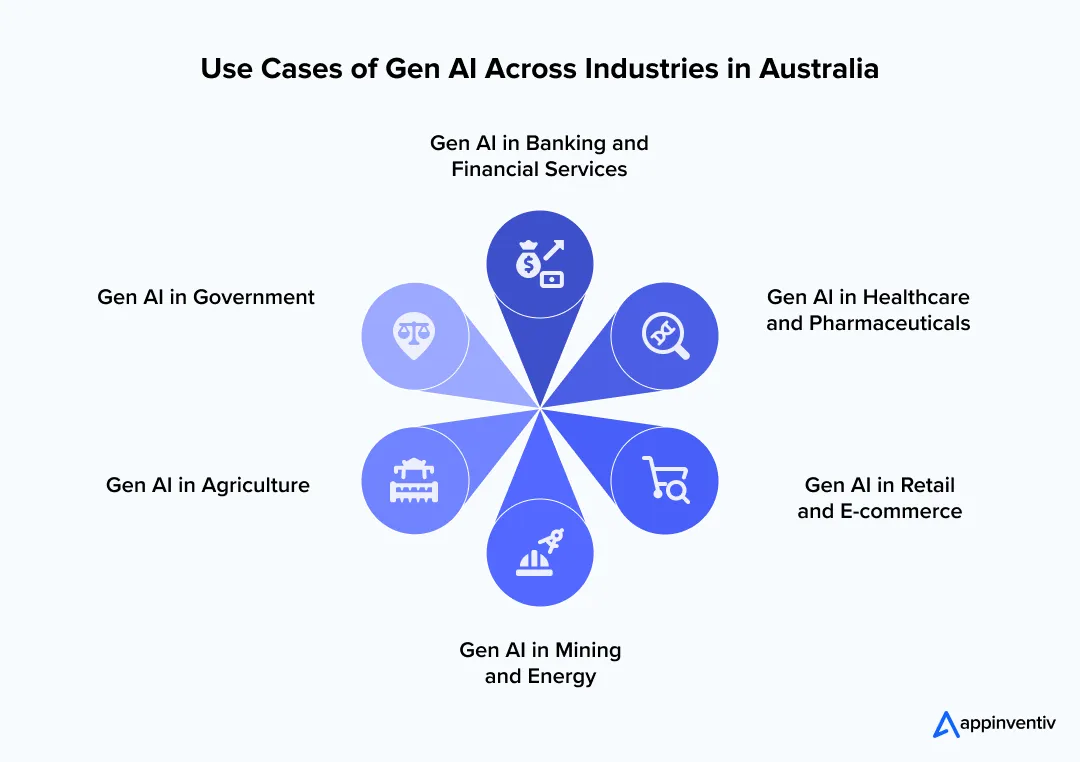
Gen AI in Banking and Financial Services
Australian banks operate under sustained regulatory scrutiny, with APRA expectations extending beyond capital adequacy into operational resilience, model risk, and decision accountability. As a result, generative AI use cases in Australia within FinTech and banking remain largely internal and heavily governed.
Rather than automating decisions, banks are using Gen AI to reduce the manual effort involved in compliance-heavy knowledge work. These systems operate within secure environments, often layered over existing data platforms, with strict access controls and mandatory human review. Auditability and traceability are non-negotiable, particularly where outputs influence reporting or customer communication.
This approach aligns with CPS 230 and broader operational risk management obligations, where explainability and oversight matter more than speed.
Common use cases
- Drafting APRA-aligned risk, compliance, and board reports from structured and unstructured data
- Summarising customer interactions for frontline teams with response suggestions constrained by policy libraries
- Supporting fraud and risk teams with scenario narratives derived from transaction patterns
- Interpreting regulatory updates into internal guidance drafts for compliance teams
Gen AI in Healthcare and Pharmaceuticals
Healthcare organisations in Australia face strict privacy obligations under the Privacy Act 1988 and sector-specific data handling expectations. In parallel, sustained workforce shortages and clinician burnout have elevated administrative efficiency into a system-level concern. As a result, generative AI for business in Australia within healthcare and pharmaceuticals is applied cautiously, with a clear boundary between administrative support and clinical decision-making.
Hospitals and healthcare networks are under pressure from workforce shortages and administrative overload. Gen AI systems in AU healthcare are being introduced to reduce documentation effort while keeping clinicians firmly in control. Models are typically deployed in private or sovereign environments and are prohibited from generating diagnoses or treatment recommendations.
Pharmaceutical companies follow similar patterns, using Gen AI to accelerate research workflows while maintaining rigorous validation and ethics oversight.
Common use cases
- Drafting clinical summaries, discharge notes, and referral documentation for clinician review
- Supporting pharmacovigilance reporting by analysing adverse event data and regulatory submissions
- Assisting pharmaceutical R&D teams with literature synthesis, protocol drafting, and trial documentation preparation
- Generating internal compliance, ethics, and validation documentation aligned with healthcare and pharmaceutical governance standards
Gen AI in Retail and E-commerce
Retailers operate in fast-moving environments where content volume, product complexity, and customer expectations intersect. Margin pressure, SKU expansion, and omnichannel consistency have made scalable content and insight generation a commercial necessity. Generative AI use cases for Australian enterprises in retail focus on scaling output without diluting brand control or breaching consumer protection obligations.
Most deployments sit behind the scenes, supporting merchandising, marketing, and customer service teams. Outputs are treated as drafts and recommendations, with review workflows embedded to meet Australian Consumer Law expectations around accuracy and representation.
Retailers that succeed with Gen AI integrate it into existing platforms rather than introducing standalone tools.
Common use cases
- Generating product descriptions and category content, reviewed for compliance and brand accuracy
- Creating campaign variants and promotional copy within approved messaging frameworks
- Summarising customer service interactions and suggesting compliant response options
- Translating demand and inventory data into plain-language insights for planning teams
Gen AI in Mining and Energy
Mining and energy companies manage complex operations, geographically distributed assets, and high safety expectations. Generative AI examples in Australia within mining and energy focus on synthesising information rather than automating operational decisions.
Regulatory obligations around safety, environmental reporting, and incident management shape how Gen AI is applied. Systems are designed to support engineers, safety officers, and executives with structured insights while preserving accountability.
Given the long asset lifecycles in this sector, enterprises prioritise systems that can be owned, audited, and evolved internally.
Common use cases
- Drafting operational, safety, and incident reports from logs and sensor data
- Generating scenario summaries for exploration planning and risk assessment
- Creating workforce training and safety documentation tailored to site conditions
- Supporting sustainability and environmental impact reporting with data-driven narratives
Gen AI in Agriculture
Agriculture is one of the most pragmatic adopters of generative AI in Australia, driven by climate variability, labour constraints, and thin margins. Gen AI in Australian agriculture is valued for decision support rather than prediction alone.
Systems combine climate data, soil information, and historical yields to generate insights that farmers and agribusinesses interpret and act upon. Given biosecurity and data sensitivity concerns, deployments are increasingly localised and controlled.
These use cases highlight how generative AI for business in Australia can support resilience in high-uncertainty environments.
Common use cases
- Generating crop planning recommendations using local weather patterns, soil conditions, and historical yield data
- Summarising livestock health and behaviour patterns from sensor data, farm records, and field observations
- Supporting water, fertiliser, and pest management decisions based on seasonal conditions and resource constraints
- Translating climate and drought risk data into actionable planning insights for short- and long-term operations
Also Read: Drones in Agriculture in Australia: Use Cases, Benefits & ROI Insights
Gen AI in the Public Sector
Australian government agencies are approaching generative AI through the lens of service modernisation, funding accountability, and long-term platform sustainability. Adoption is shaped by procurement frameworks, audit expectations, and the need to support services at national and state scale.
As future programs such as, Brisbane 2032 Olympics–driven initiatives accelerate, agencies are prioritising production-ready AI capabilities that can evolve with policy direction, funding cycles, and operational demand.
Common use cases
- Supporting large-scale digital service delivery across transport, infrastructure, health, and education
- Assisting policy, briefing, and operational documentation within governed environments
- Improving citizen engagement through scalable, compliant digital interfaces
- Enabling workforce productivity while maintaining auditability and control
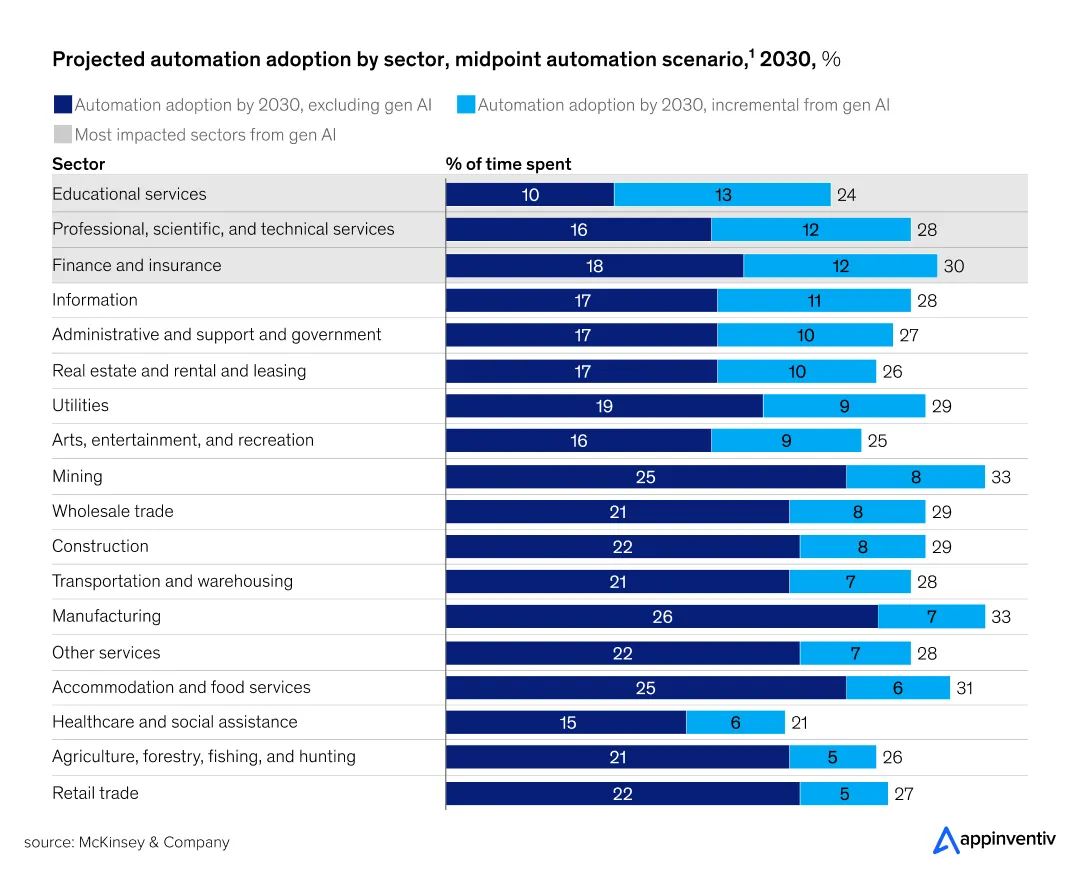
The industry examples above reflect early, practical adoption. As McKinsey research analysis projects that by 2030, between 79 and 98% of existing task hours could be technically automatable using advanced AI capabilities. Sectors central to the Australian economy are likely to see a significant share of work reshaped by generative AI–driven automation.
Types of Generative AI Models Used by Australian Enterprises
Australian enterprises tend to select generative AI models based on operational fit and control rather than model popularity or theoretical capability.
LLMs such as GPT-4, Claude, Gemini, and LLaMA are commonly used for drafting, summarisation, and internal knowledge support.
Models such as DALL·E and Midjourney are used for generating marketing visuals, design concepts, and internal creative assets, typically within brand, copyright, and usage guidelines.
RAG models are employed where responses must stay grounded in approved enterprise data, policies, or records rather than generalised model knowledge.
- Domain-Specific or Fine-Tuned Models
These types of Gen AI models are applied in regulated or specialised environments where industry language, context, and consistency directly affect outcomes.
- Multimodal Generative Models
Used in scenarios involving structured documents, mixed data sources, or digital service delivery rather than pure text generation.
- Private or Sovereign-Hosted Models
Such models are preferred for sensitive workloads, allowing organisations to retain control over data handling, access, and long-term model behaviour.
Benefits of Generative AI for Australian Businesses
When applied with governance and architectural discipline, generative AI delivers measurable benefits for Australian enterprises without increasing regulatory or operational risk. The value is less about automation at scale and more about improving how work is produced, reviewed, and governed.
| Business Area | Benefit Delivered |
|---|---|
| Productivity | Reduces manual effort in reporting, analysis, and documentation-heavy workflows |
| Cost Control | Lowers operating costs by augmenting teams rather than expanding headcount |
| Speed to Decision | Accelerates insight generation while keeping final decisions human-led |
| Compliance | Improves consistency and audit readiness across regulated processes |
| Customer Experience | Enables faster, more consistent engagement within approved governance boundaries |
| Scalability | Allows enterprises to scale output without re-architecting core systems |
| Workforce Enablement | Frees workforce to focus on higher-value, judgement-based work |
For most organisations, the benefits of generative AI for enterprises in Australia compound over time. The strongest outcomes appear where Gen AI is treated as a governed capability embedded into existing operating models, not as a standalone productivity tool.
How to Implement Generative AI in Australian Businesses?
Successful implementation of Gen AI in Australia depends on discipline, governance, and clarity of ownership. Here is a structured step by step to explain how Australian enterprises move from idea to production without increasing regulatory or operational risk.
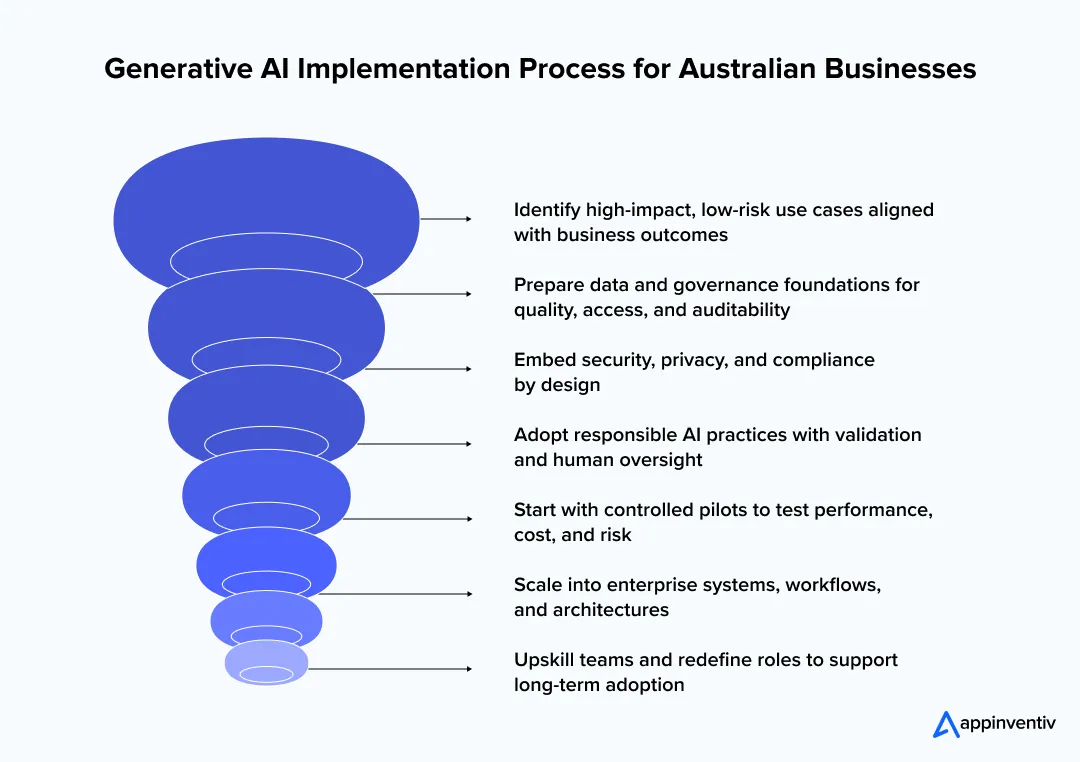
Identify high-impact, low-risk use cases
Start with areas where Gen AI removes friction from everyday work, such as drafting or analysis, without touching safety-critical or tightly regulated decisions. Favour outcomes that teams can clearly assess and stand behind.
Assess and modernise legacy systems where required
Check whether current platforms can realistically support Gen AI access, integration, and traceability. In many organisations, limited uplift through APIs or data layers is needed before AI can be used safely at scale.
Prepare data and governance foundations
Bring clarity to where data comes from, who can access it, and how it flows through systems. Without this groundwork, Gen AI outputs quickly become difficult to trust or defend.
Embed security, privacy, and compliance by design
Design Gen AI solutions to align with Australian data handling and cyber expectations from the outset. Retrofitting controls later almost always increases cost and delivery risk.
Adopt responsible AI practices with human oversight
Treat Gen AI outputs as inputs, not decisions. Human review remains essential wherever legal, financial, or ethical consequences are involved, with accountability clearly owned by the business.
Start with controlled pilots
Use early deployments to understand performance, cost behaviour, and operational impact. Keep scope tight while establishing patterns that can be repeated reliably.
Scale into enterprise systems and workflows
Introduce Gen AI through existing platforms rather than creating parallel tools. This helps avoid fragmentation and supports long-term maintainability.
Upskill teams and redefine roles
Equip teams to work alongside Gen AI through training and role clarity. Long-term value depends on adoption and operating model change, not just deployment.
Turn Generative AI into a production-ready capability
Build, integrate, and scale Gen AI as part of your modernisation roadmap without increasing operational risk.
What Makes Generative AI Fail in Enterprises and How to Avoid It
Most generative AI initiatives fail not because of technology limitations, but due to execution gaps, unclear ownership, and weak integration into existing operating models. In Australian enterprises, these issues tend to surface early when Gen AI is introduced without sufficient discipline or structural alignment. Listed below are some remarkable reasons why Gen AI adoption fails and how Aussie organisations can overcome them:
Generic Model Dependence
Why it fails: Dependence on generic, public models produces inconsistent outputs and exposes organisations to data privacy, IP, and regulatory risk.
How to avoid: Anchor Gen AI models to approved enterprise data, documented policies, and jurisdiction-aware deployment patterns.
Weak Governance and Ownership
Why it fails: Weak ownership and fragmented governance make it unclear who is accountable for AI-assisted outcomes, increasing operational and compliance risk.
How to avoid: Assign clear business and technology ownership aligned with existing risk, compliance, and assurance structures.
Treating Gen AI as a Tool Instead of a Capability
Why it fails: Treating generative AI as a standalone tool prevents integration with enterprise architecture and undermines scalability and governance.
How to avoid: Position Gen AI as a long-term capability embedded into platforms, workflows, and operating models.
Turning Generative AI Into Measurable Business Outcomes with Appinventiv
As Australian enterprises move beyond experimentation, the real measure of generative AI success is no longer technical capability. It is whether Gen AI can be embedded into core platforms, scaled responsibly, and sustained as part of long-term software modernisation and optimisation programs.
Appinventiv works as a trusted partner for AI consulting solutions for Australia delivering generative AI within modernised, resilient systems so it strengthens existing operating models rather than introducing parallel complexity. This execution-led approach reflects how Australian enterprises and government bodies evaluate long-term technology investments.
For instance, in our 10+ years of APAC delivery experience, we have supported this shift with practical delivery experience across Australian organisations such as Lite N’ Easy, Multinail, and Rapid Teachers, focusing on outcomes rather than experimentation.
Our generative AI work is backed by scale and experience in 35+ AU industries.
- 80+ Gen AI applications launched
- 75+ custom Gen AI models trained and deployed
- 200+ data scientists and AI engineers
The outcome focus is clear:
- 70% faster content and knowledge workflows
- 98% content quality and compliance alignment
Generative AI use cases deliver value only when it is implemented with discipline, aligned to future operating realities, and supported by an experienced artificial intelligence development company in Australia who understands both technology and accountability.
Discuss your Gen AI vision with us and translate ideas into production-ready outcomes.
FAQs
Q. How does generative AI work in Australian enterprises?
A. In Australian enterprises, generative AI typically operates as a controlled layer within existing systems. Models are connected to internal data through secure architectures such as retrieval-augmented generation, with strict access controls, logging, and human review to meet governance and audit expectations.
Q. How are Australian enterprises using generative AI today?
A. The common generative AI use cases in Australia are listed below:
- Drafting and reviewing internal reports, summaries, and decision briefs
- Supporting customer communication and service interactions at scale
- Assisting analysis across risk, operations, and planning functions
- Reducing administrative workload in documentation-heavy processes
- Embedding Gen AI into modernised systems to improve productivity without increasing risk
Q. How much does it cost to implement gen AI in Australia?
A. Gen AI implementation cost in Australia generally ranges from AUD 70,000 to AUD 700,000. Costs depend on data readiness, security and compliance requirements, system integrations, model hosting choices, and the level of customisation needed for enterprise-grade governance.
Q. How long does it take to implement Generative AI in Australian enterprises?
A. The typical timeline to implement Generative AI in Australian enterprises ranges from 4 to 12+ months, depending on scope, data readiness, and integration complexity.
For instance:
- 4–6 months for controlled pilots embedded into existing workflows
- 6–9 months when legacy systems or data platforms require uplift or modernisation
- 9–12+ months for enterprise-wide deployment with governance, security, and change management in place
Q. Which industries in Australia will benefit most from generative AI?
A. Industries with high documentation load and regulatory pressure see the fastest returns. This includes but is not limited to:
- Banking and financial services
- Healthcare and pharmaceutical
- Retail and eCommerce
- Mining and energy
- Education
- Agriculture etc.
Q. What is the future of generative AI in Australia for businesses and app development?
A. The future of generative AI in Australia will be shaped by modernisation programs, public sector digitisation, and sovereign capability expectations. Adoption will move away from standalone tools toward deeply integrated, governed systems embedded within enterprise and government platforms.