Key takeaways:
- Finance AI chatbots have moved past support. They now trigger payments, approve loans, and process claims inside real transaction systems.
- PCI compliance cannot sit outside the system. It must control how data enters, moves, and exits across every layer.
- Most failures happen where a finance AI chatbot meets payment systems. Poor data handling and weak controls expose real financial risk.
- Teams that build with compliance from day one ship faster and avoid costly rework during audits and production issues.
- As chatbots move toward autonomous actions, every decision must be traceable, controlled, and validated before execution.
Most enterprises still treat chatbots as support tools. That view is already outdated. Around 71% of companies now use AI in finance operations, and 41% run these systems at moderate to large scale. Leading firms already use chatbots for financial services to execute payments, approve loans, and process insurance claims in real time.
This shift changes the role of chatbots. They no longer sit at the edge of customer experience. They sit inside core transaction flows. A user can trigger a payment, check loan eligibility, or file a claim through a single conversation. The chatbot becomes the layer that connects intent with financial action.
This creates a direct compliance impact. The moment a chatbot handles card data or interacts with payment systems, it falls under the PCI DSS scope. That brings strict rules for data handling, encryption, and audit trails.
There is a clear gap. AI adoption is moving fast across financial services. Compliance design is not keeping pace. Many systems go live without full control over data exposure or transaction risk.
This blog explains how to close that gap. It outlines how to build custom finance AI chatbots that support real transactions and meet strict security and compliance requirements from the start.
71% Finance Leaders Already Deployed AI
Most enterprises are already executing transactions through AI. Delay now increases risk, cost, and competitive disadvantage.

Finance Chatbot Development Steps: Building a PCI-Compliant System
A chatbot enters PCI scope the moment it touches cardholder data, payment flows, or transaction systems. This includes partial card input, token exchange, and even indirect exposure through logs or model context.
When you build custom finance AI chatbots, compliance cannot sit outside the system. It must shape how data moves, how models process context, and how every request is handled across the stack.
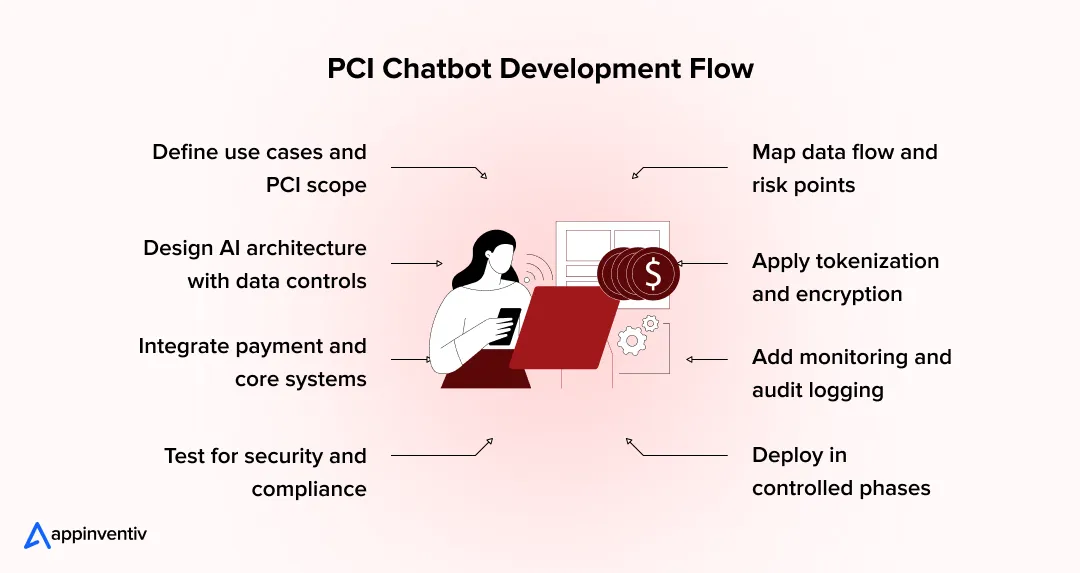
Step 1: Define Business Objectives and PCI Scope Boundaries
Start by mapping exact transaction paths, not just use cases.
- Identify where user input may contain PAN, CVV, or payment tokens
- Trace data flow across systems, APIs, and storage layers
Define PCI zones:
- In-scope systems (payment processing, tokenization services)
- Connected systems (chatbot backend, APIs)
- Out-of-scope systems (isolated AI layers if designed correctly)
Create a data flow diagram (DFD) that marks:
- Entry points (UI, chatbot input fields)
- Processing nodes (LLM, APIs)
- Storage locations (logs, caches, vector DBs)
This diagram drives every security decision that follows.
Also Read: How to Develop a PCI-Compliant Fintech App
Step 2: Design Secure Conversational Architecture
In custom fintech software development, the key decision is how to isolate AI from sensitive data
- Use an LLM orchestration layer to power your LLM-powered fintech chatbot instead of relying on direct model access
- Insert a middleware control layer between user input and model inference
For RAG pipelines:
- Store embeddings only for non-sensitive data
- Apply pre-retrieval filters to block PII or payment data
- Use attribute-based access control (ABAC) for retrieval queries
Define strict context rules:
- No raw card data enters prompts
- Replace sensitive fields with tokens or placeholders before inference
- Strip memory buffers after each transaction session
Implement prompt governance:
- Static system prompts with restricted tool access
- Tool calling only through verified APIs
- No free-form execution rights for the model
Step 3: Implement Data Security Foundations
To build a secure payment chatbot, this layer must enforce PCI controls at runtime.
Tokenization:
- Replace PAN with tokens using a PCI-compliant vault
- Ensure tokens are format-preserving where required
Also Read: How Blockchain Is Strengthening Fintech Security
Encryption:
- TLS 1.2+ for all external and internal communication
- AES-256 for data at rest, including logs and caches
API Security:
- Use API gateways with rate limiting and schema validation
- Enforce OAuth 2.0 or mTLS for service-to-service calls
Data Masking:
- Mask PAN in logs, monitoring tools, and error traces
- Apply dynamic masking based on user roles
No sensitive data should persist in:
- LLM context windows
- Vector databases
- Application logs
Also Read: The Ultimate Guide to Advantages of Encryption Technology
Step 4: Integrate Payment and Core Financial Systems
An AI chatbot for payment processing must maintain PCI boundaries at every integration point.
- Route payment requests through secure orchestration services, not directly from the chatbot
- Use token-based transactions instead of raw card data exchange
- Connect to payment gateways through certified SDKs and certified APIs that meet integration standards.
For lending and insurance:
- Integrate with LOS, LMS, or claims systems through secured APIs
- Apply request validation at every integration point
Introduce a transaction orchestration layer:
- Validates user intent
- Applies business rules
- Triggers downstream systems
This prevents direct model-to-transaction execution.
Step 5: Build AI Governance and Control Layers
AI behavior must be observable and controllable.
Model Monitoring:
- Track output patterns for anomalies
- Detect hallucinations in financial responses
Access Control:
- Apply RBAC for internal users
- Restrict tool access at the model level
Human-in-the-loop:
- Require approval for high-risk actions
- Set thresholds for transaction value or risk score
Audit Logging:
- Log every interaction, decision, and API call
- Maintain traceability from user input to transaction outcome
Logs must be immutable and time-stamped for audit review.
Step 6: Conduct Compliance Testing and Validation
Testing must cover both infrastructure and AI behavior.
PCI Readiness:
- Validate segmentation of in-scope systems
- Verify encryption and tokenization controls
Penetration Testing:
- Test API endpoints, gateways, and integrations
- Simulate unauthorized access attempts
AI Red-Teaming:
- Test prompt injection scenarios
- Attempt data extraction from model responses
- Validate that sensitive data cannot be reconstructed
Run these tests continuously, not just before deployment.
Also Read: Computer Vision Applications in Finance
Step 7: Deploy with Controlled Rollout
Do not start with full transaction capability.
- Phase 1: Read-only interactions (queries, status checks)
- Phase 2: Assisted transactions with human approval
- Phase 3: Limited autonomous execution within defined thresholds
Monitor:
- Data exposure risks
- Transaction accuracy
- Compliance violations
Set up real-time alerts for:
- Unauthorized data access
- Abnormal transaction patterns
- Model behavior anomalies
Deployment is not the end state. The system must remain under continuous compliance monitoring and control.
Types of Finance Chatbots Compliant With PCI-DSS
Chatbots for financial services differ based on what they can do with user intent. The type defines how much control, risk, and compliance exposure the system carries.
Rule-Based Chatbots
These follow predefined scripts and decision trees.
- Handle fixed queries like balance checks or FAQs
- No access to real-time decision systems
- No direct interaction with payment flows
Used where risk must stay low, and actions remain limited.
NLP-Based Chatbots
NLP-based chatbots understand user intent using trained language models.
- Process natural language queries
- Connect to backend systems for data retrieval
- Limited transaction support with strict controls
Common in customer support and basic account services.
RAG-Based Financial Assistants
These combine language models with internal data sources.
- Pull data from CRM, transaction systems, and documents
- Provide context-aware responses
- Support assisted actions like loan checks or policy queries
Require strict filtering to prevent sensitive data exposure.
Transactional Chatbots
These execute financial actions within defined workflows.
- Initiate payments, raise disputes and process applications
- Connect directly to payment gateways and core systems
- Use tokenization and validation before execution
Operate within PCI scope and require full audit logging.
Autonomous Financial Agents
These systems act with minimal human input.
- Execute multi-step workflows like loan approvals or claims processing
- Use decision engines and risk scoring models
- Trigger actions based on user intent and system data
These carry the highest compliance and security requirements.
Finance Chatbots Use Cases and Examples Across Industries
Finance AI chatbots now sit inside transaction flows. They handle actions across payments, lending, insurance, and investments.
Payments
- Conversational payments
- Dispute handling
- Fraud interaction workflows
Example:
PayPal uses AI-driven chat support to handle disputes and unauthorized transaction reports. Users can raise a dispute inside chat, verify identity, and track resolution without leaving the interface. This reduced support load and improved resolution speed for high-volume cases.
Also Read: How AI Is Transforming Banking Operations
Lending
- Loan eligibility checks
- EMI calculations
- Instant approvals
Example:
HDFC Bank offers a chatbot banking app that checks loan eligibility and provides instant pre-approved offers. It connects to internal credit systems and returns decisions in real time for existing customers.
Insurance
- Claims initiation (FNOL)
- Policy servicing
- Fraud detection workflows
Example:
Lemonade uses its AI chatbot “AI Jim” to process insurance claims. Users submit claims through chat, and simple cases are approved and paid within minutes after validation checks.
Wealth and Investment
- Portfolio insights
- Transaction triggers
- Advisory interactions
Example:
Bank of America runs the chatbot “Erica,” which provides portfolio updates, spending insights, and transaction assistance. It handles millions of client interactions and supports financial decision-making at scale.
These examples show a clear shift. Chatbots are no longer support tools. They act as execution layers tied directly to financial systems.
Others Are Already Executing Transactions Through AI
Use cases are no longer pilots. Payment, lending, and claims systems already run through chat. Waiting now increases execution risk.

How Finance AI Chatbots Now Sit Between Intent and Financial Execution
A few years ago, the chatbot in the finance industry answered basic questions. They followed scripts and handled limited requests. Then the systems improved. NLP allowed better intent recognition. Responses became more accurate.
That phase has already passed.
Today, financial AI chatbots pull live data from internal systems. They respond with context. They act in that context. The next step is already visible. Some systems can execute actions without human input.
Here is how they operate across functions.
- In payments, a chatbot captures user intent, validates details, and initiates a transaction.
- In lending, it interprets user input, checks eligibility, and structures repayment plans.
- In insurance, it records claim intent and guides the process step by step.
- In wealth management, it translates queries into portfolio actions and execution triggers.
Also Read: Why Embedded Finance Is The Next Big Thing For Modern Enterprises
This flow places the chatbot at a critical point. It receives intent and converts it into financial outcomes. That position carries direct risk. Any failure can affect money, data, or compliance.
For leadership teams at banks and lenders, conversational AI for financial institutions changes the system’s role. The chatbot in the finance industry is no longer a support layer. It is infrastructure that must meet strict financial and security standards.
Benefits of Financial AI Chatbots: What PCI-Compliant Systems Deliver
A secure finance chatbot does more than answer questions. It handles real actions like payments, loan checks, and claims while keeping strict control over sensitive data.
Conversational AI for financial institutions shows a shift in cost, speed, and risk. This broader impact of AI in fintech is already reflected in outcomes, with 96% of AI leaders reporting that AI meets or exceeds ROI expectations.
- Lower operating costs
Replaces repetitive work such as balance checks, payment queries, and claim intake. Teams handle fewer manual requests. - Faster transaction time
A user can complete a payment or submit a request in one flow. No need to switch between systems or wait for approvals at each step. - Higher completion rates
The chatbot uses past activity and system data to guide users. More users finish payments, applications, and renewals. - Reduced compliance exposure
Card data stays protected through tokenization and encryption. Every action is logged and traceable. - Quicker fraud response
The system flags unusual behavior during the interaction. It can pause or block risky actions in real time. - Scales without hiring pressure
One system can handle thousands of users at once. Service levels stay stable even during peak demand.
Reference Architecture of a Secure Finance AI Chatbot
A finance AI chatbot is not a single system. It is a set of tightly controlled layers that manage input, model behavior, transactions, and compliance boundaries. Each layer must isolate sensitive data and enforce strict controls.
This becomes more critical as 75% of finance leaders expect agentic AI in finance to be standard by 2028, which means more systems will move from assisted responses to direct execution.
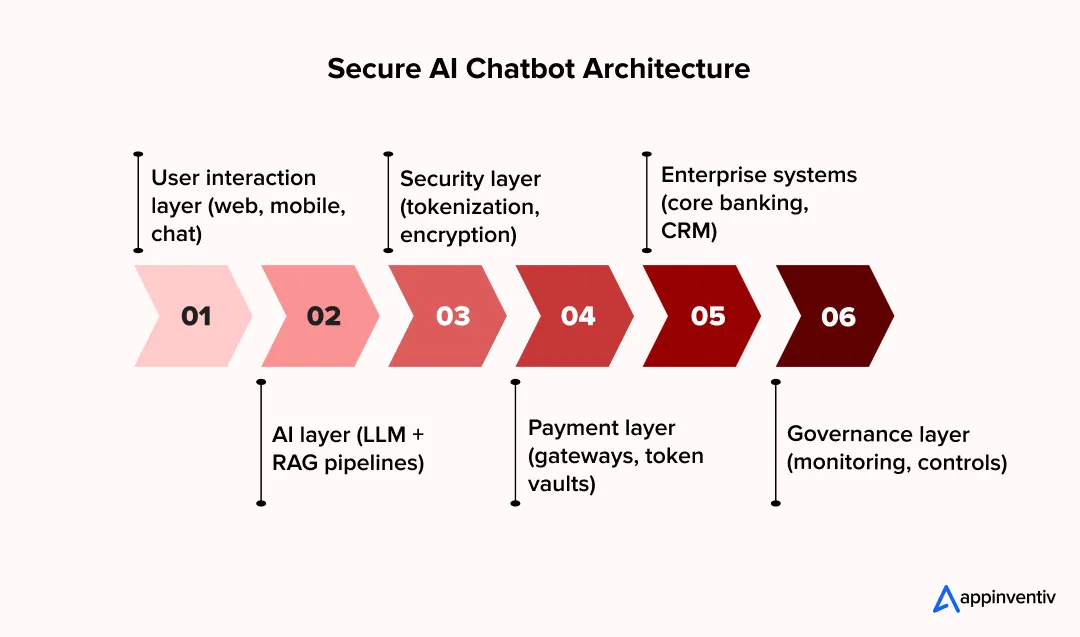
Interaction Layer
This is where users engage with the system.
- Channels: web apps, mobile apps, WhatsApp, and IVR voicebot channels that handle session management with short-lived tokens.
- Session management with short-lived tokens and inactivity timeouts
Input controls:
- Mask card fields at entry
- Block raw PAN from free-text inputs
Device and session fingerprinting to detect suspicious access
AI and RAG Layer
This layer processes intent and generates responses.
- An LLM-powered fintech chatbot runs orchestration through a backend service, not direct API calls
RAG pipelines:
- Vector databases store only non-sensitive embeddings
- Metadata filters restrict retrieval by user role and context
Context filtering:
- Strip or replace sensitive data before prompt injection
- No persistence of financial data in conversation memory
Security and Compliance Layer
To build a secure payment chatbot, this layer must enforce PCI controls across the system.
Tokenization:
- Replace PAN with tokens using a secure vault
Encryption:
- TLS for data in transit
- AES-256 for storage
Access control:
- RBAC for internal systems
- Service-level authentication using mTLS
Logging:
- Immutable logs for every interaction and API call
- Mask sensitive fields in logs
Payment Processing Layer
This layer handles transaction execution.
- Integrations with payment gateways through certified APIs
- Token vaults store and map payment tokens
- Transaction orchestration service:
- Validates inputs
- Applies business rules
- Routes transactions to correct processors
No raw card data flows through the chatbot service.
Enterprise Systems Layer
This layer connects business systems.
- Core banking systems for account and transaction data
- LOS and LMS for lending workflows
- Insurance systems for claims and policy data
- CRM systems and fintech ERP platforms provide customer and operational data through secure API gateways.
All integrations pass through secured API gateways with strict schema validation.
AI Governance Layer
This layer controls model behavior and risk.
- Monitoring: Track output patterns and detect anomalies
- Explainability: Store decision traces for audit review
- Human override: Acting as a copilot AI chatbot for finance, the system requires approval for high-risk transactions
- Risk scoring: Use financial analytics to assign risk scores based on user behavior and transaction type, triggering additional checks when thresholds are crossed.
Each layer works as a control boundary. Data, model access, and transactions never move without validation.
Compliance Frameworks Required for Finance AI Chatbots
Chatbots for financial services touch many systems at once. It handles user data, payment flows, and internal APIs. Each layer falls under a different compliance rule. Missing even one can expose the whole system.
PCI DSS
Covers cardholder data.
- Card numbers must never appear in logs or model inputs
- Use tokenization before any processing step
- Encrypt every request between services
- Keep payment systems isolated from AI layers
GDPR
GDPR compliance covers personal data and user rights.
- Ask for clear consent before storing or processing data
- Allow users to view or delete their data
- Do not store sensitive details in chatbot memory or embeddings
SOC 2
Focuses on system control and traceability.
- Log every action from user input to final response
- Track access across APIs and internal tools
- Maintain clear incident response records
ISO 27001
Sets rules for internal security practices.
- Define how data is handled across teams and systems
- Run regular risk checks
- Keep security policies enforced across all environments
These frameworks do not sit outside the system. They shape how data moves, how the model responds, and how every action is recorded.
How PCI DSS Controls Map to AI Chatbot Components
PCI DSS requirements for chatbots only work if they match what the system actually does. In a finance chatbot, that means tying each control to real data paths, API calls, and model behavior.
- Data protection (Requirement 3)
Card data must stay out of the AI layer.- Convert PAN into tokens before it reaches backend services
- Keep raw values out of prompts, logs, and memory
- Clear any temporary buffers after each request
- Secure transmission (Requirement 4)
Every request must travel in encrypted form.- Use TLS for user traffic and internal service calls
- Block any non-encrypted endpoints at the gateway level
- Rotate keys and certificates on a fixed schedule
- Access control (Requirement 7)
Not every system or user should see the same data.- Set role-based access across admin panels and APIs
- Limit what the model can call through predefined tools
- Check identity at each request, not just at login
- Monitoring and logging (Requirement 10)
You need a clear record of what happened and when.- Log each step from user input to final action
- Hide sensitive fields inside logs
- Store logs in systems that cannot be altered
- Security testing (Requirement 11)
Testing must reflect real attack paths.- Try to extract hidden data through crafted prompts
- Test APIs for weak validation or broken access rules
- Run checks after every major update
These controls must cover the full system. That includes servers, APIs, model pipelines, and every place where data moves or changes form.
Financial Chatbots Challenges and Considerations in PCI-Compliant Development
Most failures appear where chatbots for financial services connect with payment systems. The issues show up in real data flows, APIs, and model behavior. This aligns with industry trends, where 57% of organizations cite data security as a top challenge and 48% point to inconsistent data across systems.
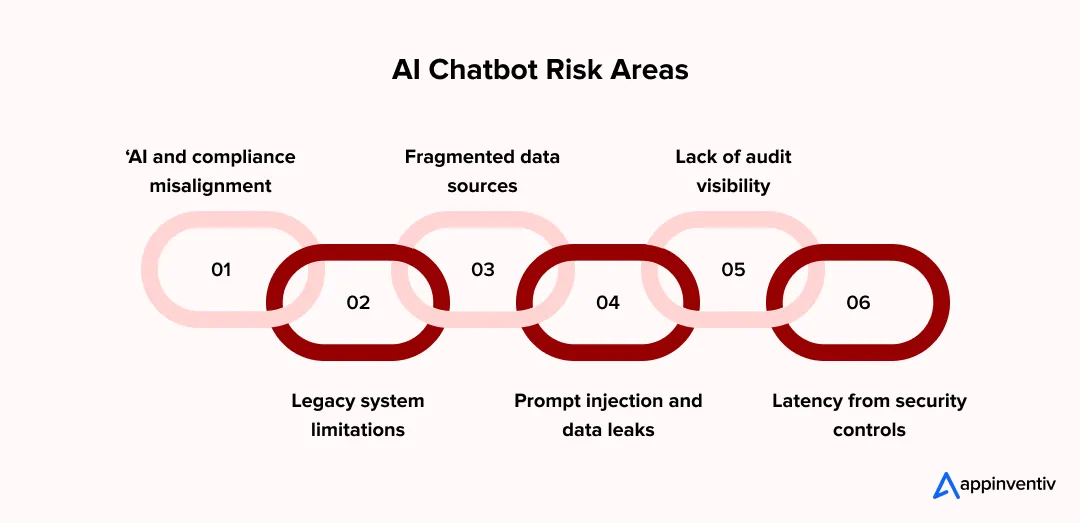
AI and Compliance Misalignment
Teams build models first and review compliance later. Card data enters prompts, logs store sensitive fields, and PCI boundaries remain unclear. Tokenize inputs before they reach the model. Disable memory for payment flows. Define PCI zones at the architecture level.
Legacy System Constraints
Core systems lack real-time APIs. Chatbot requests fail, responses slow down, and integrations break under load. Add a transaction orchestration layer. This is where intelligent automation helps by using middleware to convert legacy services into API-ready endpoints.
Data Fragmentation in RAG Pipelines
Without a proper finance data warehouse, data sits across systems with no control layer, causing the model to retrieve outdated records. Index only approved datasets. Fetch sensitive data through APIs at runtime instead of embeddings.
AI Security Risks
Models accept malicious input. Prompt injection exposes hidden data and bypasses validation steps. Sanitize inputs, restrict model actions to defined APIs, and scan outputs for sensitive data.
Auditability Gaps
AI decisions lack traceability. No clear link exists between user input, model output, and transaction execution. Log each step with a transaction ID. Store prompts, outputs, and API calls in structured logs.
Real-Time vs Security Trade-offs
Security checks add delay. Latency increases and systems fail under load. Cache safe data, reuse secure tokens, and keep payment execution paths isolated from AI processing.
Others Are Scaling AI Faster Than You
AI-led financial systems are already in production. Waiting now means catching up under pressure with a higher compliance risk.

Future of Finance Chatbots: From Assisted Interactions to Autonomous Systems
The chatbot in the finance industry is moving beyond assisted interactions. The next phase focuses on systems that act with minimal human input while staying within strict control boundaries.
- AI agents executing full workflows
Chatbots will handle end-to-end actions such as loan processing, payment execution, and claims settlement. Each step will be processed by predefined rules and validation layers. - Real-time compliance validation
Compliance checks will run alongside every action. Systems will validate data usage, access control, and transaction rules before execution, not after.
Also Read: How IoT Is Reshaping Banking and Finance
- Hyper-personalized financial decisions
This is where generative AI in finance will use transaction history, behavior patterns, and risk profiles to guide hyper-personalized financial decisions. This will improve approval rates and reduce manual review cycles. - Controlled and adaptive RAG pipelines
Retrieval systems will adjust based on user role and context. Sensitive data will never enter embeddings. Real-time API access will replace static indexing for critical data. - Stricter regulatory oversight
Regulators are increasing their focus on AI-driven financial systems. Audit trails, explainability, and data control will become mandatory across regions.
From our 10+ years of experience in financial systems, one pattern stands out. Systems that embed compliance into architecture scale faster and face fewer audit issues.
After delivering 200+ fintech platforms, we have seen that automation without control creates risk. The next generation of systems will succeed by combining execution speed with strict governance.
Why Appinventiv for Finance AI Chatbot Development
As a leading finance chatbot development company, Appinventiv brings over 10 years of fintech experience across payments, lending, and insurance systems, with 200+ fintech products delivered. This experience reflects in systems built for accuracy, scale, and control.
- PCI-aligned AI architectures designed with clear data boundaries
- Secure RAG pipelines with strict control over sensitive data flow
- Ability to build custom finance AI chatbots with agent-driven workflows that execute real financial actions
- Deep integrations with core banking, LOS, and payment systems
From our experience, finance AI chatbot implementation cost drops by up to 30% when compliance is embedded early and maintains transaction SLAs of 99.50%, with fraud detection accuracy reaching 98%.
Also Read: AI Chatbot Development Cost Guide 2026: Enterprise Pricing and ROI
Case Example: Mudra Budget Management App
- Delivered an AI-powered budgeting platform across 12+ countries
- Enabled real-time tracking and categorization of 10,000+ user transactions daily
- Improved user engagement by 40% through automated insights and spend alerts
- Reduced manual financial tracking effort by over 30% for active users
- Built secure data pipelines to handle sensitive financial inputs without exposure
After delivering over 200 fintech platforms, one pattern stands out. Systems scale only when AI, security, and compliance are built together from day one.
If you plan to build a finance AI chatbot or hire fintech chatbot developers who can handle real transactions without exposing your business to compliance risk, then contact us today and start with an architecture that gets it right from day one.
Frequently Asked Questions
Q. How to secure financial chatbot data?
A. In order to secure finance AI chatbots, you should start by stopping raw card data from entering the system. Use tokenization before processing. Encrypt all data in transit and storage. Route requests through secure APIs with strict validation. Limit what the model can access and log every action with masked data. Security comes from controlling data flow, not just adding tools later.
Q. What are the advantages of AI chatbots in finance?
A. They reduce manual work across payments, lending, and support. Users complete actions faster in a single flow. Conversion improves with context-aware responses. When built correctly, they reduce risk through controlled data handling. They also scale without increasing team size.
Q. What does it cost to implement a finance AI chatbot?
A. The cost depends on how deep the system goes. A basic chatbot may cost $50,000 to $150,000. A transaction-ready system with PCI compliance, integrations, and security layers can range from $250,000 to $500,000+. The biggest cost drivers are payment integrations, compliance requirements, and AI architecture complexity. Systems built for real transactions cost more but avoid expensive fixes later.
Q. How do you build a finance AI chatbot that passes audits and scales?
A. Start with compliance at the design stage. Map data flow, isolate sensitive inputs, and use token-based transactions. Keep AI separate from execution layers. Add logging, validation, and access control across every step. Systems that scale are the ones that stay traceable and controlled under load.
Q. Why choose Appinventiv for finance AI chatbot development?
A. Appinventiv builds systems that handle real financial actions, not just conversations. The focus stays on secure architecture, PCI alignment, and controlled data flow. With experience across payments and lending, systems are designed to pass audits and scale in production without rework.