• About Us
  • Disclaimer
  • Contact Us
  • Privacy Policy
Friday, July 24, 2026
mGrowTech
No Result
View All Result
  • Technology And Software
    • Account Based Marketing
    • Channel Marketing
    • Marketing Automation
      • Al, Analytics and Automation
      • Ad Management
  • Digital Marketing
    • Social Media Management
    • Google Marketing
  • Direct Marketing
    • Brand Management
    • Marketing Attribution and Consulting
  • Mobile Marketing
  • Event Management
  • PR Solutions
  • Technology And Software
    • Account Based Marketing
    • Channel Marketing
    • Marketing Automation
      • Al, Analytics and Automation
      • Ad Management
  • Digital Marketing
    • Social Media Management
    • Google Marketing
  • Direct Marketing
    • Brand Management
    • Marketing Attribution and Consulting
  • Mobile Marketing
  • Event Management
  • PR Solutions
No Result
View All Result
mGrowTech
No Result
View All Result
Home Al, Analytics and Automation

Feature Scaling in Practice: What Works and What Doesn’t

Josh by Josh
September 30, 2025
in Al, Analytics and Automation
0
Feature Scaling in Practice: What Works and What Doesn’t


Feature Scaling in Practice: What Works and What Doesn’t

Feature Scaling in Practice: What Works and What Doesn’t
Image by Editor | ChatGPT

Introduction

In machine learning, the difference between a high-performing model and one that struggles often comes down to small details. One of the most overlooked steps in this process is feature scaling. While it may seem minor, how you scale data can affect model accuracy, training speed, and stability. However, not all scaling methods are equally effective in every scenario. Some techniques improve performance and ensure balance across features, while others may unintentionally distort the underlying relationships in the data.

READ ALSO

Working to automate nuclear plant operations | MIT News

How to Build an End-to-End OCR Pipeline with Baidu’s Unlimited-OCR for High-Resolution Images and Multi-Page PDF Parsing

This article explores what works in practice when it comes to feature scaling and what does not.

What is Feature Scaling?

Feature scaling is a data preprocessing technique used in machine learning to normalize or standardize the range of independent variables (features).

Since features in a dataset may have very different units and scales (e.g., age in years vs. income in dollars), models that rely on distance or gradient calculations can be biased toward features with larger numeric ranges. Feature scaling ensures that all features contribute proportionally to the model.

Why Feature Scaling Matters

  • Improves model performance: Algorithms like gradient descent converge faster when features are normalized, since they don’t have to “zig-zag” across uneven scales
  • Interpretability: Standardized features (mean 0, variance 1) make it easier to compare the relative importance of coefficients in linear models
  • Better Accuracy: Distance-based models such as k-nearest neighbors (KNN), k-means, and support vector machines (SVMs) perform more reliably with scaled features
  • Faster Convergence: Neural networks and gradient descent optimizers reach optimal solutions more quickly when features are scaled

Common Feature Scaling Techniques

1. Normalization

Normalization is one of the simplest and most widely used feature scaling techniques. It rescales feature values to a fixed range, typically [0, 1], though it can be adjusted to any custom range [a, b].

Formula:
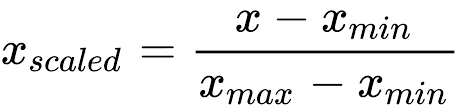
Normalization

2. Standardization

Standardization is a widely used scaling technique that transforms features so that they have a mean of 0 and a standard deviation of 1. Unlike min-max scaling, it does not bound values within a fixed range; instead, it centers features and scales them to unit variance.

Formula:
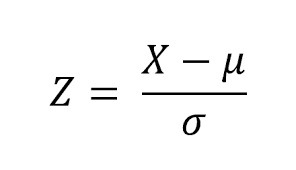
Standardization

3. Robust Scaling

Robust Scaling is a feature scaling technique that uses the median and the interquartile range (IQR) instead of the mean and standard deviation. This makes it robust to outliers, as extreme values have less influence on the scaling process compared to min-max scaling or standardization.

Formula:
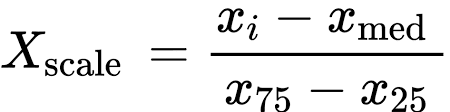
Robust_Scaling

4. Max-Abs Scaling

Max-Abs scaling rescales each feature individually so that its maximum absolute value becomes 1.0, while preserving the sign of the data. This means all values are mapped into the range [-1, 1].

Formula:

Max-Abs Scaling

Limitations of Feature Scaling

  • Not always necessary: Tree-based models are largely insensitive to feature scaling, so applying normalization or standardization in these cases adds computation without improving results
  • Loss of interpretability: Scaling can make raw feature values harder to interpret, which can complicate communication with non-technical stakeholders
  • Method-Dependent: Different scaling techniques can yield different results depending on the algorithm and dataset, and an ill-suited choice can degrade performance

Conclusion

Feature scaling is a critical preprocessing step that can improve the performance of machine learning models, but its effectiveness depends on the algorithm and the data. Models that rely on distances or gradient descent often require scaling, while tree-based methods usually do not benefit from it. Always fit your scaler on the training data only (or within each fold for cross-validation and time series) and apply it to validation and test sets to avoid data leakage. When applied carefully and tested across different approaches, feature scaling can lead to faster convergence, greater stability, and more reliable results.

Jayita Gulati

About Jayita Gulati

Jayita Gulati is a machine learning enthusiast and technical writer driven by her passion for building machine learning models. She holds a Master’s degree in Computer Science from the University of Liverpool.




Source_link

Related Posts

Working to automate nuclear plant operations | MIT News
Al, Analytics and Automation

Working to automate nuclear plant operations | MIT News

July 24, 2026
How to Build an End-to-End OCR Pipeline with Baidu’s Unlimited-OCR for High-Resolution Images and Multi-Page PDF Parsing
Al, Analytics and Automation

How to Build an End-to-End OCR Pipeline with Baidu’s Unlimited-OCR for High-Resolution Images and Multi-Page PDF Parsing

July 24, 2026
MIT projects selected for funding under US Department of Energy’s Genesis Mission | MIT News
Al, Analytics and Automation

MIT projects selected for funding under US Department of Energy’s Genesis Mission | MIT News

July 23, 2026
You Didn’t Get the AI Model You Paid For
Al, Analytics and Automation

You Didn’t Get the AI Model You Paid For

July 23, 2026
Anthropic Releases Claude Security Plugin for Claude Code in Beta: A Multi-Agent Vulnerability Scanner That Runs in Your Terminal
Al, Analytics and Automation

Anthropic Releases Claude Security Plugin for Claude Code in Beta: A Multi-Agent Vulnerability Scanner That Runs in Your Terminal

July 23, 2026
Professor Emeritus Dimitri Bertsekas, influential computer scientist and prolific author, dies at 83 | MIT News
Al, Analytics and Automation

Professor Emeritus Dimitri Bertsekas, influential computer scientist and prolific author, dies at 83 | MIT News

July 22, 2026
Next Post
The Ultimate Guide to Preparing for VCTA-DCV Certification

The Ultimate Guide to Preparing for VCTA-DCV Certification

POPULAR NEWS

Trump ends trade talks with Canada over a digital services tax

Trump ends trade talks with Canada over a digital services tax

June 28, 2025
15 Trending Songs on TikTok in 2025 (+ How to Use Them)

15 Trending Songs on TikTok in 2025 (+ How to Use Them)

June 18, 2025
Communication Effectiveness Skills For Business Leaders

Communication Effectiveness Skills For Business Leaders

June 10, 2025
App Development Cost in Singapore: Pricing Breakdown & Insights

App Development Cost in Singapore: Pricing Breakdown & Insights

June 22, 2025
Comparing the Top 7 Large Language Models LLMs/Systems for Coding in 2025

Comparing the Top 7 Large Language Models LLMs/Systems for Coding in 2025

November 4, 2025

EDITOR'S PICK

How to Design Production-Grade Mock Data Pipelines Using Polyfactory with Dataclasses, Pydantic, Attrs, and Nested Models

February 8, 2026

The Scoop: Tim Cook makes a play for his legacy at final WWDC

June 9, 2026
The 21 Best Social Media Marketing Tools to Try in 2025

The 21 Best Social Media Marketing Tools to Try in 2025

July 29, 2025
Dark Social: What It Is and How to Measure in ABM

Dark Social: What It Is and How to Measure in ABM

December 30, 2025

About

We bring you the best Premium WordPress Themes that perfect for news, magazine, personal blog, etc. Check our landing page for details.

Follow us

Categories

  • Account Based Marketing
  • Ad Management
  • Al, Analytics and Automation
  • Brand Management
  • Channel Marketing
  • Digital Marketing
  • Direct Marketing
  • Event Management
  • Google Marketing
  • Marketing Attribution and Consulting
  • Marketing Automation
  • Mobile Marketing
  • PR Solutions
  • Social Media Management
  • Technology And Software
  • Uncategorized

Recent Posts

  • Google signs EU AI Act Transparency Code of Practice
  • The Scoop: Meta bans harassment content made with smart glasses
  • Silicon Valley Is Completely Divided Over Chinese AI
  • Working to automate nuclear plant operations | MIT News
  • About Us
  • Disclaimer
  • Contact Us
  • Privacy Policy
No Result
View All Result
  • Technology And Software
    • Account Based Marketing
    • Channel Marketing
    • Marketing Automation
      • Al, Analytics and Automation
      • Ad Management
  • Digital Marketing
    • Social Media Management
    • Google Marketing
  • Direct Marketing
    • Brand Management
    • Marketing Attribution and Consulting
  • Mobile Marketing
  • Event Management
  • PR Solutions