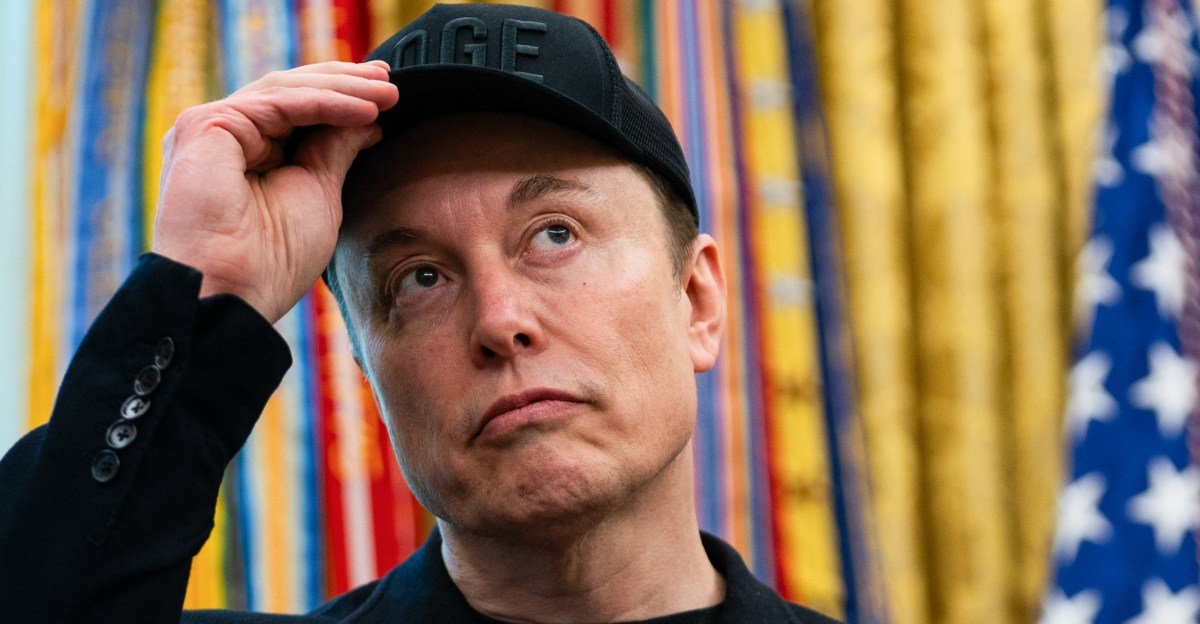
Earlier this month, Elon Musk said he wanted to form a new political party. He’d been teasing the idea ever since clashing with President Donald Trump over his “big, beautiful bill,” which Musk accused of exploding the deficit. In June, Musk ran a poll on X asking users whether it was “time to create a new political party in America that actually represents the 80% in the middle?” More than 5 million people responded, and 80 percent voted yes. Then, on July 5, Musk announced he was forming the American Party in hopes of giving voters their “back [their] freedom.”
Those who follow Musk closely, like Bloomberg Businessweek national correspondent Joshua Green, have said Musk’s latest project is in line with his pursuit of political power and attention.
“I think he thought he’d essentially bought that by backing Donald Trump to the tune of $300 million in the last election,” Green said previously on Today, Explained. “And Trump turned on him, ousted him, took away his EV tax credits, didn’t cut the deficit, trashed him on social media. And now I think Elon is humiliated and looking for a way to respond and hit back.”
Trump has called Musk’s third-party proposal “ridiculous.” And the billionaire appeared to have moved from his third obsession by mid-July — at least on X — posting instead about Europe’s fertility rate and running damage control for the antisemitic rants of his AI platform Grok.
But regardless of whether he follows through on the “America Party,” Musk appears to have hit a chord with an American electorate disillusioned by the two-party system.
On Today, Explained, co-host Noel King dove into voters’ desires, the history of third parties, and possible solutions to the two-party stranglehold with Lee Drutman, senior fellow at the New America think tank and author of Breaking the Two Party Doom Loop: The Case for Multiparty Democracy in America.
Below is an excerpt of their conversation, edited for length and clarity. There’s much more in the full episode, so listen to Today, Explained wherever you get podcasts, including Apple Podcasts, Pandora, and Spotify.
You are not a big fan of the two-party system.
You know, I think it’s outlived its usefulness. I think America is a pretty big, diverse country these days, you may have noticed. And to fit everybody into just two parties seems like kind of insanity, and it’s clearly not working. Also, it has divided this country into two teams — the red and the blue team — that have learned to absolutely hate each other. It’s created these artificial divisions around this zero-sum, winner-take-all electoral politics that is just really breaking down the foundations of democracy in this country. So, I think there was a time when it worked reasonably well for certain reasons, but that time is in the past.
You will know that Elon Musk agrees with you. He says he wants to start a third party. He ran one of his polls [on X], and the question was: “Is it time to create a new political party in America that actually represents the 80% in the middle?” I’m looking at that poll now. Eighty percent of people said yes, 20 percent said no. How does that match up with reality in the US?
Well, there are two parts to that question. One is: How many people want a third party? And then two is: How many people want that party to be somewhere in the middle?
Now, the first part: How many people want a third party? That 80 percent is a little bit high. There might be some selection bias there, but it is close to polls that I’ve seen. Generally, about 60 to 70 percent of Americans say there ought to be more than two parties when polled. So, overwhelmingly, Americans say they want more than two parties.
Now, is the party that they want a party in the center? That’s less clear. I think people’s perception of the political center depends on themselves. [Most] people think that they’re more reasonable and they’re more moderate. But in reality, when you look at the viewpoints of the American electorate, as I’ve done repeatedly, you see that the support for a genuine center party is limited to maybe 10 to 15 percent. But there is a lot of interest in parties that are maybe not as traditional.
Third-party candidates do run for office all the time in the United States, they very rarely win. If so many voters want more options, why don’t we have more people in elected office from third parties?
Here you’re hitting on the core problem, which is that we have a single-winner system of elections. So in a single-winner election, third parties become spoilers and wasted votes, because one of the two major parties is going to win every election. So, voting for a third party is just basically a protest vote, or maybe it could spoil the election. And as a result, most people don’t want to do that because they think, well, I want to vote for somebody who at least has a chance of winning. And, more importantly, people who have ambition in politics say, well, I’m not going to waste my time with one of these fringe parties. I want to actually win. So you get minor parties that are mostly cranks and weirdos and people say, well, I’d like to vote for another party, but not that third party.
What’s the recent history of third-party candidates? Serious third-party candidates at a national level? I have a vague memory of Ross Perot, but I couldn’t give you many details. It was the nineties. How serious have third-party candidates been over time?
Well, Ross Perot is the most recent third-party candidate to actually get a pretty decent share of the electorate. He got almost 20 percent of the electorate, although he didn’t win a single state. A lot of people remember Ralph Nader in 2000, who only got about 3 percent of the vote, but it was a very well placed 3 percent because his votes were more than the difference between Bush and Gore in Florida and a few other states.
Before that, you had George Wallace running in 1968 on the American Independent Party as sort of a “preserve segregation” platform. And then 1912, you have Teddy Roosevelt running as a Bull Moose third-party candidate. [He] was the most successful third-party candidate. Of course, he had already been president. So you’ve periodically had third-party challenges at a presidential level. At a House and Senate level, you have a few people who run as independents. But people tend to go right for the presidency because that creates a level of visibility if you’re trying to build a party.
If one thinks that the two-party system is a problem, let’s talk about solutions. You advocate for something called proportional representation. Explain what that is and why you think it might be a solution here.
Well, proportional representation is the most common system of voting, and it basically, at its simplest level, it means that parties get shares of seats in proportion to what percent of the vote they get. So if a party gets 30 percent of the vote, it gets 30 percent of the seats in the legislature. If it gets 10 percent, it gets 10 percent. Now, there are varieties of proportional representation that we could spend an hour going in the weeds.
Tell me the one you like the best. What would work in the US?
What I think would work in the US is probably the most commonly used version, which is called open list proportional representation with multi-member districts — which is this idea that rather than having a single district with a single representative, you have a single district with five representatives. The district is larger, and then the parties put forward lists of candidates. You choose the candidate from the party that you like, all the votes for each party get tallied up, and then the seats get allocated in proportion. So if a party gets 40 percent of the votes in that five member district, its top two candidates go to represent the district. If a party gets 20 percent, its top candidate [goes]. So, in theory, you could have five parties representing the same district.
“We’ve never had this level of dissatisfaction with the two-party system as far back as we’ve seen polling.”
We talk a lot about gerrymandering as a huge problem, and it is. But [if] you move to five member proportional districts, gerrymandering becomes irrelevant. It doesn’t matter because votes are going to be allocated proportionally no matter what. So, everybody gets to cast a meaningful vote because every seat matters. Every seat is competitive. Every vote matters. Electoral reform is the most powerful tool we have.
So, at the end of the day, has Elon Musk done something admirable here [by] making this a topic of conversation in a kind of real way?
Yeah. So, I think by raising the issue of the need for a third party, it certainly opens up a conversation about what it would take. I’m not sure Elon’s approach is going to be successful. On the other hand, if he’s strategic and wants to spoil a few races that will determine control of the House and the Senate by running a spoiler candidate, then, historically, that’s actually what has led to a wider conversation about electoral reform. And that’s one of the reasons that a lot of countries moved to electoral reform.
We’ve never had this level of dissatisfaction with the two-party system as far back as we’ve seen polling. So, there is a real understanding that what we’re doing in our electoral system is just not working.