[ad_1]
Data preparation, labeling, validation, and quality assurance are required to train, evaluate, and refine models. As a result, organizations are increasingly turning to data annotation outsourcing partners to accelerate dataset curation and improve model output. In 2026, outsourcing data annotation is simply no longer a cost-saving measure; it also involves tips for choosing a vendor. It has become a strategic decision that directly influences model performance, development speed, and business outcomes.
Why data annotation outsourcing in 2026?
Data annotation provides a structured context for labeled data. It includes relationships, bounding boxes, or sentiment scores. Poorly labeled data usually results in unreliable machine learning models, irrespective of the architecture. Consistent and accurately labeled data helps an AI system perform at its best.
Rather than building an in-house team, businesses prefer outsourcing data annotation services to partners like Cogito Tech. It provides them access to professional teams that can process a large volume of data consistently and quickly. A team of domain-specific knowledge specialists helps protect model quality from the outset, a capability hard to replicate in-house.
When Should You Outsource Data Annotation?
At the following stages, partnering with an experienced annotation provider can improve and accelerate AI development.
- Dataset volumes exceed internal capacity, making it hard to maintain quality and meet delivery timelines.
- Projects involve multimodal data such as images, video, audio, LiDAR, or sensor data that require specialized annotation expertise.
- Domain-specific knowledge is essential, particularly in regulated industries such as healthcare, finance, legal AI, and autonomous systems.
- Internal AI teams are spending more time labeling data than building models, slowing innovation and product development.
- Projects require rapid scaling to support large training datasets, frequent model retraining, or tight production deadlines.
Data Annotation Outsourcing Use Cases Across Industries
The type of data and annotation requirements vary significantly depending on the application.
Healthcare AI
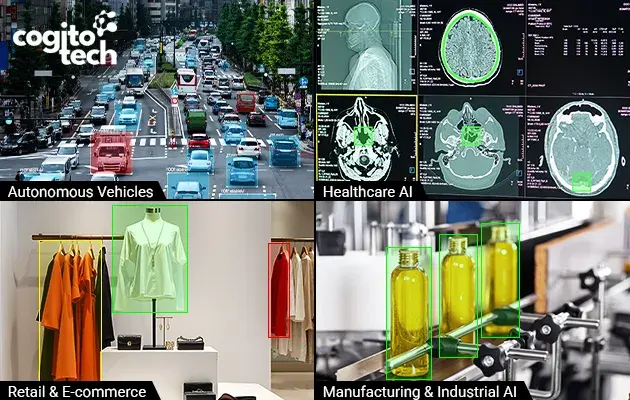
Healthcare organizations often outsource labeling for radiology scans, medical images, clinical notes, EHRs, etc. In practice, domain experts will tag diseases, body anatomy, tumors, lesions, and medical entities to help diagnostic AI, imaging tools, clinical decision assist, and even healthcare copilots.
Autonomous Vehicles & Robotics
Companies building autonomous systems outsource annotation for camera images, LiDAR point clouds, radar signals, sensor fusion data, and video sequences. The work typically covers object detection, semantic segmentation, lane marking, 3D cuboid annotation, pose estimation, and trajectory labeling… all of which are used to properly train perception and navigation models.
Retail & E-commerce
Retailers outsource annotation for product images, product catalogs, customer reviews, shopping behavior, and shelf images. These datasets end up backing product recognition, visual search, suggestion engines, inventory management, and other automated retail workflows, you know.
Financial Services
Banks and fintech firms outsource annotation for financial documents, loan applications, invoices, customer communications, transaction records, and compliance documents. Annotation here supports fraud detection, document intelligence, risk evaluation, entity extraction, and regulatory compliance.
Insurance
Insurance providers annotate claims documents, repair estimates, policy documents, damage images, and customer correspondence. With these datasets they enable automated claims handling, damage assessment, fraud detection, document classification, and underwriting decisions.
Manufacturing & Industrial AI
Manufacturers outsource annotation for factory images, machine vision data, thermal imagery, sensor data, and equipment inspection videos. AI models use these datasets for defect detection, predictive maintenance, quality inspection.
How to Choose the Right Data Annotation Vendor
The process of selecting the best data labeling vendor goes beyond comparing costs. AI leaders must assess vendors as per their quality assurance processes, domain expertise, scalability, security standards, and their capability to support accelerating AI requirements.
Evaluate Domain Expertise
AI models sink quietly due to poor labels that cost millions and erode trust. Domain expertise goes beyond tagging data; it also involves catching edge cases, interpreting ambiguity, and preventing failures. Before you choose a data annotation service provider, it is good to ask the following questions:-
- In which industry do they specialize in?
- Do they employ domain experts?
- Can they support complex annotation workflows?
Assess Quality Assurance Processes
Quality control is required in each stage. It works on a widely recognized principle, “Garbage In, Garbage Out”, which means poor-quality data inevitably leads to poor model performance. It makes data quality an integral part of AI development, ensuring reliable training datasets, model accuracy, and trustworthy outcomes.
Confirm the presence of :
- Statistical quality monitoring
- Multi-layer reviews
- Consensus validation
- Expert audits
Review Security and Compliance
Secure data labeling is the lifeline for annotating sensitive and regulated data while maintaining privacy, security, and compliance. Further, implementation of secure environments, access control, and governance frameworks helps protect confidential information throughout the annotation process and scale AI development responsibly.
Key considerations must include:
- GDPR compliance
- HIPAA compliance
- SOC 2 certification
- Secure infrastructure
- Data governance policies
Examine Scalability
Annotation requirements hardly remain constant. A project that starts with a few thousand images might expand to millions of multimodal samples. You need to check whether the selected data annotation vendor can scale its infrastructure, workforce, and quality processes without sacrificing accuracy. Before hiring a data labeling partner, ask the following questions.
Can the vendor support:
- Growing volumes?
- Multiple data types?
- Global operations?
- Tight deadlines?
Understand Technology Capabilities
Modern annotation providers combine automation with Human-in-the-Loop (HITL) workflows. AI-assisted pre-labeling and human labelers work hand in hand, where AI accelerates annotation while human experts validate, correct, and refine labels to ensure accuracy. AI companies must assess whether a vendor supports AI-assisted labeling, human review workflows, quality analytics, and continuous feedback mechanisms.
Evaluate:
- Annotation platforms
- AI-assisted labeling
- Workflow management
- Human-in-the-Loop review workflows
- Analytics and reporting
- Integration capabilities
Advantages of data annotation outsourcing
Many AI initiatives underestimate the effort required to prepare AI training data. Industry studies suggest that data preparation, labeling, and management can consume up to 80% of an AI project’s lifecycle. As datasets grow in size and complexity, organizations increasingly outsource annotation to specialized providers that can deliver scalability, domain expertise, and quality assurance while allowing internal teams to focus on model development and deployment. Here are the key benefits of outsourcing data annotation:-
1. Access to Experts
Domain-specific knowledge is highly recommended for modern AI projects that deal beyond basic labeling. Professional annotators help ensure accurate and consistent data, whether it’s required to annotate medical images, evaluate voice AI systems, train multilingual NLP models, or support autonomous technology. Outsourcing provides access to experienced professionals without the time and cost required to build these capabilities internally.
2. Scalability for Growing Data Needs
Throughout the AI lifecycle, data requirements can change rapidly. A project might start with a few thousand samples and further scale to millions of annotations across different data modalities. Outsourcing partners bring the flexibility to scale annotation up or down according to project demands. It eliminates the challenges of hiring and managing a large internal staff.
3. Cost Optimization
A considerable share of investment is required to build and manage internal annotation operations, including recruitment, training management, infrastructure, and quality assurance. Outsourcing converts these fixed costs into flexible operational expenses, enabling organizations to allocate resources more efficiently while maintaining access to skilled annotation talent.
4. Focus on Core AI Development
By outsourcing data preparation tasks, data scientists, machine learning engineers, and AI teams can focus on higher-value activities such as model development, evaluation, deployment, and optimization.
5. Improved Compliance and Data Governance
For regulated industries such as healthcare, finance, and legal services, annotation providers often implement robust security controls, compliance frameworks, and governance processes. This helps organizations manage sensitive data while meeting industry and regulatory requirements.
What Does Data Annotation Outsourcing Cost?
The cost of data annotation varies widely according to the data type, annotation complexity, level of domain expertise, and more. Organizations should evaluate annotation costs in relation to data quality and model performance rather than focusing solely on the lowest price.
Common Data Annotation Pricing Models
These are three standard pricing models named hourly, per-label, and project-based pricing. The right selection depends on project complexity, volume, and predictability.
Hourly Pricing
In this model, clients pay for the time annotators spend on a project. It is best suited for complex or evolving tasks such as semantic segmentation, 3D annotation, or specialized domain work where effort can vary significantly. While flexible, costs can be less predictable.
Per-Label Pricing
Per-label pricing charges based on the number of annotations created, such as bounding boxes, polygons, or text tags. This pricing model provides greater cost transparency and is ideal for projects with clearly defined annotation requirements and volumes.
Project-Based Pricing
Project-based pricing establishes a fixed cost for a predefined scope of work. It offers budget certainty and simplified management for well-defined projects but may be less flexible if requirements change. This model is most effective when annotation volumes, complexity, and deliverables can be accurately estimated upfront.
| Pricing Model | Best For | Benefits | Consideration |
|---|---|---|---|
| Hourly Pricing | Complex or evolving projects | Flexibility | Costs may vary |
| Per-Label Pricing | Large, well-defined datasets | Cost transparency | Requires clear annotation guidelines |
| Project-Based Pricing | Fixed-scope projects | Predictable budget | Limited flexibility for scope changes |
How much does data annotation outsourcing typically cost?
Annotation costs vary depending on data type, project complexity, quality requirements, and domain expertise. Simple text or image labeling projects may cost only a few cents per item, while specialized tasks such as medical image annotation, LiDAR labeling, or RLHF can cost significantly more.
Avoid Mistakes When Outsourcing Data Annotation
- Choosing based on price alone
- Poor annotation guidelines
- Ignoring pilot projects
- No quality metrics
- Overlooking security requirements
Conclusion
As AI moves from experimentation into production, the whole point about high-quality data just keeps growing in importance. Data annotation outsourcing has kind of shifted, from being a plain operational task into a strategic enabler for AI results.
Teams that pick the right annotation partners actually get access to specialized know how, scalable delivery, and reliable quality controls that speed things up, and generally make the model output better. By 2026, the AI efforts that really stand out won’t always be tied to the biggest models. They’ll be the ones that are built on the strongest data, the foundations that are harder to replicate.
Frequently Asked Questions
Data modality (text, image, video, audio, LiDAR) kind of ends up being the biggest cost driver. And beyond that, there are other things like annotation complexity, total volume, the level of expertise you need, plus quality assurance routines, security requirements, and the whole project schedule.
Honestly, a pilot project is a good start, because it lets you check annotation accuracy, consistency, turnaround times, how they communicate, whether they scale, and how their quality assurance workflows actually work. Then you can decide, without going all in on a larger engagement too early.
Most of the established vendors can provide scalable workforces, clear and structured workflows, and project management support that is meant for millions of annotations across different data types and geographies.
Synthetic data can reduce labeling needs and help with coverage in rare cases, but it generally does not fully swap out real-world annotated data. Usually, organizations use both synthetic and human-labeled data together, so the model performance improves in a more reliable way.
It remains very critical, especially if you are in regulated industries. You should look for vendors that offer access controls, secure environments, audit trails, encryption, and alignment with standards such as GDPR, HIPAA, or SOC 2.
Outsourcing becomes more valuable when the project volume goes beyond internal capacity, when you need specialized skills, when meeting deadlines becomes harder, or when your internal team should spend more time on model development rather than data preparation.
[ad_2]
Source_link