Do you know that most companies are using AI the same way people used the internet in 1998. They know it matters. So what they have done is plugged something in and they are hoping for the best.
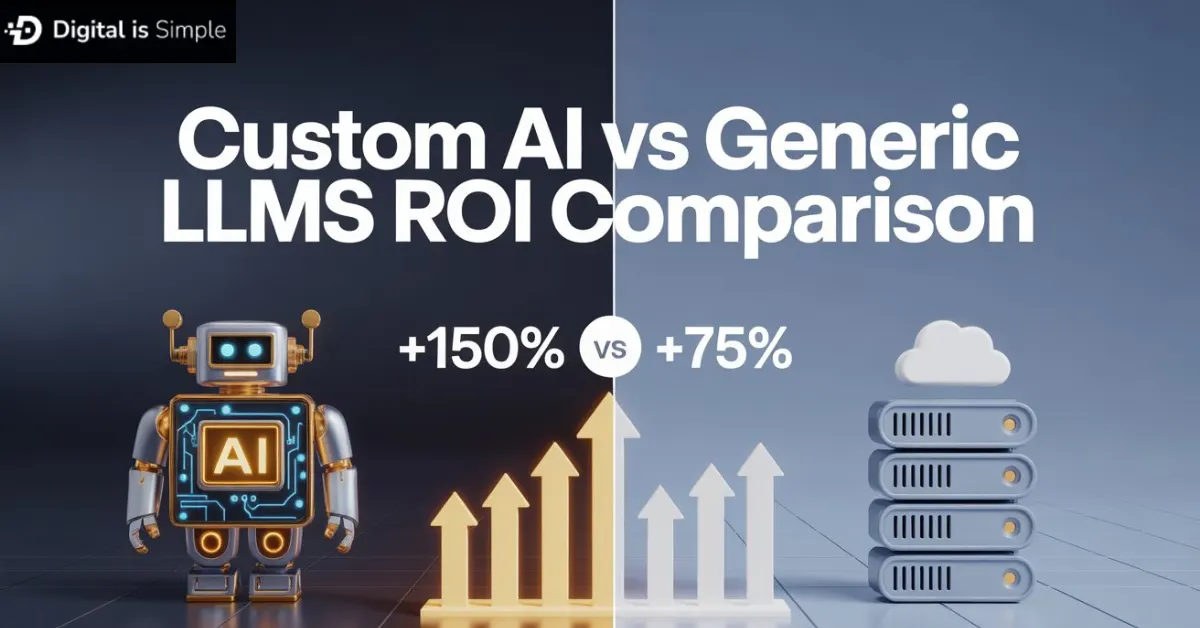
The question is whether a generic LLM is actually the right tool for your business, or if a customized solution built by an AI development company would deliver significantly better returns.
According to McKinsey’s 2024 AI report, companies that move beyond generic AI adoption and integrate AI deeply into their workflows see 20 to 30% improvements in key performance metrics compared to peers who don’t.
What Do We Actually Mean by “Custom AI“?
Before we talk ROI, we need to get the terminology straight. Because “custom AI” means very different things depending on who you ask.
At the lightest end, you have prompt-engineered wrappers. This is essentially taking a generic model like GPT-5 or Claude and giving it detailed instructions about how to behave for your specific use case.
This is low cost and fast to build. But you’re still fundamentally renting someone else’s brain.
One step up is Retrieval-Augmented Generation, or RAG. Instead of retraining a model, you connect it to your own data so it can pull relevant context before responding. This is where a lot of businesses are landing right now because it hits a sweet spot of cost versus relevance.
Then at the far end, you have fine-tuned or fully custom-trained models. These are models that have been retrained on your proprietary data, your industry language, your workflows. They are more expensive and take longer to build. But they behave and respond in ways no generic tool ever will.
What Generic LLMs Are Great at and Where They Fall Short
Let’s give credit where it’s due. Generic LLMs are genuinely impressive out of the box. They are fast to deploy and can handle a surprisingly wide range of tasks from drafting emails to summarizing reports to writing code.
For small teams or early stage companies just getting started, they are a legitimate and smart entry point.
But the cracks start to show at scale.
The biggest issue is context. A generic model knows nothing about your business. Every prompt starts from zero. That means your team spends enormous time engineering prompts just to get usable output.
Then there’s the hallucination problem. Generic models confidently produce wrong answers. In low-stakes tasks that’s annoying. In legal, medical, or financial contexts, it’s a liability.
IBM’s 2024 Cost of a Data Breach report found that AI related errors and data incidents are increasingly showing up as contributors to breach costs, which now average 4.88 million dollars globally.
Finally, there’s data privacy. When your team pastes proprietary information into a consumer-grade AI tool, you have little control over how that data is used or stored. For regulated industries, that alone can be a dealbreaker.
The ROI Case for Custom AI
Salesforce put out a State of AI report in 2024 that stuck with me. Companies using AI tools built around their actual workflows had noticeably better employee adoption than those handing out generic tool access and calling it a day.
McKinsey’s research tells a similar story from the performance side. Businesses that have genuinely embedded AI into their core operations are outperforming peers by 20 to 30% on things like revenue growth and customer satisfaction.
Now yes, building something custom costs more upfront. Nobody is pretending otherwise. But that framing ignores what generic tools are quietly costing you already.
The hours your team burns wrestling prompts into shape. The human review cycles patching over inconsistent outputs. Add all that up and the price difference between generic and custom starts looking a lot smaller than the invoice suggests.
The ROI Case for Generic LLMs
Look, I am not here to sell you on custom AI at all costs. That would be a dishonest argument.
If you are an early stage startup still figuring out what your core workflows even look like, please do not go spend six figures on a custom build. Generic tools exist precisely for this stage.
Same goes for the everyday stuff. Drafting content and answering basic customer questions. A well-configured generic model handles most of that just fine.
Cost is also real and worth being straight about. Maintaining a custom model is not a one-time project. It needs infrastructure, it needs retraining as your business evolves, and it needs someone who knows what they are doing.
So no, custom AI is not a universal upgrade. It is the right answer for specific situations and a waste of money in others. The goal of this post is to help you tell the difference.
Read also: Generative AI vs LLM: What’s the Real Difference in 2026?
Which Should You Choose?
Here are five questions to settle it for your business.
Do you have proprietary data that defines your competitive edge? If yes, a generic model will never fully leverage it.
Are you operating in a regulated industry where errors carry legal or financial consequences? Custom is worth the investment.
Is your AI usage high volume and deeply embedded in core workflows? The ROI on customization compounds fast at scale.
How much output inconsistency can you tolerate? If the answer is very little, generic tools will frustrate you.
And finally, do you have the in-house talent or a trusted vendor to build and maintain a custom solution? If not, start generic and build toward it.
Conclusion
Let me be direct. If your current AI strategy is “we use ChatGPT,” you don’t have an AI strategy. You have a subscription.
Generic LLMs are one of the most accessible technology entry points in business history and there is no shame in starting there. But starting there and staying there are two very different decisions.
Custom AI is not for everyone right now. If your use cases are simple, your volume is low, and you are still learning how AI fits into your workflows, a generic tool is the right call.
Before your next AI budget conversation, do one thing. Add up what your team is actually spending on AI tools, in licenses, in hours spent fixing bad outputs, in opportunities missed. That number will tell you everything you need to know about your next move.