When your brand is referenced in social posts, news articles, Reddit threads, podcasts, and other places, it signals authority to search engines and influences whether AI systems recommend you.
In this guide, you’ll learn where mentions happen, which KPIs matter, how to set up monitoring workflows, and how to ensure your brand appears in AI-driven answers.
What Are Brand Mentions?
A brand mention is any online reference to your company, product, or service—whether or not it links back to your site.
Online brand mentions indicate how well-known your company is on the web. And they can reveal how people and algorithms perceive your reputation.
Why Does Tracking Brand Mentions Matter?
Tracking brand mentions matters because it allows you to:
- Measure your brand awareness: Tracking online mentions provides a concrete way to see whether knowledge of your brand is growing
- Manage your reputation: Tracking brand mentions lets you monitor what people say about your brand, which gives you the opportunity to respond strategically to shape public perception when needed
- Gauge how reputable you are: Brand mentions signal authority to search engines and AI systems, which can improve your visibility
- Compare yourself to competitors: Tracking competitors’ mentions lets you see where competitors earn coverage, which outlets mention them, and how their sentiment compares to yours, revealing market gaps and narrative shifts
3 Types of Brand Mentions & What Each Does
Brand mentions contribute to visibility in different ways. Some strengthen SEO, some reflect brand awareness, and some show how often AI systems reference your company.
Here’s how each one works and why it matters:
|
Type |
Description |
Why it matters |
|
Linked mentions |
Mention you and also include a backlink to your site |
Passes SEO authority, drives referral traffic, and improves discoverability |
|
Unlinked mentions |
Reference your brand without a link |
Builds awareness and credibility, and can often be converted into backlinks |
|
When you appear in AI-generated answers |
Influences how users perceive your brand and can inform purchase decisions |
How to Track Online Brand Mentions
You can track online brand mentions using free tools or paid solutions that provide more insights.
Start Free: Google Alerts & Manual Searches
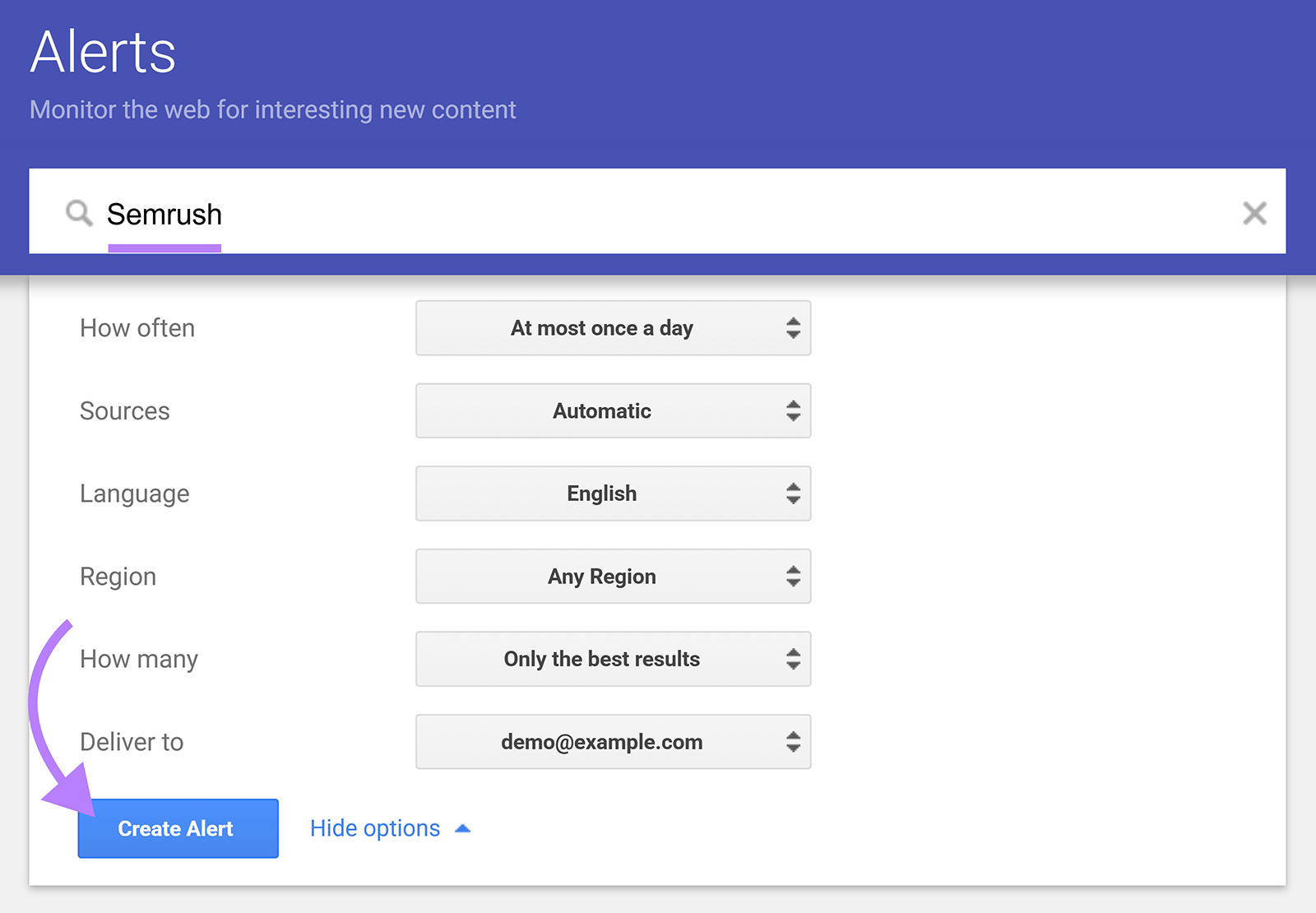
Google Alerts offers simple brand monitoring via email notifications whenever your brand appears in news articles, blogs, or other websites.
Set up alerts for your brand name (including common misspellings), executives’ names, product/service names, etc.

Google Alerts doesn’t cover mentions on social platforms or forums like Reddit. It also lacks sentiment analysis and historical data, making trend tracking difficult.
To fill the gaps, manually search X, Instagram, LinkedIn, Reddit, and TikTok for brand mentions. Monitor mention frequency, relevant hashtag use, and exactly how users talk about you and other brands.
Best for:
- Small teams testing demand for monitoring
- Brands with low mention volume
- A baseline option before upgrading to tools with broader coverage and analytics
Level Up: Social Listening & Brand Monitoring Platforms
After you’ve covered the basics with free tools, the next step is a dedicated monitoring platform. These tools track conversations across social networks, forums, blogs, news sites, and review platforms. Giving you more visibility into where and how your brand is being discussed.
Social listening tools surface trends across community-driven platforms and offer features such as sentiment analysis, influence scoring, keyword grouping, and language or location filters.
Media and brand monitoring platforms focus on earned coverage and let you track mentions across news outlets, industry publications, and high-authority sites. They often include journalist databases, share of voice reporting, and historical data, so you can benchmark your presence over time.
Some platforms also connect mentions with SEO insights so you can identify opportunities to earn more coverage or strengthen your visibility.
For example, Semrush’s Brand Monitoring app shows mentions across web, social, press, and backlinks in a single dashboard.

Best for:
- PR and social teams that need sentiment tracking and coverage analysis
- Brands that want competitive benchmarking across multiple channels
- Teams that prefer unified dashboards that consolidate mentions and trends
Set Up Your Monitoring Workflow in 4 Steps
No matter which tool you use, the workflow for an effective brand monitoring system is the same: define what to track, set relevant alerts, route mentions to the right people, and respond consistently with a clear playbook.

1. Build Your Term List
Include your brand name (plus common misspellings and abbreviations), product/service names, executives’ names, and other terms that are relevant to your brand.
Include competitors if you plan to track category coverage.
2. Configure Filters and Alerts
Set alerts for high-impact mentions (e.g., publications with 10K+ followers or posts with 1K+ engagement) and daily or weekly digests for lower-priority ones.
Match alert frequency to your team’s bandwidth to ensure you can keep up.
Use filters to exclude spam, bot activity, job listings, and unrelated content by blocking irrelevant keywords or low-quality sources.
3. Route Notifications to the Right Stakeholders
Send each mention type to the right team or team member. For example:
- Social mentions: Community management
- Press coverage or high-visibility negative mentions: PR
- Unlinked mentions with backlink potential: SEO, so they can evaluate and reach out if appropriate
Deliver alerts via email, Slack, or in-platform notifications depending on urgency and workflow.
4. Create a Response Playbook
Define clear rules for how your team should respond to different types of mentions. For example:
- Engage when the mention could lead to conversation or value:Respond to positive mentions, genuine questions, product feedback, or neutral comments that show curiosity
- Escalate when the mention could impact reputation or accuracy: Flag legal threats, emerging crises, factual errors, negative campaigns, or high-visibility criticism
- Ignore noise that doesn’t require action:Skip spam, bot activity, irrelevant comments, or mentions from low-quality sources with no audience. Engaging with these adds noise without delivering value.
A clear playbook ensures every team member knows when to respond, when to seek support, and when to let a mention pass. It keeps communication consistent across the organization.
Brand Mention-Related KPIs That Matter
Track the following key performance indicators (KPIs) related to brand mentions on a weekly basis to monitor your progress and spot trends early:
|
KPI |
What to track |
What it’s useful for |
|
Total brand mentions |
Total number of mentions over a specific time period |
Identifying sharp increases or decreases and establishing a baseline |
|
Reach |
The estimated number of people who are likely exposed to your mentions |
Understanding the potential size of your audience and identifying opportunities |
|
Sentiment |
Percentage of mentions that are positive, negative, or neutral |
Detecting shifts in reputation and responding quickly to negative sentiment |
|
Share of voice |
Your portion of total mentions within your category |
Seeing how your visibility compares to competitors’ |
Ways to Get More Out of Brand Mentions
Brand mentions create value when you turn them into backlinks, marketing assets, and media relationships that expand visibility and trust.
Convert Unlinked Mentions to Backlinks
Converting unlinked brand mentions into backlinks strengthens your SEO authority and drives referral traffic.
When you find unlinked mentions, reach out to the site or author who mentioned you and request that they add a link to the relevant page on your site.
Send a short, personalized email to thank them for the mention, explain how a link helps readers, and share the URL to include. Follow up if there’s no reply after a week.
Repurpose User-Generated Content
User-generated content (UGC)—reviews, social posts, forum threads, testimonials—offers authentic social proof that you can repurpose in marketing campaigns.
Monitor mentions across social, review, and community platforms to find standout content.
You can reuse many types of UGC without formal permission. Such as embedding public social posts, quoting reviews, or reposting. For anything you download, edit, or use outside its original context, ask the creator for permission and credit them clearly.
For example, Airbnb turns guest-created content into marketing assets across its website, emails, and social channels. Photos and videos posted by travelers—showing real stays, host interactions, and unique homes—are embedded or reshared to highlight authentic experiences.

Build Relationships with Journalists & Creators
Keep an eye out for writers and creators who mention your brand, and engage with them to increase the likelihood that they’ll reference you again.
Position yourself as a trusted source by offering creators something helpful, such as expert quotes, proprietary data, or early access to research or announcements.
The goal is to become their go-to expert whenever they’re covering a topic related to you.
For example, Duolingo engages with creators who reference their brand. They repost and respond to social posts, stitch videos, leave comments, and incorporate viral moments into their own content. When journalists publish stories about language learning or app engagement trends, Duolingo amplifies those articles on its social channels and often provides additional quotes or data.

How to Get Your Brand Mentioned in AI Responses
AI systems like ChatGPT, Google’s AI Overviews, and Perplexity are more likely to mention brands that appear consistently across reliable sources. The more often your brand is referenced in trusted articles, comparison pieces, forum discussions, and reviews, the more likely it is to surface in AI search results.
For example, when people ask ChatGPT about project management tools, Asana often appears because it’s mentioned across tech publications, Reddit threads, and the text layers of YouTube content—like titles, descriptions, and transcripts. That repeated presence gives AI systems reliable trust signals to include Asana when forming an answer.

To earn AI mentions, focus on creating consistent, trustworthy signals across the sources these systems rely on:
- Strengthen your presence in publications: Frequent mentions in trusted articles, listicles, and comparison pieces help AI models recognize your brand as relevant to a topic or category
- Expand your presence across multiple platforms: Brands mentioned across a wide range of credible sources and communities tend to appear more often in AI responses because the model can triangulate their relevance
- Show up in user-driven conversations: AI systems learn from real user discussions—Reddit threads, forums, Quora answers, reviews, tutorials, and comparison posts—because they reveal who uses your product, what it’s known for, and the problems it solves
- Answer common questions clearly on your own site: Provide straightforward explanations about your product, audience, use cases, and differentiators so AI can understand when your brand is relevant
- Maintain consistent brand signals: Make sure your name, products, descriptions, and value props are accurate and aligned across your site, social profiles, and third-party references
Bring Your Brand Mentions Full Circle
Begin with Google Alerts and manual searches on relevant platforms.
From there, you can decide whether a dedicated brand mention tool like Brand Monitoring makes sense for your company.
Once your monitoring system is in place, keep the loop active. Review your core metrics regularly, respond when needed, and use what you learn to improve.
Once you have a system in place for gaining and acting on brand mentions across the web, you can pay attention to how that awareness translates to AI mentions. Which you can monitor with the AI Visibility Toolkit.
![How To Write With AI Without Sounding Like a Machine [Free AI Workflows & Prompts]](https://mgrowtech.com/wp-content/uploads/2026/03/How-To-Write-With-AI-Without-Sounding-Like-a-Machine-OG-Image-2-350x250.png)