Key takeaways:
- Building a Shein-style app is fundamentally about reducing inventory risk through data and speed, not copying a brand
- Australian market realities demand strong governance, transparency, and predictable delivery, even in fast-fashion models.
- AI delivers commercial advantage only when platforms prioritise explainability, governance, and operational outcomes over experimentation.
- The cost to build an app like Shein in Australia ranges between AUD 70,000 and AUD 700,000 or more.
- Selecting a delivery partner with proven execution depth materially reduces long-term ownership risk in Shein-like app development in Australia.
Fashion is one of Australia’s largest eCommerce categories, with online fashion revenue projected to cross $ 1 trillion by 2030 worldwide, driven largely by mobile-first shoppers and Gen Z buyers.
Yet behind these numbers sits a persistent operational problem.
Australian fashion brands still plan collections months in advance, commit capital before demand is proven, and rely on post-season discounting to manage excess stock. By the time sales data explains what worked and what didn’t, the opportunity to respond has already passed. Inventory risk, margin pressure, and slow reaction cycles remain baked into the model.
Apps like Shein changed this dynamic. Instead of treating fashion as a seasonal bet, they operate it as a live feedback system. Products launch in small batches, real customer behaviour is tracked immediately, and only designs that show traction are scaled. Demand leads supply, not the other way around.
For businesses evaluating how to build an app like Shein in Australia, this is the real value proposition. It is not about copying fast fashion aesthetics. It is about building an eCommerce platform that reduces inventory exposure, reacts faster to trends, and aligns pricing, supply chain, and customer engagement in near real time, while still meeting Australian expectations around delivery, transparency, and consumer protection.
This blog breaks down how Shein-style platforms actually work and how to develop a shopping app like Shein in Australia. So, without further ado, let’s get started:
Also Read: Top 20+ Profitable Ecommerce Business Ideas In Australia in 2026
Ready to move from concept to execution?
If you’re evaluating Shein-like app development in Australia and want clarity on cost, risk, and delivery approach, start with a focused strategic conversation.

Why Apps Like Shein Are Gaining Massive Traction in Australia
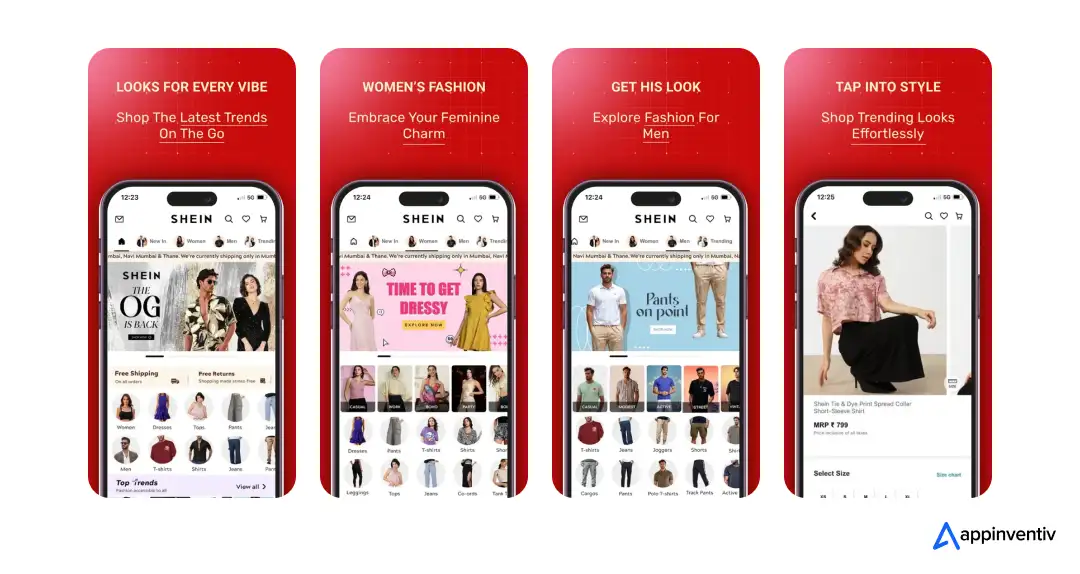
Australian consumers have become increasingly comfortable with mobile commerce that feels fast, personalised, and price-led. Buy Now Pay Later adoption, simplified checkout flows, and real-time order tracking are now baseline expectations. What distinguishes Shein-style platforms is their ability to combine these expectations with a user-friendly UI/UX and a sense of constant novelty.
From an operational perspective, the appeal lies in three forces converging:
- First, price sensitivity has increased across demographics. Cost-of-living pressures have pushed consumers toward platforms that offer perceived value without long-term brand commitment. This favours marketplaces that can test and scale winning products rapidly.
- Second, trend velocity has accelerated. Social media platforms influence demand cycles measured in days rather than seasons. Traditional catalogue-based eCommerce struggles to keep pace with this rhythm.
- Third, eCommerce logistics transparency for Australian businesses has become as important as speed. Aussie customers are generally tolerant of slightly longer delivery windows if they receive consistent updates and predictable outcomes.
These realities explain why leadership teams evaluating how to develop a shopping app like Shein in Australia must think beyond UI and promotions. The winning platforms align software, suppliers, and logistics into a single operating rhythm.
How to Build an App Like Shein in Australia: A Step-by-Step Process
Building a Shein-like shopping app at scale demands deliberate execution of careful planning. Australian enterprises that succeed treat this as platform engineering, executed through a series of careful steps. Each step locks in architectural, commercial, and governance decisions that directly affect cost, risk, and long-term control. Here is the step by step process to create an app like Shein in Australia.
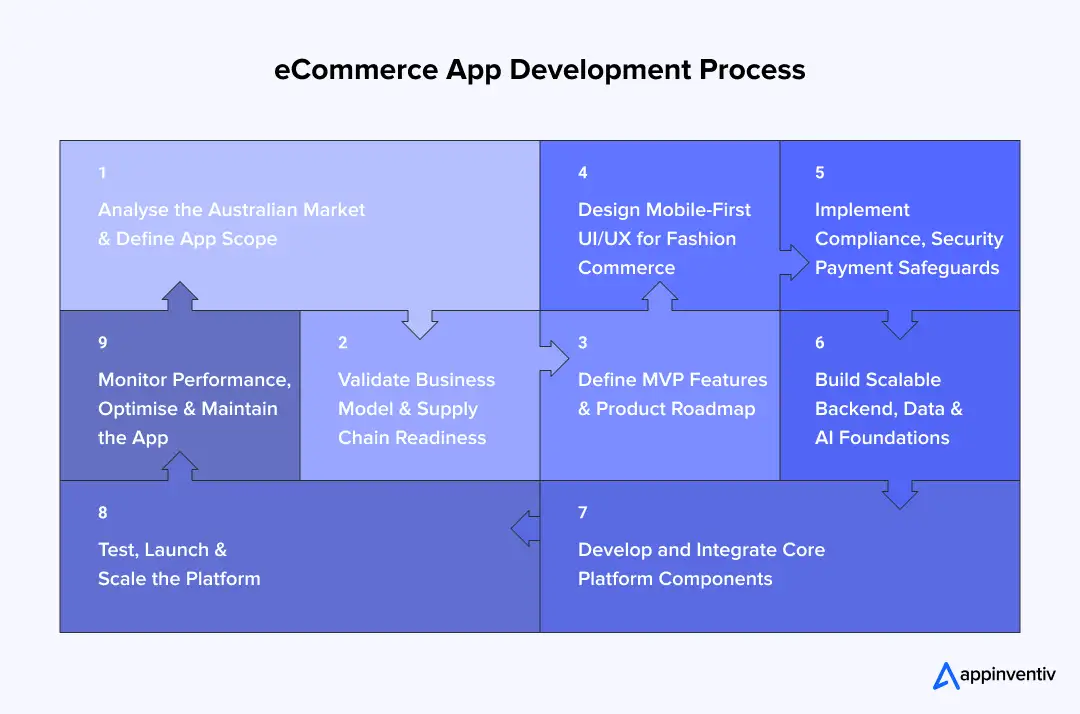
Analyse the Australian Market and Define App Scope
You should begin by validating whether the decision to build an app like Shein in Australia holds up under local commercial realities. Leaders assess pricing tolerance against higher fulfilment costs, regional delivery expectations, and return behaviour.
Key decisions at this stage include:
- Defining metro and regional delivery feasibility
- Assessing consumer price sensitivity and discount tolerance
- Mapping regulatory exposure across data, payments, and suppliers
Clear scoping at this stage prevents uncontrolled expansion in Shein like app development costs later.
Validate Business Model and Supply Chain Readiness
Before engineering begins, businesses should confirm whether suppliers can support the speed and flexibility required to build an app similar to Shein. Technology cannot compensate for slow or rigid supply chains.
At this stage, decision makers focus on:
- Production turnaround capability and batch flexibility
- Supplier readiness to consume real-time demand data
- Contractual SLAs, penalties, and escalation workflows
This step protects delivery credibility and margin in an Australian operating context.
Define MVP Features and Product Roadmap
The next step is to define the MVP by filtering aggressively. At this stage, you need to prioritise features that influence conversion, inventory risk, and fulfilment reliability, and defer everything else.
At this stage, the development team aligns on:
- Capabilities that directly drive revenue and repeat usage
- Features that can wait without operational consequence
- Roadmap phases tied to funding, compliance, and scale milestones
This discipline keeps the cost to create an app like Shein predictable across phases.
Design Mobile-First UI/UX for Fashion Commerce
This is one of the most critical steps where the design teams create intuitive and visually appealing features that can hook your targeted consumers. At this stage, the designers focus on speed, clarity, and visual hierarchy to prevent drop-offs during flash drops.
Effective design supports:
- Rapid launch of collections and campaigns
- High-concurrency traffic without UI degradation
- Operational independence for marketing and merchandising teams
Strong UI governance reduces rework and stabilises engagement.
Implement Compliance, Security, and Payment Safeguards
When building a shopping app like Shein in Australia, compliance and security come first. Considering this, the eCommerce developers embed compliance controls during core development. They design privacy, security, and payment workflows into the architecture instead of layering them later.
Australian enterprises typically implement:
This regulatory checklist (details later) approach reduces remediation risk and protects platform credibility as transaction volumes grow in Australia.
Build Scalable Backend, Data, and AI Foundations
This is the most critical step where your app idea actually takes shape. At this stage, the engineering teams architect the backend for peak demand, not average load. They design systems to absorb flash-sale traffic without cascading failures.
Core execution priorities include:
- Microservices isolation to limit blast radius
- Event-driven workflows to manage demand spikes
- Production-grade data pipelines for pricing and inventory signals
These foundations define the success of Shein-like app development in Australia.
Integrate Core Platform Components
This is the stage where the delivery teams integrate systems incrementally. They test catalogues, checkout, payments, logistics, and analytics together under realistic conditions.
Best-practice execution includes:
- Continuous integration with live-like data
- Early validation of third-party dependencies
- Cross-functional testing beyond technical sign-off
This approach stabilises delivery in online fashion shopping app development in Australia.
Test, Launch, and Scale the Platform
This is a nerve-wracking stage where the quality analysts test the platform under real operational stress. They simulate flash drops, concurrent campaigns, and peak concurrency before exposing the platform publicly.
Launch execution focuses on:
- Staged rollouts instead of big-bang releases
- Controlled traffic ramps
- Fast operational feedback loops
This discipline protects revenue and brand credibility during scale-up.
Post-launch operations determine whether the platform scales or degrades. Ongoing app maintenance focuses on commercial performance, operational stability, and regulatory exposure rather than feature output.
Ongoing maintenance covers:
- Fixing bugs and resolving production issues without disrupting live traffic
- Releasing feature enhancements and experience improvements in controlled cycles
- Managing version upgrades, dependency updates, and platform patches
- Monitoring performance, fulfilment accuracy, and transaction integrity
This discipline protects uptime, revenue, and compliance as the platform evolves.
Build a Shein-Like Platform Without Rework or Compliance Surprises
Work with a delivery partner experienced in scalable ecommerce platforms, payments, data, and governance. Focus on long-term control, not just speed to launch.

Business Model of a Shein-Like App: How the Platform Makes Money
A Shein-style platform earns margin by compressing the time between the demand signal and fulfilment. The model combines direct sales, rapid drops, and supplier automation to minimise inventory exposure while maintaining high engagement frequency. In the Australian context, this structure directly offsets higher logistics and operating costs. Let’s uncover the business models of an eCommerce platform in detail:
Direct-to-Consumer Sales
The platform generates primary revenue through direct product sales. By bypassing traditional retail layers, it controls pricing, margins, and customer data. High purchase frequency offsets lower average order values.
Limited Drops and Flash Sales
Time-bound product releases create urgency and accelerate conversion. This model improves cash flow while limiting inventory exposure, which is critical in markets with higher logistics costs like Australia.
Personalised Promotions and Dynamic Pricing
Data-driven pricing adjusts offers based on demand, inventory risk, and user behaviour. This protects the margin while maintaining competitiveness without blanket discounting.
High Engagement and Repeat Purchases
The platform conditions frequent visits through constant product refreshes. Higher session frequency increases lifetime value without proportional marketing spend.
Operational Efficiency Through Data
AI-driven demand forecasting converts real-time browsing and purchase signals into production and replenishment decisions. This limits excess inventory and reduces markdown risk. At scale, this approach stabilises margins while supporting rapid product turnover.
Also Read: How Do Apps Make Money in 2026? 14 Proven Strategies
Must-Have Features Required to Build an App Like Shein in Australia
When businesses decide to build an app like Shein in Australia, features must earn their prime place. At scale, every capability either compresses cycle time, protects margin, or reduces compliance exposure. Here is a list of essential and advanced features required to build an app like Shein.
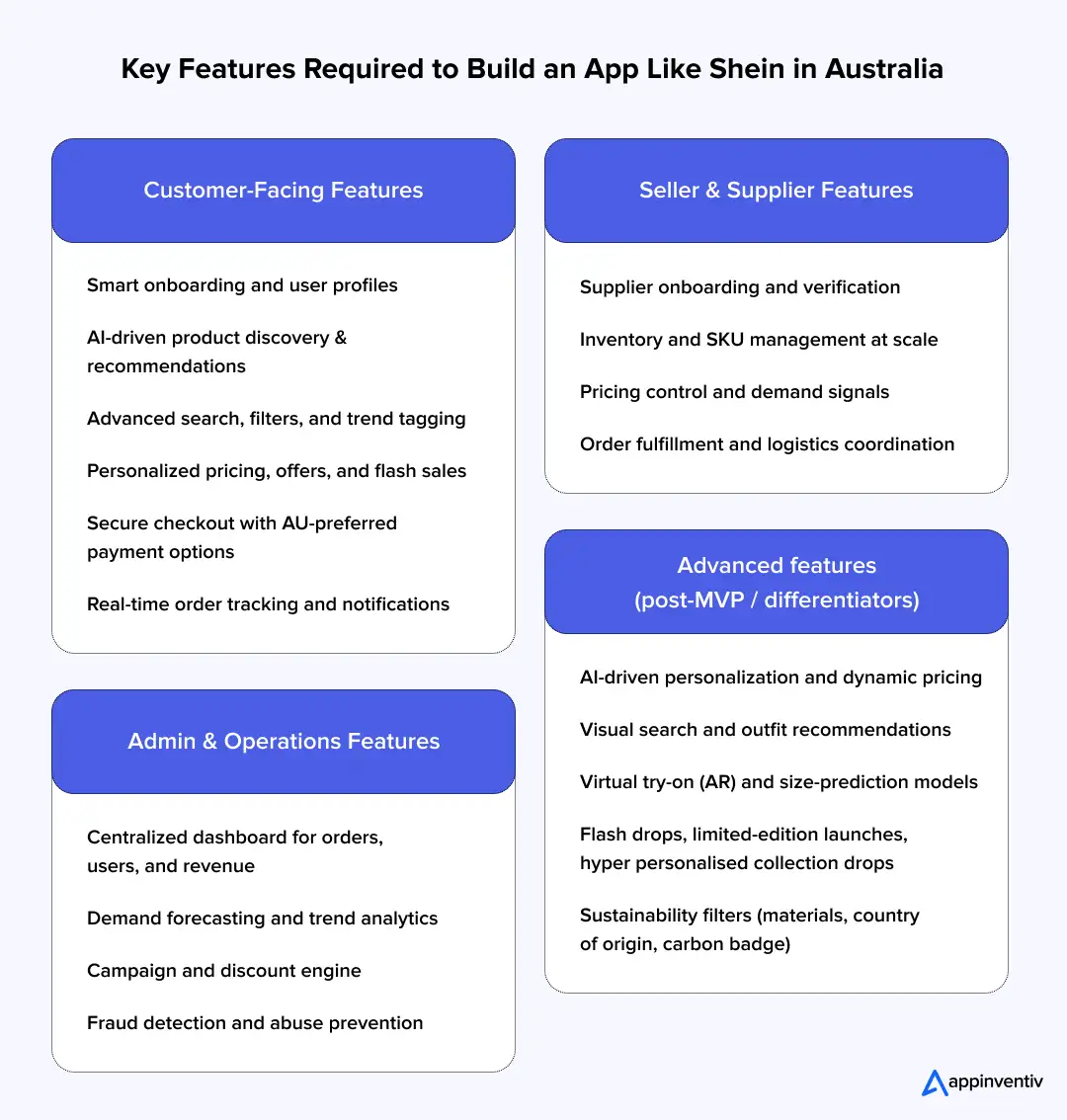
Customer-Facing Features
- Smart Onboarding and User Profiles
Effective onboarding shortens the path to relevance. By capturing behavioural signals early, the platform reduces discovery friction and increases first-session conversion. In Australia’s price-sensitive market, relevance drives engagement more than brand loyalty. - AI-Driven Product Discovery and Recommendations
Real-time recommendations shift the platform from catalogue browsing to demand orchestration. This capability directly influences inventory efficiency by ensuring emerging trends surface before demand peaks, reducing overproduction risk. - Advanced Search, Filters, and Trend Tagging
Search systems that understand trends rather than static categories keep users engaged longer. For Australian consumers influenced by social content, this feature translates inspiration into transactions without forcing intent-based navigation. - Personalised Pricing, Offers, and Flash Sales
Dynamic pricing and personalised promotions protect margins while maintaining competitiveness. This capability allows platforms to balance discounting against inventory velocity, which is critical given Australia’s higher fulfilment costs. - Secure Checkout with AU-Preferred Payment Options
Checkout reliability impacts both conversion and regulatory exposure. Supporting BNPL and local payment methods while maintaining PCI-DSS compliance reduces abandonment and aligns with ACCC expectations on transparency. - Real-Time Order Tracking and Notifications
Accurate tracking builds trust in a geographically dispersed market. Proactive push notifications reduce customer support load and mitigate dissatisfaction when delivery timelines extend beyond metro centres.
Seller and Supplier Features
- Supplier Onboarding and Verification
Structured onboarding ensures suppliers meet quality, compliance, and turnaround expectations. This reduces downstream disputes and supports audit readiness, which becomes critical as supplier networks expand. - Inventory and SKU Management at Scale
Fast-fashion platforms generate high SKU turnover. Systems must handle rapid product creation and retirement without degrading performance, enabling small-batch experimentation without operational instability. - Pricing Control and Demand Signals
Providing suppliers with live demand data aligns production decisions with real consumption. This reduces lead times and inventory waste, which directly impacts working capital efficiency. - Order Fulfillment and Logistics Coordination
Integrated fulfilment systems dynamically route orders based on location and capacity. In Australia, where last-mile logistics vary significantly by region, this capability stabilises delivery performance.
Admin and Operations Features
- Centralised Platform Dashboard
A single operational view supports faster decision-making and stronger governance. Role-based access and audit trails align with Australian enterprise expectations around accountability. - Demand Forecasting and Trend Analytics
Forecasting tools convert behavioural data into production signals. This reduces reliance on intuition and improves margin predictability across volatile trend cycles. - Campaign and Discount Engine
Controlled promotion engines prevent margin erosion while supporting experimentation. Governance rules ensure aggressive discounting does not undermine long-term profitability. - Fraud Detection and Abuse Prevention
High-frequency promotions attract misuse. Early investment in fraud controls protects revenue and reduces regulatory scrutiny, particularly in payment-heavy environments.
Advanced Features to Scale a Shopping App like Shein
- AI-Driven Personalisation and Dynamic Pricing
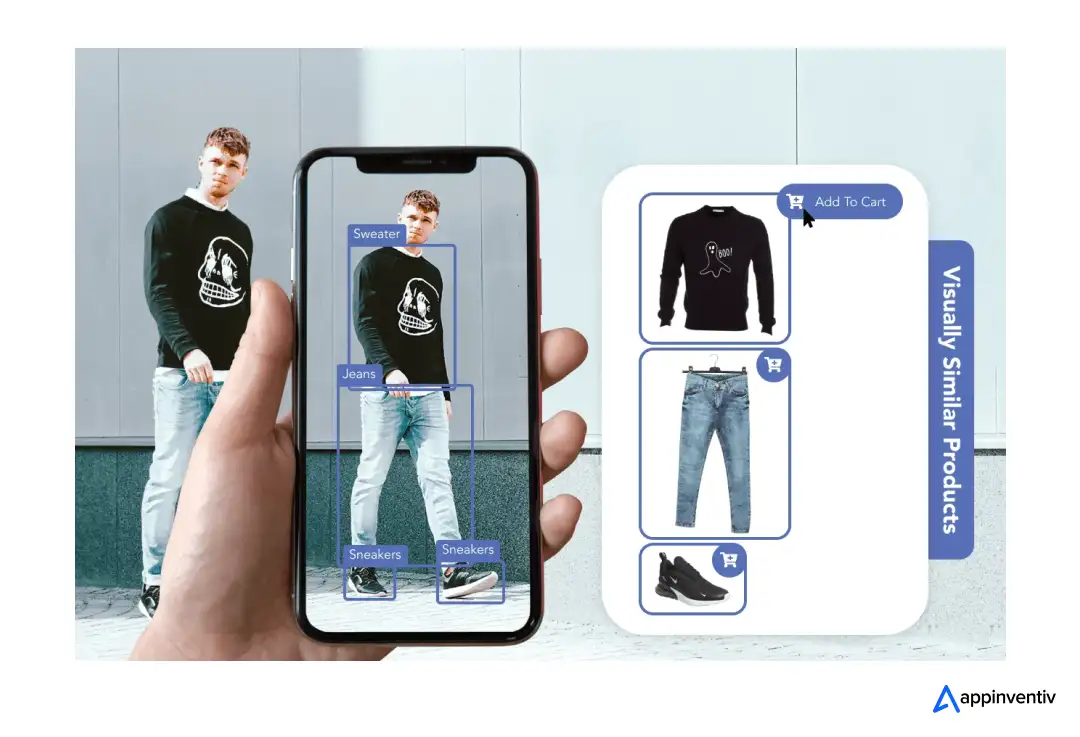
At maturity, personalisation becomes a profit lever. Explainable AI ensures pricing decisions remain defensible under regulatory or customer challenge. - Visual Search and Outfit Recommendations
Visual discovery shortens decision time and increases basket size. This capability aligns with social-first consumption patterns increasingly common among Australian Gen-Z shoppers.
- Virtual Try-On and Size Prediction
Giving your customers the ability to virtually try products results in reducing sizing uncertainty, which directly lowers return rates. Given Australia’s logistics costs, this feature delivers measurable operational savings rather than cosmetic appeal. - Flash Drops and Limited-Edition Launches
Time-bound releases create urgency without overstock risk. Technically, this capability tests platform resilience under peak load conditions. - Sustainability and Transparency Filters
As regulatory and consumer pressure increases, transparency features future-proof the platform. They support alignment with national sustainability initiatives without re-architecting later. isual Search and Outfit Recommendations in a shopping app
Essential Tech Stack to Build an App Like Shein
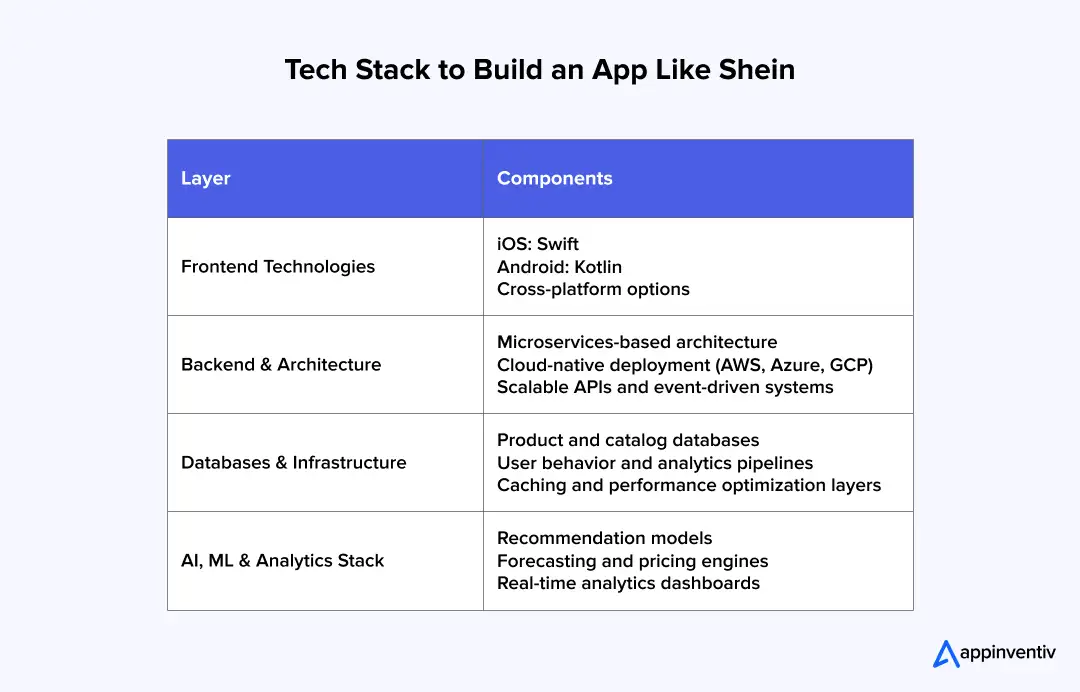
Selecting the tech stack for fashion ecommerce app development is a strategic decision, not just a technical one. For Shein-style platforms, the stack directly affects scalability, transaction reliability, data governance, and long-term cost control, especially in the Australian regulatory environment.
Frontend Technologies
High-frequency fashion commerce demands consistent performance during traffic spikes, flash drops, and rapid browsing sessions. Native mobile development offers the stability and responsiveness required for these scenarios.
- iOS: Swift
- Android: Kotlin
- Cross-platform options: Used selectively where performance trade-offs are acceptable
Native apps reduce latency and abandonment risk during peak usage periods.
Backend and Architecture
A Shein-like platform must remain resilient under uneven demand patterns. Backend architecture should absorb sudden load increases without degrading core shopping and payment journeys.
- Microservices-based architecture to isolate failures
- Cloud-native deployment using AWS, Azure, or GCP
- Event-driven APIs to handle demand spikes and real-time updates
This structure allows independent scaling of catalogue, pricing, and checkout services.
Databases and Infrastructure
Fashion platforms manage large, fast-changing catalogues alongside high volumes of user interaction data. Infrastructure choices must balance performance with regulatory obligations.
- Product and catalogue databases optimised for frequent reads
- User behaviour and analytics pipelines for real-time insight
- Caching and performance optimisation layers to reduce system load
Local cloud regions support Australian data sovereignty requirements under the Privacy Act.
AI, ML, and Analytics Stack
Data intelligence underpins the Shein model, but automation must remain controlled and explainable. AI analytics capabilities should evolve as data maturity improves.
- Recommendation models for personalised discovery
- Forecasting and pricing engines to manage demand and margins
- Real-time analytics dashboards for operational visibility
Explainable AI reduces governance risk and builds trust in automated decisions.
Key Challenges in Building a Shein-Like App and How to Solve Them
Enterprises that attempt to build an app like Shein in Australia encounter a different class of challenges than traditional eCommerce app development. These challenges do not emerge from feature gaps. They surface from scale pressure, operational velocity, and governance exposure. Addressing them early separates viable platforms from fragile ones.
Managing Scale Without Performance Degradation
Flash drops and time-bound campaigns generate extreme concurrency spikes. Platforms that scale linearly or rely on monolithic architectures struggle under this load.
Successful platforms address this by:
- Designing backend services for peak demand, not average traffic
- Using event-driven workflows to absorb sudden transaction surges
- Isolating critical services to prevent cascading failures
Handling High SKU Volumes and Rapid Inventory Churn
Fast-fashion platforms create and retire SKUs at a pace that overwhelms traditional catalogue systems. Poor SKU management leads to search latency, incorrect availability, and fulfillment errors.
Platforms mitigate this risk by:
- Implementing catalogue systems optimised for high write frequency
- Automating SKU lifecycle management
- Linking inventory visibility directly to demand signals
Balancing Low Pricing With Sustainable Margins
Australian consumers expect aggressive pricing, yet logistics and compliance costs remain high. Platforms that rely solely on discounting erode profitability quickly.
Sustainable models achieve balance by:
- Using dynamic pricing tied to inventory risk
- Reducing waste through small-batch production
- Improving conversion efficiency rather than lowering prices
Building AI Capabilities Without Overengineering
AI in eCommerce app development in Australia promises differentiation but introduces complexity and governance risk. Overbuilt models slow delivery and reduce explainability.
Effective platforms:
- Deploy AI incrementally against defined business outcomes
- Monitor model performance continuously
- Maintain transparency in pricing and recommendation logic
Ensuring Compliance While Scaling Internationally
As transaction volumes increase, regulatory scrutiny intensifies. Privacy, payments, and cyber maturity expectations rise with scale.
Australian enterprises reduce exposure by:
- Embedding privacy-by-design across data pipelines
- Maintaining audit-ready security controls
- Aligning cyber posture with national guidance from the Australian Cyber Security Centre
Regulatory Checklist for Running a Successful Fashion eCommerce App in Australia
Australian fashion platforms must meet multiple overlapping obligations. Compliance succeeds when platforms embed these requirements into architecture and operations rather than treating them as legal add-ons.
- Privacy Act 1988 (Cth)
Collect, store, and use customer data in line with the Australian Privacy Principles, with clear consent and access controls. - Australian Consumer Law (ACL)
Disclose pricing, product details, refund rights, and terms of sale clearly to meet ACCC expectations. - PCI-DSS Compliance
Secure all payment processing and card data to industry standards to reduce fraud and insurer exposure. - Data Residency and Sovereignty
Store sensitive customer data in Australia or manage cross-border transfers in line with regulatory requirements. - Spam Act 2003
Obtain explicit consent for marketing communications and provide simple opt-out mechanisms. - Cyber Security Framework Alignment
Implement controls aligned with Australian Cyber Security Centre guidance to manage evolving threat profiles. - Accessibility Standards (WCAG 2.1 AA)
Ensure digital experiences remain accessible to all users across devices and capabilities. - Supply Chain Transparency
Disclose country of origin, materials, and sustainability credentials in line with emerging regulations and consumer expectations. - Record-Keeping and Audit Readiness
Maintain clear audit trails across transactions, data access, and supplier activity to support regulatory review.
Also Read: AI in eCommerce in Australia: 10 Ways to Boost Growth
Development Cost to Build an App Like Shein in Australia
Businesses evaluating whether to build an app like Shein in Australia quickly realise there is no fixed price. Cost varies based on architectural ambition, compliance posture, supply chain complexity, and the depth of AI-driven decisioning embedded into the platform.
In the Australian market, development investment typically ranges from AUD 40,000 to AUD 600,000 and beyond, depending on sevral cost driving factors. Platforms that underestimate cost drivers often experience budget overruns, delayed launches, or post-release re-engineering.
Key factors affecting the cost of developing an eCommerce app like Shein include:
- Depth of demand forecasting and real-time personalisation
- Volume and volatility of SKU creation and retirement
- Supplier onboarding automation and compliance controls
- Payment complexity and fraud risk exposure
- Australian data residency, privacy, and cybersecurity requirements
- Complexity of projects and functionality requirements
These variables explain why shein like app development cost differs sharply between MVPs and enterprise-grade platforms.
Here is a cost breakdown of an eCommerce app based on different project complexities
| App Complexity Level | Typical Scope | Estimated Cost (AUD) | Timeline |
|---|---|---|---|
| MVP Version | Core shopping, checkout, basic admin | 40,000 – 90,000 | 3–4 months |
| Mid-Scale Marketplace | Personalisation, supplier tooling, analytics | 120,000 – 250,000 | 5–7 months |
| Advanced Platform | AI recommendations, demand signals, promotions engine | 250,000 – 450,000 | 7–10 months |
| Enterprise-Grade Shein-Like Platform | Full marketplace, AI optimisation, compliance-ready architecture | 450,000 – 600,000+ | 10–14 months |
An MVP validates demand and engagement mechanics. Enterprise-grade platforms fund resilience, compliance, and AI maturity required for sustained scale. This distinction matters when founders ask about the cost to create an app like Shein without fully defining long-term ambition.
Here is the eCommerce app cost breakdown by development stage
| Development Stage | Cost Range (AUD) | What This Stage Covers |
|---|---|---|
| Discovery and Design | 10%–15% | Market validation, architecture planning, UX systems |
| Core Development and Integrations | 40%–50% | Mobile apps, backend services, supplier and payment integrations |
| AI and Data Engineering | 15%–25% | Analytics pipelines, recommendation logic, forecasting |
| QA, Deployment, and Support | 10%–15% | Performance testing, security reviews, production readiness |
| Ongoing Maintenance | 15%–25% annually | Enhancements, optimisation, infrastructure, model tuning |
Australian enterprises that compress discovery or security phases often face higher costs post-launch, particularly during audits or scale events.
Understand the Real Cost of Building a Shein-Like App
Move beyond headline numbers. Get a realistic cost range based on features, AI maturity, compliance needs, and long-term ownership in the Australian market.

Future Trends Shaping Shein-Like Fashion Apps
The next phase of Shein-style platforms will not reward speed alone. Australian operators who sustain advantages will do so by tightening decision loops, reducing waste, and increasing operational certainty under regulatory and cost pressure. Here is what the future of a shopping app will look like in the coming years:
Predictive Design Over Reactive Merchandising
Platforms increasingly shift from reacting to trends to shaping them. By analysing early behavioural signals, operators guide design decisions before demand peaks. This reduces overproduction and protects margin, particularly valuable in Australia, where logistics costs amplify inventory risk.
Content-Led Commerce as the Primary Entry Point
Shopping journeys now start with content rather than search. Discovery feeds, influencer-led collections, and user-generated content will increasingly replace category navigation. Platforms that treat content as infrastructure, not marketing, will retain users longer and drive higher visit frequency.
For Australian platforms, this shift requires tighter integration between merchandising, analytics, and publishing workflows.
Sustainability Visibility as an Operating Requirement
Transparency around sourcing and materials is moving from differentiation to expectation. While regulation continues to evolve, platforms that surface sustainability data early avoid future retrofitting and reputational risk.
Predictability Over Pure Delivery Speed
Australian consumers prioritise delivery certainty over absolute speed. Platforms that optimise routing, inventory placement, and communication outperform those relying on blanket express shipping. This trend reinforces the need for logistics intelligence embedded directly into platform architecture rather than treated as a third-party dependency.
Also Read: Future of Mobile Commerce: Stats & Trends to Know in 2026
How Appinventiv Can Help You Build a Shein-Like App for Australia
Building a Shein-style platform is not a one-off development exercise. It is a long-term operating decision that affects how fashion products are designed, priced, distributed, and governed at scale. In the Australian market, this decision carries additional weight because regulatory expectations, data accountability, and cost control sit firmly at the board level.
At Appinventiv, the focus is not on replicating Shein’s surface features, but on engineering the underlying system that makes high-velocity fashion commerce sustainable. This approach is fueled by delivering 400+ eCommerce platforms, serving 30+ retailers and brands, and nearly a decade of experience in continuous eCommerce platform transformation.
What Matters When Building an Enterprise-Grade Shopping App in Australia?
Australian organisations pursuing Shein-like app development typically face three non-negotiables:
- Governance and compliance readiness from day one
- Scalability without operational fragility
- Clear visibility into cost, performance, and risk over time
This is where many platforms struggle. Fast fashion apps demand constant iteration, but Australian enterprises cannot afford uncontrolled change. The platform must evolve without destabilising payments, data integrity, or supplier operations.
Appinventiv’s delivery model is built around this reality, with a 99.50% SLA on transaction reliability and long-term accountability reflected in a 96% client satisfaction rate.
For organisations evaluating eCommerce app development services in Australia, this translates into reduced execution risk and predictable ownership outcomes rather than short-term delivery wins.
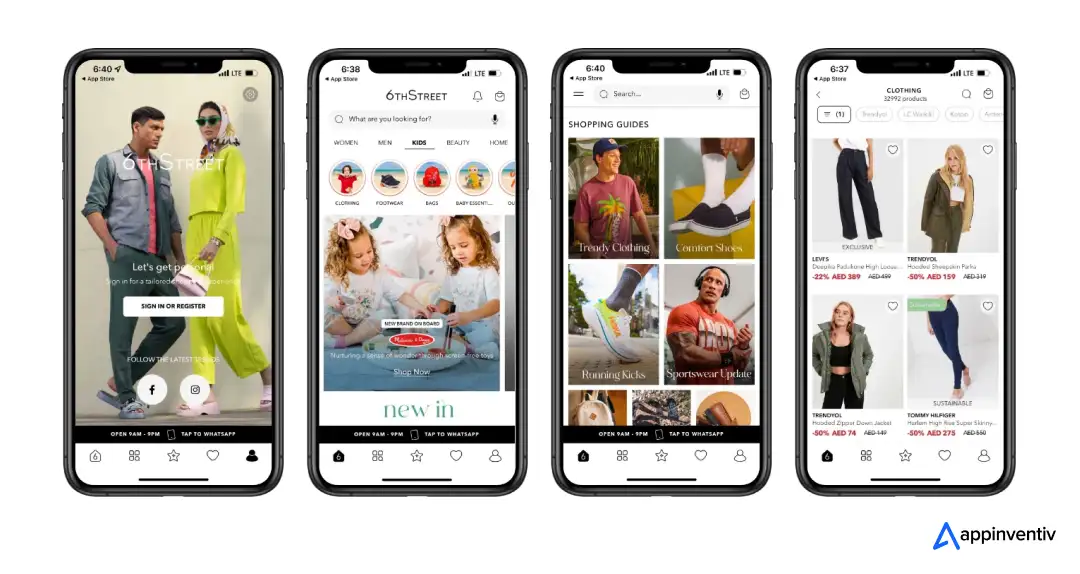
Real World Delivery Experience: 6thStreet eCommerce Platform
Our work on 6thStreet, a large-scale fashion eCommerce platform, reflects the same principles required to build an app similar to Shein.
The platform supported:
- High SKU volumes across multiple fashion categories
- Rapid campaign launches and flash promotions
- Personalised discovery flows that delivered up to 40% conversion uplift
- A scalable backend designed to absorb demand spikes without degradation
More importantly, the solution functioned as a system rather than a storefront. Product discovery, pricing logic, supplier workflows, and analytics were tightly integrated, allowing demand signals to influence decisions in near real time.
Where Appinventiv Adds the Most Value
For leaders asking how to build an app like Shein in Australia, Appinventiv’s value typically concentrates on four areas:
- Platform architecture and scalability design aligned with Australian governance expectations
- Data and AI foundations that support personalisation and demand signals without overengineering
- Security, payments, and compliance integration embedded into the platform lifecycle
- Cost and roadmap discipline, ensuring early decisions do not create long-term constraints
This approach is particularly relevant for organisations looking for app developers in Australia who understand both technical depth and enterprise accountability.
Discuss your project vision with our eCommerce app experts today and bring your idea to life.
FAQs
Q. Does a SHEIN-like app require AI features?
A. Yes. AI is no longer an enhancement. It forms the decision layer of the platform. AI drives product discovery, demand forecasting, pricing optimisation, and inventory risk management. Without these capabilities, platforms struggle to handle high SKU churn and fast trend cycles.
For organisations planning to build an app like Shein in Australia, AI directly influences margin control, stock efficiency, and long-term competitiveness rather than just user experience.
Q. How does an app like Shein work from an operating model perspective?
A. A Shein-style platform operates as a demand-sensing system rather than a traditional retail channel. It continuously captures user behaviour, converts it into pricing and production signals, and feeds those signals into supplier and inventory workflows.
This approach reduces reliance on seasonal forecasting and bulk inventory commitments. For Australian businesses, this model helps offset higher logistics costs by minimising unsold stock and improving cash flow discipline.
Q. How much does it cost to build an app like Shein in Australia?
A. The cost to create an app like Shein varies widely based on scope, compliance depth, and AI maturity. Australian data privacy, payment compliance, and cyber maturity requirements also influence investment levels.
For instance, a focused MVP development starts around AUD 40,000, while an enterprise-grade platform with advanced AI, supplier automation, and security controls can exceed AUD 600,000.
Leaders should evaluate cost over a multi-year ownership horizon rather than treating it as a one-time build expense.
Q. How long does it take to develop a SHEIN-like ecommerce app?
A. The timelines of eCommerce app development in Australia vary, depending on different project complexities and several other factors. On average, the time it takes to build an app like Shein in Australia ranges between 3 and 14 months or more:
- MVP versions usually take 3–4 months
- Mid-scale marketplaces take 5–7 months
- Enterprise-grade platforms may require 10–14 months
Q. Are there legal or compliance requirements for fashion apps in Australia?
A. Yes. Australian platforms must comply with data privacy obligations under the Privacy Act, maintain PCI-DSS-aligned payment processing, and demonstrate cyber maturity as transaction volume grows.
These requirements apply regardless of whether suppliers operate offshore. As platforms scale, audit readiness and security posture attract board and insurer scrutiny. Treating compliance as a core design input avoids costly retrofitting and reputational exposure.
Q. What are the biggest risks enterprises underestimate when building a Shein-like app?
A. Organisations often focus on the frontend experience while underestimating operational complexity. Commonly overlooked risks include:
- Supplier readiness to act on real-time demand signals
- Infrastructure resilience during flash drops
- Governance gaps in AI-driven pricing and recommendations
- Long-term cloud and data cost escalation
Addressing these early reduces the challenges of Shein like app development later.
Q. What should Australian enterprises prioritise first when planning a Shein-like platform?
A. Leaders should prioritise foundational decisions before feature expansion. This includes:
- Demand-led architecture over catalogue-driven systems
- Supplier integration and SLA discipline
- Compliance-first data and payment design
- Scalability planning for peak, not average, traffic
This sequencing improves outcomes for Shein-like app development in Australia and keeps execution predictable.