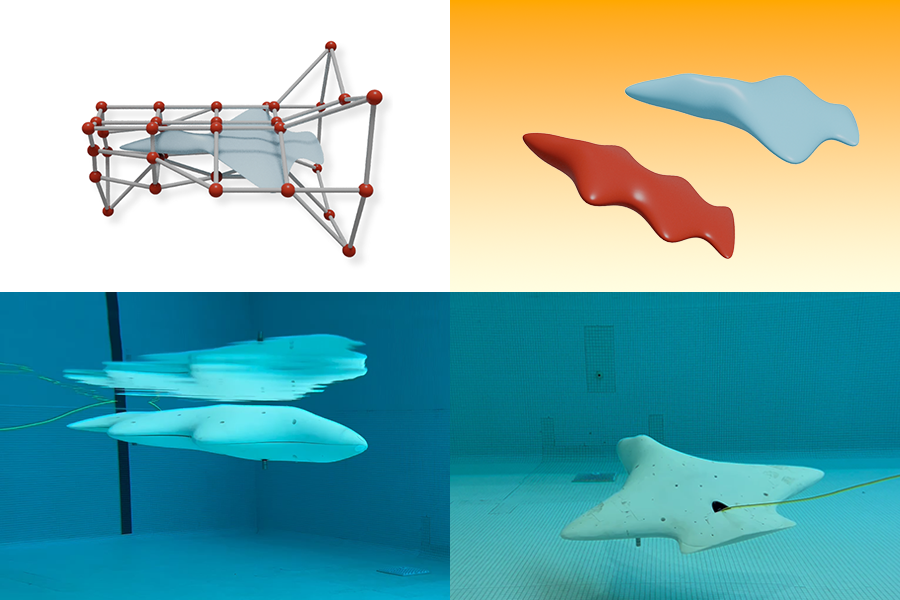
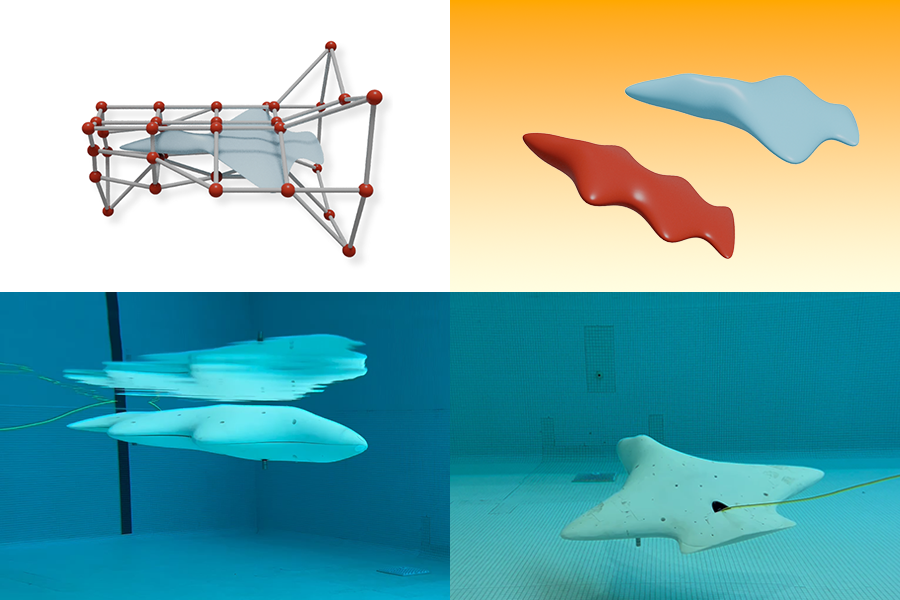
Marine scientists have long marveled at how animals like fish and seals swim so efficiently despite having different shapes. Their bodies are optimized for efficient, hydrodynamic aquatic navigation so they can exert minimal energy when traveling long distances.
Autonomous vehicles can drift through the ocean in a similar way, collecting data about vast underwater environments. However, the shapes of these gliding machines are less diverse than what we find in marine life — go-to designs often resemble tubes or torpedoes, since they’re fairly hydrodynamic as well. Plus, testing new builds requires lots of real-world trial-and-error.
Researchers from MIT’s Computer Science and Artificial Intelligence Laboratory (CSAIL) and the University of Wisconsin at Madison propose that AI could help us explore uncharted glider designs more conveniently. Their method uses machine learning to test different 3D designs in a physics simulator, then molds them into more hydrodynamic shapes. The resulting model can be fabricated via a 3D printer using significantly less energy than hand-made ones.
The MIT scientists say that this design pipeline could create new, more efficient machines that help oceanographers measure water temperature and salt levels, gather more detailed insights about currents, and monitor the impacts of climate change. The team demonstrated this potential by producing two gliders roughly the size of a boogie board: a two-winged machine resembling an airplane, and a unique, four-winged object resembling a flat fish with four fins.
Peter Yichen Chen, MIT CSAIL postdoc and co-lead researcher on the project, notes that these designs are just a few of the novel shapes his team’s approach can generate. “We’ve developed a semi-automated process that can help us test unconventional designs that would be very taxing for humans to design,” he says. “This level of shape diversity hasn’t been explored previously, so most of these designs haven’t been tested in the real world.”
But how did AI come up with these ideas in the first place? First, the researchers found 3D models of over 20 conventional sea exploration shapes, such as submarines, whales, manta rays, and sharks. Then, they enclosed these models in “deformation cages” that map out different articulation points that the researchers pulled around to create new shapes.
The CSAIL-led team built a dataset of conventional and deformed shapes before simulating how they would perform at different “angles-of-attack” — the direction a vessel will tilt as it glides through the water. For example, a swimmer may want to dive at a -30 degree angle to retrieve an item from a pool.
These diverse shapes and angles of attack were then used as inputs for a neural network that essentially anticipates how efficiently a glider shape will perform at particular angles and optimizes it as needed.
Giving gliding robots a lift
The team’s neural network simulates how a particular glider would react to underwater physics, aiming to capture how it moves forward and the force that drags against it. The goal: find the best lift-to-drag ratio, representing how much the glider is being held up compared to how much it’s being held back. The higher the ratio, the more efficiently the vehicle travels; the lower it is, the more the glider will slow down during its voyage.
Lift-to-drag ratios are key for flying planes: At takeoff, you want to maximize lift to ensure it can glide well against wind currents, and when landing, you need sufficient force to drag it to a full stop.
Niklas Hagemann, an MIT graduate student in architecture and CSAIL affiliate, notes that this ratio is just as useful if you want a similar gliding motion in the ocean.
“Our pipeline modifies glider shapes to find the best lift-to-drag ratio, optimizing its performance underwater,” says Hagemann, who is also a co-lead author on a paper that was presented at the International Conference on Robotics and Automation in June. “You can then export the top-performing designs so they can be 3D-printed.”
Going for a quick glide
While their AI pipeline seemed realistic, the researchers needed to ensure its predictions about glider performance were accurate by experimenting in more lifelike environments.
They first fabricated their two-wing design as a scaled-down vehicle resembling a paper airplane. This glider was taken to MIT’s Wright Brothers Wind Tunnel, an indoor space with fans that simulate wind flow. Placed at different angles, the glider’s predicted lift-to-drag ratio was only about 5 percent higher on average than the ones recorded in the wind experiments — a small difference between simulation and reality.
A digital evaluation involving a visual, more complex physics simulator also supported the notion that the AI pipeline made fairly accurate predictions about how the gliders would move. It visualized how these machines would descend in 3D.
To truly evaluate these gliders in the real world, though, the team needed to see how their devices would fare underwater. They printed two designs that performed the best at specific points-of-attack for this test: a jet-like device at 9 degrees and the four-wing vehicle at 30 degrees.
Both shapes were fabricated in a 3D printer as hollow shells with small holes that flood when fully submerged. This lightweight design makes the vehicle easier to handle outside of the water and requires less material to be fabricated. The researchers placed a tube-like device inside these shell coverings, which housed a range of hardware, including a pump to change the glider’s buoyancy, a mass shifter (a device that controls the machine’s angle-of-attack), and electronic components.
Each design outperformed a handmade torpedo-shaped glider by moving more efficiently across a pool. With higher lift-to-drag ratios than their counterpart, both AI-driven machines exerted less energy, similar to the effortless ways marine animals navigate the oceans.
As much as the project is an encouraging step forward for glider design, the researchers are looking to narrow the gap between simulation and real-world performance. They are also hoping to develop machines that can react to sudden changes in currents, making the gliders more adaptable to seas and oceans.
Chen adds that the team is looking to explore new types of shapes, particularly thinner glider designs. They intend to make their framework faster, perhaps bolstering it with new features that enable more customization, maneuverability, or even the creation of miniature vehicles.
Chen and Hagemann co-led research on this project with OpenAI researcher Pingchuan Ma SM ’23, PhD ’25. They authored the paper with Wei Wang, a University of Wisconsin at Madison assistant professor and recent CSAIL postdoc; John Romanishin ’12, SM ’18, PhD ’23; and two MIT professors and CSAIL members: lab director Daniela Rus and senior author Wojciech Matusik. Their work was supported, in part, by a Defense Advanced Research Projects Agency (DARPA) grant and the MIT-GIST Program.