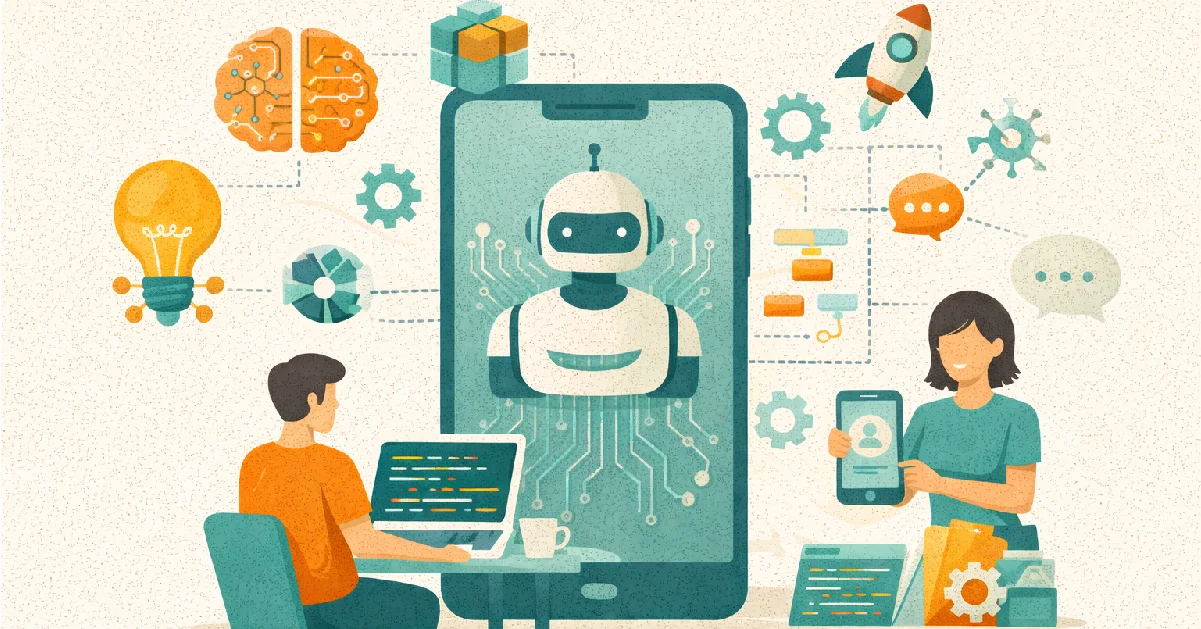
AI is taking place in every market, so how can mobile development stay behind? AI is becoming much more than just an additional feature; now it’s the core engine behind how modern mobile apps are planned, built, tested, and optimized. The main goal behind the rise of AI use is to improve user experience. Apps can now predict user behavior, personalize content in real time, and automate actions based on individual usage patterns, and a traditional app logic could never achieve this.
It’s not just helping the user but employees as well, because development cycles are getting shorter because AI is automating the boring, repetitive work. It can enable automated code suggestions, AI-driven testing, and bug detection, enabling developers to ship better apps faster without compromising quality. This is how AI works now, but it will transform mobile app development even more by 2026. AI is not limited to any particular industry; every industry, like e-commerce, finance, healthcare, entertainment, and education, is adopting AI-driven apps because users simply expect smarter, more intuitive experiences. And those companies that don’t integrate AI are already falling behind in both engagement and retention. The growth of AI is unstoppable, and it’s growing rapidly, so let’s talk about how AI is transforming mobile development.
How AI Improves Mobile App Development

Faster Development Cycles
AI can easily generate large chunks of repetitive code automatically, which cuts down the hours developers usually waste on basic structures. It can predict the next line of code accurately; it ultimately helps developers to avoid errors and move faster. So developers get
ready-made code blocks, templates, and logic suggestions in seconds instead of building them from scratch. It not only generates the new code but also reviews the written code and fixes small mistakes instantly, reducing debugging time. With the help of AI, you can build solid features in a few hours that used to take days and weeks to build, because now AI handles all the foundation work.
Smarter and Quicker Testing
The most important thing in mobile app development is testing, and AI has the features to test apps by acting like thousands of users at the same time. It clicks, scrolls, swipes, and performs actions automatically to spot hidden bugs. AI easily spots all the hidden bugs that manual testing often misses because it checks every path in detail. It tells you exactly where a bug is happening, so developers don’t waste time guessing. And the best part is, every time developers push a new update, AI automatically retests the entire app within minutes. Ultimately, AI makes the entire testing cycle faster, more accurate, and far more reliable.
Real-Time Personalization for Users
AI is very fast and sharp in analyzing what users do inside the app, like what they like, ignore, search for, and spend time on. Then, according to the analysis report, it customizes the data for what it shows to each user, creating a unique experience for everyone. It updates home screens, suggestions, and product lists automatically based on recent user behavior. It also understands the active timing of every user, like it knows when a user is most active and shows the right content at the right moment. This feature makes users feel connected to the app, and it does increase retention and loyalty.
Improved App Performance
AI constantly checks the app’s performance, and it measures speed, loading time, errors, and background activity in a timely manner. This process can tell you which part of the app is slowing things down and pinpoint the exact cause. It also tells you when your app might crash or start lagging based on current usage patterns. And it will create an alert for developers before the issue reaches users, preventing negative experiences. Now, AI is becoming so advanced that it can even suggest how to optimize images, APIs, or server load to boost speed. And you will get a smoother, faster, and more stable app.
Steps to Build AI-Powered Mobile Apps in 2026

Define the Purpose of Using AI
The very first step is to decide exactly why the app needs AI, personalization, chatbots, recommendations, image scanning, prediction, etc. Check out the user problem AI will solve, not just adding AI because it’s trending. Decide what AI features you want to include and how they improve the user experience because a clear purpose saves time and prevents waste during development.
Collect and Prepare the Right Data
If you want to use AI effectively, collect your data, because AI needs good-quality data to learn and to get better. Data like behavior data, product info, images, user patterns, etc., really help in tracking growth and improvements. So it’s your responsibility to start gathering the data early, because AI models become smarter only if they get enough examples. For better results, you can just clean the data by removing errors, duplicates, and unnecessary details. And then just organize the data into categories so it becomes easy to feed into the AI system. One thing you have to take care of is that your data collection must follow privacy rules and protect user information.
Choose the Right AI Model
Every app needs different AI models, like chatbot models, image recognition models, voice models, recommendation models, etc. Decide what your app needs, then choose frameworks like TensorFlow, PyTorch, Core ML, Firebase ML, or ONNX. Choose a model that fits your budget and can scale when your app grows with time. If your objective is to find quick results, then use pre-trained AI models that already understand language, images, or audio. Do not miss checking how fast the model works on mobile devices, because some heavy models can slow down the app.
Build the Basic App Structure First
You don’t need to start with AI features immediately; before the final app, create the core screens, navigation, and app flow first. Basically, you have to build a simple working version of your app with the basic features you need. In this version of your app, create a placeholder in your app structure where the AI feature will fit later, like recommendation slots or chatbot buttons. This step will help your team to understand how AI will interact with the overall app design.
Integrate AI into the App
This is the most important step, where you connect the AI model to the app using APIs or SDKs so it can start processing user data. Then test how the AI responds to different user inputs, like text, voice, images, or behavior. See if AI results are quick or not because slow responses can irritate users. And do not forget to optimize the AI models so they use less battery and storage on the user’s device.
Test the AI Feature Under Real Conditions
Your work doesn’t end when the AI is live, but this is where the real work starts. Check how the AI performs on different devices, screen sizes, and internet speeds. Test the AI performance with real user behavior, like fast typing, wrong inputs, background noise, multiple images, etc. Take care that the AI does not give misleading or incorrect results. And also check how quickly the AI responds, especially for chatbots and recommendations. Because with every test, you make the AI better.
Conclusion
AI is getting better day by day, and in 2026, AI will have become a core part of mobile app development, not an extra feature. Apps are now built faster, tested better, secured stronger, and updated smarter because AI supports every stage of development. Every app will perform better with AI because AI-powered mobile apps deliver better user experiences through personalization, smart recommendations, voice support, and automation.
This directly improves engagement, retention, and overall app performance. But building an AAI-powered app needs the correct strategy, data handling, and technical expertise. So, for building a perfect app, go with an experienced mobile app development company in Bangalore, which helps businesses implement AI features correctly while avoiding performance and security issues. A good and reliable app development company in Bangalore will not only build the app, but they will also guide businesses on where AI actually adds value, ensuring long-term scalability and smoother maintenance.