[ad_1]
Summary
AI-powered customer engagement helps brands deliver more relevant experiences, automate decision-making, and drive measurable revenue growth across the customer lifecycle. The biggest gains come from combining unified customer data, predictive insights, and intelligent orchestration to improve conversions, retention, and customer lifetime value.
You have email running, push notifications live, SMS in market, and an onsite personalization layer someone configured two years ago. Each channel has its own logic, its own send calendar, and its own reporting dashboard. And yet, customers feel none of it as a coherent conversation. That tension is where enterprise engagement budgets quietly leak.
The question is not whether to use AI in customer engagement. The question is where in the stack AI actually creates durable revenue impact, which layers depend on each other, and how to tell the difference between a vendor rebuilding a capability that already exists and one delivering something structurally new. This article maps that arc from data foundation to agentic orchestration, with a clear framework for measuring what is working.
Why channel-based engagement is losing to AI-orchestrated journeys
Channel-first engagement made sense when the primary constraint was reach. Once you could send an email, you built an email program. Once you could push a notification, you built a push program. Each channel got its own team, its own tool, and its own key performance indicator (KPI). The problem is that customers do not experience channels; they experience a brand. When those channels operate in isolation, the customer gets three messages in six hours from three different systems that share no information about what the others just did.
The structural cost of individual channel thinking
Message fatigue is the visible symptom. The deeper cost is lost signal. When a customer ignores a push notification because they already converted through email 20 minutes earlier, that interaction records as a push failure rather than a cross-channel success. The AI decisioning layer, if there is one, trains on the wrong outcome. Over time, the models drift away from reality and the personalization layer produces experiences that feel off, even when the individual recommendation logic is technically sound.
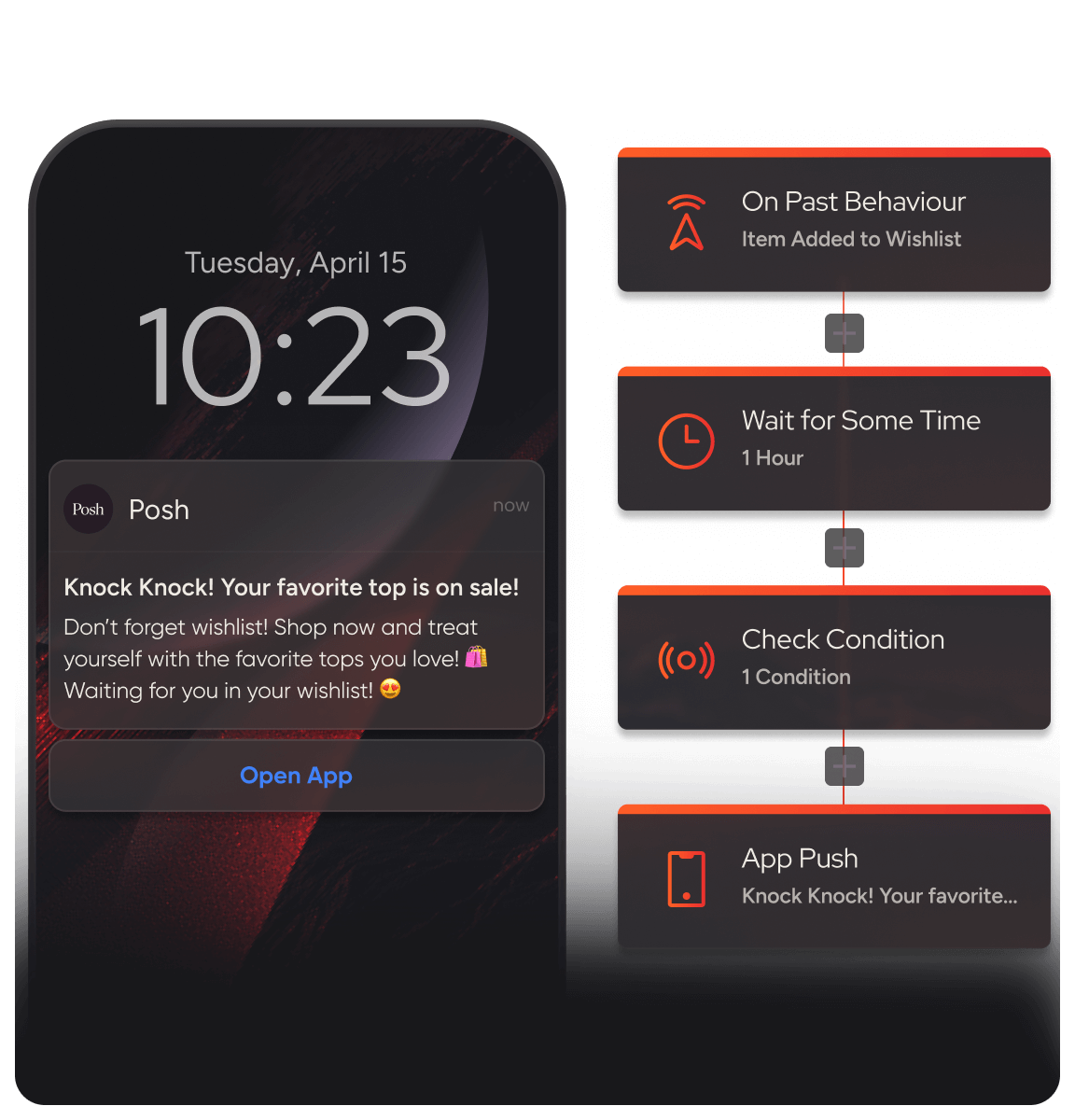
AI journey orchestration addresses this by treating every touchpoint as a node in a continuous decisioning graph rather than a standalone send event.
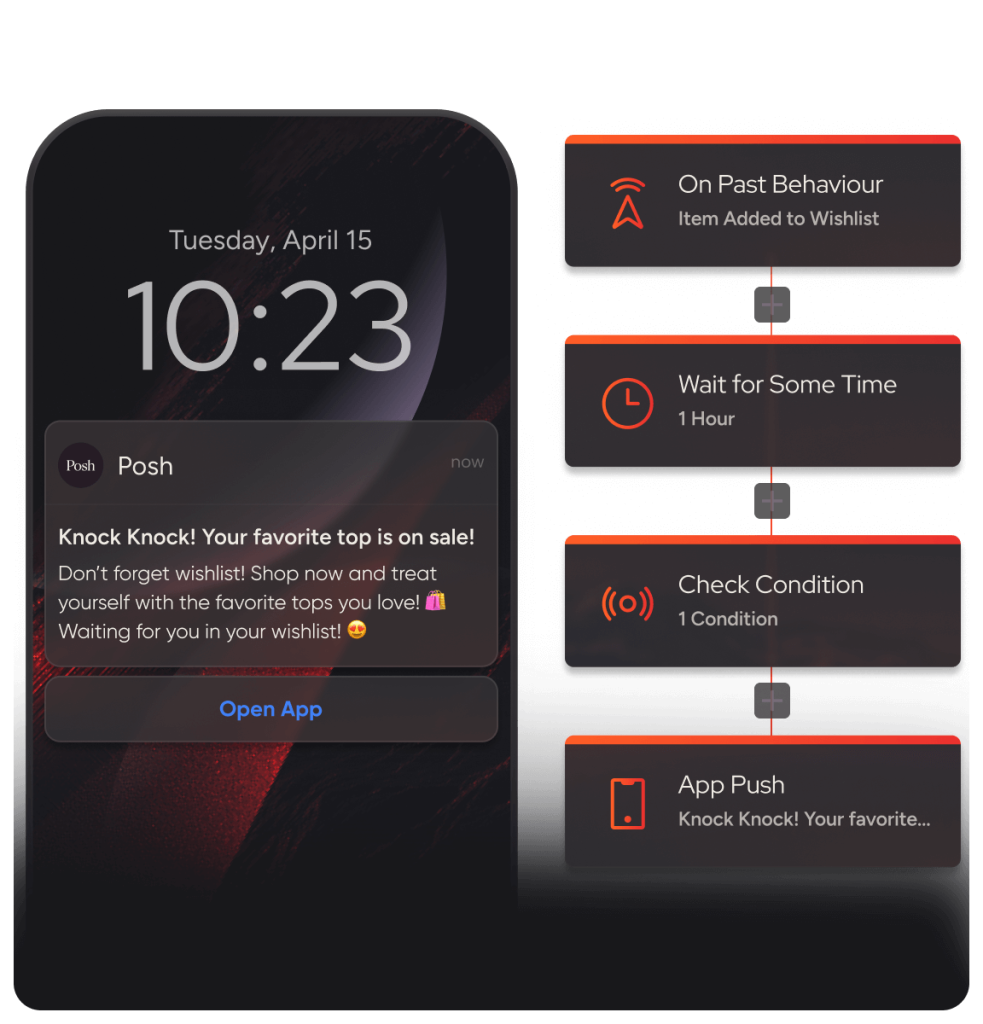
The model evaluates what channel to use, what message to deliver, what time to send, and whether to send at all, based on the full behavioral context of that individual at that moment. The outcome is a coherent customer experience rather than a coordinated broadcast schedule, and the retention and CLTV effects are measurable in weeks, not quarters.
The data foundation every AI engagement strategy needs first
The single most reliable predictor of AI personalization failure is not a bad model. It is an incomplete data layer. If the AI is making decisions without a real-time unified profile, it is optimizing against a partial picture and calling it personalization. That gap between what the system knows and what is actually true about the customer is where relevance breaks down.
What a production-ready data layer actually looks like
A production-ready foundation connects online behavioral data, offline purchase and service history, anonymous visitor profiles, and channel-reachability scores into a single customer profile that updates in real time.
It resolves identity across devices and sessions, so the customer who browsed on mobile and purchased on desktop is recognized as one person, not two. It captures declared preferences alongside inferred intent, and it exposes that unified profile to every downstream AI model, whether that model is driving email sequencing, onsite recommendations, or paid audience suppression.
The gap most teams hit is that their engagement platform and their customer data platform (CDP) are separate systems from separate vendors that were integrated as an afterthought. Data latency, schema mismatches, and incomplete identity graphs are the predictable result.
Insider One’s Customer Data Management approach embeds the unified profile directly into the engagement layer, which means the AI models always have access to current signals rather than yesterday’s export. That architectural choice compresses the time between a customer action and a relevant response from hours to seconds.
Predictive personalization: from segments to individual-level signals
Segment-based targeting was a meaningful improvement over batch-and-blast. It is no longer the ceiling. Grouping customers into behavioral buckets and sending the same message to everyone in the bucket assumes that the most useful thing you know about a customer is which group they belong to. Predictive models at the individual level know considerably more than that.
What individual-level prediction changes
Next-best-action models, likelihood-to-purchase scoring, and churn propensity signals each operate on the full behavioral history of one person and produce a recommended action specific to that person at that moment.
The revenue impact follows a consistent pattern across engagement programs: higher relevance drives higher conversion, and fewer irrelevant messages drive lower unsubscribe rates and fewer inbound support contacts. The mechanism is straightforward, and the return on investment (ROI) compounds as the models accumulate more behavioral signals over time.
The operational change that matters most is sequencing. Predictive signals should not trigger individual messages in isolation; they should inform the entire next sequence of touchpoints across email, SMS, push, and web. A customer with a rising churn propensity score should not just receive a win-back email. They should enter a coordinated sequence where the channel, message, offer, and timing are each calibrated to their specific history, which is why a bolted-on CDP creates compounding delays rather than solving the sequencing problem.
Adidas achieved a 259% increase in average order value and a 13% conversion rate lift in one month by running personalized journeys through Insider One rather than coordinating campaigns across separate channel tools.
Agentic AI in customer engagement: what it actually means (and what it doesn’t)
Agentic AI is the most consequential and most misused term in enterprise marketing right now. It describes AI systems that complete multi-step tasks autonomously across functions, without requiring a human to approve each action. The difference between an agentic system and a sophisticated automation is not speed or sophistication; it is autonomy and scope.
Distinguishing real agentic AI from rebranded automation
A well-built agentic system can identify a churn risk, evaluate the customer’s full profile, select an intervention, execute it across the right channel, and feed the outcome back into the model, all without human instruction at each step.
Industry analysts have flagged “agent washing” as a growing risk: vendors relabeling existing automation, rule-based chatbots, or simple recommendation engines as agentic AI without meaningful architectural change. For enterprise buyers, the distinction matters because they are making multi-year platform commitments.
A vendor evaluation checklist that cuts through the noise:
• Does it complete multi-step tasks autonomously, or does it recommend actions that a human must then approve and trigger?
• Does it operate across marketing, service, and commerce simultaneously, or is it confined to a single channel or function?
• Does it learn continuously from outcomes and adjust its own decision logic, or does it apply static rules in a new interface?
• Can it initiate action proactively based on a predicted future state, or does it only respond to explicit triggers?
Insider One’s Agent One™ is designed against these criteria, with autonomous decisioning operating across the customer journey from proactive churn intervention to cart-abandonment recovery without requiring campaign-by-campaign human configuration. Sirius AI™ provides the underlying intelligence layer, continuously updating predictions as new behavioral signals arrive.
Practical agentic use cases already in production
Three use cases are in production at enterprise scale. First, proactive churn intervention: when a customer’s engagement score drops below a predicted threshold, the system intervenes before the customer contacts support, with a recovery sequence tailored to that individual’s most recent interaction pattern.
Second, autonomous cart-abandonment recovery: rather than a fixed three-email sequence, the system selects the channel, timing, and offer dynamically based on that customer’s prior recovery behavior and current reachability score.
Third, real-time price-drop alerts: when a product a customer has viewed or wishlisted drops in price, the alert fires immediately through the channel most likely to reach them, without waiting for a scheduled campaign run. Each resolution feeds back into the model, improving future decisioning for that customer and for behaviorally similar customers.
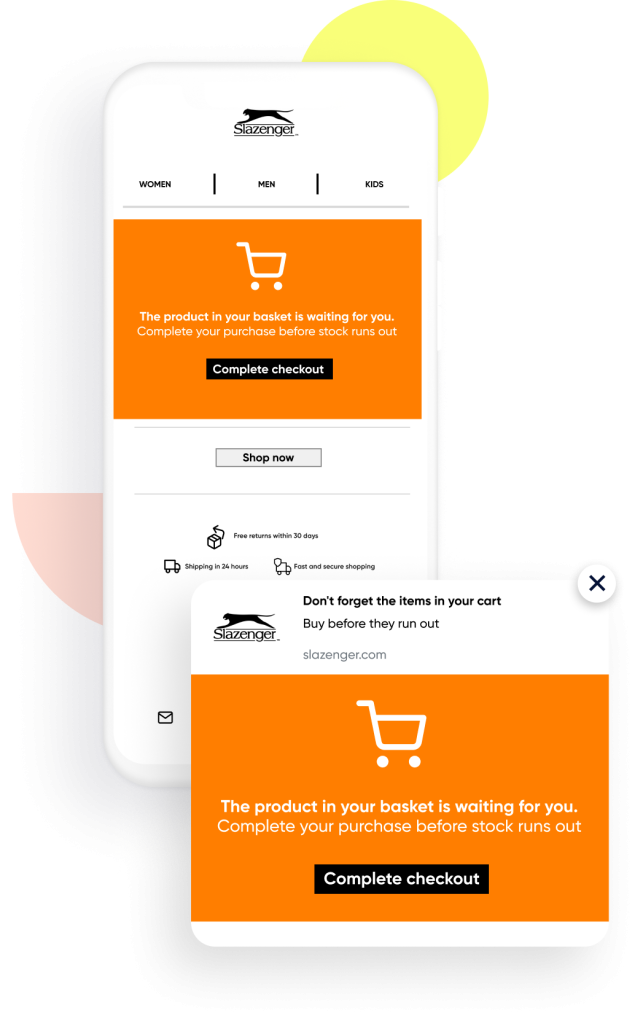
Slazenger demonstrated what this kind of connected orchestration delivers at pace, achieving 49X ROI in eight weeks through Insider One’s omnichannel approach.
How to measure AI engagement ROI without vanity metrics
Open rates and session counts tell you whether a message was received. They do not tell you whether it drove revenue, reduced cost, or changed the trajectory of a customer relationship. Treating those metrics as the primary dashboard is one of the clearest ways to understate the actual impact of AI investment and to miss early signals that something is underperforming.
A revenue-impact measurement framework
Replace the vanity dashboard with four metrics that have direct business consequence:
• Incremental revenue per journey: The revenue attributable to the orchestrated AI journey versus a holdout group receiving no intervention; this isolates AI impact from organic purchasing behavior
• Cost-to-serve delta: The change in support contacts, escalations, and manual interventions per customer segment once AI proactive engagement is active; a well-functioning agentic layer resolves issues before they become support tickets
• First-contact resolution rate: Particularly relevant when AI is operating in service and support contexts; tracks whether the AI intervention fully resolves the customer need without human escalation
• Predicted CLTV shift: The change in predicted customer lifetime value for cohorts who received AI-orchestrated engagement versus those who did not, measured over a rolling 90-day window
Building measurement cadence without adding headcount
Teams running live agentic AI in customer journeys benefit from tracking journey performance weekly rather than quarterly, because the AI is continuously adapting and anomalies surface faster than traditional reporting cycles can catch.
The practical way to build that cadence without adding analyst headcount is to instrument the AI platform itself as the reporting layer. Journey performance dashboards, anomaly flags, and segment-level CLTV tracking should be native outputs of the engagement system, not exports requiring manual assembly.
Insider One’s platform surfaces these signals at the journey level, giving senior marketers a direct view of where each AI-orchestrated journey is performing and where the model needs recalibration, without requiring a separate analytics build. You can read more about what this kind of capability looks like in practice across the AI overview.
If you want to see how Insider One’s Architect, Customer Data Management, and AI personalization turn live customer data into coordinated, revenue-driving experiences, book a personalized demo to see the exact use cases, decision logic, and growth levers most relevant to your team.
FAQs
Customer engagement is the ongoing set of interactions between a brand and a customer that build or erode the relationship over time. AI changes it by shifting from scheduled, campaign-driven interactions to continuous, signal-driven decisioning that responds to each customer’s actual behavior in real time, rather than assuming what that behavior will be based on segment membership.
AI-driven engagement and customer service share the same data foundation. When the marketing layer knows a customer has had a recent service failure, it can suppress promotional messages and substitute a recovery experience instead. When the service layer knows a customer is high-value and at churn risk, it can prioritize their ticket and trigger a proactive outreach from marketing simultaneously. The integration of these two functions is where agentic AI creates its most distinctive value.
Ask four questions: Does it complete multi-step tasks autonomously without human approval at each step? Does it operate across more than one function or channel simultaneously? Does it update its own decision logic based on outcomes? Can it act proactively on a predicted future state rather than only responding to explicit triggers? A vendor that cannot answer all four concretely is describing automation with a new label, not agentic AI.
Timeline depends on the quality of the existing data layer and how quickly unified profiles can be populated with real-time signals. Teams with a clean identity graph and connected data sources often see measurable incremental revenue within the first 8 to 12 weeks of AI-orchestrated journey deployment. Teams rebuilding their data foundation first should plan for a longer ramp but a steeper and more durable performance curve once the foundation is complete.
[ad_2]
Source_link