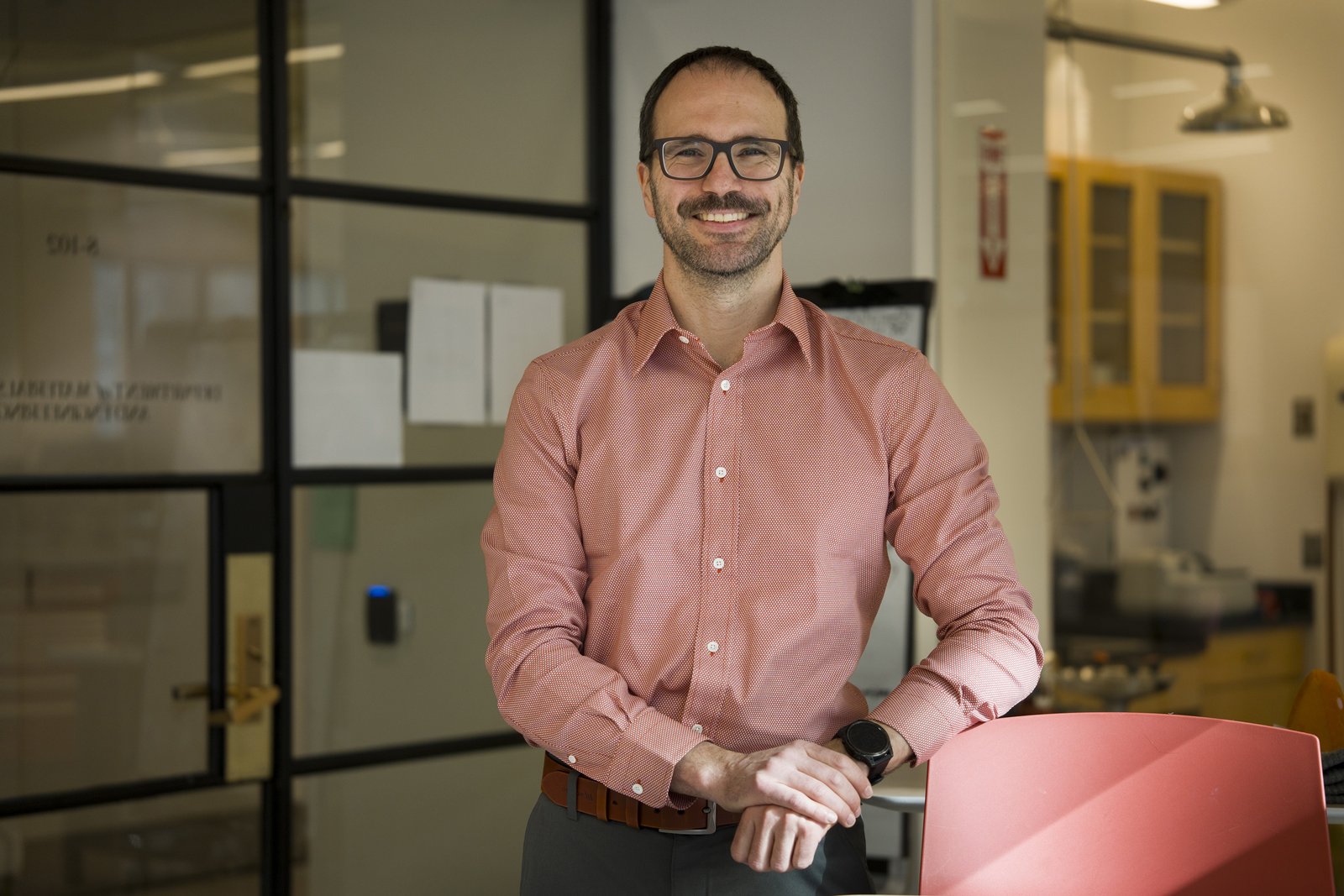
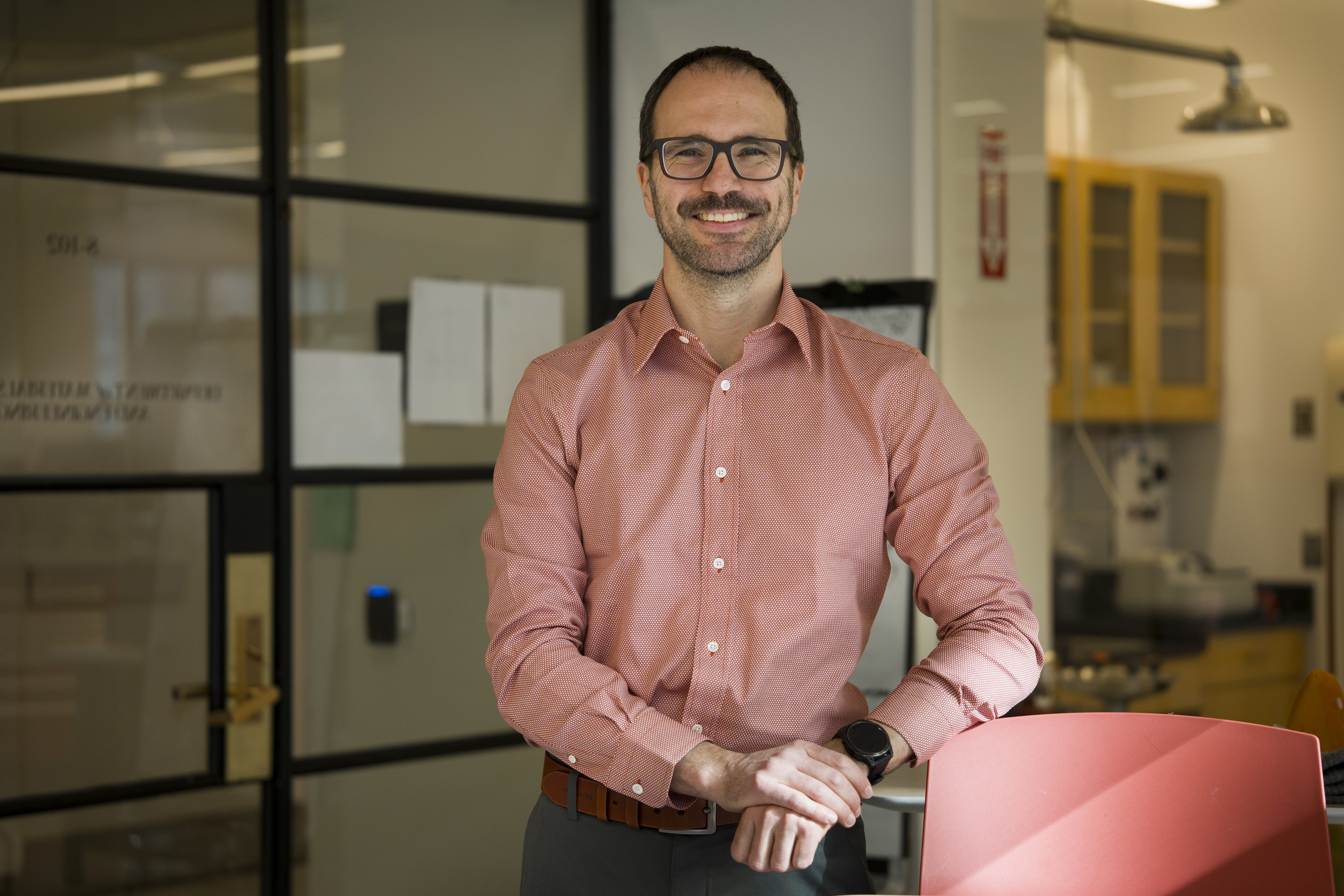
For more than a decade, MIT Associate Professor Rafael Gómez-Bombarelli has used artificial intelligence to create new materials. As the technology has expanded, so have his ambitions.
Now, the newly tenured professor in materials science and engineering believes AI is poised to transform science in ways never before possible. His work at MIT and beyond is devoted to accelerating that future.
“We’re at a second inflection point,” Gómez-Bombarelli says. “The first one was around 2015 with the first wave of representation learning, generative AI, and high-throughput data in some areas of science. Those are some of the techniques I first brought into my lab at MIT. Now I think we’re at a second inflection point, mixing language and merging multiple modalities into general scientific intelligence. We’re going to have all the model classes and scaling laws needed to reason about language, reason over material structures, and reason over synthesis recipes.”
Gómez Bombarelli’s research combines physics-based simulations with approaches like machine learning and generative AI to discover new materials with promising real-world applications. His work has led to new materials for batteries, catalysts, plastics, and organic light-emitting diodes (OLEDs). He has also co-founded multiple companies and served on scientific advisory boards for startups applying AI to drug discovery, robotics, and more. His latest company, Lila Sciences, is working to build a scientific superintelligence platform for the life sciences, chemical, and materials science industries.
All of that work is designed to ensure the future of scientific research is more seamless and productive than research today.
“AI for science is one of the most exciting and aspirational uses of AI,” Gómez-Bombarelli says. “Other applications for AI have more downsides and ambiguity. AI for science is about bringing a better future forward in time.”
From experiments to simulations
Gómez-Bombarelli grew up in Spain and gravitated toward the physical sciences from an early age. In 2001, he won a Chemistry Olympics competition, setting him on an academic track in chemistry, which he studied as an undergraduate at his hometown college, the University of Salamanca. Gómez-Bombarelli stuck around for his PhD, where he investigated the function of DNA-damaging chemicals.
“My PhD started out experimental, and then I got bitten by the bug of simulation and computer science about halfway through,” he says. “I started simulating the same chemical reactions I was measuring in the lab. I like the way programming organizes your brain; it felt like a natural way to organize one’s thinking. Programming is also a lot less limited by what you can do with your hands or with scientific instruments.”
Next, Gómez-Bombarelli went to Scotland for a postdoctoral position, where he studied quantum effects in biology. Through that work, he connected with Alán Aspuru-Guzik, a chemistry professor at Harvard University, whom he joined for his next postdoc in 2014.
“I was one of the first people to use generative AI for chemistry in 2016, and I was on the first team to use neural networks to understand molecules in 2015,” Gómez-Bombarelli says. “It was the early, early days of deep learning for science.”
Gómez-Bombarelli also began working to eliminate manual parts of molecular simulations to run more high-throughput experiments. He and his collaborators ended up running hundreds of thousands of calculations across materials, discovering hundreds of promising materials for testing.
After two years in the lab, Gómez-Bombarelli and Aspuru-Guzik started a general-purpose materials computation company, which eventually pivoted to focus on producing organic light-emitting diodes. Gómez-Bombarelli joined the company full-time and calls it the hardest thing he’s ever done in his career.
“It was amazing to make something tangible,” he says. “Also, after seeing Aspuru-Guzik run a lab, I didn’t want to become a professor. My dad was a professor in linguistics, and I thought it was a mellow job. Then I saw Aspuru-Guzik with a 40-person group, and he was on the road 120 days a year. It was insane. I didn’t think I had that type of energy and creativity in me.”
In 2018, Aspuru-Guzik suggested Gómez-Bombarelli apply for a new position in MIT’s Department of Materials Science and Engineering. But, with his trepidation about a faculty job, Gómez-Bombarelli let the deadline pass. Aspuru-Guzik confronted him in his office, slammed his hands on the table, and told him, “You need to apply for this.” It was enough to get Gómez-Bombarelli to put together a formal application.
Fortunately at his startup, Gómez-Bombarelli had spent a lot of time thinking about how to create value from computational materials discovery. During the interview process, he says, he was attracted to the energy and collaborative spirit at MIT. He also began to appreciate the research possibilities.
“Everything I had been doing as a postdoc and at the company was going to be a subset of what I could do at MIT,” he says. “I was making products, and I still get to do that. Suddenly, my universe of work was a subset of this new universe of things I could explore and do.”
It’s been nine years since Gómez Bombarelli joined MIT. Today his lab focuses on how the composition, structure, and reactivity of atoms impact material performance. He has also used high-throughput simulations to create new materials and helped develop tools for merging deep learning with physics-based modeling.
“Physics-based simulations make data and AI algorithms get better the more data you give them,” Gómez Bombarelli’s says. “There are all sorts of virtuous cycles between AI and simulations.”
The research group he has built is solely computational — they don’t run physical experiments.
“It’s a blessing because we can have a huge amount of breadth and do lots of things at once,” he says. “We love working with experimentalists and try to be good partners with them. We also love to create computational tools that help experimentalists triage the ideas coming from AI .”
Gómez-Bombarelli is also still focused on the real-world applications of the materials he invents. His lab works closely with companies and organizations like MIT’s Industrial Liaison Program to understand the material needs of the private sector and the practical hurdles of commercial development.
Accelerating science
As excitement around artificial intelligence has exploded, Gómez-Bombarelli has seen the field mature. Companies like Meta, Microsoft, and Google’s DeepMind now regularly conduct physics-based simulations reminiscent of what he was working on back in 2016. In November, the U.S. Department of Energy launched the Genesis Mission to accelerate scientific discovery, national security, and energy dominance using AI.
“AI for simulations has gone from something that maybe could work to a consensus scientific view,” Gómez-Bombarelli says. “We’re at an inflection point. Humans think in natural language, we write papers in natural language, and it turns out these large language models that have mastered natural language have opened up the ability to accelerate science. We’ve seen that scaling works for simulations. We’ve seen that scaling works for language. Now we’re going to see how scaling works for science.”
When he first came to MIT, Gómez-Bombarelli says he was blown away by how non-competitive things were between researchers. He tries to bring that same positive-sum thinking to his research group, which is made up of about 25 graduate students and postdocs.
“We’ve naturally grown into a really diverse group, with a diverse set of mentalities,” Gomez-Bombarelli says. “Everyone has their own career aspirations and strengths and weaknesses. Figuring out how to help people be the best versions of themselves is fun. Now I’ve become the one insisting that people apply to faculty positions after the deadline. I guess I’ve passed that baton.”