• About Us
  • Disclaimer
  • Contact Us
  • Privacy Policy
Tuesday, June 9, 2026
mGrowTech
No Result
View All Result
  • Technology And Software
    • Account Based Marketing
    • Channel Marketing
    • Marketing Automation
      • Al, Analytics and Automation
      • Ad Management
  • Digital Marketing
    • Social Media Management
    • Google Marketing
  • Direct Marketing
    • Brand Management
    • Marketing Attribution and Consulting
  • Mobile Marketing
  • Event Management
  • PR Solutions
  • Technology And Software
    • Account Based Marketing
    • Channel Marketing
    • Marketing Automation
      • Al, Analytics and Automation
      • Ad Management
  • Digital Marketing
    • Social Media Management
    • Google Marketing
  • Direct Marketing
    • Brand Management
    • Marketing Attribution and Consulting
  • Mobile Marketing
  • Event Management
  • PR Solutions
No Result
View All Result
mGrowTech
No Result
View All Result
Home Al, Analytics and Automation

A New MIT Study Shows Reinforcement Learning Minimizes Catastrophic Forgetting Compared to Supervised Fine-Tuning

Josh by Josh
September 8, 2025
in Al, Analytics and Automation
0
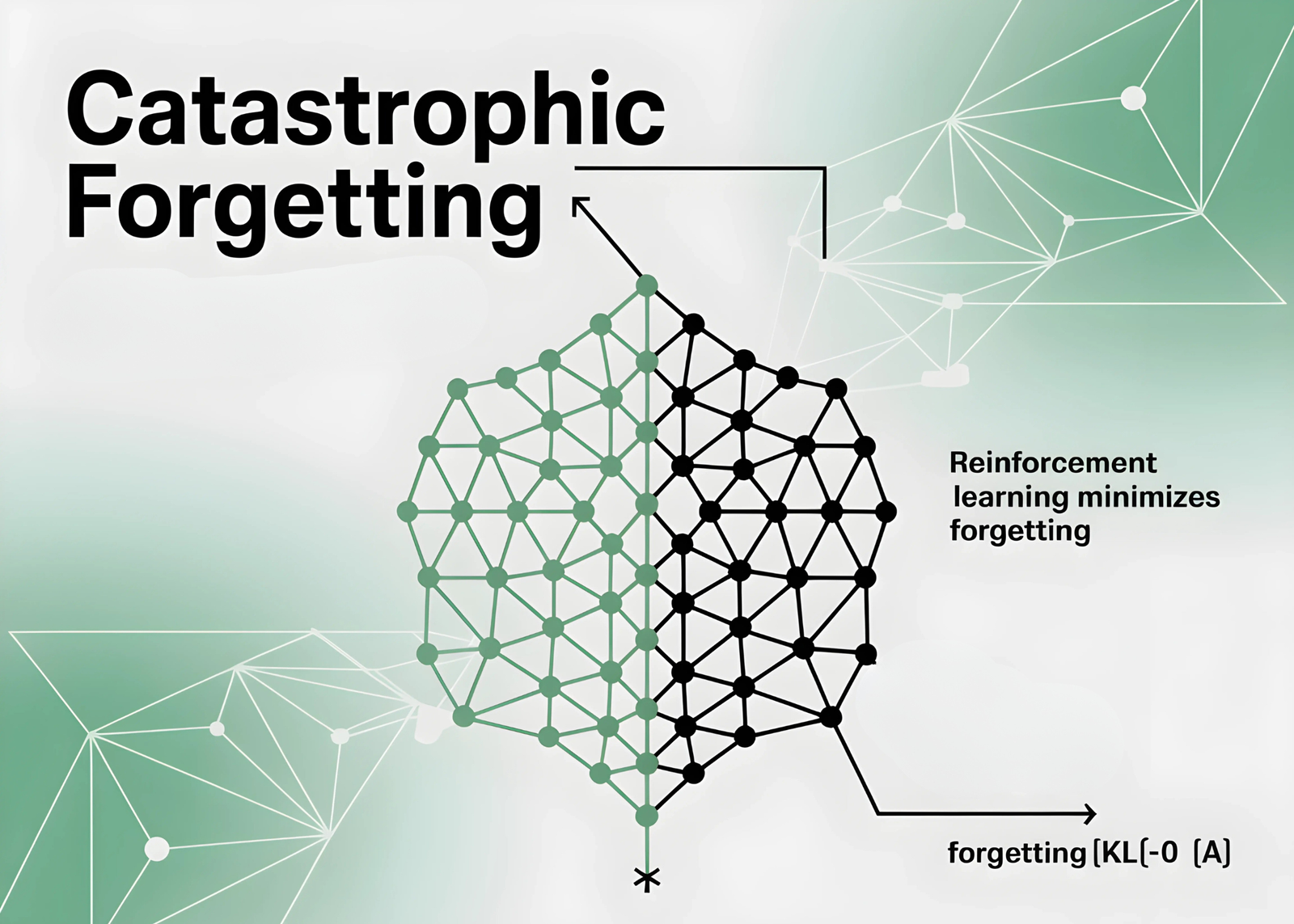
A New MIT Study Shows Reinforcement Learning Minimizes Catastrophic Forgetting Compared to Supervised Fine-Tuning


What is catastrophic forgetting in foundation models?

Foundation models excel in diverse domains but are largely static once deployed. Fine-tuning on new tasks often introduces catastrophic forgetting—the loss of previously learned capabilities. This limitation poses a barrier for building long-lived, continually improving AI agents.

Why does online reinforcement learning forget less than supervised fine-tuning?

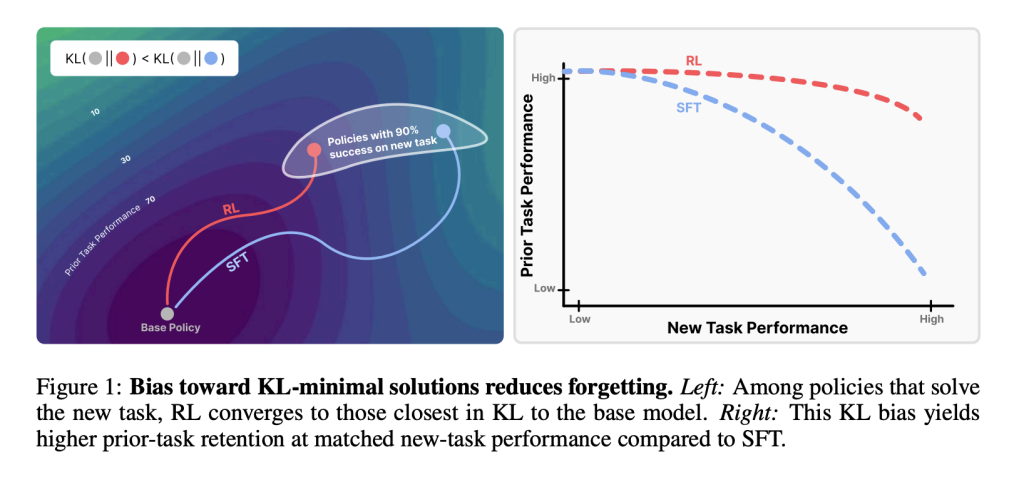
A new MIT study compares reinforcement learning (RL) and supervised fine-tuning (SFT). Both can achieve high performance on new tasks, but SFT tends to overwrite prior abilities. RL, by contrast, preserves them. The key lies in how each method shifts the model’s output distribution relative to the base policy.
https://arxiv.org/pdf/2509.04259

How can forgetting be measured?

The research team proposes an empirical forgetting law:

Forgetting∝KL(π0​∣∣π)

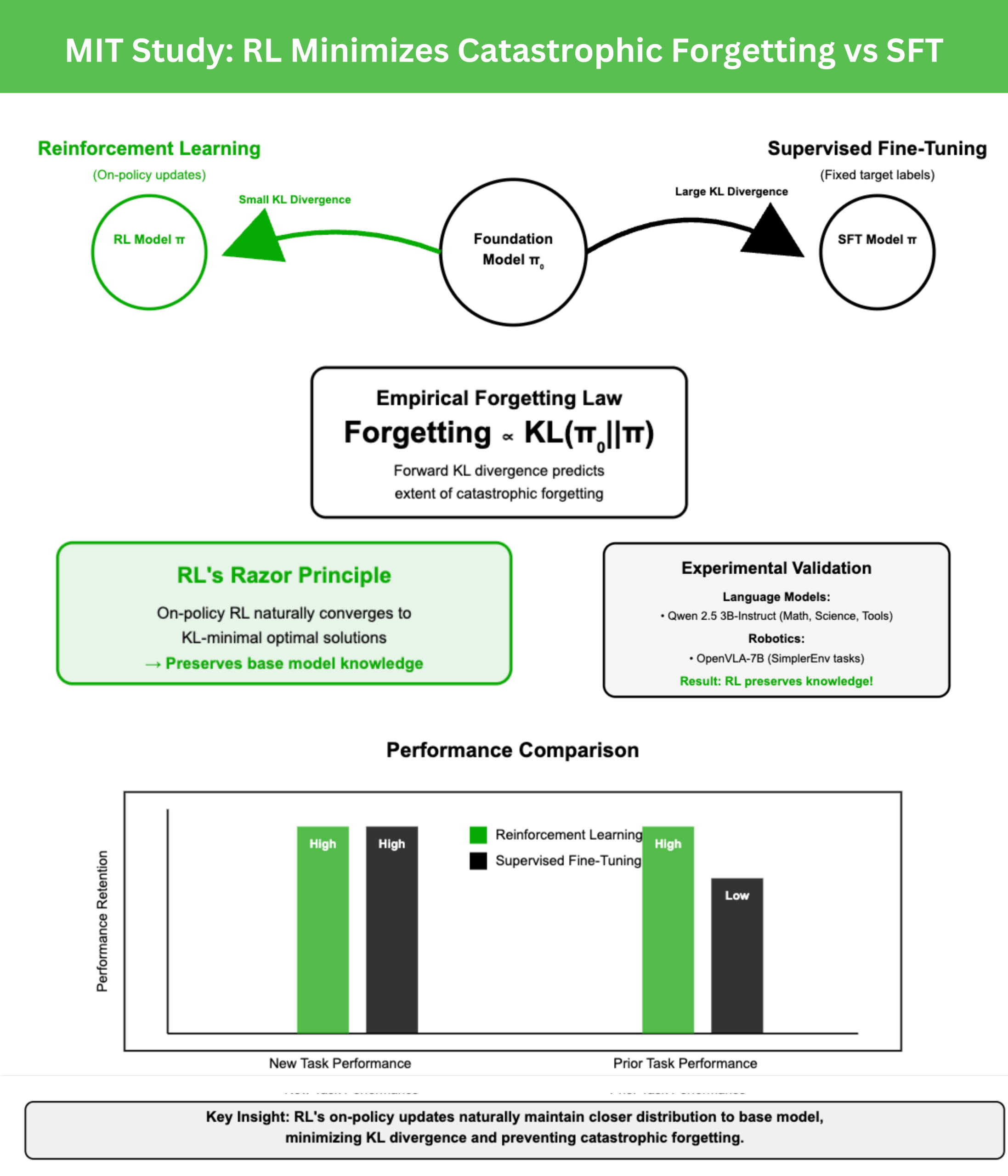
where π0 is the base model and π is the fine-tuned model. The forward KL divergence, measured on the new task, strongly predicts the extent of forgetting. This makes forgetting quantifiable without needing data from prior tasks.

What do experiments on large language models reveal?

Using Qwen 2.5 3B-Instruct as the base model, fine-tuning was performed on:

  • Math reasoning (Open-Reasoner-Zero),
  • Science Q&A (SciKnowEval subset),
  • Tool use (ToolAlpaca).

Performance was evaluated on prior benchmarks such as HellaSwag, MMLU, TruthfulQA, and HumanEval. Results showed that RL improved new-task accuracy while keeping prior-task accuracy stable, whereas SFT consistently sacrificed prior knowledge.

How does RL compare to SFT in robotics tasks?

In robotic control experiments with OpenVLA-7B fine-tuned in SimplerEnv pick-and-place scenarios, RL adaptation maintained general manipulation skills across tasks. SFT, while successful on the new task, degraded prior manipulation abilities—again illustrating RL’s conservatism in preserving knowledge.

What insights come from the ParityMNIST study?

To isolate mechanisms, the research team introduced a toy problem, ParityMNIST. Here, RL and SFT both reached high new-task accuracy, but SFT induced sharper declines on the FashionMNIST auxiliary benchmark. Crucially, plotting forgetting against KL divergence revealed a single predictive curve, validating KL as the governing factor.

Why do on-policy updates matter?

On-policy RL samples from the model’s own outputs, incrementally reweighting them by reward. This process constrains learning to distributions already close to the base model. SFT, in contrast, optimizes against fixed labels that may be arbitrarily distant. Theoretical analysis shows policy gradients converge to KL-minimal optimal solutions, formalizing RL’s advantage.

Are other explanations sufficient?

The research team tested alternatives: weight-space changes, hidden representation drift, sparsity of updates, and alternative distributional metrics (reverse KL, total variation, L2 distance). None matched the predictive strength of forward KL divergence, reinforcing that distributional closeness is the critical factor.

What are the broader implications?

  • Evaluation: Post-training should consider KL-conservatism, not just task accuracy.
  • Hybrid methods: Combining SFT efficiency with explicit KL minimization could yield optimal trade-offs.
  • Continual learning: RL’s Razor offers a measurable criterion for designing adaptive agents that learn new skills without erasing old ones.
Conclusion

The MIT research reframes catastrophic forgetting as a distributional problem governed by forward KL divergence. Reinforcement learning forgets less because its on-policy updates naturally bias toward KL-minimal solutions. This principle—RL’s Razor—provides both an explanation for RL’s robustness and a roadmap for developing post-training methods that support lifelong learning in foundation models.

Key Takeaways

  • Reinforcement learning (RL) preserves prior knowledge better than Supervised fine-tuning (SFT): Even when both achieve the same accuracy on new tasks, RL retains prior capabilities while SFT erases them.
  • Forgetting is predictable by KL divergence: The degree of catastrophic forgetting is strongly correlated with the forward KL divergence between the fine-tuned and base policy, measured on the new task.
  • RL’s Razor principle: On-policy RL converges to KL-minimal solutions, ensuring updates remain close to the base model and reducing forgetting.
  • Empirical validation across domains: Experiments on LLMs (math, science Q&A, tool use) and robotics tasks confirm RL’s robustness against forgetting, while SFT consistently trades old knowledge for new-task performance.
  • Controlled experiments confirm generality: In the ParityMNIST toy setting, both RL and SFT showed forgetting aligned with KL divergence, proving the principle holds beyond large-scale models.
  • Future design axis for post-training: Algorithms should be evaluated not only by new-task accuracy but also by how conservatively they shift distributions in KL space, opening avenues for hybrid RL–SFT methods.

Check out the PAPER and PROJECT PAGE. Feel free to check out our GitHub Page for Tutorials, Codes and Notebooks. Also, feel free to follow us on Twitter and don’t forget to join our 100k+ ML SubReddit and Subscribe to our Newsletter.


Michal Sutter is a data science professional with a Master of Science in Data Science from the University of Padova. With a solid foundation in statistical analysis, machine learning, and data engineering, Michal excels at transforming complex datasets into actionable insights.




Source_link

READ ALSO

ClawHub Security Signals: A Coding Guide to End-to-End Security Signal Analysis and Verdict Classification on the AI Skills Dataset

Microsoft AI Introduces MAI-Transcribe-1.5: 2.4% WER on Artificial Analysis, Best-in-Class FLEURS Accuracy, and Up to 5x Faster Long-Audio Transcription

Related Posts

ClawHub Security Signals: A Coding Guide to End-to-End Security Signal Analysis and Verdict Classification on the AI Skills Dataset
Al, Analytics and Automation

ClawHub Security Signals: A Coding Guide to End-to-End Security Signal Analysis and Verdict Classification on the AI Skills Dataset

June 8, 2026
Microsoft AI Introduces MAI-Transcribe-1.5: 2.4% WER on Artificial Analysis, Best-in-Class FLEURS Accuracy, and Up to 5x Faster Long-Audio Transcription
Al, Analytics and Automation

Microsoft AI Introduces MAI-Transcribe-1.5: 2.4% WER on Artificial Analysis, Best-in-Class FLEURS Accuracy, and Up to 5x Faster Long-Audio Transcription

June 8, 2026
Building Reflective Prompt Optimization with GEPA: Multi-Component Prompts, Structured Feedback, and Held-Out Validation
Al, Analytics and Automation

Building Reflective Prompt Optimization with GEPA: Multi-Component Prompts, Structured Feedback, and Held-Out Validation

June 7, 2026
Best 21 Low-Code and No-Code AI Tools in 2026
Al, Analytics and Automation

Best 21 Low-Code and No-Code AI Tools in 2026

June 7, 2026
Tod Machover receives George Peabody Medal for contributions to music and technology | MIT News
Al, Analytics and Automation

Tod Machover receives George Peabody Medal for contributions to music and technology | MIT News

June 6, 2026
Moonshot AI Releases Kimi Code CLI: A Terminal AI Coding Agent Built in TypeScript for Next-Gen Agents
Al, Analytics and Automation

Moonshot AI Releases Kimi Code CLI: A Terminal AI Coding Agent Built in TypeScript for Next-Gen Agents

June 6, 2026
Next Post
Best Linux Distros with User-Friendly Interface

Best Linux Distros with User-Friendly Interface

POPULAR NEWS

Trump ends trade talks with Canada over a digital services tax

Trump ends trade talks with Canada over a digital services tax

June 28, 2025
15 Trending Songs on TikTok in 2025 (+ How to Use Them)

15 Trending Songs on TikTok in 2025 (+ How to Use Them)

June 18, 2025
Communication Effectiveness Skills For Business Leaders

Communication Effectiveness Skills For Business Leaders

June 10, 2025
App Development Cost in Singapore: Pricing Breakdown & Insights

App Development Cost in Singapore: Pricing Breakdown & Insights

June 22, 2025
Comparing the Top 7 Large Language Models LLMs/Systems for Coding in 2025

Comparing the Top 7 Large Language Models LLMs/Systems for Coding in 2025

November 4, 2025

EDITOR'S PICK

Future Horizons Semiconductor Update for November

Future Horizons Semiconductor Update for November

November 24, 2025
We’re working with Vaulted to remove carbon and quantify superpollutants.

We’re working with Vaulted to remove carbon and quantify superpollutants.

September 17, 2025
Newegg Promo Code: 10% Off in May 2026

Newegg Promo Code: 10% Off in May 2026

May 2, 2026
How to turn your old iPad into a digital picture frame

How to turn your old iPad into a digital picture frame

June 5, 2025

About

We bring you the best Premium WordPress Themes that perfect for news, magazine, personal blog, etc. Check our landing page for details.

Follow us

Categories

  • Account Based Marketing
  • Ad Management
  • Al, Analytics and Automation
  • Brand Management
  • Channel Marketing
  • Digital Marketing
  • Direct Marketing
  • Event Management
  • Google Marketing
  • Marketing Attribution and Consulting
  • Marketing Automation
  • Mobile Marketing
  • PR Solutions
  • Social Media Management
  • Technology And Software
  • Uncategorized

Recent Posts

  • 12 best online reputation management tools for 2026
  • Researchers trained an open source AI search agent, Harness-1, that outperforms GPT-5.4 on recalling relevant information
  • Stephen Curry and Curry Brand Enter Long-Term Deal with LI-NING
  • Gemini models for Apple developers
  • About Us
  • Disclaimer
  • Contact Us
  • Privacy Policy
No Result
View All Result
  • Technology And Software
    • Account Based Marketing
    • Channel Marketing
    • Marketing Automation
      • Al, Analytics and Automation
      • Ad Management
  • Digital Marketing
    • Social Media Management
    • Google Marketing
  • Direct Marketing
    • Brand Management
    • Marketing Attribution and Consulting
  • Mobile Marketing
  • Event Management
  • PR Solutions