[ad_1]
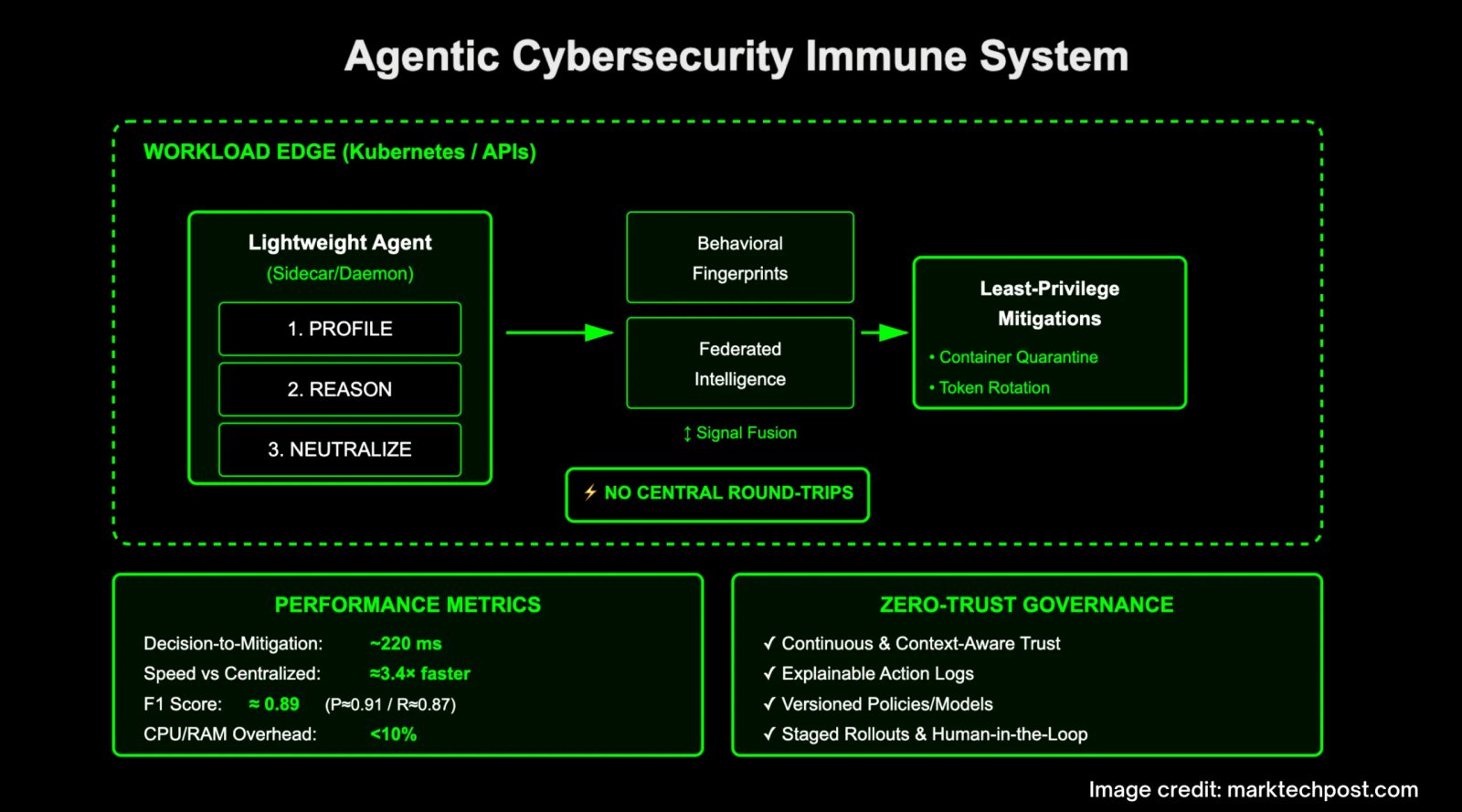
Can your AI security stack profile, reason, and neutralize a live security threat in ~220 ms—without a central round-trip? A team of researchers from Google and University of Arkansas at Little Rock outline an agentic cybersecurity “immune system” built from lightweight, autonomous sidecar AI agents colocated with workloads (Kubernetes pods, API gateways, edge services). Instead of exporting raw telemetry to a SIEM and waiting on batched classifiers, each agent learns local behavioral baselines, evaluates anomalies using federated intelligence, and applies least-privilege mitigations directly at the point of execution. In a controlled cloud-native simulation, this edge-first loop cut decision-to-mitigation to ~220 ms (≈3.4× faster than centralized pipelines), achieved F1 ≈ 0.89, and held host overhead under 10% CPU/RAM—evidence that collapsing detection and enforcement into the workload plane can deliver both speed and fidelity without material resource penalties.
What does “Profile → Reason → Neutralize” mean at the primitive level?
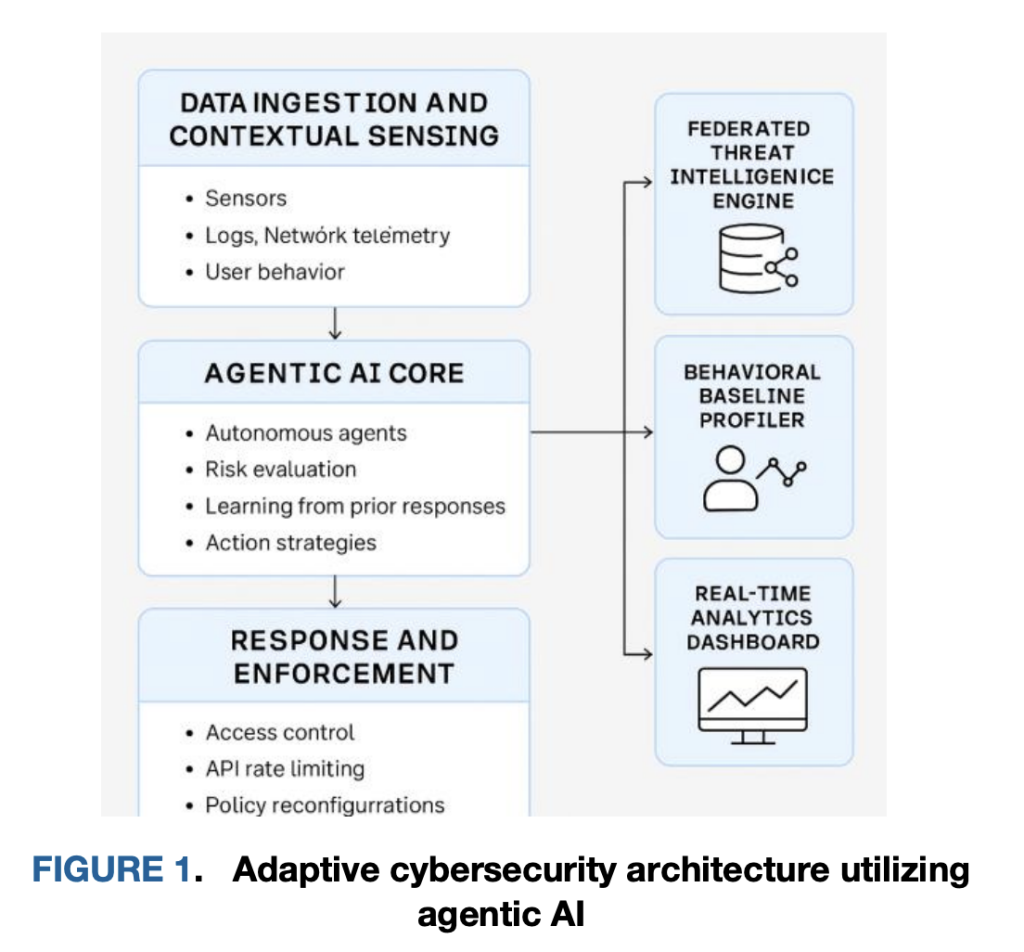
Profile. Agents are deployed as sidecars/daemonsets alongside microservices and API gateways. They build behavioral fingerprints from execution traces, syscall paths, API call sequences, and inter-service flows. This local baseline adapts to short-lived pods, rolling deploys, and autoscaling—conditions that routinely break perimeter controls and static allowlists. Profiling is not just a threshold on counts; it retains structural features (order, timing, peer set) that allow detection of zero-day-like deviations. The research team frames this as continuous, context-aware baselining across ingestion and sensing layers so that “normal” is learned per workload and per identity boundary.
Reason. When an anomaly appears (for example, an unusual burst of high-entropy uploads from a low-trust principal or a never-seen-before API call graph), the local agent mixes anomaly scores with federated intelligence—shared indicators and model deltas learned by peers—to produce a risk estimate. Reasoning is designed to be edge-first: the agent decides without a round-trip to a central adjudicator, and the trust decision is continuous rather than a static role gate. This aligns with zero-trust—identity and context are evaluated at each request, not just at session start—and it reduces central bottlenecks that add seconds of latency under load.
Neutralize. If risk exceeds a context-sensitive threshold, the agent executes an immediate local control mapped to least-privilege actions: quarantine the container (pause/isolate), rotate a credential, apply a rate-limit, revoke a token, or tighten a per-route policy. Enforcement is written back to policy stores and logged with a human-readable rationale for audit. The fast path here is the core differentiator: in the reported evaluation, the autonomous path triggers in ~220 ms versus ~540–750 ms for centralized ML or firewall update pipelines, which translates into a ~70% latency reduction and fewer opportunities for lateral movement during the decision window.
Where do the numbers come from, and what were the baselines?
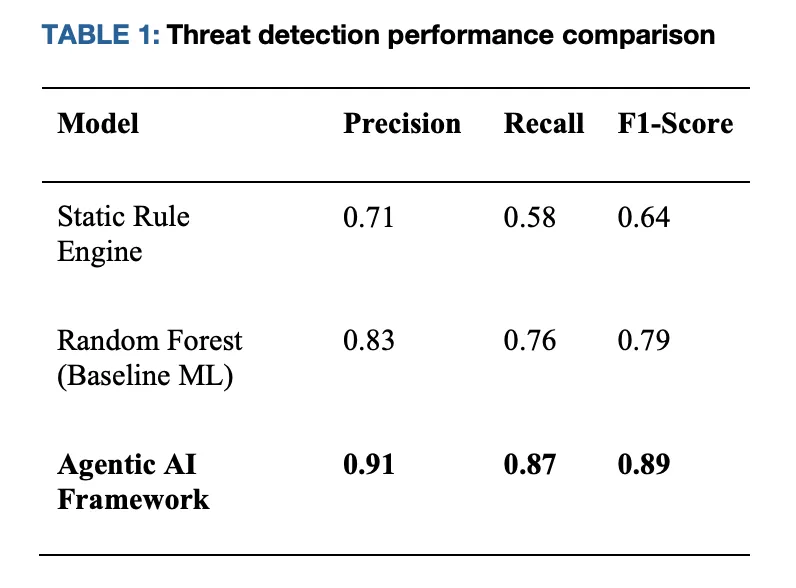
The research team evaluated the architecture in a Kubernetes-native simulation spanning API abuse and lateral-movement scenarios. Against two typical baselines—(i) static rule pipelines and (ii) a batch-trained classifier—the agentic approach reports Precision 0.91 / Recall 0.87 / F1 0.89, while the baselines land near F1 0.64 (rules) and F1 0.79 (baseline ML). Decision latency falls to ~220 ms for local enforcement, compared with ~540–750 ms for centralized paths that require coordination with a controller or external firewall. Resource overhead on host services remains below 10% in CPU/RAM.
Why does this matter for zero-trust engineering, not just research graphs?
Zero-trust (ZT) calls for continuous verification at request-time using identity, device, and context. In practice, many ZT deployments still defer to central policy evaluators, so they inherit control-plane latency and queueing pathologies under load. By moving risk inference and enforcement to the autonomous edge, the architecture turns ZT posture from periodic policy pulls into a set of self-contained, continuously learning controllers that execute least-privilege changes locally and then synchronize state. That design simultaneously reduces mean time-to-contain (MTTC) and keeps decisions near the blast radius, which helps when inter-pod hops are measured in milliseconds. The research team also formalizes federated sharing to distribute indicators/model deltas without heavy raw-data movement, which is relevant for privacy boundaries and multi-tenant SaaS.
How does it integrate with existing stacks—Kubernetes, APIs, and identity?
Operationally, the agents are co-located with workloads (sidecar or node daemon). On Kubernetes, they can hook CNI-level telemetry for flow features, container runtime events for process-level signals, and envoy/nginx spans at API gateways for request graphs. For identity, they consume claims from your IdP and compute continuous trust scores that factor recent behavior and environment (e.g., geo-risk, device posture). Mitigations are expressed as idempotent primitives—network micro-policy updates, token revocation, per-route quotas—so they are straightforward to roll back or tighten incrementally. The architecture’s control loop (sense → reason → act → learn) is strictly feedback-driven and supports both human-in-the-loop (policy windows, approval gates for high-blast-radius changes) and autonomy for low-impact actions.
What are the governance and safety guardrails?
Speed without auditability is a non-starter in regulated environments. The research team emphasizes explainable decision logs that capture which signals and thresholds led to the action, with signed and versioned policy/model artifacts. It also discusses privacy-preserving modes—keeping sensitive data local while sharing model updates; differentially private updates are mentioned as an option in stricter regimes. For safety, the system supports override/rollback and staged rollouts (e.g., canarying new mitigation templates in non-critical namespaces). This is consistent with broader security work on threats and guardrails for agentic systems; if your org is adopting multi-agent pipelines, cross-check against current threat models for agent autonomy and tool use.
How do the reported results translate to production posture?
The evaluation is a 72-hour cloud-native simulation with injected behaviors: API misuse patterns, lateral movement, and zero-day-like deviations. Real systems will add messier signals (e.g., noisy sidecars, multi-cluster networking, mixed CNI plugins), which affects both detection and enforcement timing. That said, the fast-path structure—local decision + local act—is topology-agnostic and should preserve order-of-magnitude latency gains so long as mitigations are mapped to primitives available in your mesh/runtime. For production, begin with observe-only agents to build baselines, then turn on mitigations for low-risk actions (quota clamps, token revokes), then gate high-blast-radius controls (network slicing, container quarantine) behind policy windows until confidence/coverage metrics are green.
How does this sit in the broader agentic-security landscape?
There is growing research on securing agent systems and using agent workflows for security tasks. The research team discussed here is about defense via agent autonomy close to workloads. In parallel, other work tackles threat modeling for agentic AI, secure A2A protocol usage, and agentic vulnerability testing. If you adopt the architecture, pair it with a current agent-security threat model and a test harness that exercises tool-use boundaries and memory safety of agents.
Comparative Results (Kubernetes simulation)
| Metric | Static rules pipeline | Baseline ML (batch classifier) | Agentic framework (edge autonomy) |
|---|---|---|---|
| Precision | 0.71 | 0.83 | 0.91 |
| Recall | 0.58 | 0.76 | 0.87 |
| F1 | 0.64 | 0.79 | 0.89 |
| Decision-to-mitigation latency | ~750 ms | ~540 ms | ~220 ms |
| Host overhead (CPU/RAM) | Moderate | Moderate | <10% |
Key Takeaways
- Edge-first “cybersecurity immune system.” Lightweight sidecar/daemon AI agents colocated with workloads (Kubernetes pods, API gateways) learn behavioral fingerprints, decide locally, and enforce least-privilege mitigations without SIEM round-trips.
- Measured performance. Reported decision-to-mitigation is ~220 ms—about 3.4× faster than centralized pipelines (≈540–750 ms)—with F1 ≈ 0.89 (P≈0.91, R≈0.87) in a Kubernetes simulation.
- Low operational cost. Host overhead remains <10% CPU/RAM, making the approach practical for microservices and edge nodes.
- Profile → Reason → Neutralize loop. Agents continuously baseline normal activity (profile), fuse local signals with federated intelligence for risk scoring (reason), and apply immediate, reversible controls such as container quarantine, token rotation, and rate-limits (neutralize).
- Zero-trust alignment. Decisions are continuous and context-aware (identity, device, geo, workload), replacing static role gates and reducing dwell time and lateral movement risk.
- Governance and safety. Actions are logged with explainable rationales; policies/models are signed and versioned; high-blast-radius mitigations can be gated behind human-in-the-loop and staged rollouts.
Summary
Treat defense as a distributed control plane made of profiling, reasoning, and neutralizing agents that act where the threat lives. The reported profile—~220 ms actions, ≈ 3.4× faster than centralized baselines, F1 ≈ 0.89, <10% overhead—is consistent with what you’d expect when you eliminate central hops and let autonomy handle least-privilege mitigations locally. It aligns with zero-trust’s continuous verification and gives teams a practical path to self-stabilizing operations: learn normal, flag deviations with federated context, and contain early—before lateral movement outpaces your control plane.
Check out the Paper and GitHub Page. Feel free to check out our GitHub Page for Tutorials, Codes and Notebooks. Also, feel free to follow us on Twitter and don’t forget to join our 100k+ ML SubReddit and Subscribe to our Newsletter.

Asif Razzaq is the CEO of Marktechpost Media Inc.. As a visionary entrepreneur and engineer, Asif is committed to harnessing the potential of Artificial Intelligence for social good. His most recent endeavor is the launch of an Artificial Intelligence Media Platform, Marktechpost, which stands out for its in-depth coverage of machine learning and deep learning news that is both technically sound and easily understandable by a wide audience. The platform boasts of over 2 million monthly views, illustrating its popularity among audiences.
[ad_2]
Source_link