• About Us
  • Disclaimer
  • Contact Us
  • Privacy Policy
Friday, March 13, 2026
mGrowTech
No Result
View All Result
  • Technology And Software
    • Account Based Marketing
    • Channel Marketing
    • Marketing Automation
      • Al, Analytics and Automation
      • Ad Management
  • Digital Marketing
    • Social Media Management
    • Google Marketing
  • Direct Marketing
    • Brand Management
    • Marketing Attribution and Consulting
  • Mobile Marketing
  • Event Management
  • PR Solutions
  • Technology And Software
    • Account Based Marketing
    • Channel Marketing
    • Marketing Automation
      • Al, Analytics and Automation
      • Ad Management
  • Digital Marketing
    • Social Media Management
    • Google Marketing
  • Direct Marketing
    • Brand Management
    • Marketing Attribution and Consulting
  • Mobile Marketing
  • Event Management
  • PR Solutions
No Result
View All Result
mGrowTech
No Result
View All Result
Home Al, Analytics and Automation

A Technical Roadmap to Context Engineering in LLMs: Mechanisms, Benchmarks, and Open Challenges

Josh by Josh
August 4, 2025
in Al, Analytics and Automation
0
A Technical Roadmap to Context Engineering in LLMs: Mechanisms, Benchmarks, and Open Challenges

READ ALSO

How to Build an Autonomous Machine Learning Research Loop in Google Colab Using Andrej Karpathy’s AutoResearch Framework for Hyperparameter Discovery and Experiment Tracking

Meta Unveils Four New Chips to Power Its AI and Recommendation Systems


Estimated reading time: 4 minutes

The paper “A Survey of Context Engineering for Large Language Models” establishes Context Engineering as a formal discipline that goes far beyond prompt engineering, providing a unified, systematic framework for designing, optimizing, and managing the information that guides Large Language Models (LLMs). Here’s an overview of its main contributions and framework:

What Is Context Engineering?

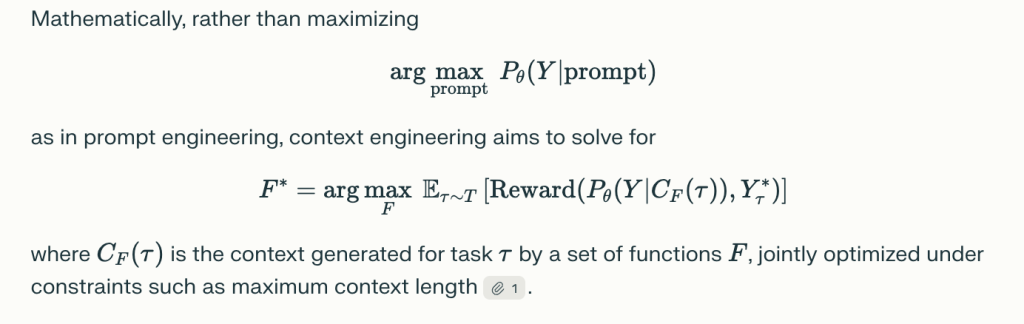
Context Engineering is defined as the science and engineering of organizing, assembling, and optimizing all forms of context fed into LLMs to maximize performance across comprehension, reasoning, adaptability, and real-world application. Rather than viewing context as a static string (the premise of prompt engineering), context engineering treats it as a dynamic, structured assembly of components—each sourced, selected, and organized through explicit functions, often under tight resource and architectural constraints.
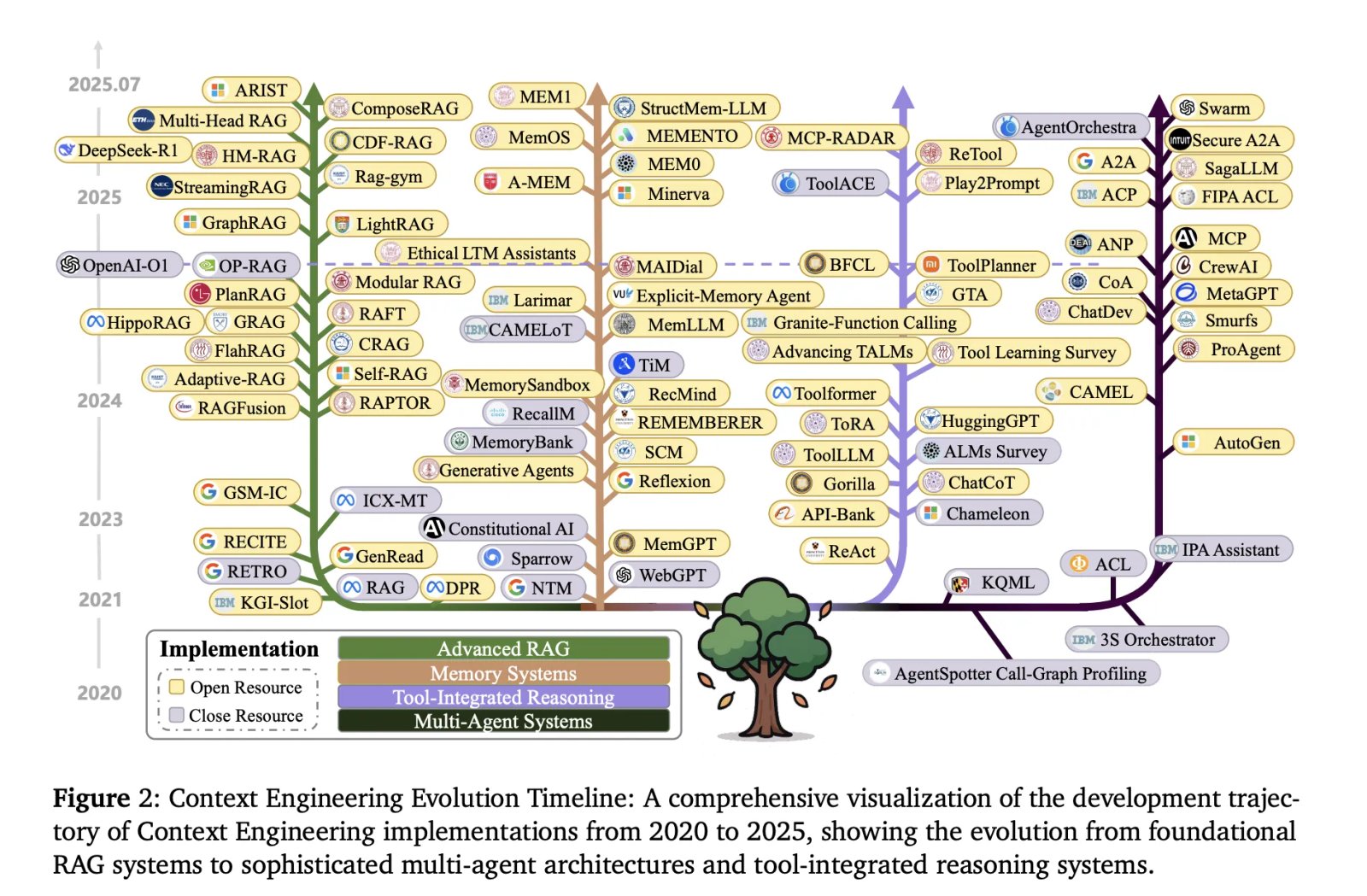
Taxonomy of Context Engineering

The paper breaks down context engineering into:

1. Foundational Components

a. Context Retrieval and Generation

  • Encompasses prompt engineering, in-context learning (zero/few-shot, chain-of-thought, tree-of-thought, graph-of-thought), external knowledge retrieval (e.g., Retrieval-Augmented Generation, knowledge graphs), and dynamic assembly of context elements1.
  • Techniques like CLEAR Framework, dynamic template assembly, and modular retrieval architectures are highlighted.

b. Context Processing

  • Addresses long-sequence processing (with architectures like Mamba, LongNet, FlashAttention), context self-refinement (iterative feedback, self-evaluation), and integration of multimodal and structured information (vision, audio, graphs, tables).
  • Strategies include attention sparsity, memory compression, and in-context learning meta-optimization.

c. Context Management

  • Involves memory hierarchies and storage architectures (short-term context windows, long-term memory, external databases), memory paging, context compression (autoencoders, recurrent compression), and scalable management over multi-turn or multi-agent settings.

2. System Implementations

a. Retrieval-Augmented Generation (RAG)

  • Modular, agentic, and graph-enhanced RAG architectures integrate external knowledge and support dynamic, sometimes multi-agent retrieval pipelines.
  • Enables both real-time knowledge updates and complex reasoning over structured databases/graphs.

b. Memory Systems

  • Implement persistent and hierarchical storage, enabling longitudinal learning and knowledge recall for agents (e.g., MemGPT, MemoryBank, external vector databases).
  • Key for extended, multi-turn dialogs, personalized assistants, and simulation agents.

c. Tool-Integrated Reasoning

  • LLMs use external tools (APIs, search engines, code execution) via function calling or environment interaction, combining language reasoning with world-acting abilities.
  • Enables new domains (math, programming, web interaction, scientific research).

d. Multi-Agent Systems

  • Coordination among multiple LLMs (agents) via standardized protocols, orchestrators, and context sharing—essential for complex, collaborative problem-solving and distributed AI applications.

Key Insights and Research Gaps

  • Comprehension–Generation Asymmetry: LLMs, with advanced context engineering, can comprehend very sophisticated, multi-faceted contexts but still struggle to generate outputs matching that complexity or length.
  • Integration and Modularity: Best performance comes from modular architectures combining multiple techniques (retrieval, memory, tool use).
  • Evaluation Limitations: Current evaluation metrics/benchmarks (like BLEU, ROUGE) often fail to capture the compositional, multi-step, and collaborative behaviors enabled by advanced context engineering. New benchmarks and dynamic, holistic evaluation paradigms are needed.
  • Open Research Questions: Theoretical foundations, efficient scaling (especially computationally), cross-modal and structured context integration, real-world deployment, safety, alignment, and ethical concerns remain open research challenges.

Applications and Impact

Context engineering supports robust, domain-adaptive AI across:

  • Long-document/question answering
  • Personalized digital assistants and memory-augmented agents
  • Scientific, medical, and technical problem-solving
  • Multi-agent collaboration in business, education, and research

Future Directions

  • Unified Theory: Developing mathematical and information-theoretic frameworks.
  • Scaling & Efficiency: Innovations in attention mechanisms and memory management.
  • Multi-Modal Integration: Seamless coordination of text, vision, audio, and structured data.
  • Robust, Safe, and Ethical Deployment: Ensuring reliability, transparency, and fairness in real-world systems.

In summary: Context Engineering is emerging as the pivotal discipline for guiding the next generation of LLM-based intelligent systems, shifting the focus from creative prompt writing to the rigorous science of information optimization, system design, and context-driven AI.


Check out the Paper. Feel free to check out our GitHub Page for Tutorials, Codes and Notebooks. Also, feel free to follow us on Twitter and don’t forget to join our 100k+ ML SubReddit and Subscribe to our Newsletter.


Michal Sutter is a data science professional with a Master of Science in Data Science from the University of Padova. With a solid foundation in statistical analysis, machine learning, and data engineering, Michal excels at transforming complex datasets into actionable insights.



Source_link

Related Posts

Al, Analytics and Automation

How to Build an Autonomous Machine Learning Research Loop in Google Colab Using Andrej Karpathy’s AutoResearch Framework for Hyperparameter Discovery and Experiment Tracking

March 13, 2026
Meta Unveils Four New Chips to Power Its AI and Recommendation Systems
Al, Analytics and Automation

Meta Unveils Four New Chips to Power Its AI and Recommendation Systems

March 12, 2026
New MIT class uses anthropology to improve chatbots | MIT News
Al, Analytics and Automation

New MIT class uses anthropology to improve chatbots | MIT News

March 12, 2026
How to Design a Streaming Decision Agent with Partial Reasoning, Online Replanning, and Reactive Mid-Execution Adaptation in Dynamic Environments
Al, Analytics and Automation

How to Design a Streaming Decision Agent with Partial Reasoning, Online Replanning, and Reactive Mid-Execution Adaptation in Dynamic Environments

March 12, 2026
3 Questions: On the future of AI and the mathematical and physical sciences | MIT News
Al, Analytics and Automation

3 Questions: On the future of AI and the mathematical and physical sciences | MIT News

March 12, 2026
NVIDIA Releases Nemotron 3 Super: A 120B Parameter Open-Source Hybrid Mamba-Attention MoE Model Delivering 5x Higher Throughput for Agentic AI
Al, Analytics and Automation

NVIDIA Releases Nemotron 3 Super: A 120B Parameter Open-Source Hybrid Mamba-Attention MoE Model Delivering 5x Higher Throughput for Agentic AI

March 11, 2026
Next Post
Review Keywords Enhancement – Jon Loomer Digital

Review Keywords Enhancement - Jon Loomer Digital

POPULAR NEWS

Trump ends trade talks with Canada over a digital services tax

Trump ends trade talks with Canada over a digital services tax

June 28, 2025
Communication Effectiveness Skills For Business Leaders

Communication Effectiveness Skills For Business Leaders

June 10, 2025
15 Trending Songs on TikTok in 2025 (+ How to Use Them)

15 Trending Songs on TikTok in 2025 (+ How to Use Them)

June 18, 2025
App Development Cost in Singapore: Pricing Breakdown & Insights

App Development Cost in Singapore: Pricing Breakdown & Insights

June 22, 2025
Google announced the next step in its nuclear energy plans 

Google announced the next step in its nuclear energy plans 

August 20, 2025

EDITOR'S PICK

How AI and IoT Are Shaping 2025

How AI and IoT Are Shaping 2025

October 1, 2025
Google’s Gemini app can check videos to see if they were made with Google AI

Google’s Gemini app can check videos to see if they were made with Google AI

December 23, 2025
We Analyzed 26K Quora URLs Cited in Google AI Mode: Here’s What Works

We Analyzed 26K Quora URLs Cited in Google AI Mode: Here’s What Works

September 30, 2025
Sending Christmas Business Cards in 2022

Sending Christmas Business Cards in 2022

June 2, 2025

About

We bring you the best Premium WordPress Themes that perfect for news, magazine, personal blog, etc. Check our landing page for details.

Follow us

Categories

  • Account Based Marketing
  • Ad Management
  • Al, Analytics and Automation
  • Brand Management
  • Channel Marketing
  • Digital Marketing
  • Direct Marketing
  • Event Management
  • Google Marketing
  • Marketing Attribution and Consulting
  • Marketing Automation
  • Mobile Marketing
  • PR Solutions
  • Social Media Management
  • Technology And Software
  • Uncategorized

Recent Posts

  • A 4-part process for building an executive voice framework
  • How to watch Jensen Huang’s Nvidia GTC 2026 keynote
  • How to Build an Autonomous Machine Learning Research Loop in Google Colab Using Andrej Karpathy’s AutoResearch Framework for Hyperparameter Discovery and Experiment Tracking
  • New AI features in Google Maps
  • About Us
  • Disclaimer
  • Contact Us
  • Privacy Policy
No Result
View All Result
  • Technology And Software
    • Account Based Marketing
    • Channel Marketing
    • Marketing Automation
      • Al, Analytics and Automation
      • Ad Management
  • Digital Marketing
    • Social Media Management
    • Google Marketing
  • Direct Marketing
    • Brand Management
    • Marketing Attribution and Consulting
  • Mobile Marketing
  • Event Management
  • PR Solutions