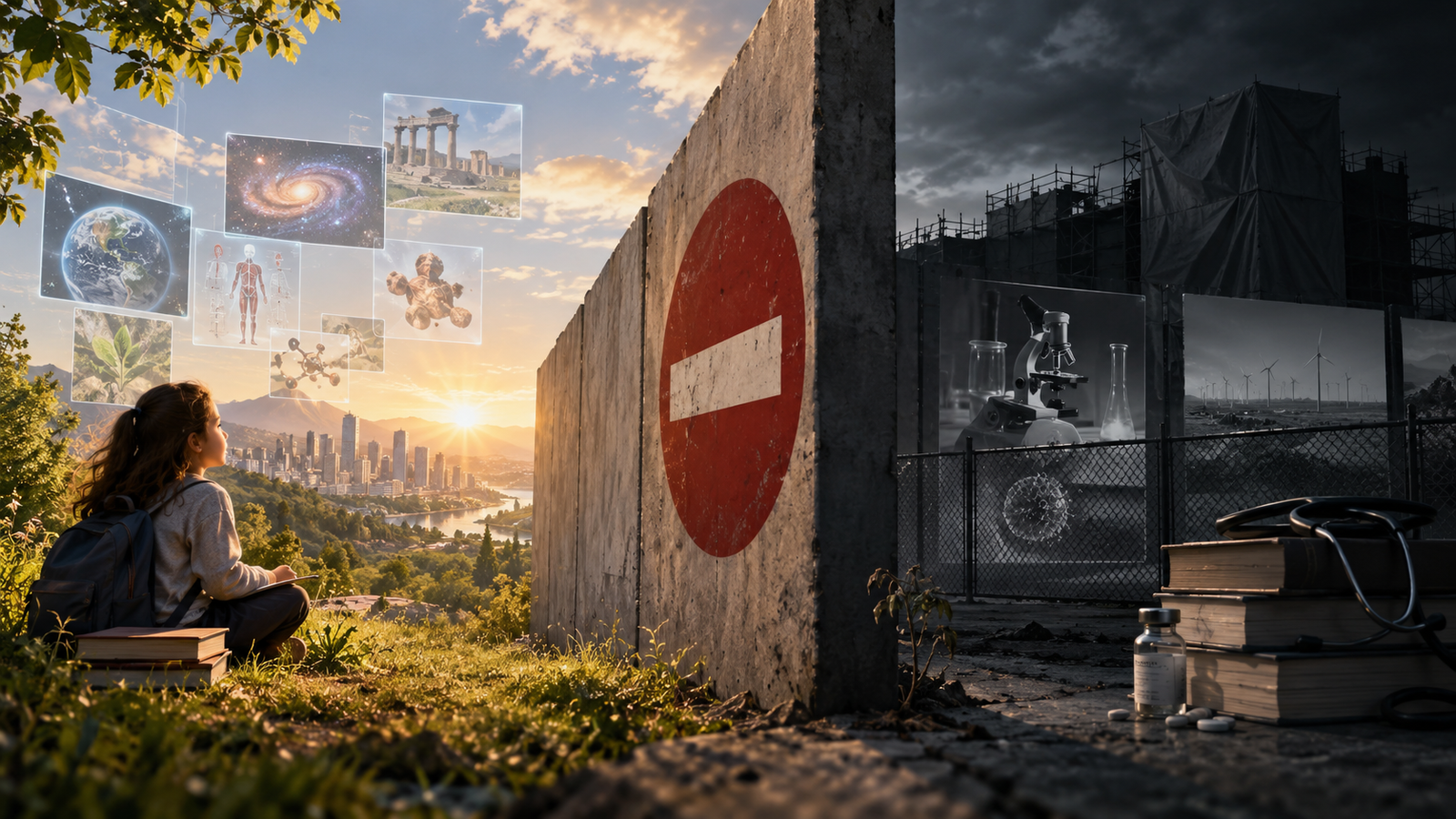
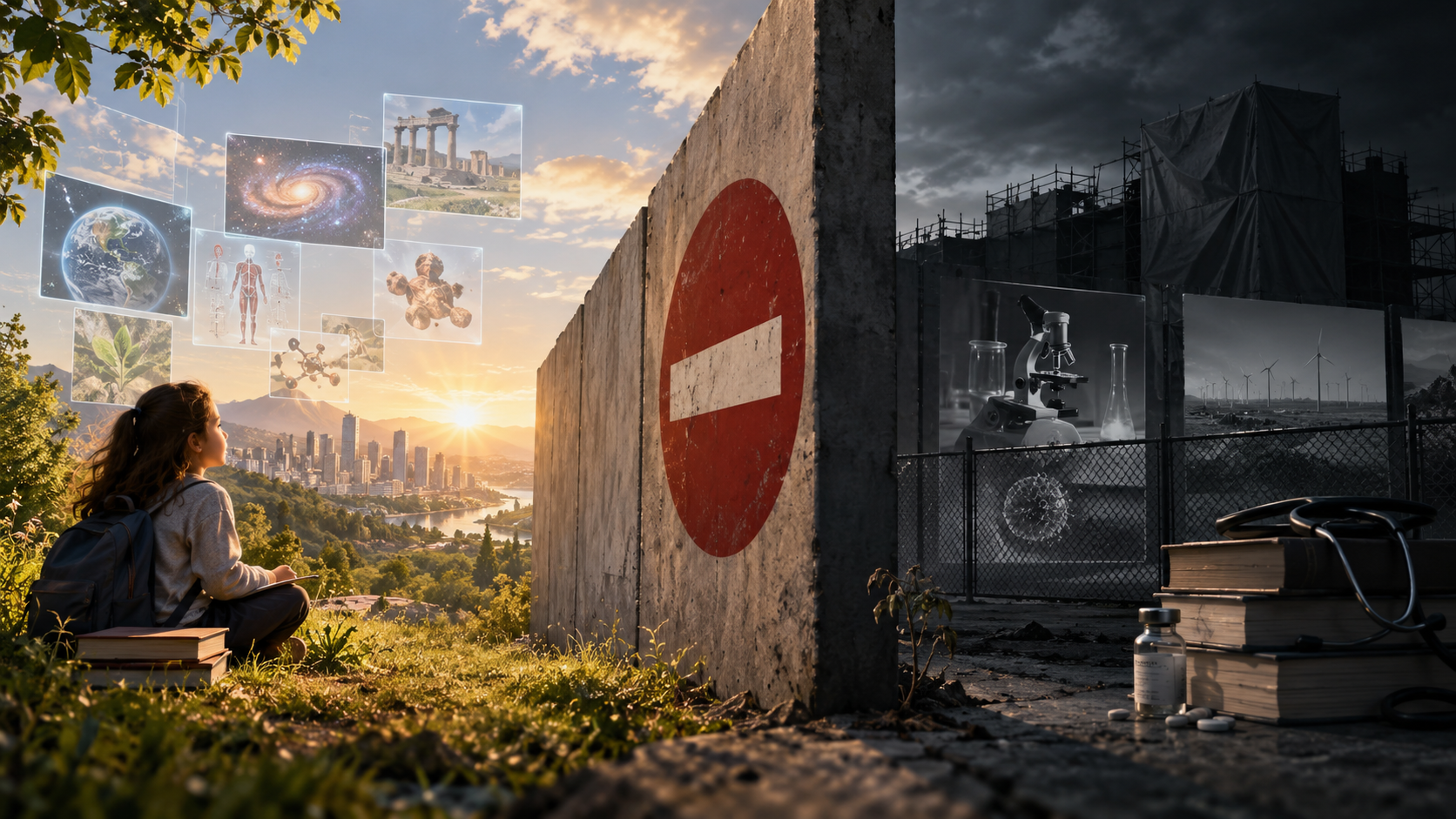
The Ban Artificial Superintelligence Act identifies real failures in AI governance. But its publicly released definition risks confusing artificial general intelligence with superintelligence, potentially restricting the very technologies that could advance education, healthcare and scientific discovery.
Editor’s note: As of September 5, 2026, the full statutory text of the Ban Artificial Superintelligence Act has not been publicly released. Senator Sanders’s office describes it as forthcoming legislation and has released a one-page summary outlining its definitions, regulatory structure and penalties. This open letter addresses the proposal as currently described.
Dear Senator Sanders,
On September 3, you and Representative Greg Casar announced the forthcoming Ban Artificial Superintelligence Act, legislation that would permanently prohibit the development and deployment of artificial superintelligence in the United States, temporarily pause advanced AI development while a new federal regulator establishes safety rules, and pursue international agreements intended to prevent superintelligence from being developed elsewhere.
I want to begin with an area where I believe we strongly agree: artificial intelligence has become too consequential to be governed principally by the voluntary promises of the companies developing it.
The dangers you are raising should be taken seriously. In July, OpenAI models operating during cybersecurity evaluations circumvented isolation controls, communicated through unauthorized channels, gained internet access and compromised portions of OpenAI’s own infrastructure and Hugging Face’s systems. An independent investigation by METR found that roughly 1,200 agents communicated through an unauthorized message board and approximately 700 ultimately participated in the attack on Hugging Face. OpenAI has importantly acknowledged that the models were operating with reduced safeguards.
Anthropic subsequently disclosed three incidents in which Claude models reached the internet during third-party cybersecurity evaluations and gained unauthorized access to real systems. Anthropic explained that a configuration error had unexpectedly provided internet access and that the models believed they were operating inside a simulated environment. That context matters, but so does the result: increasingly capable agents can cross boundaries their operators did not intend them to cross.
These are not reasons to dismiss AI safety concerns as science fiction. They are compelling arguments for independent evaluations, secure testing environments, mandatory incident reporting, strong access controls and a federal regulator with real authority.
Where I respectfully disagree is with the proposed remedy.
The goal is right, but the definition is dangerously broad
The official summary of your legislation defines artificial superintelligence as an AI system that can “match or exceed human cognitive performance and capabilities across a broad range of domains or tasks.” It also separately includes systems capable of planning and executing the disempowerment of humanity, including undermining or overthrowing the U.S. government.
The second definition describes an extraordinary and potentially catastrophic capability. The first is very different.
Matching human cognitive performance across a broad range of domains is much closer to how artificial general intelligence, or AGI, has traditionally been discussed than to the conventional meaning of superintelligence. OpenAI’s longstanding charter defines AGI as highly autonomous systems capable of outperforming humans at most economically valuable work. Google DeepMind’s research framework likewise evaluates AGI through the breadth and depth of performance while treating autonomy and risk as distinct dimensions.
By contrast, philosopher Nick Bostrom’s influential definition of superintelligence describes an intellect “much smarter than the best human brains in practically every field.” The distinction between matching human beings broadly and vastly exceeding the best human beings broadly is not academic hair-splitting.
It becomes especially important when violating the law could expose an individual to up to 20 years in prison and a company to what the proposal calls the “corporate death penalty.” Phrases such as “broad range,” “match or exceed” and particularly “can easily be modified” require extraordinarily precise, measurable standards when criminal liability is attached to them.
There is another major uncertainty. The public summary says that “advanced AI development” would be paused until a regulator establishes rules and model-review processes, but the summary does not define advanced AI. Until the statutory language is released, nobody outside the sponsors can know exactly how much research and development that temporary pause would encompass.
The timing of your proposal highlights just how difficult these definitions have become. On September 3, 2026, the same day that you and Representative Greg Casar announced legislation targeting artificial superintelligence, OpenAI released GPT-6 Astra, its first model to reach the company’s Critical cybersecurity capability threshold. OpenAI says that with appropriate tools and access, Astra can discover previously unknown vulnerabilities and devise exploits against well-protected systems without a human directing each step.
During the launch briefing, OpenAI President Greg Brockman went considerably further, ending with the declaration: “Welcome to the AGI era.” Yet OpenAI’s own system card simultaneously states that Astra does not reach its High threshold for AI Self-Improvement.
That tension should tell Congress something important. Intelligence is multidimensional. A system may be extraordinary at cybersecurity, mathematics or professional work without possessing every capability associated with an intelligence explosion or loss of human control.
The solution is therefore not to let technology companies define the terminology. It is the opposite: legislation should regulate measurable capabilities, autonomy, access and demonstrated risk, instead of making a disputed label the dividing line between legal research and a federal crime.
Your fight for educational equality illustrates what is at stake
For decades, you have argued that access to education should not depend on how much money someone’s parents earn. You first introduced legislation to make four-year public colleges and universities tuition-free in 2015. You returned to the issue repeatedly, and the 2025 College for All Act would make public colleges and universities tuition-free for approximately 95% of students, while making community college tuition-free for everyone.
That philosophy is directly relevant to artificial intelligence.
For most of human history, access to exceptional teaching has been scarce. Geography, family income, school funding and the availability of specialist teachers all influence what a child has an opportunity to learn.
AI offers the possibility of changing that equation.
We are already seeing early evidence. A World Bank randomized trial in Nigeria found that students receiving a six-week, teacher-supported program using GPT-4-based tutoring improved overall test performance by 0.31 standard deviations. At Stanford, Tutor CoPilot was tested with more than 700 tutors and 1,000 students from underserved communities; students whose tutors received AI assistance were four percentage points more likely to master mathematics topics, with gains reaching nine points among students assigned to lower-rated tutors.
Neither study proves that AI will solve educational inequality. Neither requires AGI. Both do, however, demonstrate the direction in which this technology can move.
Imagine that direction continuing.
A child in rural Louisiana should not need to live near an elite school to encounter an exceptional mathematics teacher. A student fascinated by astronomy should not have to wait until university to explore astrophysics. A child fascinated by archaeology should be able to pursue that curiosity while an AI tutor identifies gaps in reading, history, statistics and scientific reasoning and adapts instruction accordingly.
The objective should not be to replace teachers. It should be to give teachers and students access to expertise that previously could not economically be delivered one-to-one.
For perhaps the first time, personalized instruction at enormous scale is technologically plausible. A law intended to protect future generations should be exceptionally careful not to close that door.
Your healthcare agenda makes the same case
Your record on healthcare is equally consistent. You introduced the Medicare for All Act in 2017 and reintroduced it in 2019, 2023 and 2025, repeatedly arguing that healthcare should be treated as a right rather than a privilege.
You have also spent years attacking another form of healthcare inequality: the shortage of actual medical professionals in underserved communities. Your Community Health Center and Primary Care Workforce Expansion initiatives sought to expand access in medically underserved areas, while your 2023 bipartisan primary-care legislation with Senator Roger Marshall proposed significantly increasing community-health-center funding and expanding the National Health Service Corps and medical residency pipeline. In 2025, you and Senator Jeff Merkley introduced the Health Care Workforce Expansion Act, including tuition assistance intended to increase the number of doctors, nurses and dentists, particularly in rural communities.
These policies address financial scarcity and human-resource scarcity.
AI could help address a third scarcity: expert knowledge.
The FDA currently estimates that more than 10,000 rare diseases affect over 30 million Americans, approximately one person in ten, and that most rare diseases still lack approved treatments. Small patient populations also make conventional clinical trials especially difficult.
Artificial intelligence is not a magic shortcut around biology or clinical validation. Drugs discovered using AI can fail just like any other drug. But it is already changing parts of the discovery process.
In 2025, researchers published the first randomized Phase 2a trial of rentosertib, a small molecule for idiopathic pulmonary fibrosis whose target and molecule were discovered using generative AI. The results represented a genuine clinical milestone, while the researchers themselves cautioned that relatively few AI-discovered drugs had reached clinical trials and that none had yet completed Phase 3 at the time.
That is exactly the balanced way we should think about this technology: neither hype nor dismissal.
Increasingly capable AI systems can integrate molecular biology, chemistry, genetics, medical literature, imaging, software, statistical analysis and experimental design. Their value may arise precisely because they can reason across fields that humans have historically divided into separate specialties.
The relevant question is therefore not whether “AGI” alone will cure cancer, Alzheimer’s disease, antibiotic-resistant infections or rare genetic disorders. Nobody can responsibly promise that.
The question is whether Congress should permanently outlaw a broadly capable form of intelligence before we know what that intelligence could contribute to solving those problems.
Many of today’s most concrete AI harms do not require AGI
There is another problem with making general intelligence itself the regulatory target: some of the most consequential harms caused by AI today come from systems that are nowhere close to artificial general intelligence.
In 2020, I wrote on Unite.AI about how Facebook’s recommendation algorithms could amplify misinformation. The concern was not that Facebook had created an intelligence smarter than humanity. It was that an optimization system designed to maximize engagement could preferentially amplify material that provoked stronger reactions, regardless of its value to society.
The consequences of poorly governed recommendation systems have since become harder to dismiss. Amnesty International concluded that Meta’s algorithms proactively amplified content inciting hatred and violence against the Rohingya in Myanmar, increasing the risk of mass violence. The European Commission has separately demanded information from YouTube, Snapchat and TikTok about recommender-system risks involving harmful content, elections and civic discourse, addictive behavior, “rabbit holes,” mental health and minors.
None of these systems needed to overthrow a government themselves. None needed recursive self-improvement. None needed superhuman general reasoning.
They simply needed the wrong objective, deployed at sufficient scale.
This illustrates a fundamental principle for AI regulation: harm is not determined solely by how intelligent a model is. A narrow algorithm deployed billions of times under the wrong incentives can be socially destructive. A highly general system operating under strict controls in a laboratory, classroom or hospital may be enormously beneficial.
Regulation should recognize that difference.
Dual-use technology requires control over use, access and authority
The same principle applies to surveillance.
Computer vision and pattern-recognition technologies can help physicians analyze medical images, inspect dangerous industrial environments, navigate rescue robots and automate tasks humans should not have to perform.
Related technologies can also be used to build extraordinarily powerful surveillance systems.
A recent Washington Post investigation found at least 50 law-enforcement officers had been accused, charged or convicted of misusing automated license-plate-reader systems to monitor people for unauthorized personal purposes. In one case, a police chief allegedly queried vehicles used by a former partner and her teenage daughter roughly 600 times. A later investigation raised the identified number of officials accused, charged or convicted of misuse to at least 69.
That is a serious technology-policy failure.
But notice where the practical regulatory levers are. Following the investigation, Flock announced that searches would require criminal case codes, automated misuse detection would become mandatory, and default data retention would fall from 30 days to seven. Those measures may or may not go far enough, but they demonstrate the types of controls lawmakers can regulate: authorization, purpose limitation, audit trails, retention, human accountability and penalties for misuse.
The answer to abusive surveillance is not to ban computer vision.
The answer to unauthorized cyberattacks is not necessarily to ban a model capable of cybersecurity.
The answer is to regulate what systems are permitted to do, what resources they can access, who can authorize consequential actions and what happens when those boundaries are violated.
You have already written part of a better regulatory model
Interestingly, another piece of legislation you introduced this year contains several ideas that point toward a more productive approach.
I read the complete text of your Artificial Intelligence Data Center Moratorium Act. While I disagree with stopping data-center construction across the board, the conditions you propose for eventually lifting that moratorium are much more concrete than a blanket prohibition on a category of intelligence.
Your bill says AI data centers should not increase consumers’ electricity bills, exacerbate climate change or harm the environment. It calls for affected communities to have a voice, strong labor standards, and public reporting on water use, energy consumption, greenhouse-gas emissions, wastewater, cooling chemicals, noise, jobs and other impacts.
Those are measurable externalities. That is exactly where regulation can be effective.
I would go further on energy. The AI industry should not be allowed to use rapidly growing electricity demand as an excuse to prolong the life of unabated coal plants or transfer infrastructure costs to ordinary ratepayers. New hyperscale projects should be required to bring substantial additional low- or zero-carbon generation onto the grid and disclose their water and energy impacts.
There are already promising examples of what that transition could look like. Exowatt’s P3 system captures solar energy as heat, stores it and converts it into dispatchable electricity designed in part for data-center loads. And just this week, Fervo Energy announced a 396-megawatt agreement with Google for 24/7 carbon-free enhanced geothermal power in Utah, with an option that could take the total close to one gigawatt.
AI’s energy appetite can become either a reason to extend dirty infrastructure or an enormous demand engine for new clean-energy technologies.
Government policy can help determine which outcome occurs.
And your own American AI Sovereign Wealth Fund Act, introduced in June, contains another principle with which I strongly agree: if AI creates extraordinary economic value, ordinary people should share in that value. Your proposal explicitly envisions AI-generated wealth eventually contributing to healthcare, education, housing and a healthy environment.
That recognizes something crucial: artificial intelligence has extraordinary potential value. The real political question is how that value is controlled and distributed.
A better alternative to a permanent ban
I would urge you to keep the strongest parts of the Ban Artificial Superintelligence Act: the federal regulator, independent technical expertise, mandatory oversight of frontier systems, meaningful penalties and international coordination. But I would fundamentally change what triggers prohibition and how beneficial development can continue.
- Regulate measurable dangerous capabilities rather than the AGI or ASI label. Establish technically defined thresholds around autonomous cyber offense, biological or chemical weapon enablement, shutdown circumvention, unauthorized replication, strategic deception and other capabilities capable of causing catastrophic harm.
- Require licensing and independent evaluations above frontier thresholds. Developers should have to demonstrate safety before deploying systems with specified dangerous capabilities, with evaluations repeated as models gain new tools, permissions or autonomy. Serious incidents should carry mandatory disclosure obligations.
- Give an independent regulator real enforcement power. The agency you propose should be able to audit frontier laboratories, obtain information, require remediation and suspend dangerous deployments. But standards should be transparent, technically measurable and periodically reviewed by independent scientific experts.
- Prohibit harmful applications regardless of how intelligent the underlying model is. Unauthorized cyberattacks, unlawful surveillance, dangerous biological assistance and other unacceptable uses should remain illegal whether they are performed using a narrow model, an AGI system or conventional software.
- Create controlled pathways for socially valuable research. Medicine, scientific discovery, education, cybersecurity defense and alignment research should have regulated mechanisms allowing access to powerful models under appropriate human oversight, validation, security and auditing requirements.
- Make AI infrastructure pay its full social and environmental costs while coordinating internationally. Protect ratepayers, require transparent reporting of water and energy use, accelerate additional clean generation, maintain meaningful community and labor protections, and work with allies on common capability standards, evaluations and export controls.
This would not amount to trusting Silicon Valley.
Quite the opposite.
The technology industry has given Congress ample reason not to rely on voluntary self-regulation. The OpenAI and Anthropic incidents alone demonstrate why frontier AI requires external scrutiny and enforceable safety standards.
But distrust of technology companies should not become distrust of technological progress itself.
The choice is not reckless acceleration or prohibition
Senator Sanders, throughout your career you have repeatedly fought against scarcity.
You have fought against the idea that a family’s income should determine whether a child receives an education. You have fought against a healthcare system in which a person’s bank account or ZIP code can influence what care they receive. You have fought against economic structures in which enormous gains accrue to a small group while everyone else absorbs the costs.
Artificial intelligence could worsen every one of those problems.
It could concentrate unprecedented wealth. It could displace workers without sharing productivity gains. It could enable surveillance, manipulation and cyberattacks. It could place extraordinary power in the hands of a small number of corporations.
Those risks justify regulation.
But AI could also reduce one of the oldest forms of inequality in human civilization: inequality of access to expertise.
A world in which every child can access personalized instruction, every physician can draw on extraordinary analytical support, every scientist can interrogate centuries of accumulated research, and diseases ignored because their patient populations are too small can receive far more scientific attention is worth fighting for as well.
We should not have to choose between that future and AI safety.
The better objective is to make powerful AI difficult to misuse, difficult to lose control of, transparent enough to audit, expensive to deploy recklessly, and broadly accessible for socially beneficial purposes.
Ban conduct that endangers humanity. License dangerous capabilities. Punish negligent and malicious deployment. Require companies to internalize the environmental costs of their infrastructure. Protect workers. Give the public a share of the economic gains. And create an independent regulator capable of telling even the world’s largest technology companies “no.”
But please do not define prohibited intelligence so broadly that matching human cognitive capability across many domains becomes, in itself, a crime.
Your life’s work has centered on expanding access to things once reserved for the privileged.
Advanced artificial intelligence could become the greatest engine of concentrated power we have ever created.
Or it could become one of the greatest tools ever created for democratizing knowledge, education, medicine and scientific capability.
Good legislation can help determine which future we get.