TL;DR
HR analytics vendors are experimenting more with AI. While they’re using new tech to spot trends, they’re hesitant to incorporate insights and suggestions, leaving HR leaders to rely more on human-in-the-loop AI cohorts than fully autonomous agents.
As other software providers embrace AI, its landing in HR analytics remains rocky. Human users are pushing to use more AI, but having trouble trusting the outcomes. We looked at 10,000+ reviews and feedback from four major vendors to dig into this issue. What did we find? Surveyed vendors consistently positioned AI as a decision-support tool rather than an autonomous decision-maker, particularly for sensitive decisions involving hiring, performance, promotion, and attrition.
The findings show where HR teams are already using AI, why trust continues to limit adoption, and what vendors believe responsible implementation should look like.
Research Methodology
- G2 Review Data:
- Reviews analyzed: 10,000+ | Period: August 2025 | Category: HR Analytics
- Vendor Research:
This report combines G2’s proprietary review data with structured input from four leading HR analytics vendors. Vendor insights are clearly attributed throughout and represent platform-level observations.
Do users actually listen to the recommendations from AI tools in HR analytics?
While more and more solutions are incorporating AI assistants to comb through data and suggest courses of action, HR professionals are still hesitant to take that advice. Here’s what one leading HR analytics vendor had to say. While AI can get down with data, HR professionals still trust their own gut because of flaws in data collection.
“The honest state of AI-powered HR analytics in 2026 is that AI is better at explaining workforce data than predicting people. Today, its strongest use cases are natural-language queries, summaries, pattern detection, and retrieving information across HR systems. What it still struggles with is reliably predicting who will leave, perform well, or deserve promotion, because HR data is often incomplete, biased, and highly context-dependent.”
Iliana Deligiorgi
Product Marketing Lead, TalentHR
In other words, AI works best here as an explainer, not a decision-maker. It can surface patterns in workforce data, but HR teams still need to interpret them before taking action.
Who’s actually using AI in HR analytics?
Users in HR analytics are adopting AI at a higher rate than most types of HR software. In G2’s 2026 AI trust survey, 35% of HR Analytics reviewers said they had used AI features within the product they reviewed. That compares with 20% across HR software overall. Both numbers were lower than the average rate for all B2B software, which is not a surprise, as HR adoption rates are usually lower due to compliance concerns.
It’s worth noting that those numbers were even lower in high-risk HR categories like payroll – payroll software had only 16% answering yes, while global payroll was up at 17% – showing that a concern for compliance and worries about explanations and audits are leading the hesitance in AI. Trust-based issues like productivity paranoia can create huge gaps in an organization.
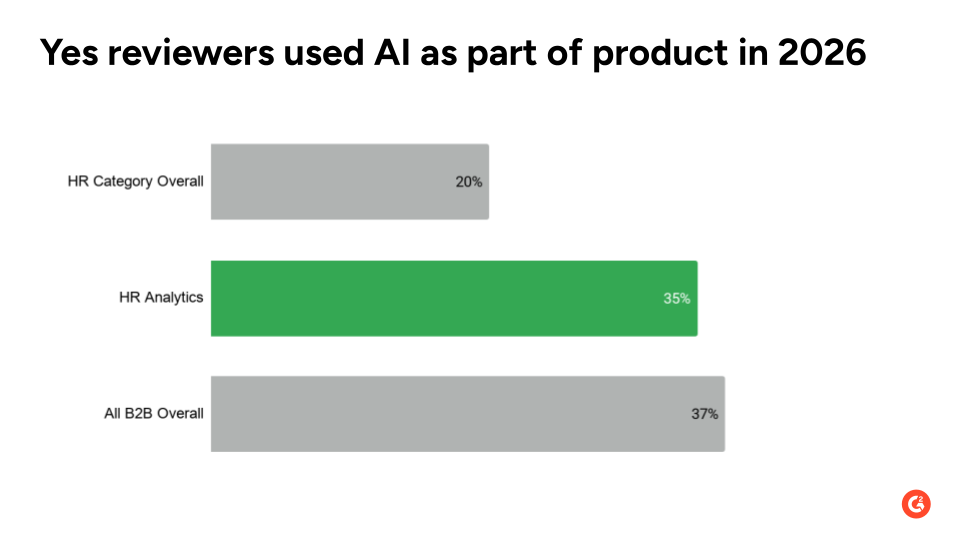
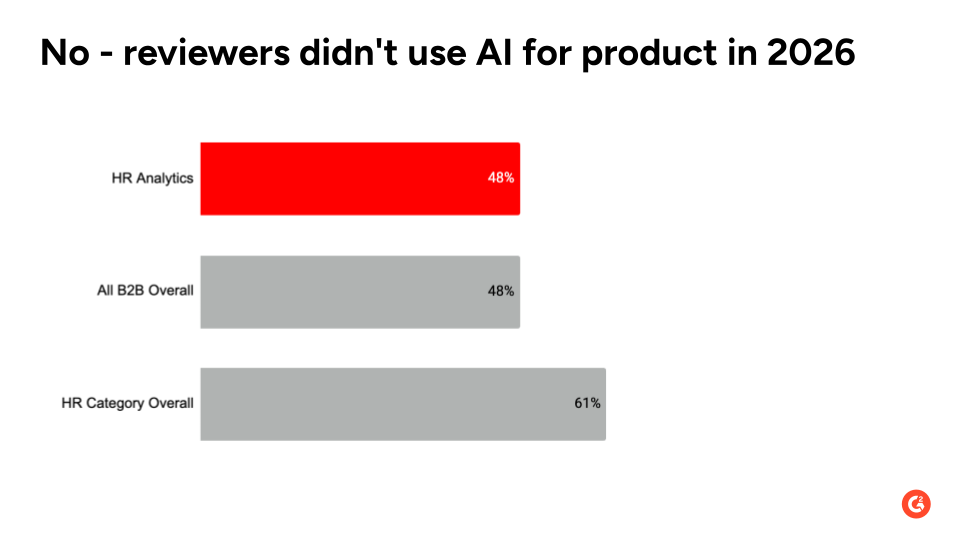
On the flip side, reviews said they didn’t use AI in HR analytics at the same rate as B2B software, at 48%. This was much lower than the average rate for HR at 61%.
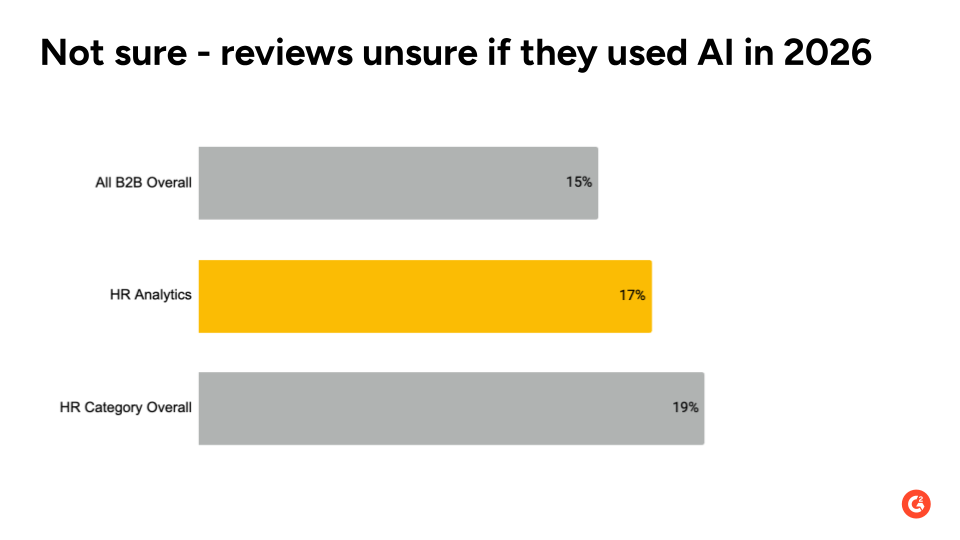
Lastly, only about 17% of reviewers were unsure if they use AI in 2026, higher than the B2B average at 15%, but lower than the HR category overall number at 19%.
Why does trust remain a barrier to AI adoption in HR?
Trust is the biggest barrier when it comes to AI adoption in HR because every move in HR needs to be explained. Three out of the four vendors discussed how confidence in AI and being able to explain those decisions if something goes awry was a huge barrier to adoption en masse.
“Trust remains the biggest barrier. Organizations need confidence that AI recommendations are accurate, explainable, and compliant. Independent validation, transparent models, and clear ROI metrics will do more to drive adoption than adding more AI features.”
Jan Mohammad
Digital Marketing Manager, Jobma
For HR teams, trust depends on more than whether an AI feature works. They also need to understand how it reached a recommendation, verify that the underlying data is reliable, and explain the decision if it affects an employee.
What does responsibility look like for HR analytics vendors in 2026 and beyond?
The responsibility HR analytics vendors have in 2026 comes down to ethics and transparency. Users expect full transparency and accountability in this field, and making sure everything is audited, explained, and fully clear is of the utmost importance. Here’s how the vendor Achievers explained it.
“Vendor responsibility ends at building systems that are transparent, auditable, and designed to keep a human in the loop by default – surfacing the ‘why’ behind an insight, not just the insight itself, and not designing for autonomous action without human review in people-impacting decisions. Customer accountability begins with how those insights are actually used: whether managers act on them fairly and consistently, whether the organization trains people to interpret AI-generated signals correctly, and whether governance policies exist for how the data informs real decisions about real people.”
Mike Stevens
VP – Product Marketing, Achievers
Why do buyers want from HR analytics vendors?
Buyers want outcomes, not AI features from HR analytics vendors. Vendors in HR innovations are more interested in focusing on problem sets than putting their AI features front and center. While the lure of the new technology is still there, greytHR explained how a strong foundation is more important than flashy lures.
“The next phase will be deeper agentic automation, employee-facing AI, and stronger AI-assisted decision support. Truly reliable predictive analytics – forecasting attrition, performance, or hiring risk with consistent confidence – is still some distance away. The winners will be platforms that deliver measurable value today while building responsibly toward that future.”
Prachi Sharma
Head – Content and Marketing Strategy , greytHR
Frequently asked questions (FAQs) about HR analytics
Q1. What is HR analytics software?
Also known as people analytics, HR analytics software is used to deep dive into data and look at trends in human capital management.
Q2. How is HR analytics different from HR reporting?
HR reporting gives you a simple account of what went on when it comes to stats like turnover or retention. Meanwhile, HR analytics goes one step deeper, leaning into predictive analytics, spotting and analyzing trends, and more.
Q3. Does an HR analytics platform replace or integrate with an HRIS?
Most HR analytics platforms integrate with a preexisting HRIS. An HRIS is, of course, the database of any HR system and the core of an HR tech stack. However, there are standalone HR analytics platforms on G2 and solutions that include HR analytics as one of many parts.
Q4. How much does HR analytics software cost?
G2 uses a combination of methods to get the most up-to-date vendor pricing to help predict, but not guarantee, what prices might be like. See more with the pricing filters on our HR analytics page.
Q5. Can HR analytics predict employee attrition or retention?
There are predictive models that forecast labor demand, employee turnover, and other such statistics.
Q6. How should buyers compare HR analytics vendors?
Compare HR analytics vendors by gathering a group of key stakeholders, considering the most important outcomes, narrowing down to a short list, setting a budget, demoing extensively, and considering all integrations.
Q7. What integrations should HR analytics software support?
Essential integrations for HR analytics include your core HR/HRIS or HCM, payroll, performance management, and other essential systems.
Q8. Why does human oversight still matter in AI-powered HR analytics?
Context matters. Only experts with a full context of your company, your industry, and your data can pick out where AI is spot on and where it’s forgetting to take something important into consideration.
Q9. What should buyers look for when evaluating AI-powered HR analytics software?
For evaluating AI-powered analytics software, consider privacy, price, permissions, audit trails, and whether it’s a technology your organization feels comfortable implementing.
Q 10. How does AI factor into HR analytics?
AI provides a nonhuman cohort to validate ideas, spot trends, and catch errors, but isn’t yet ready to serve as a fully autonomous agent in this field.
HR Analytics: AI optimized with the human firmly in the loop
Our leading vendors gave a very frank look at the reality of AI in HR analytics. While users are eager to take advantage of new tech, the leaders of 2026 and beyond are leading with a strong foundation first, consisting of trust, transparency, accountability, and keeping a human hand firmly on the wheel. Agents of the future will be cohorts, not running off by themselves, as the technology and legislation evolve.
In many ways, HR analytics has been slowly improving over the past five years. From 2022 to 2026, G2 saw the average months to ROI improve from 15.07 months to ROI to 7.84 months. (A lower number is better when it comes to months until seeing a return on investment.) Go-live times have gotten faster, from an average of 2.7 months to 2.1 months. Adoption rates have all increased from 79.7% in 2022 to just under 83% in 2026. Despite that, the net promoter score (the primary way of showing product satisfaction) has fallen from 18.2% to just under 18%, not a large drop, but still showing that HR analytics isn’t dazzling anyone.
As AI brings in data from more places at once, HR analytics might need to do more to impress and build trust. While it’s a reliable legacy product, distrust of new tech makes it stable but not impressive in the era of AI. When we look at the implementation concerns, trust is the biggest; finding a way to communicate and become a tool and co-creator with a reliable human might be the way forward.
Ultimately, HR analytics software isn’t keen on taking the human out of human resources anytime soon. Will the top vendors rise to the challenge of reinforcing this connection? Only time will tell. Until then, human-in-the-loop and messages of transparency and reliability will lead the way.
Read more about how adoption woes shape AI (and what it means for HR software).