[ad_1]
Summary
- Scripted chatbots cap conversion because they can’t access real-time order history, inventory, or browsing signals
- Conversational commerce lets customers discover, compare, and evaluate products in one continuous thread instead of a rigid decision tree
- Agentic commerce goes further: the AI agent takes action, updating carts and moving customers toward checkout inside the conversation itself
- Automating high-stakes or emotional moments without a human-escalation rule loses trust faster than it gains conversion
- A readiness checklist for this shift starts with a data audit, not a chatbot rebuild
Conversational commerce beyond chatbots starts with a blunt admission: the bot answering shipping questions on your website was built for a different job than the one customers now expect it to do.
Ask it to compare two products, check real stock nearby, or complete a purchase, and it stalls or hands the customer to a person.
That gap is the story of where conversational commerce is heading: from scripted, keyword-matching chatbots, to conversational AI that holds context across a dialogue, to agentic commerce, where the AI acts on the customer’s behalf inside the chat.
We’ll walk through the three-stage maturity curve, where agentic AI is already closing transactions, the mistakes brands make when they automate too fast, and a readiness checklist for moving past scripts without losing the human judgment that protects trust.
Why the chatbot era already feels outdated
Scripted chatbots feel outdated because they were built to match keywords, not to understand intent. A customer types “return policy” and gets a canned answer; ask a follow-up in the same thread, and the bot resets to zero, with no memory of what was just said.
That works for simple support deflection, but it breaks down the moment a shopper wants a real conversation about fit, comparison, or availability.
Context-aware conversational AI closes that gap by carrying memory across a session and, in more mature setups, across return visits. It knows a customer already looked at two jackets in size medium and can pick up that thread the next time they open a chat, rather than restarting the decision tree.
This is the reactive-to-proactive shift: instead of waiting for a typed question, the system uses browsing and purchase signals to open the conversation at the right moment.
Static, rule-based bots cap both conversion and customer satisfaction because they only handle the queries their designers anticipated.
Every unscripted question becomes a dead end or a human handoff, and each handoff resets the customer’s patience. Brands that stop at this stage are optimizing a support tool, not a commerce channel, which is why the ceiling shows up quickly once volume grows.
What conversational commerce actually means in 2026
Conversational commerce means discovery, evaluation, and purchase happening inside one continuous dialogue, not a chatbot menu bolted onto a website.
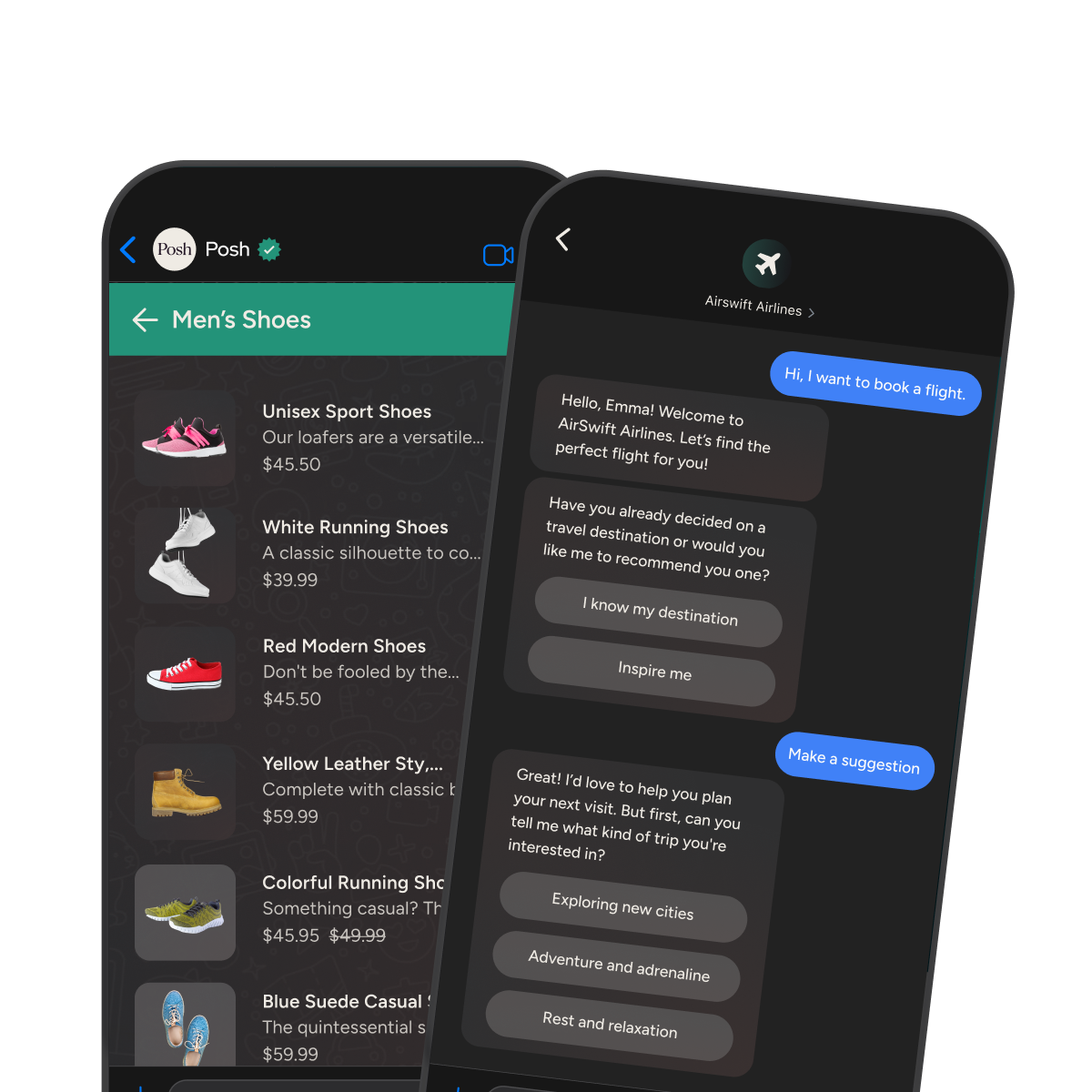
It describes a single thread, on WhatsApp, in-app chat, or a website widget, where a customer can ask about a product, compare it to alternatives, check delivery timing, and move toward buying without leaving the conversation.
The dialogue itself becomes the shopping surface, replacing the old pattern of chatting for support and clicking away to buy.
Full agentic commerce is the stage beyond that: the AI doesn’t just discuss the purchase, it executes it. An agent capable of adding an item to a cart, applying a promotion, or moving a customer toward checkout inside the chat is acting autonomously, which is a meaningfully different capability than a bot that simply recommends and links out.
This is the distinction marketers weighing agentic commerce vs chatbots need to be precise about, since vendors use “conversational AI” to describe both stages.
Insider One’s Conversational CX approach treats chat as this kind of transaction-closing surface rather than just another broadcast channel inside a broader journey orchestration plan.
Agent One™ is built for this stage specifically, executing actions like updating a cart or advancing a customer toward checkout within the same conversation instead of redirecting them to a separate page.
For a deeper look at how these formats differ in practice, our guide to conversational commerce platforms breaks down the channel-by-channel mechanics.
Where agentic AI is already moving revenue
Agentic AI already closes revenue inside chat for brands that gave it access to real product and inventory data, not just a script.
For example, Braun drove 18% of revenue influence through an AI shopping agent that guides customers through product selection and comparison inside the conversation, rather than redirecting them to a static category page.
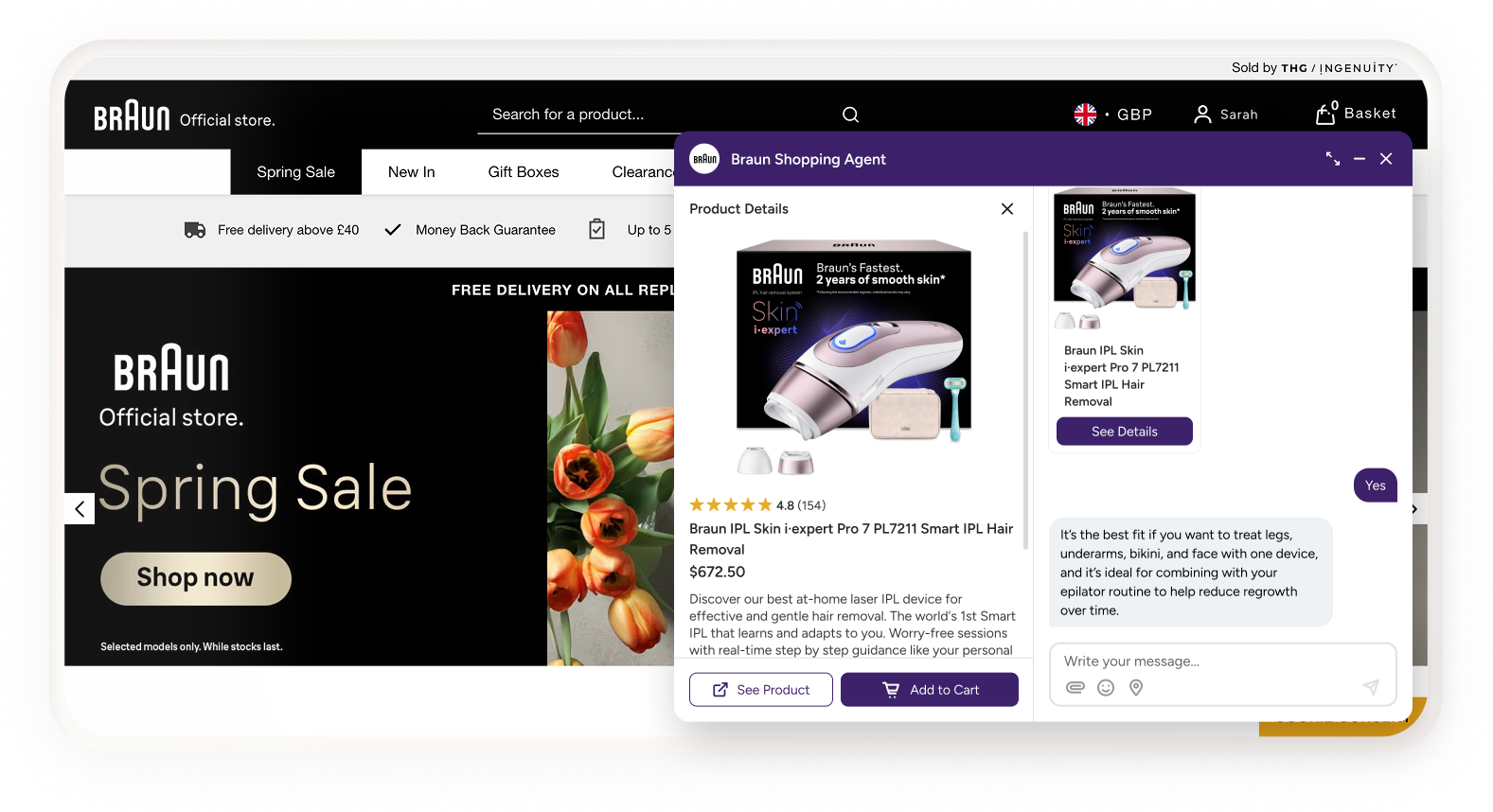
The deployment pattern that works looks similar across categories: a proactive prompt on a product page when a shopper hesitates, a follow-up message after delivery that solves a real problem instead of requesting a review, and an agent that compares items across the full catalog instead of only the product in view.
Each moment gives the agent a job a static chatbot could never do well, because it depends on live signals rather than a fixed script.
Clarins México grew WhatsApp sales 20 times over by moving beyond broadcast messaging into a flow that could guide product discovery and close the sale in the same channel customers were already using.

Patterns like these are covered in more depth in our breakdown of AI in ecommerce and how it’s redefining shopping.
Where brands get this wrong
Automating high-stakes moments without an escalation plan
The most common mistake is automating emotional or high-stakes moments, like a delivery failure or a complaint, without a clear rule for when the agent hands off to a person.
A customer asking about a lost order isn’t looking for a product recommendation; they want resolution, and often reassurance from a human. An agent that keeps trying to close a sale in that moment damages trust faster than a slow chatbot ever could.
The fix isn’t less automation, it’s a defined escalation rule that flags sentiment, order status, or repeat contact as a trigger to route to a live agent immediately.
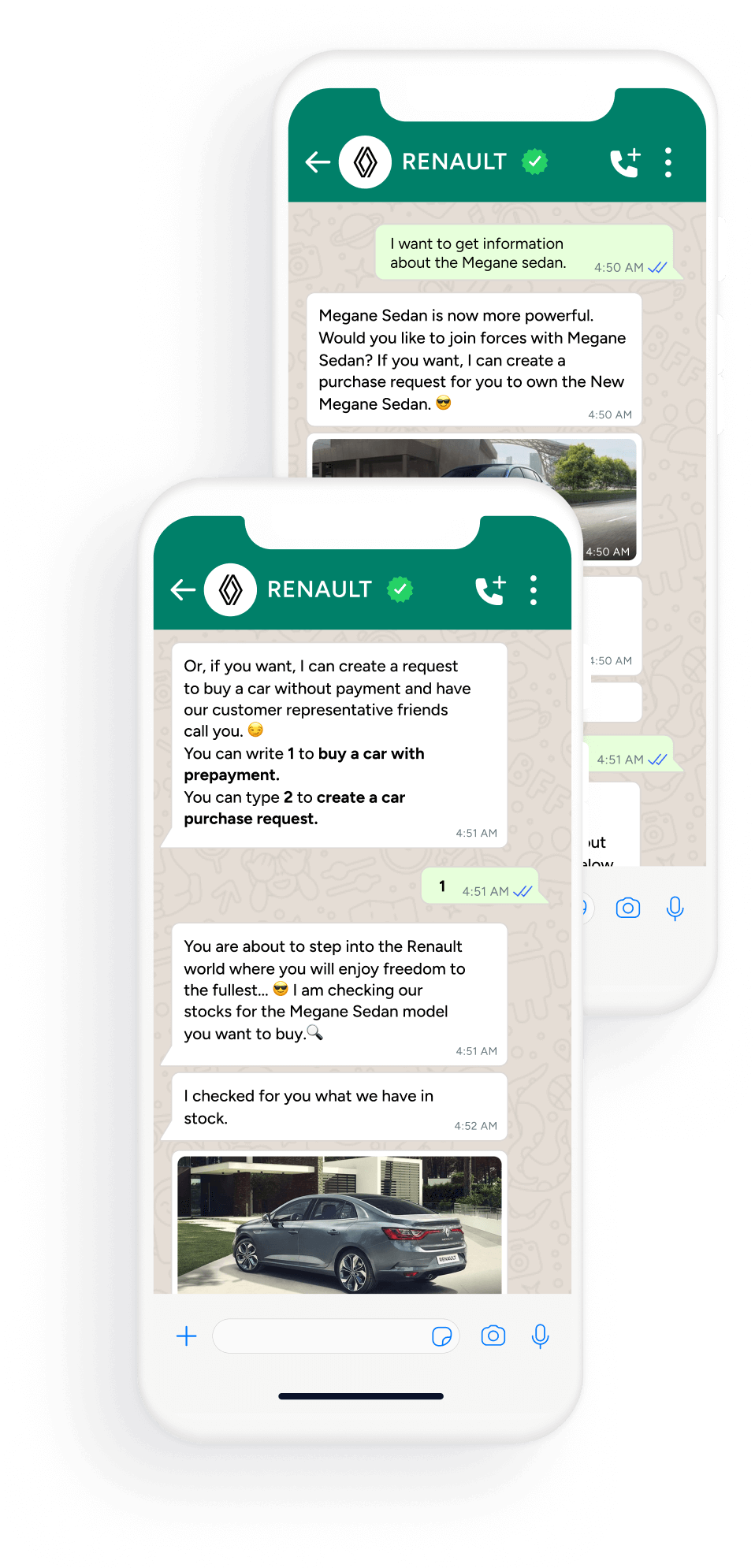
Renault cut wait times by 93% on WhatsApp partly by making the handoff between automated responses and live agents fast and clear, rather than leaving customers stuck in a bot loop while a real issue went unresolved.
Bolting agentic features onto legacy chat tools
The second mistake is layering AI onto a chatbot that was never built to hold customer identity or real-time signals.
If the underlying system can’t see order history, current inventory, or browsing behavior in the moment, the agent is still guessing, just with better language generation. Real agentic commerce needs a foundation.
That foundation is a unified data layer, like Insider One’s Customer Data Management, connected to catalog and order systems in real time, not a chat widget with a language model attached on top. Without it, “agentic” features amount to a more articulate version of the same script problem.
A readiness checklist for moving past chatbots
Audit what your current chatbot can actually see
Start by auditing whether your current chatbot can access order history, live inventory, and browsing signals, because that access, not the script, determines what it can safely automate. Check these before investing further:
- Can the bot see a customer’s order status and history in real time
- Does it know current stock across locations rather than a static catalog feed
- Can it use recent browsing or cart behavior to personalize the conversation
- Is customer identity unified across web, app, and messaging channels
Map three moments worth automating first
Map three moments where an agent could close the loop end-to-end: discovery, cart recovery, and post-purchase, before rebuilding anything.
Discovery is where a shopper compares options and needs guidance instead of a search bar. Cart recovery is where a stalled purchase needs a real answer, not a generic discount code, to move forward again.
Post-purchase is where a delivery update or a genuine follow-up question builds loyalty instead of feeling like a review request. Piloting agentic commerce on these three moments, with escalation rules already in place, gives marketers proof of value before a full rollout.
Our roundup of AI shopping assistants and how they’re deployed offers a useful reference point for scoping a first pilot.
Conclusion
The move from scripted chatbots to agentic commerce isn’t a bigger chatbot budget, it’s a different foundation: real-time data, clear escalation rules, and agents that can act, not just answer. Brands that treat chat as a transaction-closing surface, with human judgment protecting the moments that need it, will set the pace while others keep patching FAQ bots.
Ready to see what a transaction-closing agent looks like on your own catalog and customer data? Explore Insider One’s platform to see how Conversational CX and Agent One™ move a real conversation from product discovery to a completed cart, with escalation rules built in from the start.
Frequently Asked Questions
Conversational commerce is dialogue-driven discovery and evaluation inside one thread, where a customer can compare products and ask questions before buying. Agentic commerce goes further: the AI takes autonomous action, like updating a cart or moving toward checkout, inside that same conversation instead of just recommending and linking out.
A standard chatbot matches keywords and follows a fixed script, with no memory across sessions. Agentic AI carries context, uses real-time signals like inventory and browsing behavior, and can execute actions such as cart updates rather than only suggesting them. It behaves more like an assistant than a decision tree.
An agent should escalate when sentiment turns negative, when an order has failed or is delayed, or when a customer contacts support repeatedly about the same issue. These moments require judgment and reassurance a script can’t provide, and automating through them without a clear handoff rule damages trust quickly.
Yes, when it’s connected to live inventory, pricing, and order systems rather than a static catalog feed. Brands like Braun and Clarins México have used AI-driven shopping agents to guide comparison and close sales inside WhatsApp and chat, rather than redirecting customers back to a website.
Check whether the current chatbot can see order history, live inventory, and browsing signals in real time, and whether customer identity is unified across web, app, and messaging. Without that foundation, adding AI features on top of a legacy chat tool won’t produce reliable, transaction-closing conversations.
[ad_2]
Source_link