

[ad_1]
The best email marketing platform depends on your business type and objectives. HubSpot is ideal if you’re looking for an all-in-one marketing platform. GetResponse is a great option if your goal is to automate the entire customer lifecycle. Klaviyo is a decent option for most ecommerce brands.
You get the idea.
As such, the objective of this article is to help you identify the right email marketing platform for your unique business. We won’t tell you what’s best for everyone. Such a solution doesn’t exist.
Instead, we signed up for and tested several email marketing platforms to identify where they thrive and where they fall short. We also combed through customer reviews on Reddit, G2, and Capterra to see what other users have to say about each solution.
Key takeaways
- The best email marketing platform depends on your needs and budget. Our guide breaks down 12 solutions and their best use cases.
- Before picking any email marketing tool, make sure it supports the integrations and automations that align with your business and marketing goals.
- Deliverability rate, scalability, insightful analytics, and ease of use are other factors to consider when picking an email marketing service.
- GetResponse is the ideal email marketing software for businesses that want to automate and personalize the customer lifecycle.
Best email marketing service comparison
| Software | Best for | Free plan | Starting price |
|---|---|---|---|
| GetResponse | Retention and lifecycle marketing | Yes – 2,500 emails/month, 500 contacts | $15.58/mo |
| HubSpot | All-in-one marketing platform | No free plan | $10/mo per seat |
| Klaviyo | Ecommerce stores | Yes – 500 emails/mo, 250 contacts | $20/mo |
| Hostinger Reach | Small businesses | Yes – 200 emails/mo, limited access to features | $1.99/mo |
| ActiveCampaign | Advanced automations | No free plan | $15/mo |
| MailerLite | Beginners | Yes – 2,500 emails/mo, 250 subscribers | $10.80/mo |
| Moosend | Cheap email marketing | No free plan | $7/mo |
| Brevo | Free email marketing automations | Yes – 300 sends/day, 2,000 contacts | $8.08/mo |
| Sender | Small businesses | Yes – 25,000 emails/mo, 2,500 subscribers | $7/mo |
| MailChimp | Multichannel automation | Yes – 500 emails/month, 250 contacts | $13/mo |
| Kit | Creators | Yes – 1,000 subscribers, unlimited broadcasts | $33/mo |
| AWeber | Strictly email marketing | Yes – 3,000 emails per month, 500 subscribers | $12.50/mo |
How we tested and picked the email marketing solutions
The goal of email marketing is to help you build and nurture customer relationships. We tested the email marketing solutions with that goal in mind. Our objective was to determine what solutions gave you the tools you’d need to run effective email marketing campaigns.
A. Integrations
Email marketing is crucial, but it’s only one part of your overall business strategy. So, the first important thing to consider is how the platform you pick connects with your existing tech stack.
If you’re in the ecommerce industry, the email platform must support seamless integration with your ecommerce platform. If you’re in the education industry, integration with your learning management system (LMS) is a must. And so on.
Dig deeper to make sure the platform integrates with the specific solutions your team uses. This is crucial, especially if you use niche software. Some email marketing platforms integrate with mainstream tools like Shopify for ecommerce, but may not connect to niche solutions like Big Cartel.
Why is integration so important?
Successful email marketing campaigns rely on rich customer data. That data tends to live across the multiple platforms your business uses.
Seamless integrations make sure customer data is easily accessible to your email marketing solution. It also prevents cases where some automations fail to activate because an integration broke down.
B. Automations
Automation is one of the primary reasons why email marketing is so good at building customer relationships. Email marketing automation helps you respond to customer actions and behaviors with relevant content. It makes your customers feel seen, which strengthens brand affinity.
You need an email marketing platform that supports automation workflows. You should be able to set up simple workflows for basic automations like welcome emails and cart abandonment campaigns.
Support for more complex, split workflows is also crucial in various scenarios. For example, an ecommerce business may want to distinguish first-time buyers from repeat customers to target them with different automated campaigns. Or run different cart abandonment campaigns depending on the cart value.
All the email marketing platforms we’ve covered below support both simple and fairly complex automations. Our solution, GetResponse, supports both and provides prebuilt workflow templates even for complex automations. Active Campaign is also well known for supporting complex automation workflows.
Most of the platforms also come with a visual automation builder, which makes it easy to create and deploy the automations.
C. Deliverability
Email deliverability measures the percentage of emails that reach your recipients’ inboxes. Not the spam folder. This metric determines the success of your email marketing efforts.
High deliverability means more people see your emails. More people seeing your campaigns means higher engagement levels. Higher engagement translates to more clicks and conversions.
Meanwhile, low deliverability hurts your sender reputation and impacts future campaigns.
The best email marketing platforms provide reliable sending infrastructure to help your emails land in the inbox. They help with email authentication (SPF, DKIM, and DMARC) and spam complaint and bounce monitoring.
That said, a good sending infrastructure is not enough to maintain a high email deliverability rate. You must also keep your email list clean.
D. Scalability
Scalability is a real issue because too many businesses pick an email marketing solution without considering their future needs. So, they end up with performance issues and steep price jumps as their email volume increases.
The right email marketing platform provides tiered pricing plans and scalable performance. So they don’t punish you with steep price increases as your sending volume and email needs grow.
Most of the email marketing software solutions we’ve covered below offer flexible pricing plans.
They also provide powerful email marketing features so you’re not forced to migrate to another platform in case your needs evolve from basic to more advanced.
E. Pricing
Email marketing platforms charge based on the number of emails sent or the size of your list. Some solutions like Klaviyo use a combination of both.
Don’t focus on the starting price of any platform. Instead, consider what that plan offers. Does it include features that are crucial for your business needs?
And as we said above, flexible pricing is also crucial.
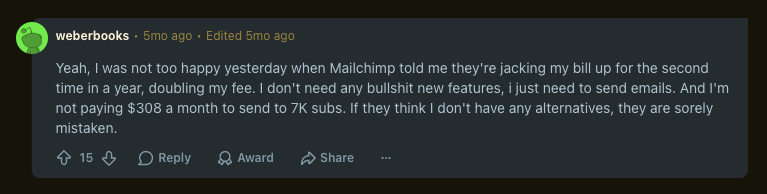
One of Mailchimp’s many complaints is behind its pricing strategy. Users tend to quickly realize how expensive the platform is the moment their sending volume increases, as reported by this Reddit user.
Platforms like GetResponse and MailerLite also have generous free plans, which make them attractive to businesses on a budget.
F. Ease of use
We were keen to pick email marketing software solutions that are easy to use. So we looked at whether they offer email marketing templates that you can edit and send quickly.
We also looked at the email design dashboard. Drag-and-drop dashboards are more intuitive to use. An HTML code editor is also a plus for advanced users who want their email designs to stand out.
Segmentation and personalization are other critical elements that must be easy to use. Platforms like Moosend also come with pre-existing customer segments.
GetResponse also offers prebuilt automation workflows that you can edit and deploy in just a few clicks.
ActiveCampaign and Klaviyo take things up a notch with powerful AI. They let users describe the segments or campaigns they want, and the AI sets it up in minutes. But you need credits to use that AI.
G. Analytics
The best email marketing services provide advanced analytics to help you make informed decisions.
Tools like GetResponse and Moosend also clean up analytics to ensure bot traffic and clicks don’t skew your data.
The ability to create custom reports is also a plus. This lets you track the specific metrics that matter to your business. It also helps with stakeholder reporting by allowing you to capture the exact metrics they care about.
H. Other marketing tools
HubSpot made it to our list because it offers a suite of marketing tools. This is important because it means you don’t need to pay for and jump between so many marketing tools.
Additionally, it makes sure customer data lives in one place. That makes personalization and segmentation much easier.
Klaviyo is another platform that offers additional tools like the Customer Data Platform.
GetResponse also provides other marketing solutions like SMS marketing, paid ads, landing page builders, conversion funnels, and web push notifications.
The best part is that some of these tools come included with the standard email marketing plans. For example, the HubSpot marketing package includes the email marketing tool as well as ad management, lead scoring, and social media management.
Similarly, GetResponse’s Marketer plan includes unlimited monthly email sends as well as a landing page builder, advanced audience segmentation, and unlimited web push notifications.
We recommend considering the additional marketing tools alongside the price tag. You can get more value for your money by paying extra to access additional marketing tools from the same platform.
The best email marketing platforms we tested
Here are the best email marketing tools based on the specific business goals and use cases they excel at.
1. GetResponse – Best for retention and lifecycle marketing
G2: 4.3 Capterra: 4.2
GetResponse is a marketing platform specifically designed for customer retention and lifecycle marketing. The platform is a finalist in the Best SaaS Product for Workflow Automation category at the 2026 SaaS Awards, hosted by The Cloud Awards.
GetResponse provides several tools, including an email marketing platform and marketing automation software, to help you automate every stage of the customer journey.
The email marketing solution is very easy to use. It features an intuitive drag-and-drop editor.
We also offer a wide variety of email design templates to get you started. We’ve grouped these templates by campaign goal so you can find the right template quickly.
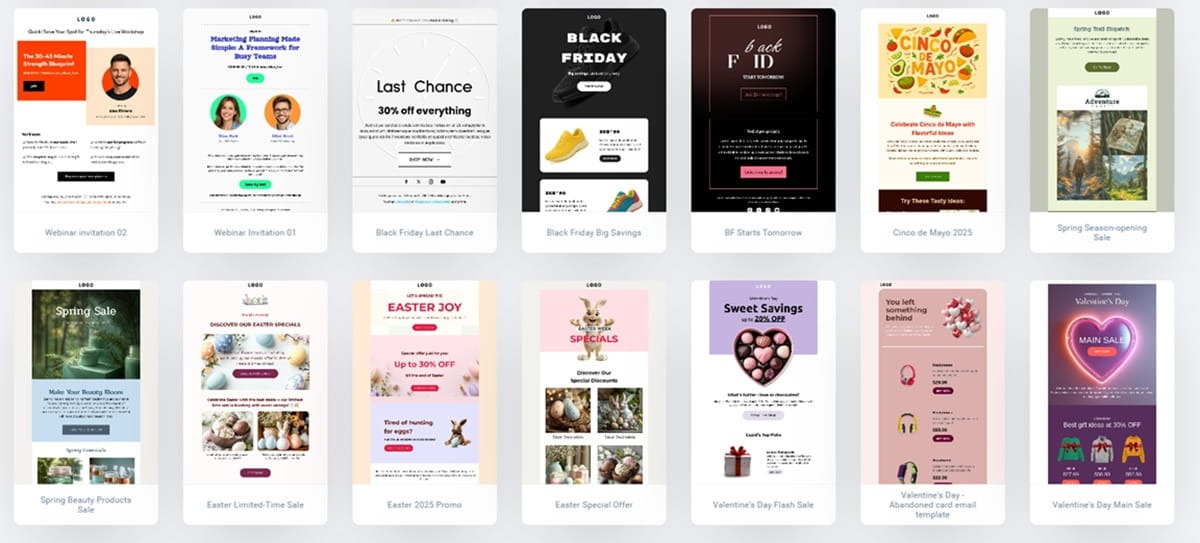
We have an AI email design assistant. Answer a few questions, and the AI will spin up the right email design for your specific campaign and goal.
The HTML editor is present for marketers who want complete control over the look and feel of their campaigns.
GetResponse’s marketing automation helps you curate customer experiences to deepen loyalty and drive customer lifetime value. It connects to your online store or website and tracks purchase history, browsing history, customer behavior, and engagement levels.
GetResponse also supports contact scoring and tagging.
The automation platform uses all that data to deliver timely, personalized emails, pop-ups, and push notifications.
Building the workflows is pretty straightforward. We have a good selection of premade templates for every stage of the customer journey.
That includes templates for welcome, lead qualifying, engagement, retention, post-purchase, abandoned cart, and sales promotions campaigns.
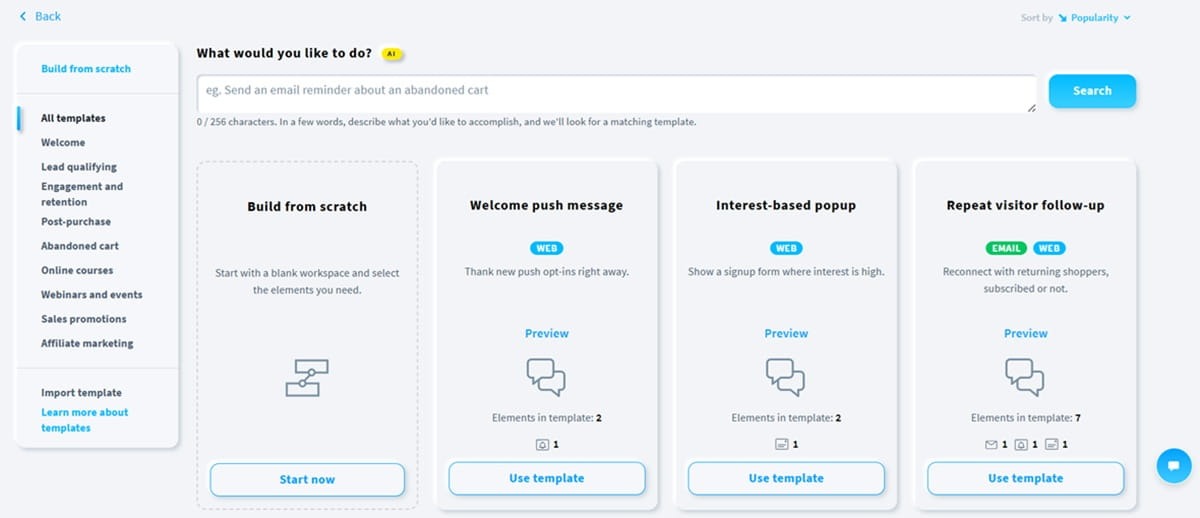
The drag-and-drop automation editor lets you customize workflows to meet your specific needs. It allows you to build and deploy automations for both email and the web from one dashboard.
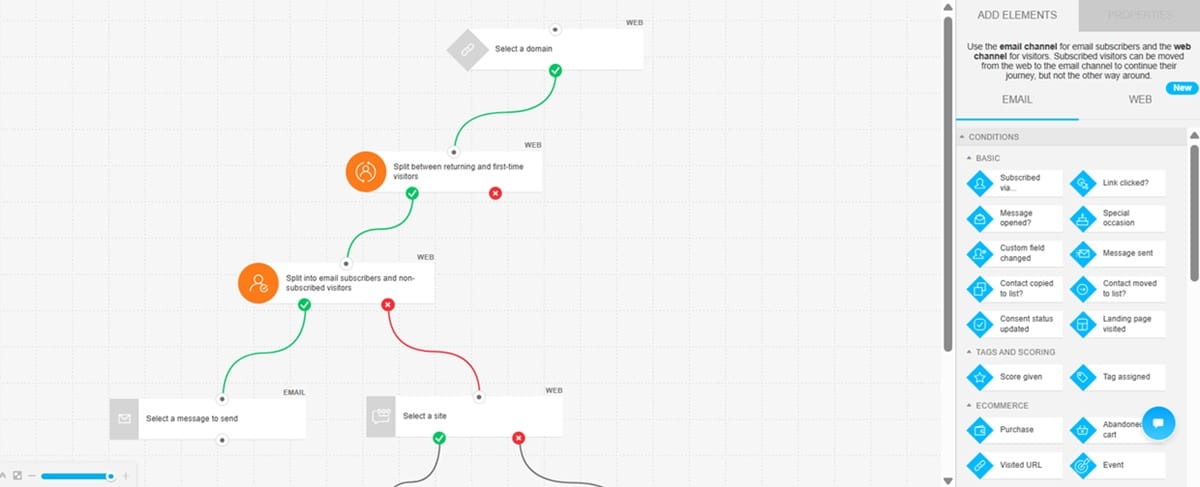
GetResponse’s email marketing platform is also ideal for ecommerce stores because of the AI-powered product recommendations. Our self-learning AI engine analyzes the needs, preferences, and habits of your site visitors. It then recommends the products they’re most likely to purchase.
It ensures repeat visitors see products based on their previous activity on your store. It also displays best products by category, the store’s best sellers, and the items other customers view.
You can customize this product recommendation engine to decide what products are displayed.
The European store Tortli saw €5,100 (approximately $5,800) worth of products added to cart within a month, thanks to AI product recommendations. Recommended products had a 9.36% conversion rate (compared to the 2.58% average ecom conversion rate).
Read more about the store’s automation campaign here.
Other key features
- Multi-channel marketing – Supports marketing across email, SMS, paid ads, and push notifications.
- Website builder – Build an entire website or landing pages using GetResponse’s website and landing page builders.
- Knowledge monetization – Create premium newsletters, online courses, and digital products using the Knowledge Monetization platform. This is ideal for creators and experts.
- Promo codes – Sync promo codes from your ecommerce site to GetResponse and include them in your newsletters to boost conversions.
- Webhooks – Get notified when contacts open an email, click a link, make a purchase, or unsubscribe.
- Transactional email – Send transactional email campaigns with high deliverability to ensure these crucial messages land in your recipients’ inboxes.
Pros
- High deliverability rate of 99% thanks to list management tools and strict zero tolerance for spam.
- Comes with a conversion funnel builder for lead magnet funnels, webinar funnels, and sales funnels.
- Supports over 100 integrations. It also supports integrations via Zapier.
Cons
- Product recommendations and the transactional email service are only available on the Enterprise plan.
Pricing
GetResponse has a free forever plan. It lets you send up to 2,500 emails per month to 500 contacts. The plan offers the drag-and-drop email builder, 1 landing page, and signup and contact forms.
Paid plans start at $15.58/mo for 1,000 contacts. It supports unlimited email sends, 1 custom automation workflow, and AI-powered content generators for your emails, courses, and landing pages.
We recommend the Marketer plan for brands that want to create successful email campaigns that drive revenue.
This plan gives you the tools for the job, including unlimited automation workflows, advanced audience segmentation, sales funnels, unlimited push notifications, and promo codes and revenue reports. It starts at $48.38/mo for 1,000 contacts.
Creators who want to monetize their knowledge can use the Creator plan. It starts at $56.58 and provides the tools to create and market your knowledge.
Finally, we have the Enterprise plan. It comes with a dedicated IP address, priority support, single sign-on (SSO), and AI product recommendations. The price is customized to suit your specific needs.
Charities and non-profit organizations get a 50% discount.
2. HubSpot – Best all-in-one marketing platform
G2: 4.4/5 Capterra: 4.5/5
HubSpot is a great email marketing platform for any business that wants their marketing, sales, and customer support tools to live in one platform.
The first obvious advantage is that you won’t require any integrations to pull customer data. Everything is in one place, which makes campaign execution and attribution much simpler.
But that means you’ll need to be using the HubSpot CRM and sales platforms.
The email marketing tool itself lives within HubSpot’s Marketing Hub. The hub offers other solutions, including SEO tools, a social media management solution, and automation workflows.
Creating marketing emails on HubSpot is pretty straightforward. You can choose between a simple email template, newsletter, or promotion template.
There’s an option to start from scratch. It lets you use HTML, CSS, JS, and HubL to create a custom email template.
The drag-and-drop dashboard makes designing emails a breeze.
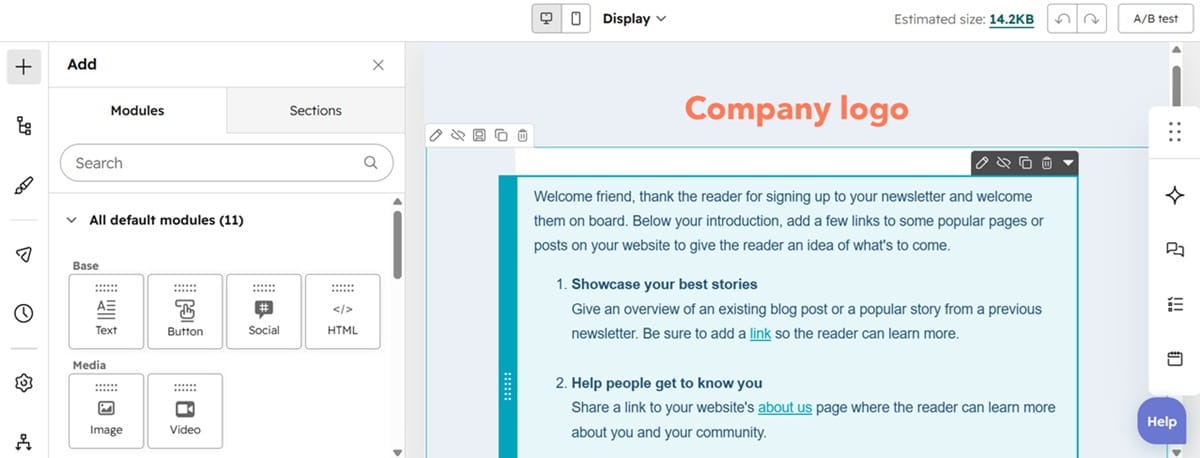
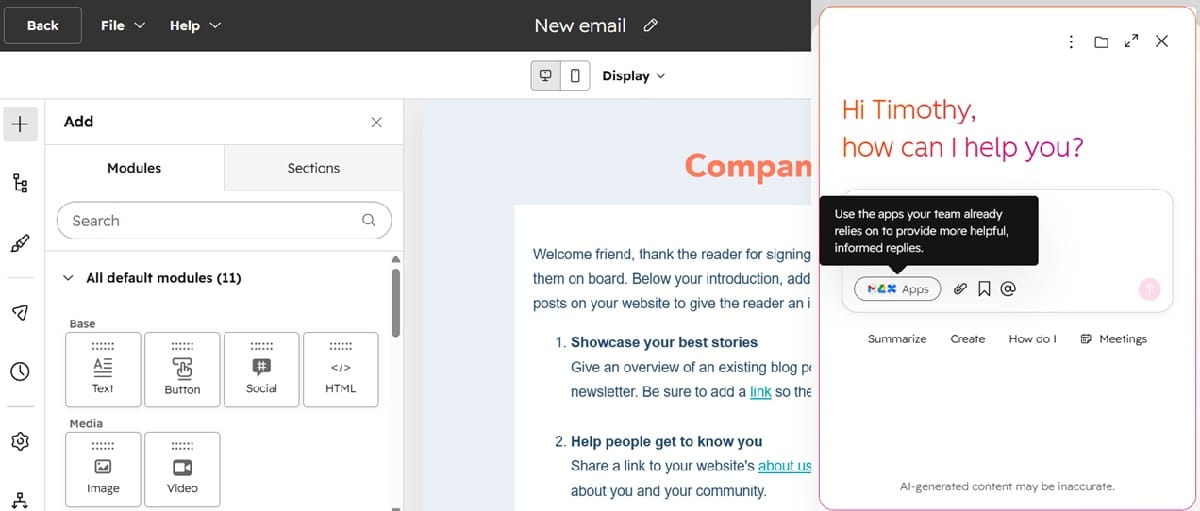
HubSpot’s AI assistant, called Breeze, is also useful for when you need help writing your email content.
The Breeze Assistant also connects to other apps. These connectors allow you to pull context for your campaigns from other tools to your email marketing dashboard. So you don’t need to go digging for that information.
It’s a clever feature that connects to apps like Teams, Google Drive, SharePoint, and Jira.
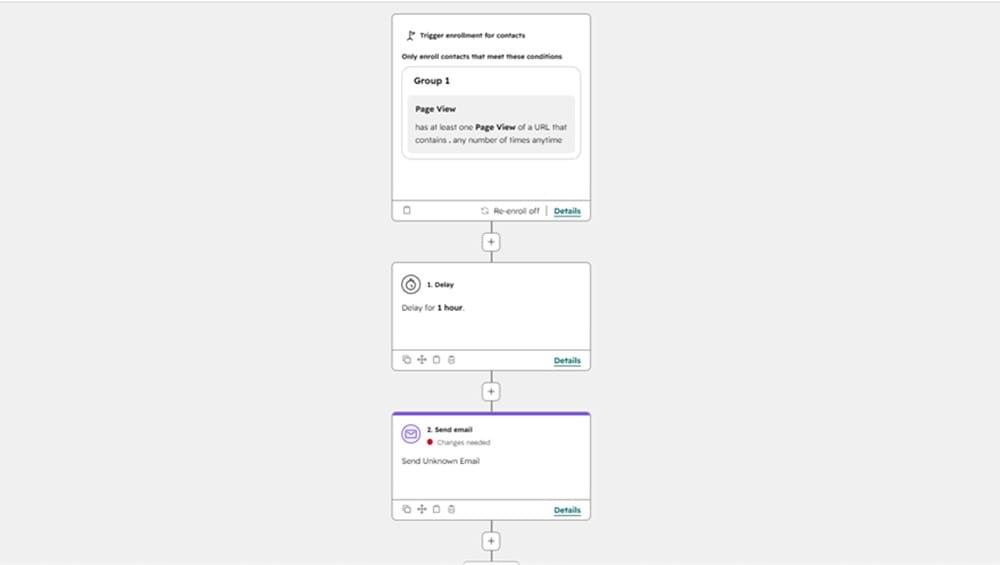
You can create automation workflows on HubSpot from scratch, through a template, or with the help of AI. They have a good selection of prebuilt automation templates for the most common campaigns. That includes re-engagement campaigns, welcome series, and confirmation emails.
You can even create an automation workflow to target repeat website visitors based on the specific page they visit.
HubSpot also thrives in customer segmentation because of the built-in customer relationship management software. You can create your own segments from scratch, pulling data from the CRM, or prompt the Breeze assistant to create the segments.
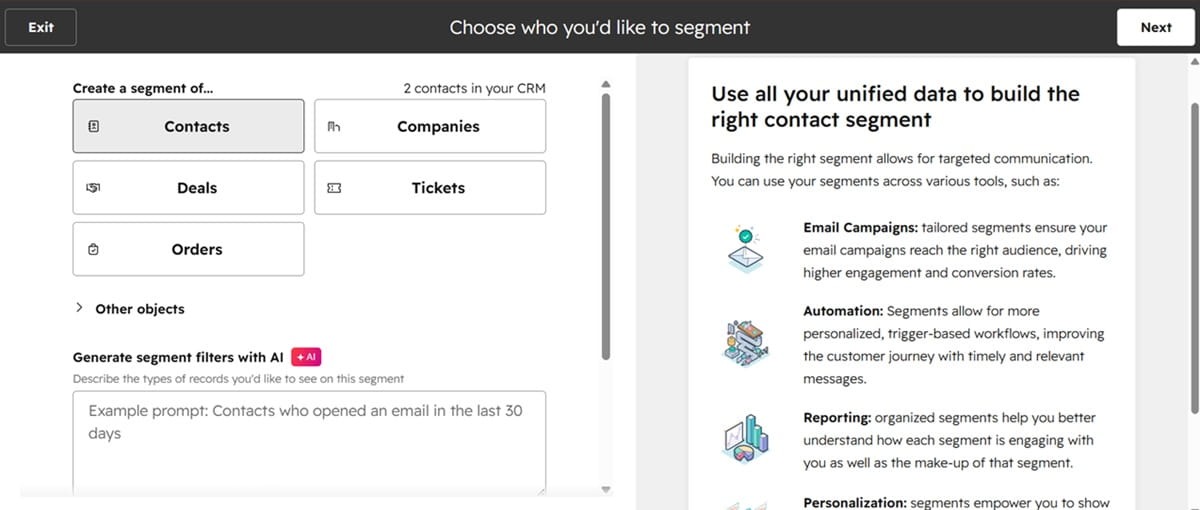
The problem with HubSpot is that you need the full package to get maximum value. And the jump from the standard Starter plan to the Pro plan is quite massive. This is a complaint among most customers.
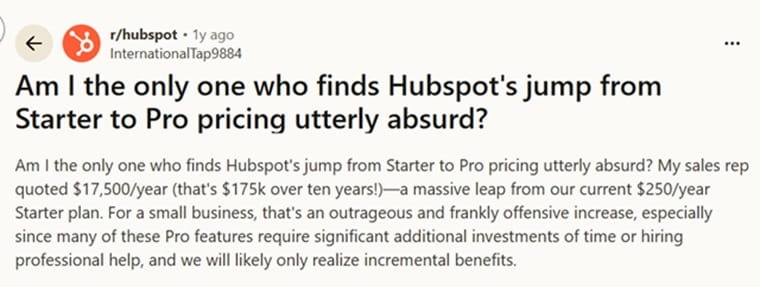
But several Reddit users report that you can negotiate hard to get a 40% or so discount.
Other key features
- Comments – Enhances collaboration with colleagues within the campaign builder. It uses @mentions to notify coworkers when they’re mentioned.
- And/or segmentation – Helps you decide how broad or narrow your segments are for better targeting.
- Marketing automation – Beyond automating emails, HubSpot automates other marketing tasks. The workflows can assign leads to specific members, alert contact owners when their contacts visit the site, update Google Sheets, send Slack notifications based on HubSpot activities, and turn Slack messages into HubSpot tickets or tasks.
- Website builder – Create a website from one of HubSpot’s themes or use the Breeze assistant to build your site from scratch.
- AEO dashboard – Track your brand’s visibility on AI platforms like Perplexity, ChatGPT, and Gemini. It shows where you’re mentioned and how competitors compare. But this is sold as a separate $50/mo add-on.
- Smart forms – HubSpot’s forms support conditional logic so website visitors only see the questions and fields relevant to them. Use it to build forms for gated content, booking a meeting, event registration, and contacting an expert from your team.
- Integrations – Connects to 2,000+ apps.
Pros
- Brings multiple products including marketing, sales, revenue, service, and data solutions under one roof.
- Breeze Assistant is everywhere on the platform, helping with creating content, orchestrating campaigns, and analyzing performance.
Cons
- Expensive
- Mostly makes sense if you also use the CRM and other tools.
Pricing
HubSpot’s Marketing HUB package starts at $10/mo per seat. This supports lead capture forms and email automation. But it only accommodates 1,000 contacts and gives you 500 HubSpot Credits.
Advanced features like content personalization, lead scoring, A/B testing, and omnichannel automation are only available on the Professional plan. It starts at $890/mo. That includes 3 seats and supports up to 2,000 marketing contacts.
You also get 3,000 HubSpot Credits. You need the credits to use things like the AI Breeze Assistant.
There’s also an enterprise plan going for $3,600/mo.
On top of the monthly payment for the Professional and Enterprise plans, you’re required to pay a $3,000 one-time onboarding fee when you first sign up.
3. Klaviyo – Best for ecommerce stores
G2: 4.5 Capterra: 4.6
Klaviyo is a popular email marketing platform among ecommerce businesses. It also supports SMS, WhatsApp, social, and mobile push notification marketing.
Klaviyo recently went through a major revamp to introduce AI features and capabilities. This includes Customer Agent, which helps with basic customer support. And Composer, which helps with creating content, suggesting campaigns, and analyzing campaign performance.
Our overall first impression with Klaviyo is that it has a much neater UI, especially when you compare it to HubSpot. Building your first campaign is easy. The Composer AI assistant on the left can suggest campaign ideas, or you can create your own campaign.
Also, you don’t have to create separate campaigns for email, SMS, and WhatsApp. Klaviyo has an omnichannel campaign setup feature that lets you create a campaign for all the channels in one go.
Klaviyo has an extensive library of prebuilt workflows. All standard automation workflows for ecommerce businesses are available here. From cart abandonment and browse abandonment to thank-you, loyalty program, welcome, and customer winback.
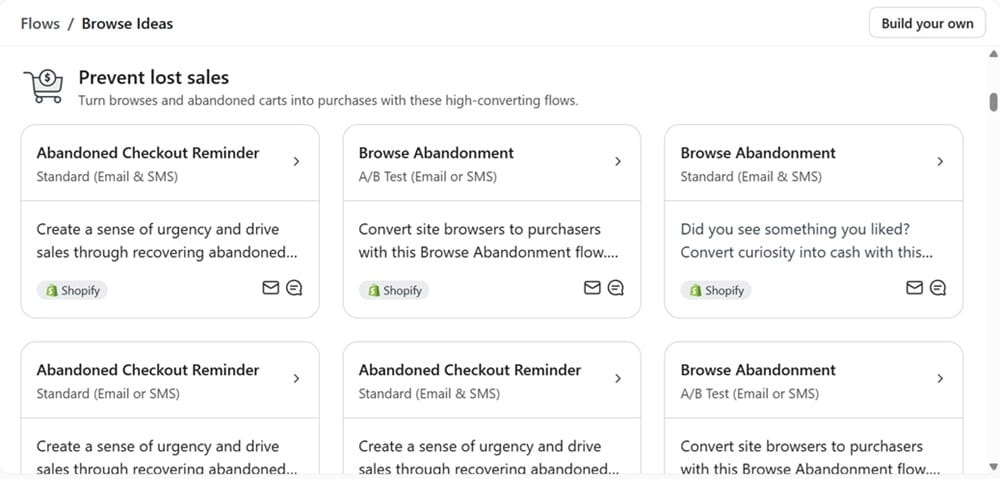
Customizing the automation templates is super easy, thanks to the drag-and-drop editor.
The automation also supports conditional split logic that takes customers through different paths depending on their traits. For example, you can set up two different workflows depending on whether a customer is in a GDPR region or not.
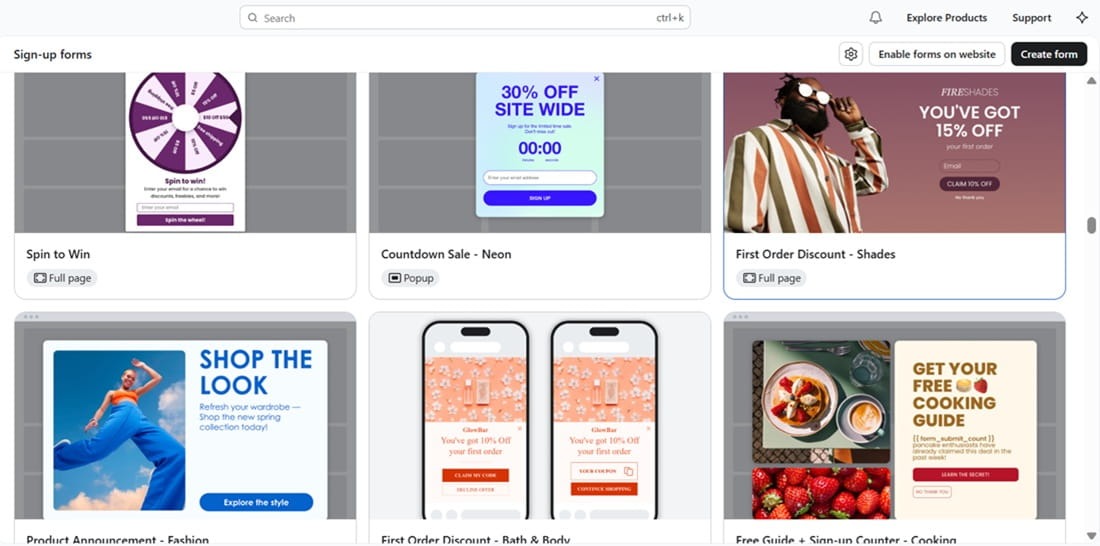
The intuitive signup form builder is also helpful for building your email list.
Klaviyo offers several signup form templates, including spin-to-win, exit-intent, and a welcome offer quiz template.
The Klaviyo data management solution compiles engagement, transactional, and behavioral customer data. This data powers personalized customer experiences, which can help drive sales and brand loyalty.
Unfortunately, the Klaviyo Data Platform is a separate add-on that costs $500/mo for 10,000 customer profiles.
Other key features
- Transactional emails – Supports transactional email campaigns like order confirmations, password resets, and account registrations.
- Smart sending – Prevents recipients from receiving too many emails within a short period of time. It lets you choose how many hours you want between each email.
- Klaviyo Reviews – Helps you collect and display customer reviews on your store. It has AI that helps with analyzing reviews and crafting personalized responses. But this feature is sold separately.
- Landing page builder – Lets you build and host landing pages on Klaviyo.
- Marketing analytics – Delivers advanced insights including RFM analysis, advanced attribution, and predictive analytics.
Pros
- Imports your branding kit from your website
- Supports AI-generated segments and email content
Cons
- Expensive since most features are sold as separate add-ons. Also, pricing is based on both email sends and list size.
Pricing
Klaviyo’s free plan supports 250 contacts, 500 emails/mo, and 10,000 Composer credits.
Paid plans start at $20/mo for 251 to 500 contacts and 5,000 emails. Mobile messages or SMS marketing starts at $40/mo. So the total for this plan is $60/mo.
Social marketing costs $38/mo (for up to 10,000 active profiles). Reviews cost $25/mo (for up to 250 orders/mo).
The marketing analytics feature starts at $100/mo (up to 500 profiles), while the customer data platform goes for $500/mo (customer profiles).
Klaviyo also offers customer service solutions. The AI-powered customer support helpdesk starts at $185/mo. It supports multichannel customer support.
The personalized AI Customer Agent starts at $140/mo for up to 200 conversations.
Finally, the self-service Customer Hub starts at $20/mo for 251 profiles. The hub offers onsite FAQs, self-serve account management, and dynamic product recommendations.
4. Hostinger Reach – Best email marketing tool for small businesses
G2: 4.4/5 Capterra: 4.5/5
Hostinger Reach automates AI-powered email marketing for creators and small businesses, letting them launch professional campaigns without design or marketing experience.
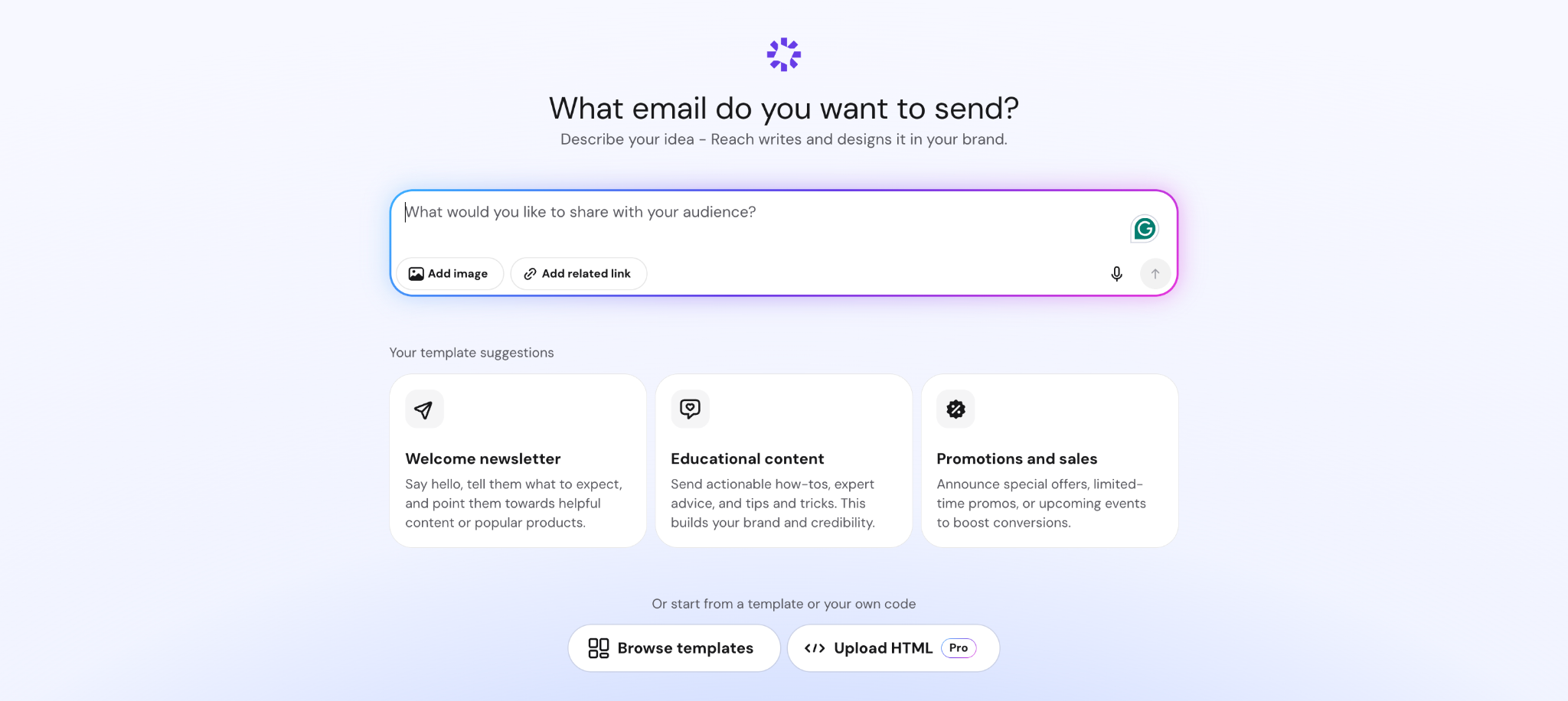
The easiest way to get started with Hostinger Reach is to use AI and answer a single prompt: “What email do you want to send?” You describe your idea and can attach an image or a related link for context. There’s also an option to browse templates or upload HTML.
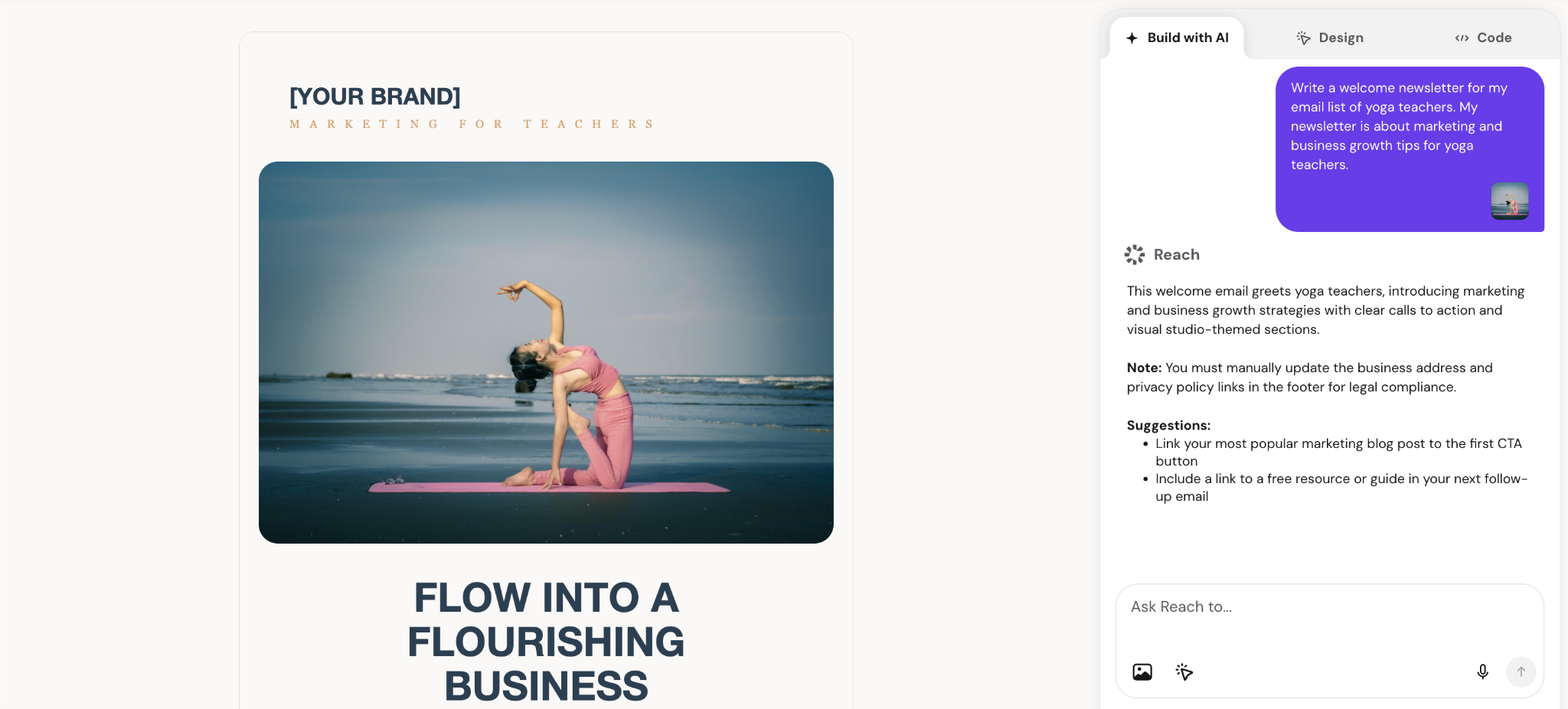
Once you submit a prompt, Hostinger Reach builds the full email with copy, layout, and imagery. Inside the editor, you can tailor the template manually, using AI prompts, or by editing the code. The AI also offers helpful suggestions, such as linking to a popular blog post in your CTA.
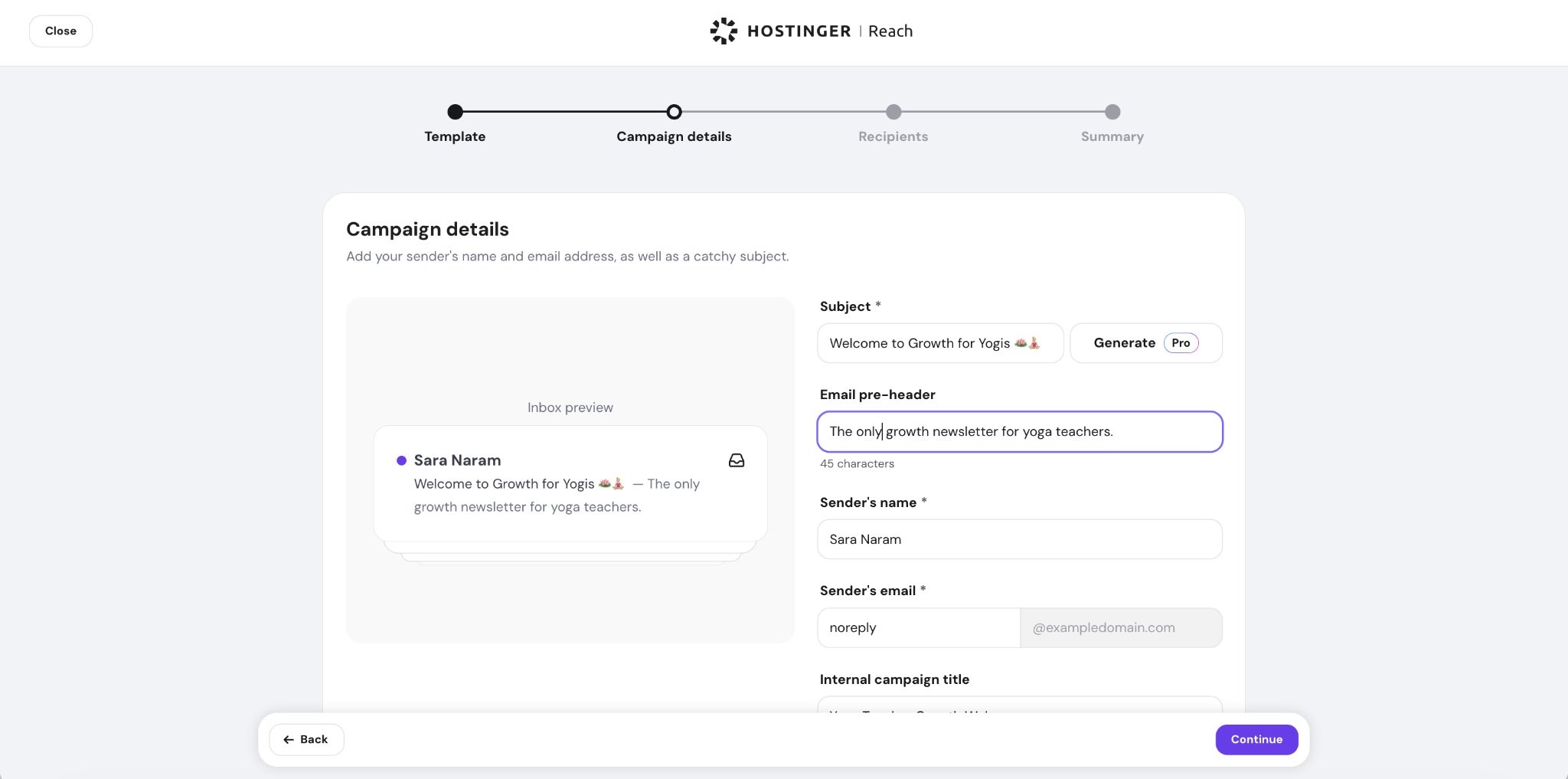
Once you finalize the email design and copy, you set up the campaign details: subject line, email pre-header, sender name, and sender email. A live inbox preview shows you exactly how it’ll look to recipients. Hostinger Reach also offers a subject line generator, which is great for when you’re feeling stuck.
Next, you add your campaign recipients. If you already have a site with Hostinger AI Builder or WordPress, your contacts are automatically synced.
For automation, Hostinger Reach covers the common use cases: automatically emailing new signups or segments, recovering abandoned carts, and following up after purchases. You set it up once, and it runs on its own.
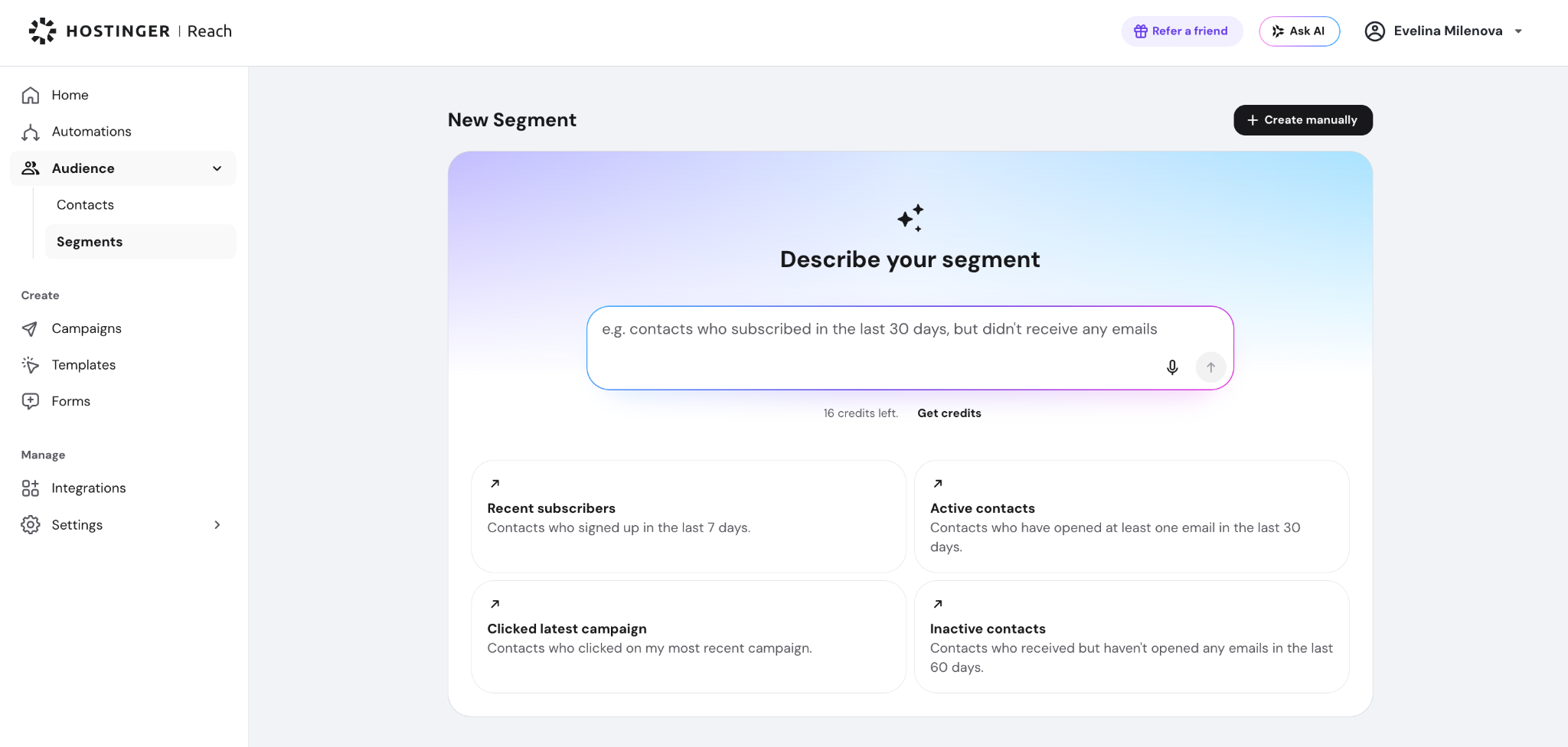
Segmentation works the same way as email creation. You describe who you want to write to in plain language, like “contacts who subscribed in the last 30 days but didn’t receive any emails,” and Hostinger Reach builds the segment for you. There are also one-click presets, like Recent subscribers, Active contacts, Clicked latest campaign, and Inactive contacts, for common targeting needs without writing a prompt at all.
One area where Hostinger Reach quietly does the heavy lifting is deliverability. It sets up SPF, DKIM, and DMARC automatically for Hostinger domains, and every email includes unsubscribe links with built-in GDPR and CAN-SPAM compliance.
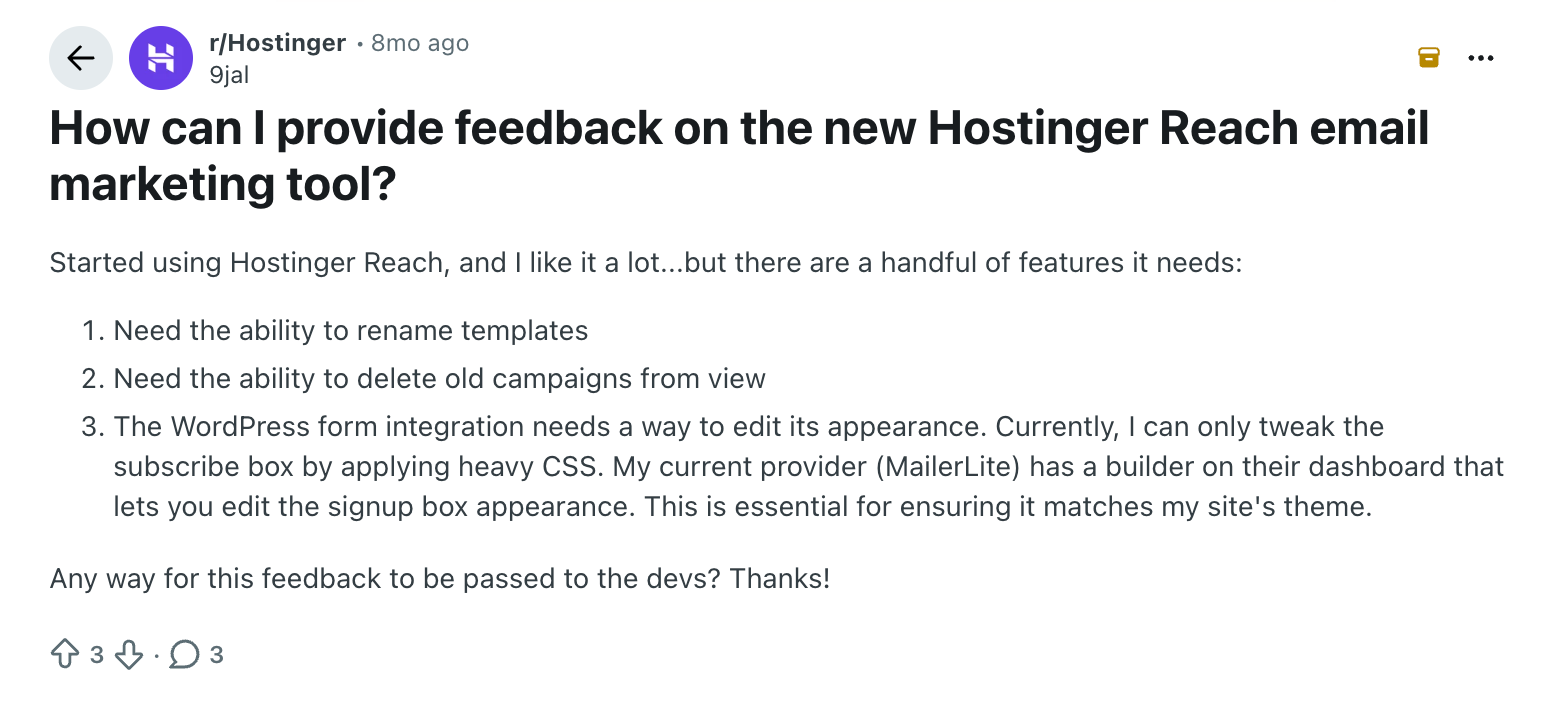
On Reddit, some users had requested missing features, and these are now live on the platform.
Other key features
- Drip campaigns – Add delay steps between emails, either relative (hours, days, weeks) or a fixed date/time. Common use case: a multi-part welcome series.
- AI-powered creation – AI is built into campaign and template creation, generating draft emails from a prompt and suggesting subject lines as you write.
- Bundle offer – Starting at $3.49/mo, you can get a domain and 2 business emails for 1 year alongside your Hostinger Reach subscription.
- Hostinger Connector – Connects your Hostinger account to AI coding tools like VS Code, Cursor, and Claude Code, giving them access to manage hosting, domains, DNS, email marketing, ecommerce, and billing directly from the editor.
- Template library – Browse and filter pre-designed templates by category to start a campaign faster.
- Campaign insights – Track opens, clicks, click-to-open rate, bounce rate, and unsubscribe rate per campaign, and use AI segmentation to identify non-openers or non-clickers for re-engagement.
Pros
- AI generates full email campaigns from a single prompt, no design or marketing experience needed.
- Hostinger Reach integrates with the Hostinger ecosystem, so it’s easy to manage your hosting, domains, business emails, and email marketing from a single place.
- Pricing scales with recipient count rather than gating features behind higher tiers, making it accessible for small lists.
Cons
- Automation and segmentation do not match the complexity of enterprise-level platforms.
- The quality of the AI template output depends on the prompt.
Pricing
Hostinger Reach has six paid tiers based on the number of recipients you email: from 0–500 to 10,000–50,000. Pricing grows with the size of your audience.
Within each tier, you choose a billing term: 1, 12, or 24 months. Committing to a longer plan can cut the cost by 67–75%. At the smallest tier (0–500 recipients), prices range from $1.99/mo (24 months) to $5.99/mo (1 month). At the largest tier (10,000–50,000 recipients), prices range from $74.99/mo (24 months) to $269.99/mo (1 month).
Every paid tier includes the same features: Smart Sending, AI/drag-and-drop/HTML editors, unlimited AI subject lines and spam checks, weekly campaign ideas, welcome/sequence emails, and cart/purchase automation. Moving up tiers just increases your emails/mo allowance (from 3,500 up to 350,000) and the price.
There is also a Free tier with up to 200 emails per month that includes all the basic features.
5. ActiveCampaign – Best for automations
G2: 4.4 Capterra: 4.6
ActiveCampaign is one of your best options if you want an email marketing software with an advanced marketing automation system.
The platform is particularly powerful for automations since it has a built-in CRM system. The system helps with storing and managing contact data. That data provides insights into customer behavior and actions. It’s used to trigger different automation workflows.
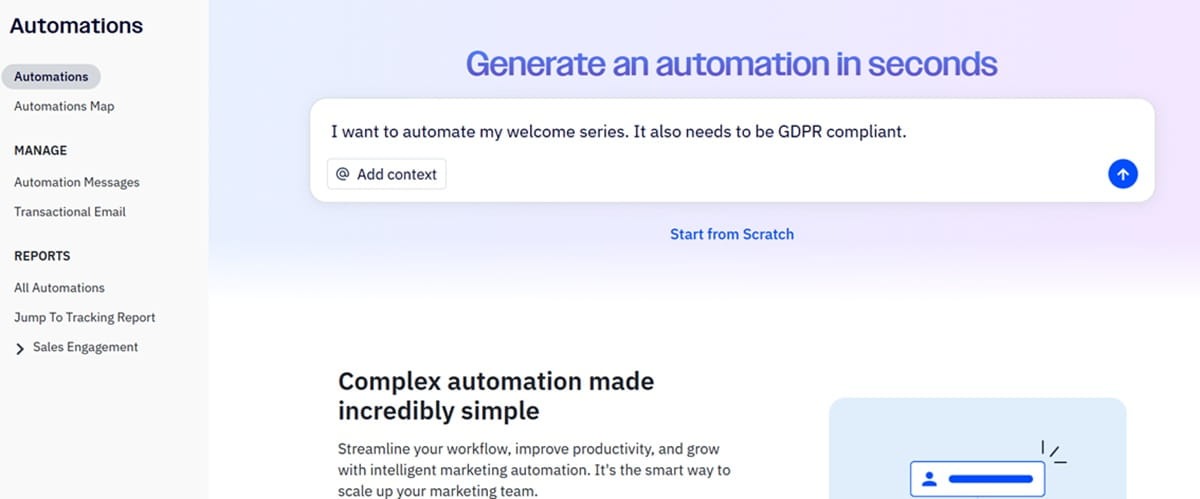
Building automations on ActiveCampaign is pretty straightforward. Instead of starting from scratch, describe your business or marketing goal to the ActiveCampaign AI called Active Intelligence. It creates the automation workflow for you within a few moments.
Another clever thing about ActiveCampaign is that it extracts business context during onboarding. It asks your current contact list size, the channels you want to automate, and a few other questions.
If you sign up using your business email, it goes through your website to see your products and services.
All that context is used to orchestrate your automation workflows. It suggests what to include in every email sequence based on the services you provide.
For example, we asked it to create a welcome email automation workflow. The AI built a 5-step welcome series starting from a standard welcome email to social proof and conversion-focused emails.
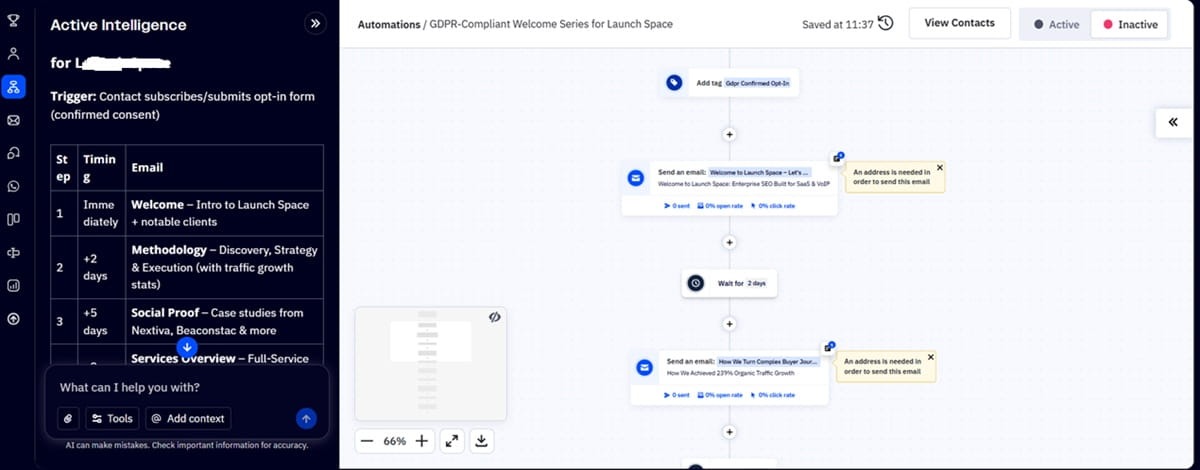
You can customize the automations using the drag-and-drop editor. The editor also lets you build workflows from scratch pretty easily.
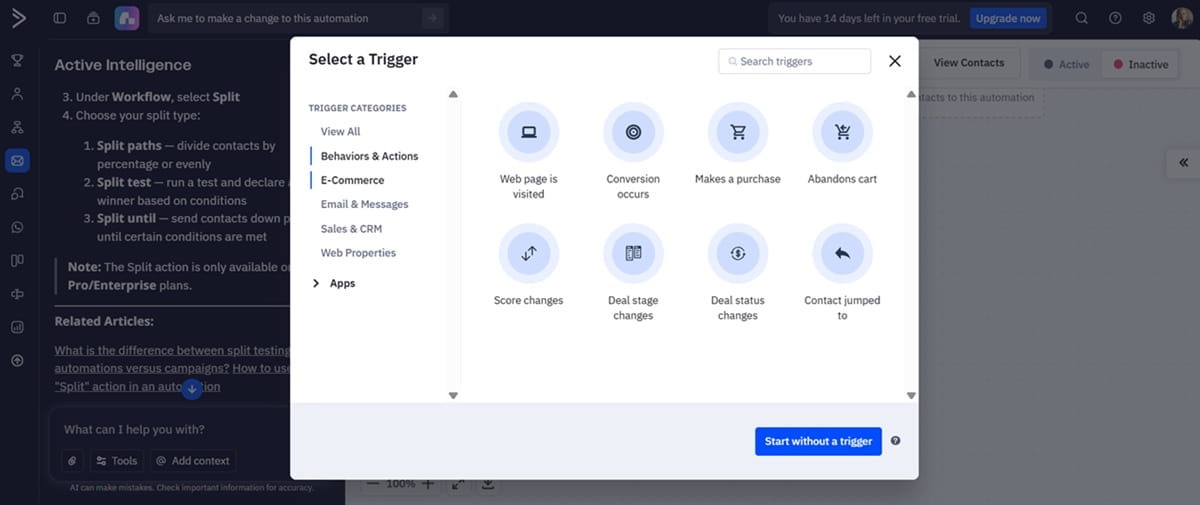
Plus, it supports lots of triggers.
Automations can activate when a customer forwards an email, visits a specific webpage, or replies to an email, to name a few.
ActiveCampaign supports SMS and WhatsApp marketing, too. It offers powerful reporting showing the performance of your different campaigns. And you don’t have to analyze the campaigns by yourself. You can use Active Intelligence to analyze and summarize performance.
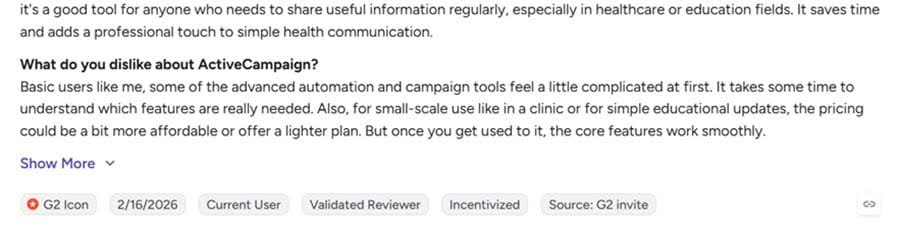
While the complex workflows are good for advanced automations, some users on G2 and other review platforms find them overwhelming and complicated.
Other key features
- Deals – Track every deal in your pipeline from the deals dashboard. You can add deal pipelines manually or import them from a CSV file.
- Split testing – Create and send multiple emails to compare performance.
- Sign up form builder – Prompt the AI to create a sign-up form and launch automations based on the information submitted.
- Contacts – ActiveCampaign offers an AI-powered contact management dashboard. You can prompt the AI to find relevant contacts and create customer segments.
- Predictive sending – Send automated emails at times when each recipient is most likely to open.
Pros
- The ever-present AI is helpful when you get stuck.
- Conditional content personalizes emails to show different content depending on the customer’s unique attributes.
Cons
- The AI can be slow at times.
- The most useful features like predictive & conditional content are locked in the $79/mo plan.
- Has a bit of a learning curve
Pricing
ActiveCampaign has no free plan.
Starter plan costs $15/mo for one user. It supports marketing automation with up to 5 actions per automation, email marketing, and limited segmentation. Active Intelligence is present but limited on this plan.
The Plus plan goes for $49/mo for one user. This offers unlimited actions per automation, standard segmentation, and landing pages. Active Intelligence limitations still apply here.
You’ll need the $79/mo Pro plan (for 3 users) to gain full access to Active Intelligence. That plan also supports advanced segmentation, predictive and conditional content, premium ecommerce integrations, and attribution and conversion tracking.
Premium ecommerce integration is necessary if your store is on BigCommerce, Magento, or Shopify Plus.
There’s also an enterprise plan that goes for $145/mo for five users. It supports single sign-on (SSO), a dedicated account team, and custom objects.
6. MailerLite – Best for beginners
G2: 4.6 Capterra: 4.7
MailerLite is a simple email marketing platform that gets the job done without overwhelming you with too many features. It’s also one of the most affordable email marketing platforms on this list.
It has a generous free plan that supports 2,500 monthly email sends, two user seats, and 250 subscribers. That’s more than what you get with Klaviyo’s free plan and almost at par with GetResponse’s, which accommodates 500 contacts.
MailerLite’s highest-tier paid plan starts at only $22.50/mo. It gets you unlimited monthly emails, unlimited user seats, and 500 contacts.
But is it any good at email marketing?
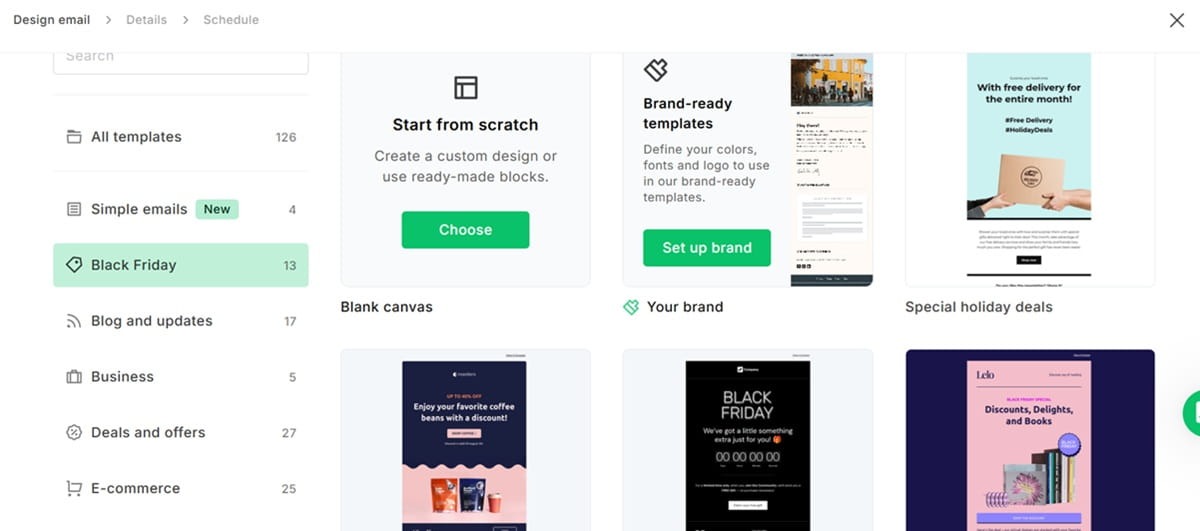
Yes, Mailerlite has a neat campaigns UI that is super easy to use. You start by choosing the campaign type you want to create, then pick from a decent selection of email templates.
Templates are organized by category, so it’s easy to find exactly what you want.
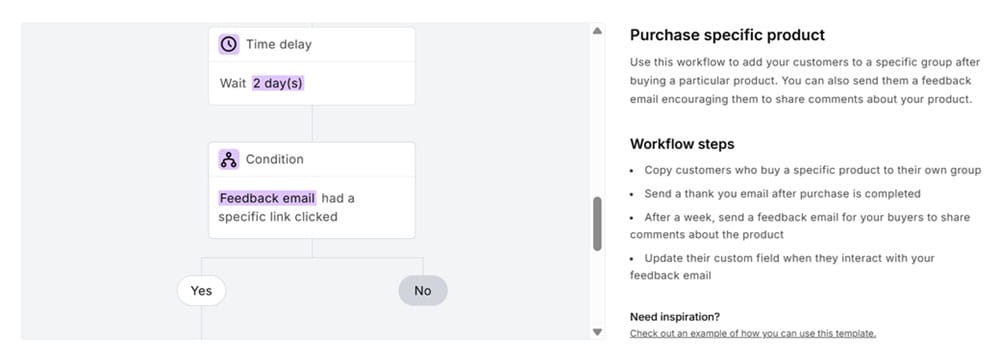
You’ll find an equally simple UI in the automations dashboard. You can either pick from prebuilt automation workflows or build from scratch.
The automations support conditional splits that take customers through different paths depending on their actions and attributes.
The drag-and-drop editor is there for people who can’t find the right template. There’s also a custom HTML editor for developers who want to design something truly unique.
One thing worth noting with MailerLite is that they’ve not been as aggressive as other email marketing platforms (like ActiveCampaign) in implementing AI features. You don’t get an AI assistant to help with creating or analyzing campaign performance, for example.
Though this has kept the platform neat, we also felt like it’s a missed opportunity.
In fact, besides the AI content and image generator, Sites is the only significant feature where there’s an AI assistant. The AI asks you several questions, then uses your answers to build several landing pages to pick from.
Other key features
- Pop-up builder – Helps create on-brand pop-ups. You can also customize the pop-up behavior, like how frequently the same user sees it and when the pop-ups appear (timed vs. scroll depth vs. exit-intent).
- A/B testing – Run split tests to understand how different pop-up and email elements influence conversions.
- Website builder – Create websites or landing pages from scratch or by editing a template. There’s also an AI that asks several questions and uses your answers to create a customizable landing page.
Pros
- Custom HTML editor lets you create distinct email designs
- Dynamic content supports personalized customer experiences
- Provides AI suggestions for content and image generation
- Supports webhooks, which promote real-time automations
Cons
- AI capabilities could be better
Pricing
There’s a free forever MailerLite plan, but it doesn’t include Smart Sending, dynamic emails, and the AI writing assistant. Those features are available on the $10.80/mo Comfort plan.
The Comfort plan has limited visual automations, landing pages, and digital products. To get unlimited access to these and other features, you need the $22.50/mo Power plan.
An enterprise package is available for customers who want a dedicated success manager, deliverability support, onboarding consultation/training, an account audit, and performance improvements.
That plan is available at a custom price, and you can get a dedicated IP as an add-on.
7. Moosend – Best for cheap email marketing
G2: 4.6 Capterra: 4.6
Moosend is another simple email marketing platform. The solution mostly focuses on email marketing and a few growth tools, including a landing page and subscription form builder.
The company has partnered with Constant Contact for marketers who want to “go beyond the inbox.”
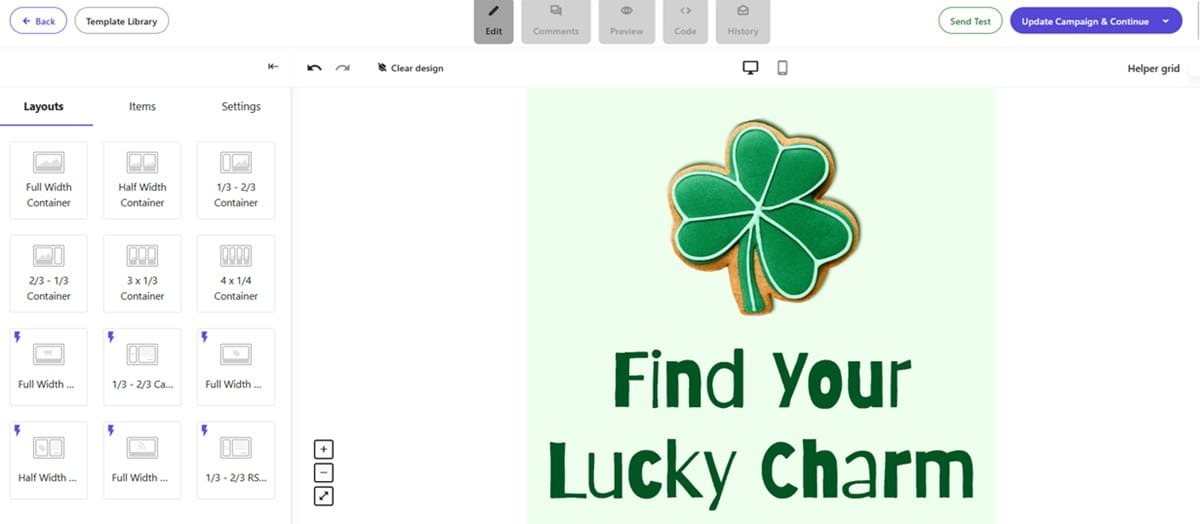
That said, the UI is not as clean as MailerLite’s. Still, it’s fairly easy to follow, and you get all the important tools you need to build successful email campaigns. That includes an AI writing assistant that helps with crafting subject lines.
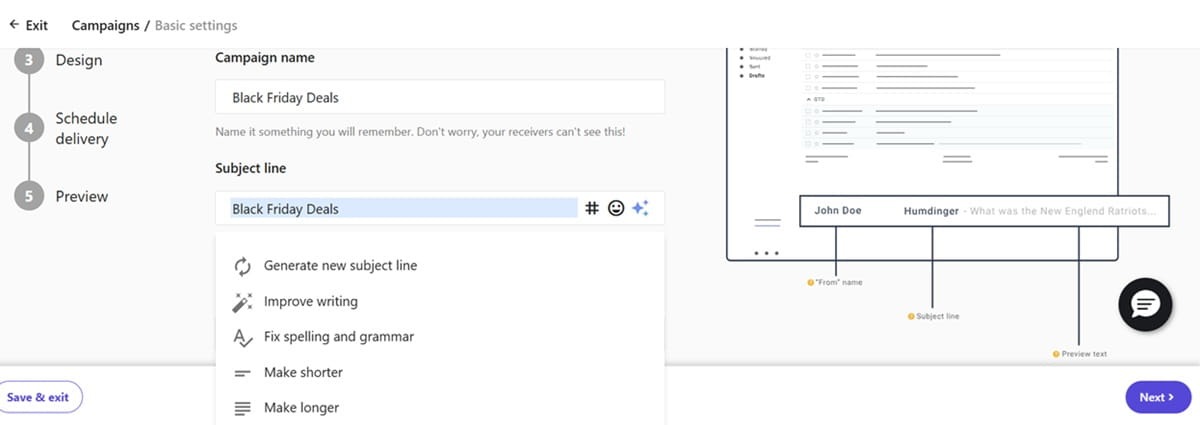
Moosend has an extensive email template library. It offers templates for all the popular ecommerce email marketing campaigns. From Mother’s Day and happy birthday wishes to out-of-stock and Thanksgiving promotions.
You can edit these templates easily through the visual drag-and-drop editor.
Setting up automations on Moosend is also easy. They have a fairly limited but still useful automation workflow library under the “Recipes” dashboard.
It provides workflows for campaigns like repeat purchase reminders, upsell/cross-sell, customer surveys, and abandoned carts.
Automations support split flows, if condition / else, and time delays.
Moosend offers several prebuilt audience segments. You can pick a template to segment customers based on total amount spent, order total, campaigns clicked, engagement levels, and products bought. You’ll find this very helpful if you’re new to ecommerce email marketing.
Lastly, Moosend has done a decent job of cleaning up email marketing reports. They don’t count bot traffic and also exclude Apple privacy opens.
Other key features
- Transactional emails – Moosend supports transactional email campaigns as well as RSS and repeatable campaigns
- Growth tools – Comes with subscription form and landing page builders.
Pros
- Helps you set up DMARC, DKIM, and SPF records to maintain a stellar domain reputation.
- Supports custom reports so you can analyze the performance of specific campaigns or products.
- It’s cheap.
Cons
- Like MailerLite, Moosend has settled for basic AI features. It doesn’t let you create entire segments or campaigns with AI, for example.
- It doesn’t support SMS, WhatsApp, or push notification campaigns.
Pricing
Moosend does not have a free forever plan. Paid plans start at $7/mo with the Pro plan. That makes Moosend the cheapest option on our list.
Unfortunately, that price tag only accommodates 500 contacts, and you don’t get the custom reports feature.
For that, you’ll need the Moosend+ plan, which comes at a custom price. This plan also supports transactional email campaigns, but as a separate add-on.
The Moosend+ plan unlocks crucial automation triggers like when customers visit a specific page and when they view a certain product.
An enterprise plan is available for large businesses that want advanced features like SSO, priority support, an account manager, and deliverability and strategy optimization assistance.
8. Brevo – Best for free marketing automation
G2: 4.5 Capterra: 4.6
Most email marketing platforms offering free plans limit automation features. That’s not the case with Brevo.
Brevo’s free plan includes multichannel marketing automation for up to 2,000 contacts. It lets you automate email, SMS, push notifications, and WhatsApp marketing. Plus, it supports dynamic content, multi-entry points for automations, and real-time event triggers.
The free plan has a 300 sends/day limit and includes Aura AI. The AI helps with content creation, summarizing chats, and optimizing campaigns.
The free package even supports abandoned cart recovery email campaigns.
These capabilities make Brevo one of the best cheap email marketing platforms.
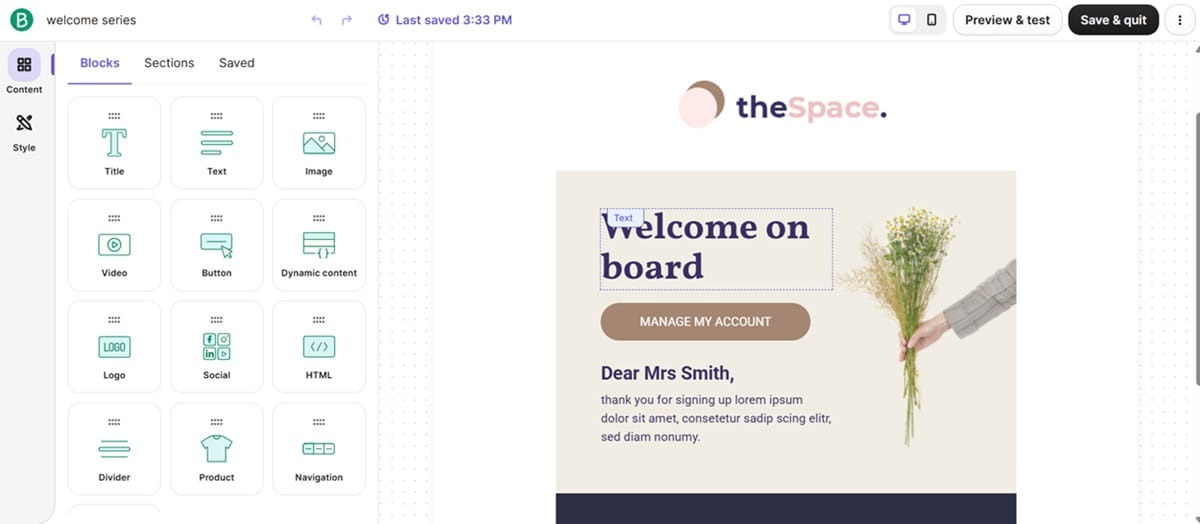
Performance-wise, the platform compares really well to other solutions. There are lots of email design templates to pick from. The visual editor makes the designing process super smooth.
Aura AI is always on hand to generate email content and images. Plus, the platform supports dynamic content blocks so you can show different content to different audiences based on your set rules.
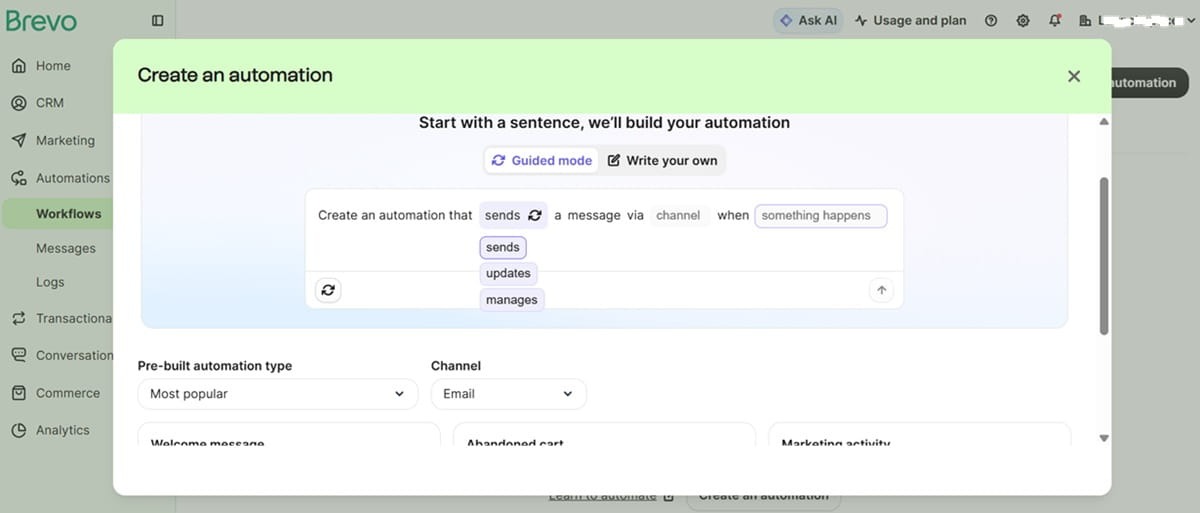
For marketing automation, there are three starting points. You can build a workflow from scratch, use a prebuilt template, or prompt Aura AI to create the workflow.
But unlike ActiveCampaign, which lets you describe the automation you want in your own words, Brevo offers an additional “guided mode” with a pre-written prompt. You simply edit to pick the action (sends, updates, or manages), channel, and execution (what happens).
That said, we found Brevo’s automation templates quite limited. First, there’s very little to pick from. Some of the workflows are also pretty basic. They don’t anticipate certain customer behaviors.
For example, it only provides one basic abandoned cart automation workflow.
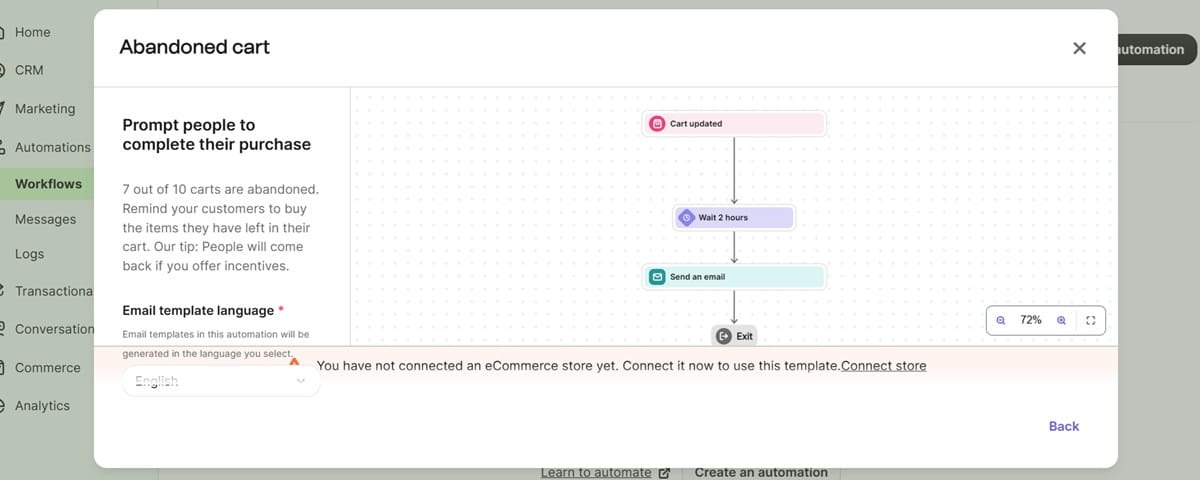
Compare that to GetResponse, which offers several templates, including an abandoned-cart series that sends several reminders.
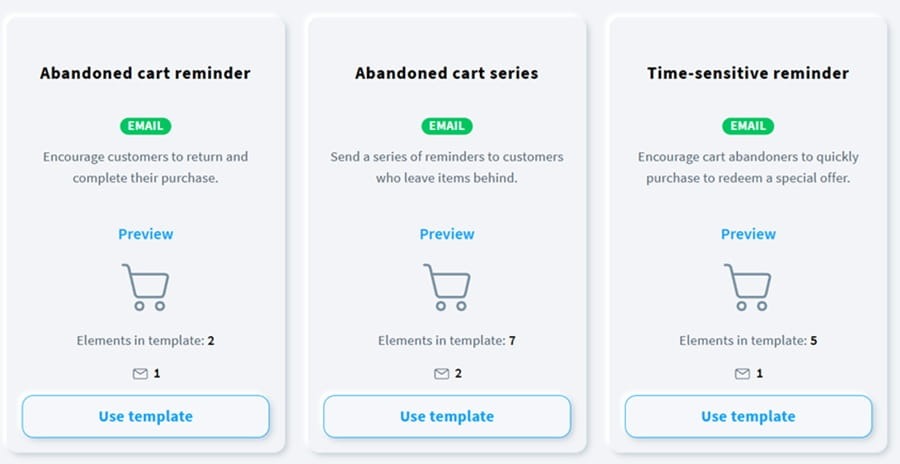
Of course, you can still edit Brevo’s template to include the additional emails.
Brevo offers a CRM system where you can manage contacts, create customer segments, and track deals and tasks. Unfortunately, you must be on the $499/mo Pro plan to unlock the full potential of the CRM and automation systems.
For example, you’ll need that plan to set up workflows that activate based on customer lifecycle events.
Other key features
- Brevo Conversations – Connect your email, WhatsApp, Facebook Messenger, and Instagram Direct to Brevo to communicate and manage all customer conversations from one place. You can also make and receive calls and manage meetings from this dashboard.
- Transactional emails – Set up your SMTP server settings on Brevo to activate transactional email and SMS campaigns.
- Dynamic coupons – Create and send personalized discount codes to encourage conversions or reward customer loyalty.
- Multi-branch testing – Test different automation paths to see which ones deliver the best results.
Pros
- The brand library makes it super easy to create on-brand campaigns.
- Brevo Conversations is great for both customer support and managing deals.
Cons
- You need the Standard plan or higher to remove the Brevo branding.
Pricing
Brevo has an impressive free plan. Paid plans start at just $8.08/mo. It gives you access to additional features like up to 100K monthly email sends, content feeds, and web push notifications to 1,000 targeted subscribers.
The issue with Brevo’s pricing is the gap between the entry-tier plan and the Professional plan that you actually need to create compelling campaigns.
You see, the Professional plan starts at $499/mo! And it’s the only plan that comes with:
- email frequency management
- Pop-ups
- Mobile push notifications
- WhatsApp campaigns
- Back-in-stock alerts
- AI product recommendations.
An enterprise plan is available at a custom price for large businesses that require advanced email marketing.
9. Sender – Best for small businesses
G2: 4.7 Capterra: 4.7
Sender has two things going for it: simplicity and price.
The platform has a clean user interface. It’s not bloated with too many features compared to other platforms like HubSpot. It simply focuses on effective marketing across two channels: email and SMS.
Then there’s the generous free-forever package and the affordable paid plans.
The free package accommodates up to 2,500 subscribers and 25,000 monthly email sends. More than enough for most small businesses.
Plus, it includes some email automation, landing pages, and signup forms. But all your campaigns will have the Sender branding.
Designing emails is easy enough. Pick from a good selection of responsive templates and customize them with the visual editor.
You can also create plain text emails or a custom HTML email.
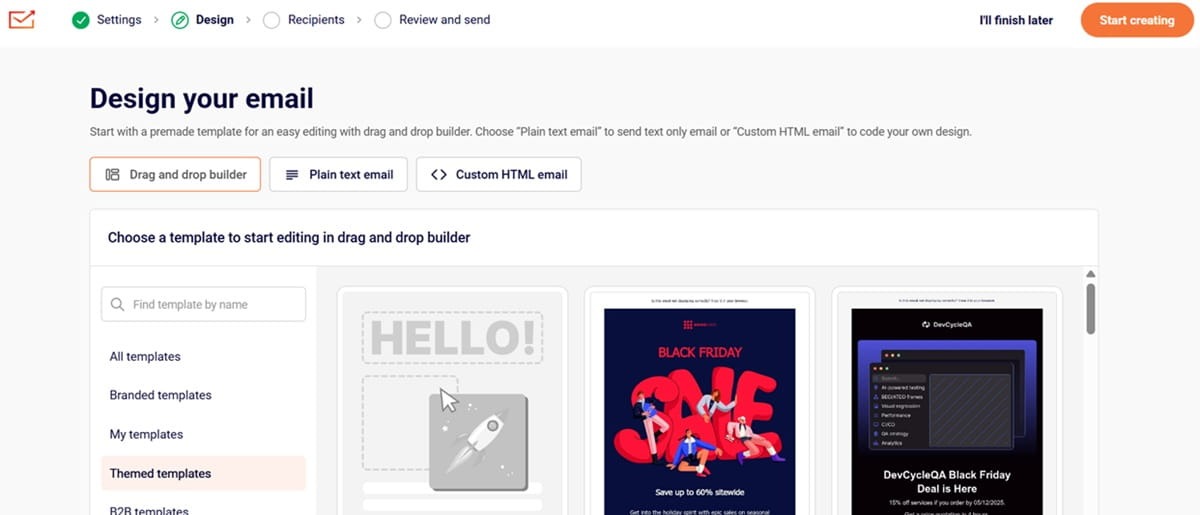
You can change templates within the editor and preview your email on both desktop and mobile devices.
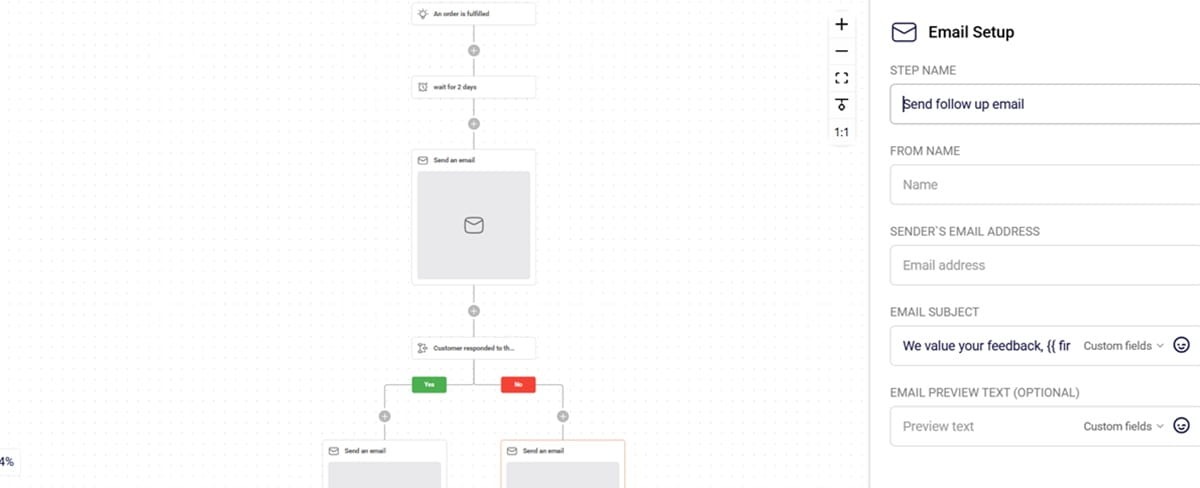
Sender supports both email and SMS automations. They have prebuilt workflows and an editor where you can create custom workflows from scratch.
Other key features
- Auto resend – Resend emails to recipients who did not open a campaign.
- Experiments – Run split tests on subject lines, sending times, content types, and preview texts. This is available on paid plans only.
- Meta ads integration – Connect your Meta ads account to Sender to pull leads directly to the tool.
- Growth tools – Build landing pages, pop-ups, and signup forms to grow your email list.
Pros
- The professional plan comes with 1 dedicated IP address.
- Easy to use
Cons
- Unlimited email sends are only available on the custom enterprise plan.
- Templates could be better, as reported by several users on G2.
Pricing
Sender’s paid plan starts at $7/mo. It supports up to 12K emails per month and 1K subscribers. It includes SMS messaging, unlimited landing pages, and 3 role-based seats.
The Professional plan goes for $14/mo. You get 24K email sends and 1K subscribers. It also unlocks advanced email editor features like the animated countdown timer and review blocks.
10. Mailchimp – Best for multichannel automation
G2:4.4 Capterra: 4.5
Mailchimp is an email, SMS, and social marketing platform. It’s one of the oldest email marketing software, but it has a bad rep for how steep the prices get as your business grows.
Mailchimp charges based on the size of your contact list. The Standard plan starts at $20/mo for up to 500 contacts. When your list grows to 1500 contacts, the price jumps to $45.50. When you get to 5,000 contacts, the price jumps to $100/mo. And so on.
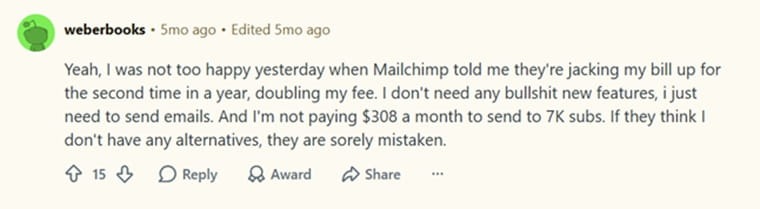
Also, none of the plans offer unlimited monthly email sends. Though they increase your volume as your list grows.
That’s the bad side of Mailchimp that gets people to migrate. The good news is that Mailchimp has reliable sending infrastructure, intuitive automations, and helpful analytics to track campaign performance.
Building campaigns is easy. Like other email marketing tools, Mailchimp lets you build from scratch, use responsive templates, or start with a basic email layout.
The visual editor makes the design process so seamless.
Plus, you can review the email design on both desktop and mobile devices without leaving the editor.
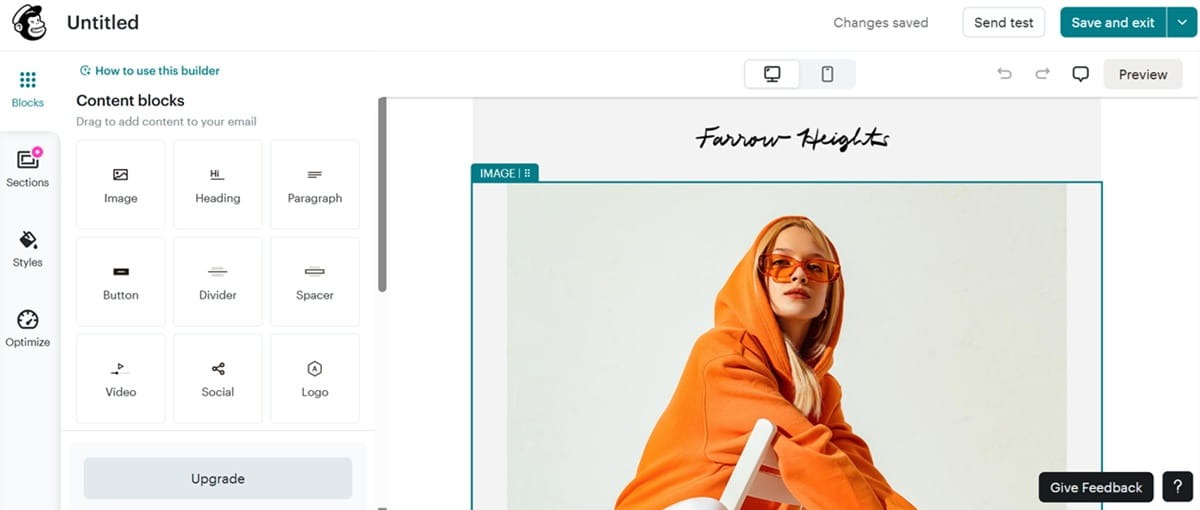
Developers can use HTML to create a unique email design from scratch.
Mailchimp supports advanced marketing automation across various channels. The vast library has workflow templates for email, SMS, WhatsApp, and even Facebook, LinkedIn, and Instagram campaigns.
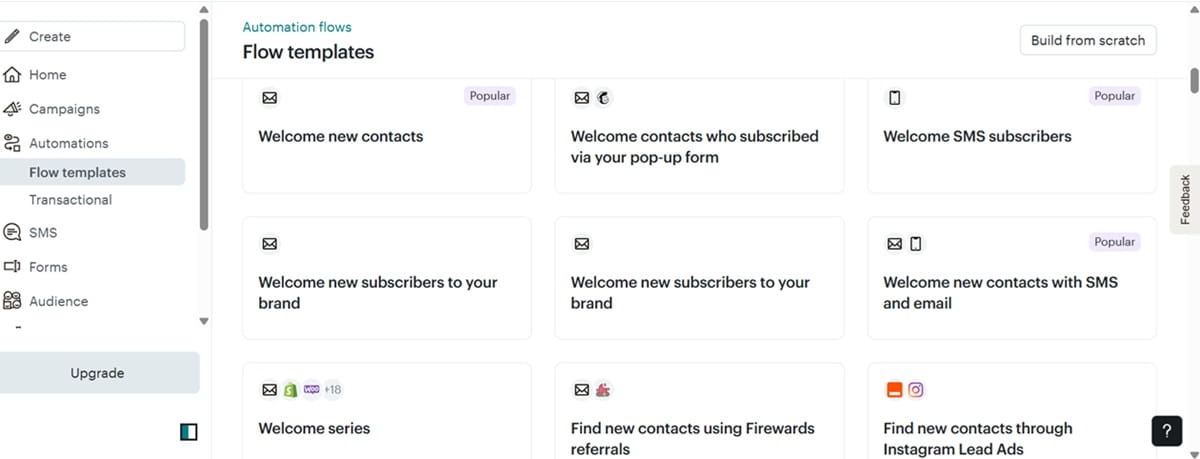
But some of these workflows will require setting up custom events on Zapier to work.
You can create a single automation workflow to deploy across several marketing channels. For example, you could create a single welcome workflow that sends either an SMS or email depending on whether a customer has opted into your SMS or email list. This helps keep your automations clean.
The automation platform also supports split and conditional logic.
Still, some Reddit users report that the automations and segmentation features are not very powerful as your business grows.

Finally, Mailchimp has a decent audience management system. It includes tags to label contacts so you can target them with personalized content. The system also supports segmentation by engagement level, customer behavior, purchase history, and other attributes.
Other key features
- Social media marketing – Create social posts and manage your social media accounts from Mailchimp.
- Transactional emails – Send time-sensitive transactional messages like receipts, order confirmations, and password resets.
- Pop-up form builder – Create pop-up forms to capture email addresses and phone numbers for lead nurturing.
- Subscriber preferences – Group contacts based on their selected preferences like the types of emails they want to receive.
- Powerful analytics – Track and compare how different campaigns, automations, and channels perform. You can also create custom reports on things like performance metrics by channel and engagement by audience or customer cohorts.
Pros
- The Import Your Brand feature pulls your branding style from your website and applies it across all your campaigns.
- Provides a tool for creating different types of surveys, including post-purchase surveys
- Supports hundreds of integrations.
Cons
- Costly
- Some templates are only available with paid plans.
Pricing
Mailchimp has a free plan, but it’s not as competitive as Brevo’s and MailerLite’s. It only supports 500 monthly email sends, for example. Compared to 300/day for Brevo and 2,500 for MailerLite.
The Essential plan starts at $13/mo for 500 contacts. It lets you send 5,000 emails per month. Automations are limited to up to 4 steps. You also don’t get any generative AI features.
The Standard plan starts at $20/mo for 500 contacts. You get 1 onboarding session, 5 seats, 6,000 monthly email sends, and up to 200 automation flows.
This plan also supports dynamic content, delivery by time zone, send time optimization, behavioral targeting, and predictive segmentation.
Essentially, you’ll need at least the Standard plan to run an effective email marketing campaign on Mailchimp.
The Premium plan goes for $350/mo. And SMS marketing is available as an add-on.
11. Kit – Best for creators
G2: 4.4 Capterra: 4.6
Kit is an email marketing platform designed specifically for creators. It provides email and SMS tools to help creators grow their audience, nurture relationships, and monetize their knowledge.
Creators earn through subscriptions, digital products, and even newsletter sponsorship.
To make it even easier for creators to earn from their audiences, Kit provides an advertiser platform. They match creators with relevant advertisers. The advertiser’s content is included natively within existing newsletters as sponsored content.
Kit is very similar to Beehiiv, another popular newsletter platform.
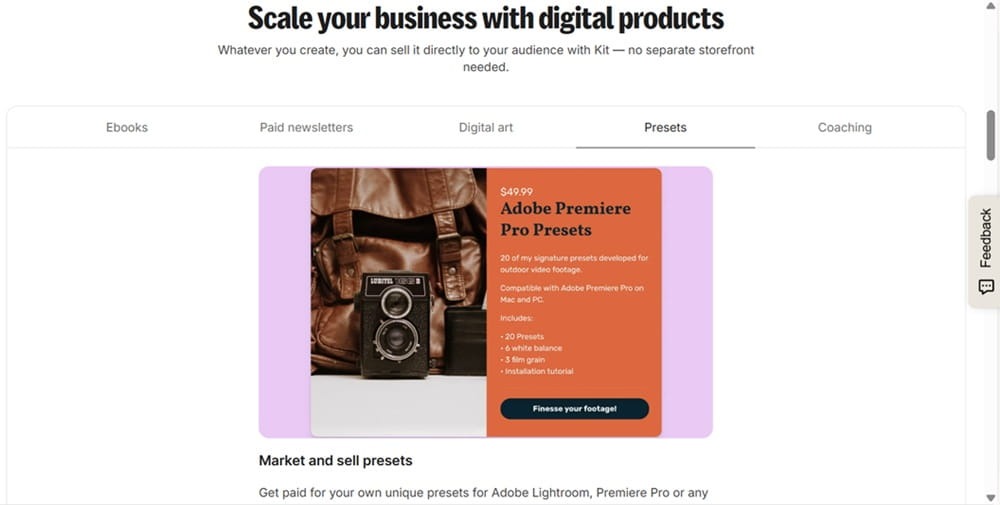
For digital products, the platform offers an inbuilt digital products creator. It lets you create ebooks, digital art, paid newsletters, coaching sessions, and presets for products like Adobe Lightroom and Premiere Pro.
For email marketing and automations, you get the same tools you’d expect. A drag-and-drop email builder as well as a visual automation editor.
But the templates are uniquely designed with creators in mind.
You’ll find automation templates for workflows like Thinkific course upsells, Calendly call booking sequence, and Shopify abandoned cart reminders.
Other key features
- Forms & landing pages – Kit offers a form and landing page builder to help with lead generation.
- Kit MCP – Connect your Kit account to LLMs like Claude and ChatGPT. This lets you use the LLMs to analyze your performance and suggest campaigns.
- Newsletter referral system – Grow your email list through fellow creator recommendations and Kit’s Smart Recommendations.
Pros
- Kit’s advertisers make it easier to earn from your newsletter.
- The Kit App store supports over 60 integrations with creator apps like Linktree, Pinterest, Mighty Networks, Kajabi, and Thinkific.
Cons
- Gets expensive as your email list grows
Pricing
Kit offers a free plan that includes 1,000 subscribers, 1 basic visual automation, and unlimited email broadcasts, forms, and landing pages.
In comparison, Beehiiv’s free plan supports up to 2,500 subscribers.
Paid plans start at $33/mo. This accommodates the same 1,000 subscribers but provides access to unlimited automations, A/B testing, and SMS marketing. It also removes the Kit branding.
The $99/mo Pro plan unlocks Subscriber signals. That feature shows the demographics, engagement data, and social influence of your subscribers.
The plan also offers deliverability reporting, subscriber scoring, collaborative editing, and the newsletter referral system.
12. AWeber – Strictly for email marketing
G2: 4.2 Capterra: 4.4
Consider AWeber if you’re only interested in email marketing. The platform doesn’t support marketing on any other channel.
That makes AWeber a potential solution for small businesses that only want email marketing and marketers who already have a solution for the other channels (SMS and WhatsApp).
Using the AWeber platform is simple enough. However, the UI feels a bit outdated compared to the other solutions we tested.
You can pick email templates from within the editor, which is convenient.
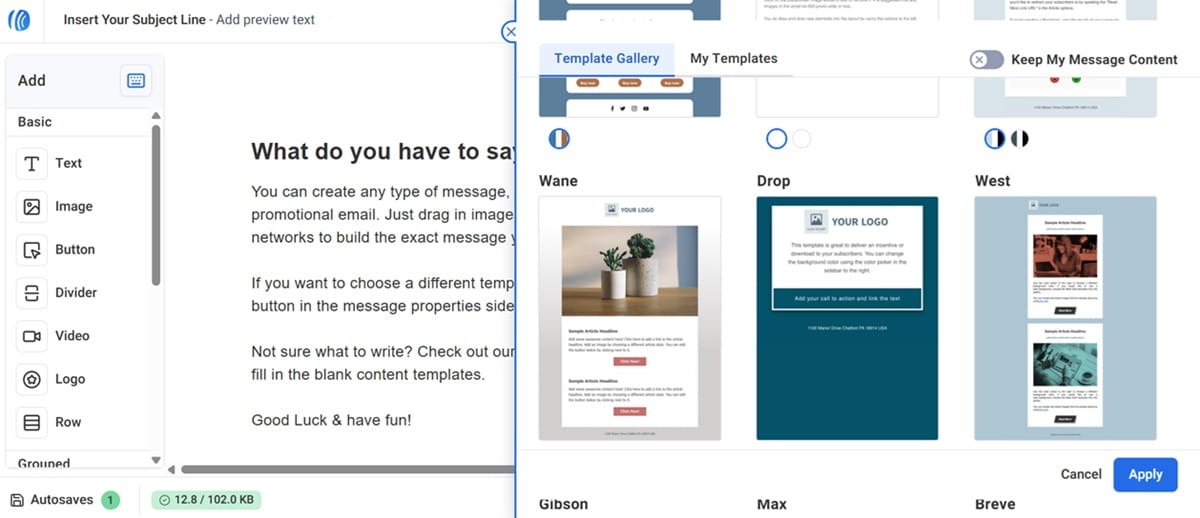
There is a good selection of automation workflow templates to pick from.
The visual workflow editor also makes customizing workflows a seamless process. But the free plan supports only one automation workflow for the welcome series.
The cheapest $12.50/mo Lite plan is also limited to only 3 automations.
Other key features
- Newsletter assistant – The AI assistant learns your brand voice and uses it to write newsletters for you. The newsletter is delivered to your inbox for you to edit or approve before it’s sent to subscribers.
- Dynamic content – Add dynamic content blocks to your emails so subscribers see relevant products, offers, and services based on their interests.
- Landing pages – Build landing pages and signup forms to grow your newsletter audience.
- Web push – Create web push notifications to promote time-sensitive content and drive website visitors to your site.
Pros
- Automation supports split paths, time delays, and contact tags.
- Supports RSS emails so you can send email automatically when you publish a new blog, YouTube video, or podcast
Cons
- Not ideal for when your marketing needs grow beyond email marketing
Pricing
Prices start at $12.50/mo for 500 contacts and 5,000 monthly sends (10X subs volume) with the Lite plan.
It supports 1 email list, 3 landing pages, 1 custom segment, and 3 automations. It doesn’t include behavioral targeting, detailed deliverability reporting, web page tracking, or email sales monitoring.
The AWeber branding will also be present in your campaigns with that plan.
The Plus package starts at $20/mo for 500 contacts. Monthly email sends are capped at 12X subscriber volume (6,000).
This plan unlocks unlimited email lists, automations, landing pages, and custom segments. It also supports sales tracking, offers detailed deliverability reports, and removes the AWeber branding.
The transaction fee for the AWeber ecommerce features, if you’re on the Plus plan, is 0.6% compared to 1% on the Lite plan.
AWeber offers a done-for-you service. You’ll work with AWeber’s experts to set up your campaigns and get unlimited edits for 30 days, 2 landing pages, and 1 email template with your branding. They also deliver newsletter content weekly.
Done-for-you services start at $20/mo, plus a $79 setup fee.
Picking the best email marketing tool
The best email marketing software hugely depends on your unique business needs.
As you’ve seen in this review, some solutions are ideal if you’re only interested in email marketing. They give you good value, but you can only use them for that one marketing channel.
Other tools have free forever plans, which is ideal if you’re budget-conscious. But they limit access to important features like advanced automations.
Our solution, GetResponse, is ideal if your priority is to automate the entire customer lifecycle.
We provide marketing and automation tools that have helped ecommerce brands scale customer acquisition and retention. This marketing automation tool was recently recognized as a finalist by the Cloud Awards in the 2026 SaaS Awards for the Best SaaS Product for Workflow Automation category.
Contact our team to see how our automation tools can help automate and personalize your brand’s customer journeys.
Best email marketing services FAQs
1. Which platform is best for email marketing?
The best platform for email marketing depends on your needs. GetResponse is great if you want to automate ecommerce customer journeys. ActiveCampaign is ideal if you’re interested in complex automations. Moosend works if budget is a concern. Use our guide above to identify the best platform based on what you want to achieve.
2. What is the cheapest email marketing service?
Moosend, GetResponse, and Brevo are the cheapest email marketing services. But we recommend checking what you’re getting for the price. The cheapest email marketing service is only valuable if it helps you generate revenue.
3. Is there a better option than Mailchimp?
Yes, there are several options better than Mailchimp depending on your needs. Hostinger Reach, Brevo, and GetResponse are good options if price is your concern. ActiveCampaign is ideal if you’re interested in robust automations.
[ad_2]
Source_link












![The Future of B2B Buying [+ video]](https://mgrowtech.com/wp-content/uploads/2025/10/Featured-image-for-QA-120x86.png)
