[ad_1]
Have you ever had an app idea you were convinced could be useful, only to realize building it would require months of coding, hiring a developer, or learning an entirely new skill?
That’s the problem Superapp is trying to solve. Instead of starting with code, you start with a prompt. Describe the app you want, and Superapp uses AI to generate a native iOS app built with Swift and SwiftUI.
Yet for many creators, the biggest barrier isn’t coming up with an idea. It’s turning that idea into something people can actually use.
I tested Superapp by creating my own habit-tracking iOS app from a single prompt. Within minutes, it generated an app preview with a dashboard, progress charts, habit tracking, reminders, and an Apple (AAPL ) -style interface that closely matched what I described.
While Superapp won’t replace experienced developers for complex apps, it makes iOS app creation much more approachable for founders, designers, and creators who want to quickly test ideas without starting from scratch.
In this Superapp review, I’ll discuss the pros and cons, what it is, who it’s best for, and its key features. Then, I’ll show you how I used it to build and publish a habit-tracking app from start to finish.
I’ll finish the article by comparing Superapp with my top three alternatives (Lovable, Bolt.new, and FlutterFlow). By the end, you’ll know which app/web builder is right for you!
Verdict
Overall, Superapp is an easy way to turn an app idea into a working iOS prototype without needing coding experience. However, while it’s great for quickly building and testing ideas, more complex apps may still benefit from traditional development tools.
Pros and Cons
- Quickly turn an idea into a working iOS prototype in minutes by describing what you want in plain English.
- Beginner-friendly interface that makes app building simple, even without technical experience.
- Upload images or Figma files to help guide the app’s design and layout.
- No Swift or Xcode experience required, so you can start building without a developer workflow.
- Generates real Swift and SwiftUI projects that can be customized and prepared for App Store submission.
- Connect databases, authentication, and storage through Supabase without setting everything up manually.
- Designs Apple-style interfaces with modern SwiftUI patterns that match the iOS ecosystem.
- Make instant AI edits to update designs and features without manually changing code.
- Full code ownership so you can export your project, customize it in Xcode, or hand it off to a developer.
- Helps founders and businesses test app ideas without hiring a full development team.
- The credits can easily add up, so large projects or frequent changes may make higher-tier plans necessary.
- AI-generated apps are a great starting point, but complex features and final testing may still need developer input.
- While you can start in the browser, workflows like App Store submission rely on Xcode and Apple’s ecosystem.
- Superapp is built for iOS, macOS, and watchOS, so it may not be the best fit for those wanting a cross-platform app.
- AI-generated designs may feel similar to other apps, requiring extra customization to create a more unique look.
- Developers who need full control over code, advanced customization, or specific optimizations may prefer traditional coding.
What is Superapp?

Superapp is an AI app builder specifically for iOS. You give it your app idea by sending it a prompt in plain English, and it generates Swift and SwiftUI code. That’s the language Apple apps are supposed to be written in.
It also connects your database automatically through Supabase. This saves you from manually configuring your app’s backend so you can focus on building features.
Superapp Background & Origin
Superapp was founded in 2025 by Vitalik Kotik, based out of Berlin. It’s still early stage (I mean, they launched at the end of 2025), but they pulled in about $1.6 million in pre-seed funding from investors like Vesna Capital and Flyer One Ventures.
Finding that out gave me more confidence that it’s a serious platform with the backing to continue growing, not a short-lived side project.
Where Superapp Fits in the AI App-Building Landscape (Product Hunt Launch, Positioning)
Superapp originally launched on Product Hunt, making its debut on November 2025. It actually landed as one of the top products that day, which got it decent early attention in a pretty crowded space.
And the space truly is crowded. You’ve got general no-code app builders, and now a wave of “vibe coding” tools.
Superapp’s angle is that it stays focused on iOS and outputs real Swift not a hybrid wrapper. That means you can create an actual iPhone app without writing the code yourself or hiring a developer. That’s its selling point over React Native-based builders (tools or platforms used to create mobile applications for both iOS and Android).
Web vs. Mac Versions
You can use Superapp in two ways: directly in your browser or through the Mac app.
Web Version
The web version runs entirely in your browser and builds apps in the cloud, so you don’t need a Mac to get started. That’s a big advantage for iOS development, where the traditional workflow usually requires Apple hardware and tools like Xcode from the start.
Mac App
The Mac app is designed for people who prefer a native desktop experience while building. Instead of working from a browser tab, you can chat with Superapp’s AI directly from your Mac.
Who is Superapp Best For?
Superapp is primarily aimed at people who want to create real, native iOS apps without building it from scratch or hiring a dev team:
- Founders and entrepreneurs with an app idea who want to turn it into a working iOS app without hiring someone.
- People who want to quickly test an idea with a real App Store-ready app instead of a basic prototype.
- Product managers and teams that need to quickly build internal tools, customer apps, or MVPs without spending months on development.
- Teams focused on product and UX who want to save time by handling most of the initial coding, design setup, and backend configuration so they can focus on the user experience.
- Designers and agencies who understand app layouts and user flows but don’t want to spend time learning SwiftUI or managing Xcode.
- Agencies building apps who want to create iOS apps faster and deliver customizable Xcode projects to clients.
- iOS developers who want AI to handle the repetitive setup work so they can focus on customizing and improving the final app.
- Teams using AI as a development assistant to speed up early development by creating the foundation of an app before actual developers take over.
- Small businesses and solo entrepreneurs who want to make a custom app without hiring a full development team.
- Freelancers who want to build apps more efficiently with a repeatable process they can use across projects.
Superapp Key Features
Here are Superapp’s key features:
- Build apps with prompts: Describe your app idea in plain English, and Superapp turns it into a native iOS app using Swift and SwiftUI.
- Native Swift and SwiftUI output: Instead of generating a web-based app, Superapp creates actual iOS code that can be opened, edited, and continued in Xcode.
- AI building and design: Superapp uses AI agents to help create app layouts, generate UI components, and refine the code as you make changes.
- Instant app previews: Preview your app as it’s being built and test the experience within the preview itself without manually setting up the project.
- Built-in Supabase integration: Connect your app to a database with Supabase for features like storing data, authentication, and managing app content.
- Figma design support: Bring in Figma designs as references to help translate your visual ideas into SwiftUI components.
- Create apps across Apple devices: Build experiences for iPhone, iPad, Mac, and Apple Watch with the same project.
- Ready for App Store publishing: Generate an Xcode project that can be prepared for submission to the App Store.
- Keep control of your code: Your generated Swift project can be customized, expanded, or handed off to developers for further work.
- Use it online or on a Mac: Build directly in your browser with cloud-based generation or use the Mac app for a more desktop-focused workflow.
How to Use Superapp
Here’s how to build and publish a habit-tracking app with Superapp:
- Create an Account
- Give Superapp a Prompt
- Choose a Device & Hit Send
- Verify the Preview
- Interact with the Preview
- Make Edits with AI
- Add Integrations
- Publish to the App Store
Step 1: Create an Account

Go to superappp.com and sign in to create an account.
Step 2: Give Superapp a Prompt
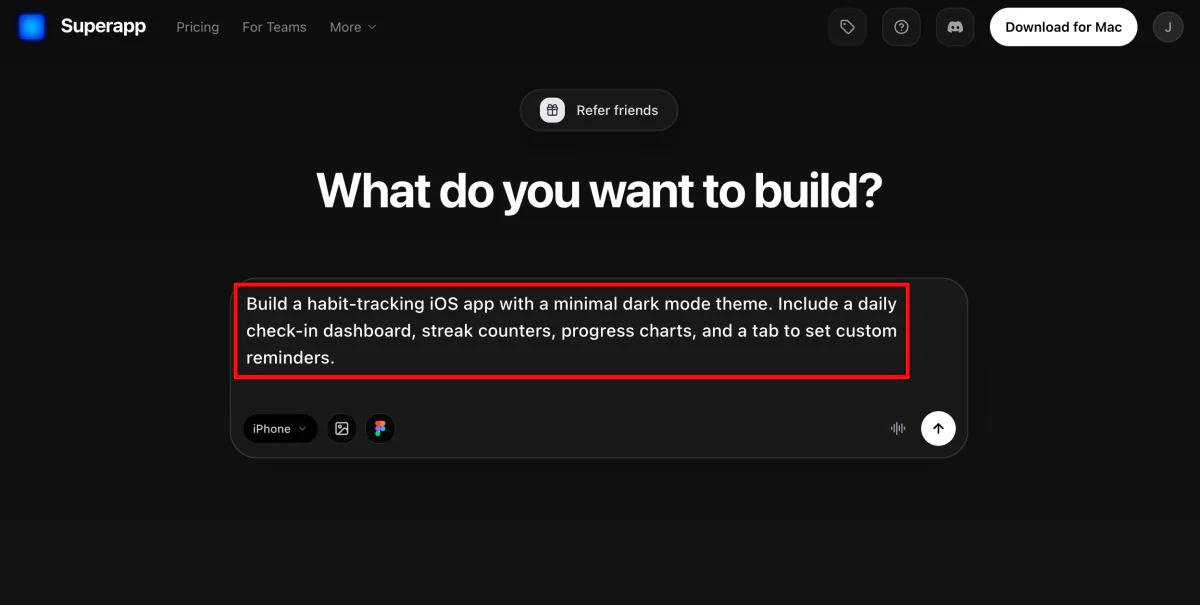
Once your account is created, Superapp will ask you what you want to build.
For example:
“Build a habit-tracking iOS app with a minimal dark mode theme. Include a daily check-in dashboard, streak counters, progress charts, and a tab to set custom reminders.”
Step 3: Choose a Device & Hit Send
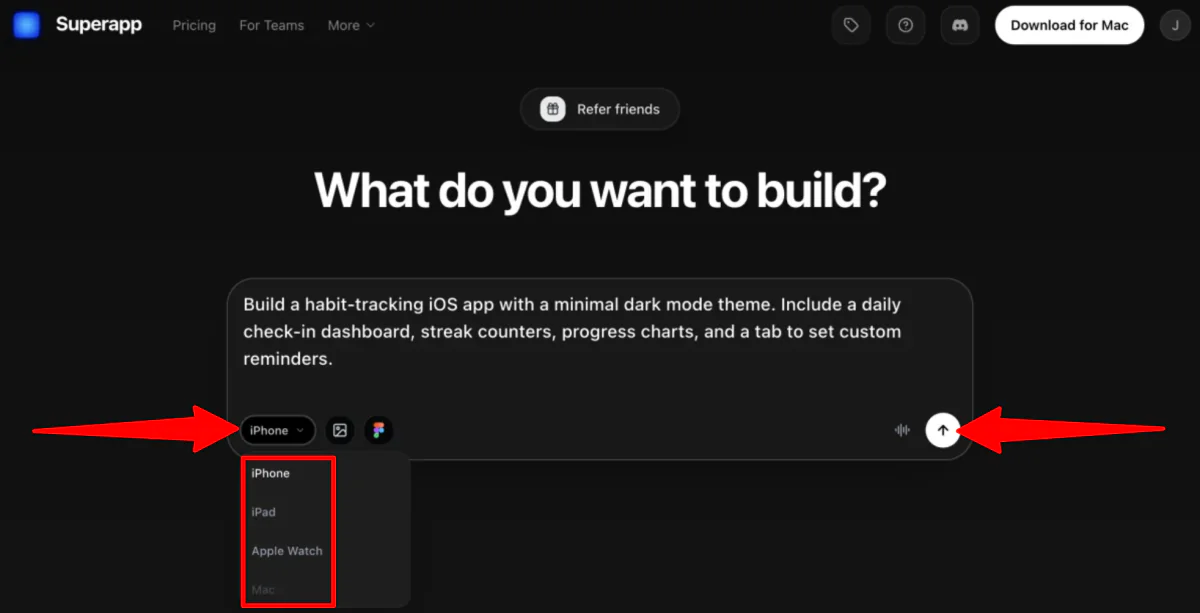
Choose a device type (iPhone, iPad, Apple Watch, or Mac) and hit send.
Step 4: Verify the Preview

Immediately, Superapp will get to work.
On the left, you can watch it work through the home screen, components, and theme. Once it’s finished, it tells you what you’ll get based on your prompt.
In my case, here’s what Superapp told me it generated:
- Today dashboard: a hero card showing “X of Y done” with a progress ring and your best active streak, right up top.
- Weekly progress chart: a clean bar chart showing your consistency across the last 7 days.
- Habit cards: each habit shows its icon, current streak with a flame, a mini 7-day dot tracker, and a big tap-to-check in button that animates when you complete it.
- Reminders tab: a second tab where you can see and toggle reminders per habit, with a friendly empty state and a “+” button that opens a bottom sheet to add a new one (time picker included).
- A minimal dark theme with mint, amber, coral, and violet accents that stays legible and calm, plus a matching dark launch screen and a new glowing mint flame app icon.
Based on the mobile preview, everything aligned with my prompt. The generated design accurately reflected the elements and style I requested!
Step 5: Interact with the Preview

Within the preview, click through buttons, navigate between tabs, and test interactive elements to make sure the user experience matches your intent.
The only limitation was that it didn’t seem I could scroll through the app preview. For the best experience, consider downloading Superapp and opening it on your iPhone to test the full functionality.
Step 6: Make Edits with AI

Use the chat interface to request targeted edits or new screens.
For example: “Change the card corners to rounded pill style and make the streak count gold.”

Superapp will immediately apply your requested changes.
Step 7: Add Integrations

Next, add API integrations or database functionality by describing what you need (e.g., “Integrate Supabase for user authentication” or “Connect to a live weather API”).
Step 8: Publish to the App Store

Once your prototype is complete, click Publish. You can submit your app directly to the App Store or TestFlight, where you can invite people to test beta versions of your app before making them available on the App Store.
Overall, Superapp made the app creation process feel surprisingly simple. It turned a written idea into a functional iOS app prototype within minutes. I was pleased that the AI preview closely matched my prompt, and the ability to interact with the design, request edits, and publish the app directly to the app store made it particularly powerful.
Top 3 Superapp Alternatives
Here are the best Superapp alternatives I’ve tried.
Lovable
The first Superapp alternative I’d recommend is Lovable. It’s a popular AI app builder that helps you create websites and applications by describing your idea, making it easy to turn concepts into working prototypes without traditional coding.
Both platforms use AI to turn prompts into functional apps, making them great options for entrepreneurs, designers, and teams who want to quickly validate ideas.
However, Lovable is designed for building web apps and websites. It gives you more flexibility for projects that need to run across different platforms, and it lets you create, refine, and deploy apps directly from your browser with templates, integrations, and real-time AI collaboration.
Meanwhile, Superapp focuses specifically on native Apple apps. It generates Swift and SwiftUI projects designed for iPhone, iPad, Apple Watch, and Mac.
For building flexible web apps and quickly launching browser-based projects, choose Lovable. For creating native iOS apps with Apple’s ecosystem in mind, choose Superapp.
Read my Lovable review or visit Lovable!
Bolt.new
The next Superapp alternative I’d recommend is Bolt.new. It’s an AI app and website builder that lets you create full-stack projects by chatting with AI.
Both platforms use AI to speed up development by letting you describe what you want in instead of starting from scratch with code.
However, Bolt.new takes a broader approach. You can build websites and apps across different platforms while also handling features like hosting, unlimited databases, authentication, and integrations through Bolt Cloud.
Meanwhile, Superapp is built specifically for creating native Apple apps. It generates Swift and SwiftUI projects designed for iPhone, iPad, Apple Watch, and Mac.
For building native iOS apps with Apple’s ecosystem, choose Superapp. For creating full-stack web apps, websites, and cross-platform projects with built-in hosting and backend tools, choose Bolt.new!
Read my Bolt.new review or visit Bolt.new.
FlutterFlow
The final Superapp alternative I’d recommend is FlutterFlow. It’s a visual app builder that helps you create custom applications by designing interfaces, adding logic, connecting databases with Firebase or Supabase integrations, and deploying apps across multiple platforms (App Store, Play Store and web).
Both platforms help you build apps faster without starting from scratch to quickly turn ideas into working products.
However, FlutterFlow gives you more hands-on control over the entire development process. It come with a visual builder with hundreds of UI components, advanced customization options, database integrations, API connections, and the ability to export your code.
Meanwhile, Superapp focuses on AI app creation, where you describe your idea with a prompt and it generates a native SwiftUI iOS app for you. While you can request changes by chatting with the AI, you have less hands-on control compared to FlutterFlow since you can’t manually edit the app within Superapp.
For maximum customization, cross-platform apps, and a more traditional visual development workflow, choose FlutterFlow. For quickly creating native Apple apps with AI and minimal technical setup, choose Superapp.
Superapp Review: The Right Tool For You?
After trying Superapp, I was impressed by how quickly it turned a simple app idea into a working iOS prototype. The biggest thing for me was the ability to describe the app I wanted and watch it generate a native SwiftUI project with an interface that matched Apple’s design style.
The biggest disappointment for me was that I couldn’t manually edit the app after it was created. While I could still request changes through the AI, Superapp is better for validating ideas and building MVPs than developers who need full control over their app.
If you need complete control over every detail of your app, you may prefer a tool with more customization options like one of these alternatives:
- Lovable is best for entrepreneurs and teams who want to quickly build and launch flexible web apps with AI.
- Bolt.new is best for developers and creators who want to build full-stack apps with AI with cross-platform support.
- FlutterFlow is best for teams and developers who want more control over app design, logic, and customization across iOS, Android, and web projects.
Otherwise, Superapp is an excellent option for creators who want to experiment with iOS app ideas without spending months learning Swift or Xcode.
Thanks for reading my Superapp review! I hope you found it helpful. Try Superapp for free and see how you like it!
[ad_2]
Source_link