[ad_1]
Plus: Rumors swirl about Taylor Farms-Trump connection; Meta’s smart glassses privacy problem.
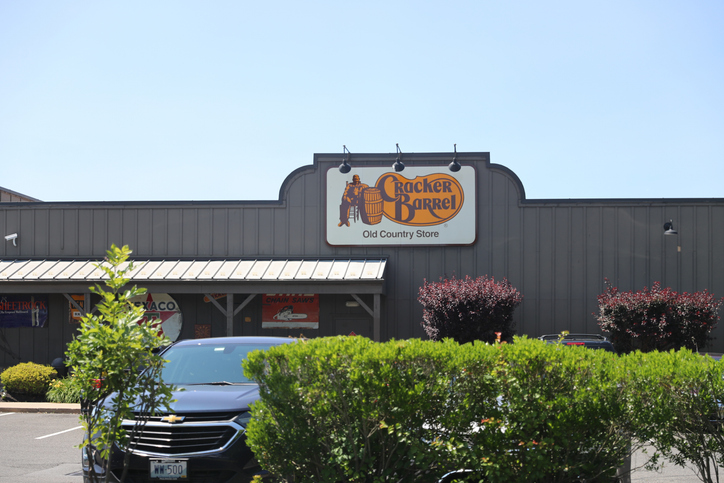
After (seemingly) surviving one of the worst rebrands in history, Cracker Barrel CEO Julie Masino will step down from her role.
It’s clear this is at least a somewhat amicable parting: while her full-time work will end Aug 10, she will remain on as an advisor until October, according to a press release. Her successor, David Deno, was chosen “following a robust and thoughtful search process,” the release said. He brings experience with Bloomin’ Brands (which owns Outback Steakhouse, Bonefish Grill and other mid-tier restaurants) and fast food conglomerate Yum! Brands.
Notably, Masino is not quoted in the press release. However, Independent Chairman of the Board Carl Berquist is quoted praising her.
“On behalf of the Board and the entire company, I want to thank Julie for her leadership and commitment to Cracker Barrel. We also appreciate her partnership to ensure a smooth leadership transition as we remain focused on the work underway to continue to serve our guests, support our employees, and execute our strategic priorities. We wish Julie all the best in her future endeavors.”
The move comes as somewhat of a surprise, as Cracker Barrel had begun a turnaround after scrapping its widely decried logo and store redesign. Year to date, its stock price had doubled, the Wall Street Journal reports. As of Wednesday morning, the stock price rose to $54.78, an increase of about $2 since the announcement.
Why it matters: Julie Masino took a big swing with the logo redesign that became a battleground in the culture war. She lost. And for a while, it looked like she might, remarkably, survive the turmoil after walking back the major changes and reassuring customers that the restaurant they loved would still be there for them.
But she earned only a temporary reprieve.
We obviously don’t know exactly what happened behind the scenes. The Wall Street Journal reports there was activity from an activist investor, which could have played a role in her departure. But it’s hard for the public not to read this as an attempt from Cracker Barrel to further distance itself from the failed rebrand and chart a new course forward with someone with lots of familiar restaurant experience.
Sometimes mistakes can’t be fully undone. It seems Masino could not outrun her past, despite improving financials. And now she’s being shown the door.
The press release handles her departure in a fairly classy way with the chairman’s gratitude, but the absence of Masino’s voice rings loudly.
What is Taylor Farms’ connection to Trump?
Yes, we’re talking about cyclospora again. This time, it’s due to a theory that the FDA announced a false positive related to Taylor Farms’ lettuce because of a $1 million donation to a Trump-related Super PAC. The FDA and White House deny any connection, but 62% of online chatter related to Taylor Farms in the last week has referenced the controversy, according to the New York Times. The rumor seems to have been propelled at least in part by bot accounts, which made up about a third of early references to the conspiracy.
Taylor Farms has not directly addressed the allegations.
In truth, there is probably little that could be said or done here to quell the fire at this point. A denial will only be seen as proof. This is, however, an important reminder that political donations can become a major PR vulnerability. They’re a standard part of most major companies’ public affairs agenda, yet when they become actually public, the reactions can be strong and unpredictable.
It’s just one more facet in the mess currently engulfing Taylor Farms, and one that may cling to them for some time.
Can you trust Meta’s smart glasses?
Meta’s smart glasses, which can record a user’s-eye view of the world with only a red light to show that you’re being filmed, aren’t new. But they are facing new scrutiny related to privacy.
The Verge contends that Meta has made a series of privacy-related mistakes in recent weeks that make it harder for people to trust the glasses. These range from shipping smart glasses with facial recognition software (albeit disabled) to using polarizing celebrity Kylie Jenner in ads.
The broader problem, however, is summed up by Uttara Ananthakrishnan, a technology professor at the University of Washington. “You cannot hinge your entire privacy policy on a single light. You can’t expect everyone in the world to know that and react to that. It puts a lot of pressure on the person who isn’t even wearing the glasses to be aware of what another person is going to do.”
It isn’t hard to see this further souring public opinion against Meta, or even leading to violence by those using the glasses without consent. Meta needs to be clearer and sharper about how it is protecting the privacy of the general public with these glasses beyond simply modifying Instagram’s content guidelines. Meta needs to lead.
What prompted new BuzzFeed layoffs?
In a sad turn of affairs, BuzzFeed, once the internet’s profitable news and entertainment darling, has laid off a third of its remaining staff. That’s about 180 people across HuffPost, Tasty and the film and television division.
“We’ve been actively managing costs for some time, working through scenarios to save as many jobs as possible,” an internal memo read. “Unfortunately, the elimination of certain roles is still required. Today’s changes include the elimination of positions across the entire company.”
It’s one of the first major moves for the company since Byron Allen acquired it in May of this year.
The story here is a familiar one of media decline, but with a twist. BuzzFeed was meant to be one of the saviors of publishing. For a while, it was an unstoppable cultural juggernaut, dominating Facebook feeds everywhere. It was the butt of plenty of jokes for its headlines and silly quizzes, but it also offered, for a time, a sustainable model for publishers.
That moment has passed, once again revealing the dangers of relying on social media and search to bolster your business.
At the moment, the only sustainable online model for publishing appears to be subscriptions, which could pose major challenges for PR professionals who must contend with paywalls.
Allison Carter is editorial director of PR Daily and Ragan.com. Follow her on LinkedIn.
The post The Scoop: Cracker Barrel’s CEO won the battle but lost the war appeared first on PR Daily.
[ad_2]
Source_link