[ad_1]
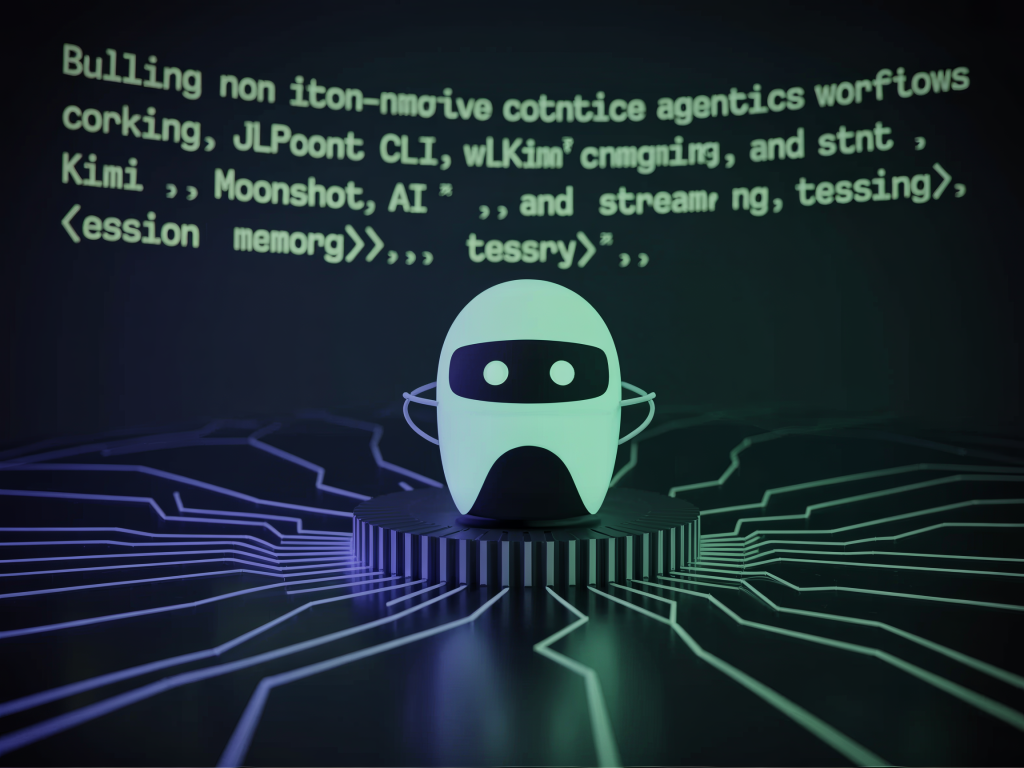
In this tutorial, we configure and operate Kimi CLI as a fully non-interactive AI coding agent. We install the CLI through uv with an isolated Python 3.13 environment, configure Moonshot API authentication through a TOML-based provider and model definition, and build a reusable Python wrapper for executing non-interactive CLI commands. We then apply Kimi to a realistic project workflow in which we inspect a codebase, identify implementation risks, autonomously modify source files, generate unit tests, execute validation commands, and iterate until the project passes its test suite. We also explore structured JSONL event streams, persistent multi-turn sessions, plan mode, model selection, Ralph loops, MCP integrations, session export, and web-based access, giving us a practical foundation for embedding Kimi CLI into automated development and agentic engineering pipelines.
Environment Setup and Kimi CLI Installation
import os, subprocess, textwrap, json, getpass, pathlib, shutil
HOME = pathlib.Path.home()
def sh(cmd, check=True, env=None, cwd=None):
   """Run a shell command, stream its output, return CompletedProcess."""
   print(f"\n$ {cmd}")
   e = {**os.environ, **(env or {})}
   r = subprocess.run(cmd, shell=True, env=e, cwd=cwd,
                      capture_output=True, text=True)
   if r.stdout: print(r.stdout)
   if r.stderr: print(r.stderr[-2000:])
   if check and r.returncode != 0:
       raise RuntimeError(f"Command failed ({r.returncode}): {cmd}")
   return r
print("=" * 70, "\nPART 1: Installing uv + Kimi CLI\n", "=" * 70)
sh("curl -LsSf https://astral.sh/uv/install.sh | sh")
UV_BIN = str(HOME / ".local" / "bin")
os.environ["PATH"] = f"{UV_BIN}:{os.environ['PATH']}"
sh("uv tool install --python 3.13 kimi-cli")
sh("kimi --version")
We begin by importing the required Python modules and defining a reusable shell-command helper for controlled subprocess execution. We install uv, add its binary directory to the environment path, and use it to provision Kimi CLI with an isolated Python 3.13 runtime. We then verify the installation by querying the installed Kimi CLI version.
Configuring Moonshot API Authentication and Model Access
print("=" * 70, "\nPART 2: Configuring API access\n", "=" * 70)
try:
   from google.colab import userdata
   API_KEY = userdata.get("MOONSHOT_API_KEY")
   print("Loaded key from Colab Secrets.")
except Exception:
   API_KEY = getpass.getpass("Paste your Moonshot API key (hidden): ")
BASE_URL   = "https://api.moonshot.ai/v1"
MODEL_NAME = "kimi-k2-0711-preview"
kimi_dir = HOME / ".kimi"
kimi_dir.mkdir(exist_ok=True)
(kimi_dir / "config.toml").write_text(textwrap.dedent(f"""\
   default_model = "kimi-k2"
   [providers.moonshot]
   type = "kimi"
   base_url = "{BASE_URL}"
   api_key = "{API_KEY}"
   [models.kimi-k2]
   provider = "moonshot"
   model = "{MODEL_NAME}"
   max_context_size = 131072
"""))
print("Wrote ~/.kimi/config.toml")
We securely retrieve the Moonshot API key from Google Colab Secrets or request it via a hidden input prompt. We define the Moonshot API endpoint and target Kimi model, then create the required .kimi configuration directory. We write the provider, model, context window, and default model settings to config.toml for non-interactive authentication.
Building a Reusable Non-Interactive Kimi Execution Wrapper
def kimi(prompt, work_dir=".", yolo=False, cont=False, quiet=True,
        stream_json=False, extra="", timeout=600):
   """Run one headless Kimi CLI turn and return its stdout."""
   flags = []
   if stream_json:
       flags.append("--print --output-format stream-json")
   elif quiet:
       flags.append("--quiet")
   else:
       flags.append("--print")
   if yolo: flags.append("--yolo")
   if cont: flags.append("--continue")
   flags.append(f'-w "{work_dir}"')
   if extra: flags.append(extra)
   cmd = f'kimi {" ".join(flags)} -p "{prompt}"'
   print(f"\n$ {cmd}\n" + "-" * 60)
   r = subprocess.run(cmd, shell=True, capture_output=True,
                      text=True, timeout=timeout)
   out = r.stdout.strip()
   print(out if out else r.stderr[-1500:])
   return out
We define a Python wrapper that executes Kimi CLI prompts programmatically without requiring an interactive terminal session. We dynamically assemble flags for quiet output, streamed JSON events, autonomous tool approval, session continuation, working-directory isolation, and step limits. We capture the command output, display the final response or error details, and return the result for further processing.
Creating and Analyzing a Realistic Sample Project
print("=" * 70, "\nPART 4: Demo A — codebase Q&A\n", "=" * 70)
proj = pathlib.Path("/content/demo_project")
if proj.exists(): shutil.rmtree(proj)
(proj / "app").mkdir(parents=True)
(proj / "app" / "inventory.py").write_text(textwrap.dedent("""\
   class Inventory:
       def __init__(self):
           self.items = {}
       def add(self, name, qty):
           self.items[name] = self.items.get(name, 0) + qty
       def remove(self, name, qty):
           # BUG: allows negative stock and KeyError on missing items
           self.items[name] = self.items[name] - qty
       def total(self):
           return sum(self.items.values())
"""))
(proj / "app" / "main.py").write_text(textwrap.dedent("""\
   from inventory import Inventory
   inv = Inventory()
   inv.add("widget", 10)
   inv.remove("widget", 3)
   print("Total stock:", inv.total())
"""))
(proj / "README.md").write_text("# Demo: a tiny inventory service\n")
kimi("Summarize this project's structure and purpose in under 120 words, "
    "then list any bugs or design risks you can spot in inventory.py.",
    work_dir=str(proj))
We create a small inventory management project that includes a Python module, an executable script, and a README file. We intentionally include implementation defects to enable Kimi to inspect the repository structure and identify functional and design risks. We then run a read-only project analysis prompt in the project directory and request a concise technical assessment.
Automating Code Repair, Testing, and Independent Validation
print("=" * 70, "\nPART 5: Demo B — Kimi fixes the bug & adds tests\n", "=" * 70)
kimi("Fix the bugs in app/inventory.py: remove() must raise KeyError->ValueError "
    "for unknown items and never allow negative stock. Then create tests.py at "
    "the project root using unittest covering add/remove/total and edge cases, "
    "run it with 'python -m unittest tests -v', and iterate until all tests pass. "
    "Finally print the test results.",
    work_dir=str(proj), yolo=True, extra="--max-steps-per-turn 30")
print("\n--- Files after Kimi's edits ---")
for f in sorted(proj.rglob("*.py")):
   print(f"\n### {f.relative_to(proj)} ###\n{f.read_text()}")
sh("python -m unittest tests -v", cwd=str(proj), check=False)
We allow Kimi to modify the project autonomously, correct the inventory logic, generate unit tests, and execute the test suite. We configure a maximum agent-step limit so the model can iteratively diagnose failures and refine its implementation until validation succeeds. We inspect the resulting Python files and independently rerun the tests to confirm that the generated changes work correctly.
Exploring Structured JSONL, Sessions, and Advanced Features
print("=" * 70, "\nPART 6: Demo C — machine-readable JSONL events\n", "=" * 70)
raw = kimi("In one sentence, what does app/main.py print when run?",
          work_dir=str(proj), stream_json=True, quiet=False)
print("\nParsed event types:")
for line in raw.splitlines():
   try:
       evt = json.loads(line)
       print(" •", evt.get("type", "?"), "-",
             str(evt)[:100].replace("\n", " "))
   except json.JSONDecodeError:
       pass
print("=" * 70, "\nPART 7: Demo D — conversational memory\n", "=" * 70)
kimi("Remember this: our release codename is BLUE-FALCON.", work_dir=str(proj))
kimi("What is our release codename? Answer with just the codename.",
    work_dir=str(proj), cont=True)
print("=" * 70, "\nPART 8: Power-user reference\n", "=" * 70)
print(textwrap.dedent("""
 # Plan mode — read-only exploration, produces an implementation plan:
 kimi --quiet --plan -w /content/demo_project -p "Plan adding SQLite persistence"
 # Pick a different model at runtime (must exist in config.toml):
 kimi --quiet -m kimi-k2 -p "hello"
 # Thinking mode (if the model supports it):
 kimi --quiet --thinking -p "Prove sqrt(2) is irrational"
 # Ralph loop — feed the same prompt repeatedly for one big task
 # until the agent outputs <choice>STOP</choice> or the limit hits:
 kimi --print --yolo --max-ralph-iterations 5 -w /content/demo_project \\
      -p "Keep improving test coverage; STOP when everything is covered."
 # MCP tools — give Kimi extra capabilities via an MCP config file:
 #   /content/mcp.json -> {"mcpServers": {"context7":
 #        {"url": "https://mcp.context7.com/mcp",
 #         "headers": {"CONTEXT7_API_KEY": "YOUR_KEY"}}}}
 kimi --quiet --mcp-config-file /content/mcp.json -p "Use context7 to ..."
 # Export a session (context.jsonl, wire.jsonl, state.json) for debugging:
 kimi export --yes
 # Web UI (needs a tunnel on Colab, e.g. cloudflared/ngrok, since it
 # binds locally): kimi web --no-open --port 5494
"""))
print("Tutorial complete ✔ — Kimi CLI is installed, authenticated, and has "
     "explored, fixed, tested, and remembered a real project headlessly.")
We execute Kimi with streamed JSON output and parse each JSONL event to inspect machine-readable response types. We demonstrate persistent multi-turn memory by storing a release codename and retrieving it during an ongoing session in the same working directory. We conclude by reviewing advanced commands for planning, model switching, thinking mode, Ralph loops, MCP tools, session export, and web access.
In conclusion, we established an end-to-end Kimi CLI workflow that runs entirely without relying on an interactive terminal session. We moved from environment provisioning and API configuration to project analysis, autonomous code repair, test generation, structured output parsing, and session continuation. We also independently verified the agent’s changes, which helps us distinguish generated output from actual execution results and improves the reliability of the workflow. With the reusable wrapper and reference commands in place, we can now extend the same architecture to larger repositories, CI-style validation tasks, MCP-enabled toolchains, iterative software improvement loops, and other programmable AI-assisted development workflows.
Check out the Full Code here. Also, feel free to follow us on Twitter and don’t forget to join our 150k+ML SubReddit and Subscribe to our Newsletter. Wait! are you on telegram? now you can join us on telegram as well.
Need to partner with us for promoting your GitHub Repo OR Hugging Face Page OR Product Release OR Webinar etc.? Connect with us

Sana Hassan, a consulting intern at Marktechpost and dual-degree student at IIT Madras, is passionate about applying technology and AI to address real-world challenges. With a keen interest in solving practical problems, he brings a fresh perspective to the intersection of AI and real-life solutions.
[ad_2]
Source_link