Reading Time: 8 minutes
The 2:47 AM Problem
An AI customer service assistant at a global retailer was asked, in the middle of the night, to summarize a returning customer’s recent order history. So it did, and shared it with the service rep. But it also provided the customer’s home address, full payment card number, and the contents of a support call from six months earlier. None of which the rep had asked for. All of which the AI assistant had access to, because the underlying systems weren’t designed for AI consumption.
Nobody saw the output. The customer service rep logged off, and the AI flagged the response as complete and moved on.
That moment is the PII problem in the AI era, compressed into a single example. The data wasn’t stolen. It wasn’t leaked. It was simply made accessible to a system that didn’t know which parts of a customer record should stay invisible.
PII has always been a compliance concern. GDPR, CCPA, PDPA, DPDP. Every major regulation traces back to the same principle: customer data belongs to the customer, and the brand is responsible for how it moves, who sees it, and what gets done with it. None of that changes in 2026. What changes is the surface area.
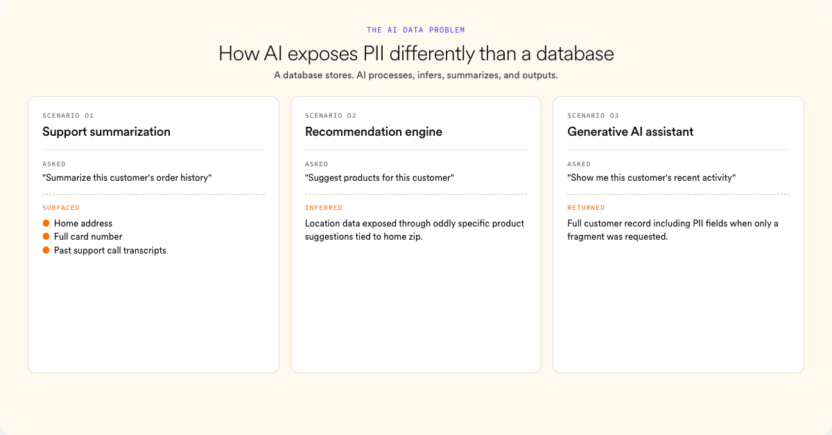
These aren’t theoretical risks but operational ones. And they’re the reason why PII protection in the AI era isn’t a compliance checklist, but an architectural decision.
If managed properly, AI actually strengthens PII handling. Modern AI tools with reasoning, source attribution, and audit trails create a more defensible compliance posture than the disintegrated tools that came before them. If poorly managed, every new AI integration becomes an additional point of exposure. The difference between the two outcomes is rarely the AI model itself. It’s whether the underlying data architecture is a unified, governed system or fragmented data scattered across 5 vendors/tools with different security standards and sync schedules.
This playbook covers what’s changed, what good PII protection looks like in the agentic AI era, and how to evaluate whether your stack is built for it.
What PII Actually is, and Why the Definition is Expanding
For most teams, the working definition of PII is still the regulatory one. Names, email addresses, phone numbers, payment information, government IDs. That definition is outdated.
In 2026, PII includes behavioral signals, device IDs, precise location data, and inferred attributes. A purchase pattern that reveals a health condition. A browsing history that signals financial distress. A device fingerprint that uniquely identifies one person across multiple anonymous sessions. None of this is regulated as PII in most jurisdictions. But all of it can be used to identify, profile, and engage an individual.
AI accelerates this. Models trained on behavioral data can infer attributes the customer never explicitly shared. Income level inferred from location and browsing patterns. Family status inferred from purchase history. Health concerns inferred from search terms. The regulatory definition of PII covers what customers gave you. The practical definition covers what your AI can figure out.
The specific risk worth naming is what happens when the same customer’s PII lives across multiple vendors:
- Each vendor handles PII under different security standards
- The gap between what’s protected and what’s exposed becomes harder to track
- Every sync between systems is a handoff, and every handoff is a potential breach point
- Adding AI on top of a fragmented stack compounds the exposure
How PII Protection Actually Works: The Three Mechanisms
Three mechanisms do the heavy lifting in modern PII protection. They aren’t interchangeable as each one solves a different problem.
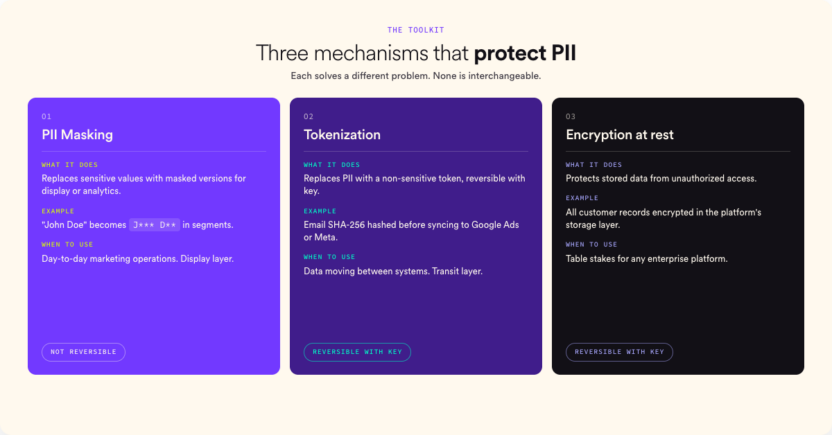
The first protects what marketers see in their tools. The second protects what moves between tools/systems when audiences sync to paid channels. The third protects what’s stored at all times on various tools. Strong PII handling means all three work together as architecture, not features.
These mechanisms aren’t just compliance controls. They’re what makes AI integration safe to scale. A model that operates on tokenized or masked data can still generate insights, run segmentation, and personalize experiences, without ever seeing raw PII.
The architecture decides what the AI can and can’t see.
The Three PII Risks Brands Face in Fragmented Stacks
Most brands don’t have a single PII problem. They have three, and the severity of each depends entirely on how many tools their data has to pass through.
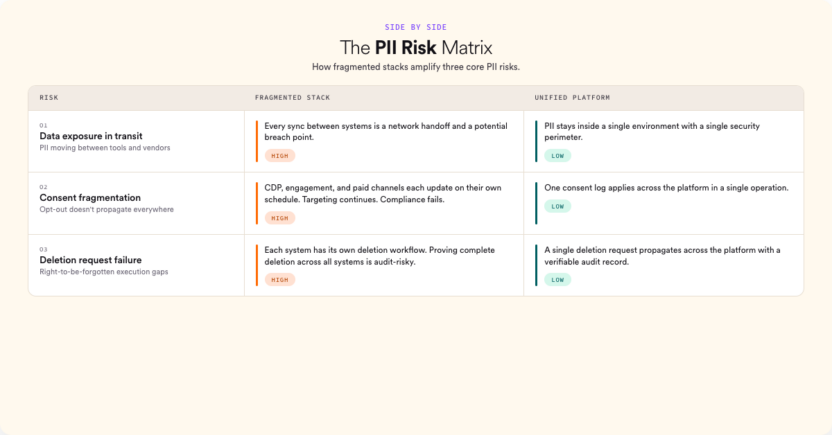
The pattern is consistent across all three risks. The more vendors involved, the larger the attack surface, the more sync points break, and the harder it becomes to prove compliance under audit. In a unified platform, all three risks shrink to a single environment, consent log, deletion workflow, and audit trail. Compliance isn’t easier because the rules changed. It’s easier because the architecture stopped working against you.
Your Data’s Journey: How PII Should Move Safely from Ingestion to Activation
Strong PII protection isn’t a single feature. It’s how data is handled at each stage of its lifecycle inside a platform.
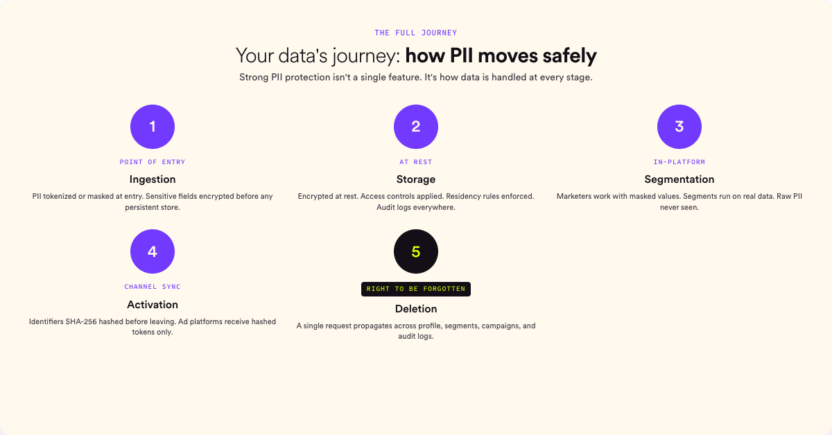
This is what good PII handling looks like when it’s built into the architecture rather than bolted on as a compliance feature. Each stage is its own safeguard and compounds the next.
What This Means for AI Specifically
The AI readiness conversation in most boardrooms is about models.
- Which vendor to use?
- Which predictive capability to prioritize?
- Which generative AI to integrate next?
Those are real questions. But they’re secondary to a more fundamental one: what does your AI actually have access to?
Three things change when PII protection is built into the foundation your AI operates on.
Right AI architecture enhances PII protection, not weakens it. Traditional disintegrated tools made compliance defensive. A regulator asks why a customer was targeted, and the answer is buried in three vendors’ logs. Modern AI systems built on a unified data layer can provide reasoning, source attribution, and full audit trails. Why was this customer included in this segment? Which data points drove the decision? When were they last given a consent option? The same architecture that makes AI smarter also makes it more defensible.
One unified system reduces risk by reducing surface area. The more vendors handling PII, the more exposure points. Every sync between a CDP, an engagement tool, an AI layer, and a paid channel creates a network call where data could be intercepted, misconfigured, or audited inconsistently. A unified Customer Data and Engagement Platform collapses that surface area into a single environment with a single security perimeter. Fewer handoffs. Fewer audit trails to reconcile. Fewer ways for compliance to fail.
Zero-copy advantage. The strongest defensive posture available is one where PII never leaves your cloud. Warehouse-native architectures make this possible. Instead of copying customer data into a marketing platform, the platform queries the warehouse directly. PII stays in the customer’s own infrastructure, governed by their own security controls. For brands in BFSI, healthcare, and other regulated industries, this isn’t a nice-to-have, but often the only architecture compliance approved.
What to Ask Vendors: PII Evaluation Checklist
For teams evaluating engagement platforms on PII handling, these are the questions worth asking explicitly. Most vendor responses to compliance questions are written for procurement teams. These questions are written for technical reality.
- Where does PII live? In your proprietary store, or in our warehouse?
- What happens to PII when data syncs to paid channels? Is it hashed before leaving your platform, and which hashing standard is used?
- How does consent propagate across the platform when a customer opts out? How long does propagation take?
- Can the platform execute a deletion request end-to-end without manual intervention, including in audit logs?
- What regional compliance standards does the platform support natively? GDPR, CCPA, PDPA, OJK, DPDP?
- Is PII masking applied in marketer-facing interfaces, or only in the backend?
- Who owns the encryption keys?
- What happens to PII handling if your AI assistant or generative features are used? Are the same masking and access controls applied?
A vendor who answers these clearly is one worth evaluating further. A vendor who deflects or generalizes is telling you something important about how seriously they take PII handling.
What PII Management Looks Like Inside MoEngage
MoEngage treats PII protection as an architecture. Four mechanisms govern how the platform handles customer data, and each one maps to a different layer of risk.
PII masking in marketer-facing interfaces. Marketers who build segments, design campaigns, and review reports can work with masked values throughout the process. Masking is enabled by the brand in data management settings, giving each organization controls over which fields stay visible. Once enabled, the marketer builds, sends, and measures campaigns without needing access to the underlying personal data.
Encryption at the point of entry. Data can be encrypted through the SDK before it’s stored, so sensitive fields are protected before they ever reach a persistent store, and stay protected against unauthorized access after.
Tokenization for brands that don’t want PII stored at all. In this model, MoEngage holds no personally identifiable information. The platform works with a user ID, and retrieves the contact detail it needs (an email address or phone number) from the client only at the moment a campaign is sent. Between sends, there’s nothing to breach.
SHA-256 hashing at every channel sync. When audiences activate across paid channels like Google Ads and Meta, identifiers are hashed before leaving the platform. Ad platforms receive tokens for matching, and raw emails, phone numbers, and device IDs stay inside the MoEngage environment.
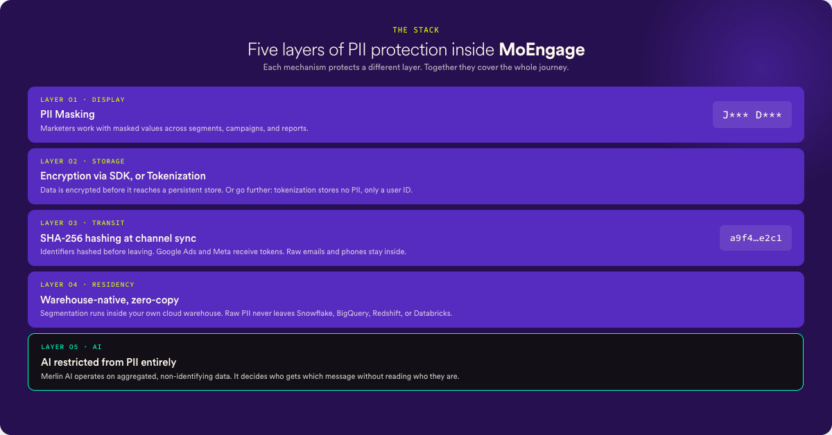
For brands with data residency mandates, such as financial data that must stay within India’s borders, the warehouse-native option goes further. Warehouse Audiences connects to the brand’s own cloud warehouse and runs segmentation in place. Raw PII never leaves the warehouse. The only thing transferred is a pre-agreed identifier that isn’t PII, which is enough to deliver the campaign. The raw data stays inside Snowflake, BigQuery, Redshift, or Databricks.
Consent and deletion follow the same single-workflow principle. End users manage their preferences on the brand’s own properties, and MoEngage provides public APIs to carry those choices through: a single API command executes a consent update or a deletion request across all MoEngage systems, producing a verifiable record.
Encryption key ownership is the brand’s choice. Hold your own keys, or have MoEngage manage them.
How Merlin AI Handles Your Data
The concern this article opened with, an AI surfacing PII it was never meant to expose, is an architecture problem. MoEngage’s AI is built around a simple boundary: it learns inside your workspace, and nothing that identifies a customer crosses over to the generative models.
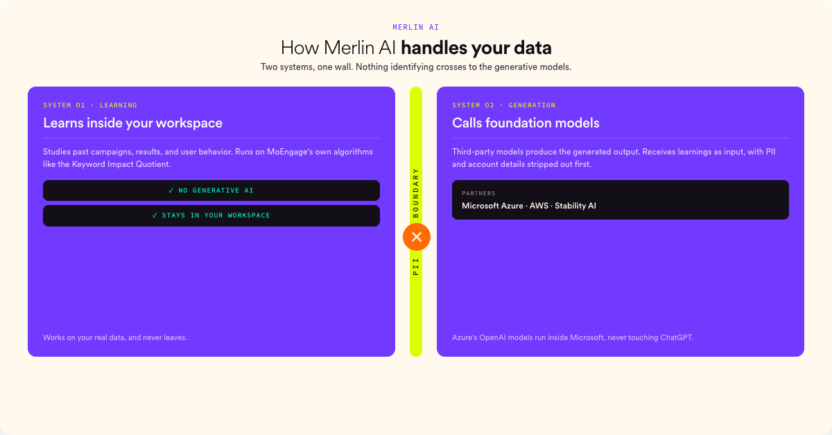
Two guarantees sit underneath that design. Your prompts, outputs, embeddings, and training data stay private, so the models are never trained on your data and other customers can never access it. And generation is built to assist rather than replace a marketer, with human review before any AI content goes live.
MoEngage complies with HIPAA, GDPR, CCPA, CSA STAR, SOC 2 Type 2, ISO 27001:2022, BCMS ISO 22301:2019, PIMS ISO 27701:2019, and the Philippines NPC. The certifications matter. So does the architecture that makes them sustainable rather than retrofitted.
Conclusion
PII protection isn’t a speed bump on the way to personalization. Done right, it’s what makes personalization possible at scale, because the data your AI needs is governed, accurate, and trusted.
The brands treating PII as a compliance checklist are building on a foundation that will crack under regulatory pressure or a data incident. The brands treating it as infrastructure are building something that compounds. They get the AI capabilities they need, the safety their compliance teams require, and the architecture that makes both sustainable.
The question worth asking isn’t whether your platform is compliant. Most platforms can claim that. The question is whether your platform handles PII in a way that enables safe AI, or in a way that turns every new AI integration into a new exposure point.
[Talk to our team] to see how MoEngage handles PII natively and what that means for your AI roadmap.
The post A PII Data Management Playbook: Protect Customer Data Without Slowing AI Personalization appeared first on MoEngage.